


Brewers Video
In a piece Monday at Baseball Prospectus, I introduced a new statistic called Swing Disruption+. The concept is exactly what it sounds like. Using the new miss distance and swing timing data from Statcast (which you can find on Baseball Savant, here), I sought to build a model that would tell us how well pitchers produce value when batters swing, and in which ways. As a batter, your goal when you go to bat is to find a pitch you can drive and hit it squarely. As a pitcher, your objective is to mess with the batter, either via changing speeds and fooling them into a mistimed swing or via extremely deceptive movement. This stat is meant to measure how well a hurler does their job in that showdown.
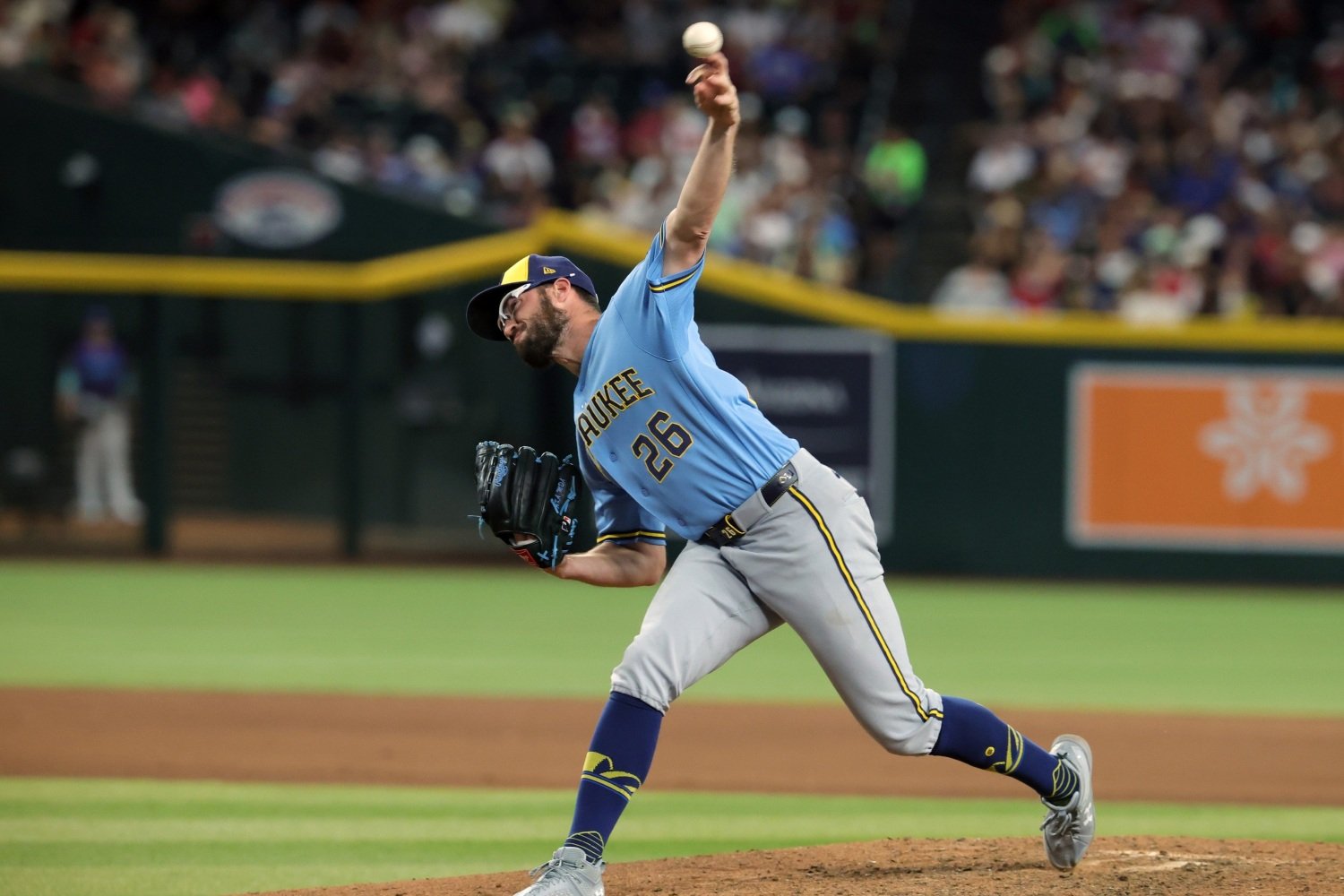
Aaron Ashby is not the highest-rated Brewers pitcher by Swing Disruption+. That, believe it or not, is DL Hall. Of the 368 pitchers who had at least 200 swings against them entering Sunday's games, Hall ranked 12th, with a 121 Swing Disruption+. (The stat is indexed to 100, which marks the average, and higher is better.) It's not just luck that allowed Hall to hold hitters to a .294 slugging average on contact (SLGCON) before he went down with a strained pectoral muscle; he's been good at all three ways that a pitcher can get out of harm's way when a batter swings.
Since Hall is out, though, let's talk about Ashby. Really, he's the more interesting case study, anyway, because he's only very good at one of those three ways. To understand the difference between the two, let's dive into those three dimensions of deception.
Firstly, you want to disrupt timing. That can take many forms, but it's the most valuable single way to get a hitter's swing out of sync, because it doesn't inherently make it harder to do either of the other two things, whereas those two do push against one another most of the time. Funky deliveries often produce mistimed swings, but the best way to reliably do so is by changing speeds often. If there are multiple pitches you can throw in or near the strike zone and they come in at significantly different speeds, hitters have to respect them all, and they can not only end up badly fooled when sitting on one option, but get caught in between when they try to cover everything.
The most important individual skill for missing bats (which is the imperative of the modern hurler) is to get above or below the bat often. Most whiffs involve the batter missing vertically; fewer of them involve horrendous timing or a brutal miss on the horizontal plane. That shouldn't surprise you. Think about the arc a bat traces through the hitting zone, and you can see how there's much less margin for error for the batter vertically than horizontally or in the depth dimension that represents time. The trick with "changing eye levels," though, is that keeping the ball in the zone while creating big vertical separation is difficult—and that the more you can stretch your movement distribution vertically, the less it's likely to stretch horizontally.
Horizontal movement matters, too, because while going high and low produces whiffs the best, having enough 'wiggle' to get off the center of a barrel is the top way to avoid hard contact. Batters produce all their best exit velocities when they center the ball on the barrel; getting it off the end of the bat or up on the handle produces weaker-hit balls. To avoid being vulnerable to power, a pitcher needs to be able to move one direction or the other, but again, doing that can often make it harder to move up and down the ladder and maximize swing-and-miss.
Ashby's 115 Swing Disruption+ ranks him 34th in baseball, still within the league's top decile and behind only Hall and Trevor Megill among Brewers hurlers. Go ahead. Take a moment, now, and guess in your head which dimension makes Ashby a standout.
Here's a brief paragraph about Megill, to give you time to think about Ashby without having it spoiled. The Brewers' newly-minted full-time closer is, as I'm sure you'd guess, elite when it comes to changing eye levels. His high-velocity, high-carry four-seamer and power curveball play off one another gorgeously, almost straight up and down. Hitters who chase the heater as it singes the top rail of the zone are often under it; those who chase the curve are usually over it. Megill is sixth in MLB in Changed Eye Levels+, at 139, which puts him right behind teammate Jacob Misiorowski (143) and three spots ahead of Gravitron (aka Kyle Harrison), at 137. Having a fastball that hitters just can't climb their way to is hugely valuable.
Alright, though: back to Ashby. Did you guess correctly? He's elite in one dimesnion, and despite his extremely high arm slot, it's not verticality. Despite his varied arsenal of offspeed stuff (the changeup, the curveball, the slider), he's also just average at upsetting timing. No, what makes Ashby special is his 141 Off Barrel+, fifth-best in baseball.
This year's version of Ashby is slightly more walk-prone and slightly less extreme a ground-ball guy than the 2025 edition. He's still been an elite hurler, though, and much of the credit goes to that unique sinker. Throwing from an arm slot from which batters mostly see four-seamers, Ashby fires a sinker that almost touches 100 MPH and has good arm-side run; guys mishit that most of the time. Their eyes can handle that pitch, vertically, but they end up getting it off the end of the bat.
That's the key, too—that it comes mostly off the end of the bat. For many pitchers, the sinker is effectively a platoon pitch, throwable only to same-handed batters on whom it can run in and attack the label. But it's much more valuable, on average, to get the ball off the center toward the end of the bat. There are more whiffs out there, and less risk of a bloop hit. Because Ashby's movement is so deceptive from the angle he uses, even righties usually don't get the center of the barrel on his sinker, the way most opposite-handed batters often do against most sinkers. His ratio of balls off the end of the bat to those off the label or handle is well above the league average, which augments his effectiveness even more than pitchers like Mark Leiter Jr., Tommy Nance and Daniel Lynch IV, who have similar Off Barrel+ ratings but lower ratios. That ratio is factored into Swing Disruption+, which is why Ashby rates so well despite only excelling in one area.
It's not news to you that Ashby is good. What's fun about this new stream of data, though, is that we can now understand and state a bit more clearly why a pitcher is good. In this case, it's an exceptional ability to move the ball horizontally to where batters don't expect it, in a way distinct even from many other pitchers who share the same broad area of strength.





Recommended Comments
Create an account or sign in to comment
You need to be a member in order to leave a comment
Create an account
Sign up for a new account in our community. It's easy!
Register a new accountSign in
Already have an account? Sign in here.
Sign In Now