


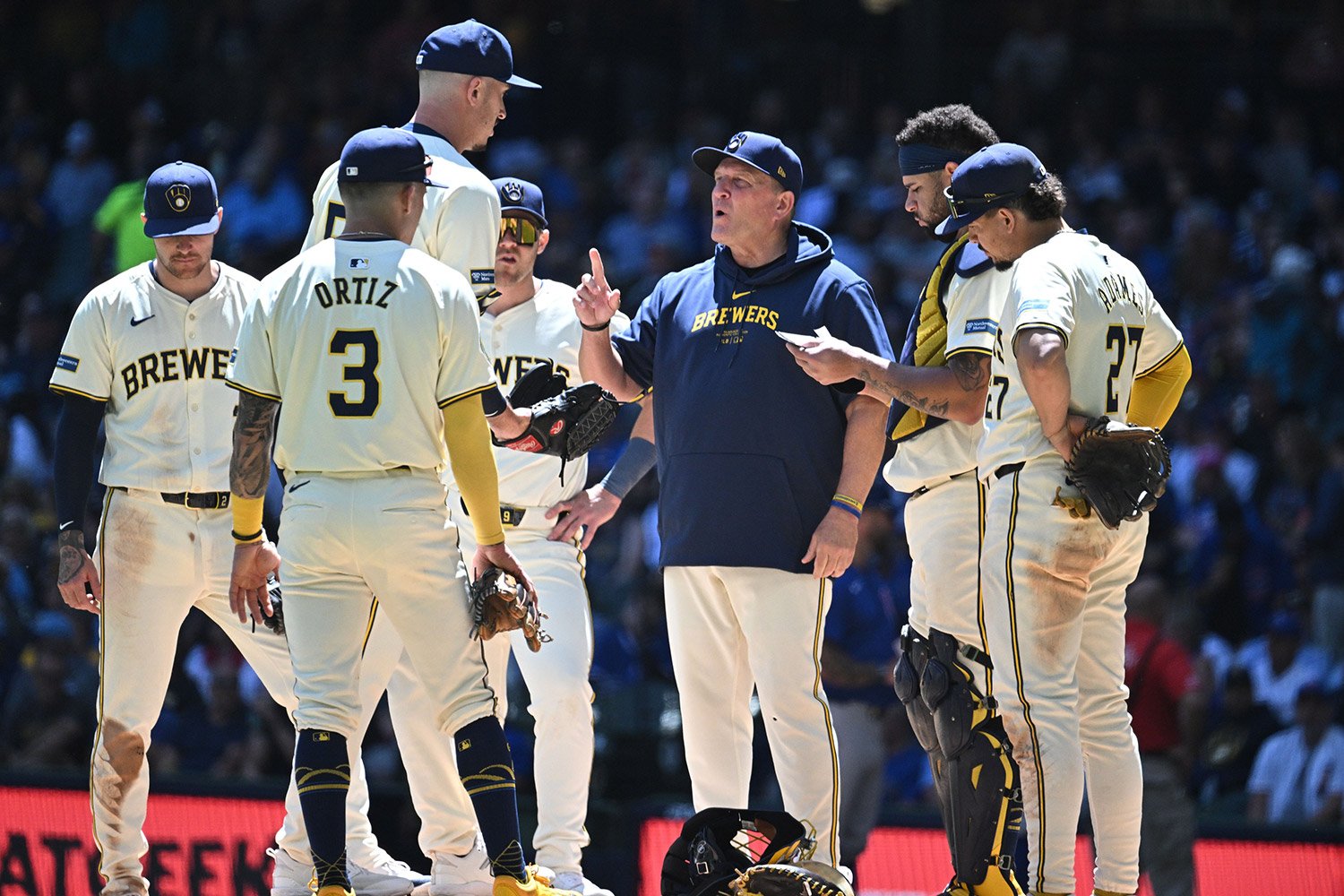
Brewers Video
Thus far, 2024 has been a good year for pitchers, with the league-average ERA decreasing from 4.33 in 2023 to 3.94. Thus, although Brewers relievers have combined for a 3.47 ERA (just .007 higher than last year), they’ve dropped from second to sixth in MLB. Part of this is due to the Guardians and Yankees having (likely) unsustainable ERAs under 3.00, but other factors exist.
Devin Williams hasn’t had a chance to pitch all year, Bryse Wilson has been thrust into the starter role, and constant injuries have caused some players to miss time or have diminished performances. Let’s start by taking a high-level overview of each bullpen arm and how they’ve pitched thus far.
|
IP |
ERA |
FIP |
WHIP |
K/9 |
|
|
32.0 |
1.13 |
2.89 |
0.75 |
10.4 |
|
|
29.0 |
3.10 |
3.25 |
1.07 |
9.3 |
|
|
25.2 |
2.81 |
2.87 |
1.52 |
8.1 |
|
|
25.1 |
2.13 |
3.66 |
1.11 |
7.1 |
|
|
21.0 |
3.86 |
3.48 |
1.00 |
7.3 |
|
|
15.0 |
2.40 |
1.81 |
1.07 |
12.6 |
|
|
7.2 |
2.35 |
4.45 |
0.91 |
7.0 |
|
|
7.0 |
0.00 |
1.57 |
0.14 |
9.0 |
|
|
5.0 |
9.00 |
5.14 |
2.80 |
5.4 |
Based on this information, a few things become apparent. First of all, Milwaukee has some great lefty pitchers. Second, Trevor Megill has done an admirable job filling in the closer role in Williams’ absence. Third, there’s definitely room for improvement, especially when it comes to getting strikeouts and limiting traffic on the basepaths.
Current Roster
Bryan Hudson was a low-key offseason acquisition from the Dodgers that has panned out excellently. After being designated for assignment, he was shipped over from Los Angeles in exchange for LHP prospect Justin Chambers. Since the start of the season, he’s accumulated 1.6 rWAR, the most of any pitcher and the fifth-most on the team. His sweeper has been notably effective, with an opposing batting average of just .056, a whiff rate of 41.5%, and a strikeout rate of 46.3%.
Jared Koenig is another unexpected star who signed with the Brewers after a frustrating Triple-A season in the Padres system. His 2.13 ERA might be unsustainable as his FIP and WHIP are disproportionately high, and he has a relatively low strikeout rate (19.0%). His cutter is especially concerning, as it has an opposing slugging percentage of .476 and is his second most-used pitch.
Hoby Miler and Elvis Peguero have been holding down the fort and have remained pretty consistent compared to last year. Milner doesn’t have the same 1.82 ERA he did in 2023, but his strikeout rate is up slightly, and last year’s FIP of 3.13 may have indicated that a sub-2.00 ERA for Milner was the exception, not the rule.
Kevin Herget, Enoli Paredes, and Janson Junk have sample sizes that are too small to draw any major conclusions. Paredes’ seven scoreless innings are undoubtedly impressive, and Herget has already had three multi-innings appearances but with a total of just 19 ⅔ innings pitched between these three (and Junk has barely pitched since the start of May and was just recalled at the start of June).
Joel Payamps is a more complex case. Last year, he posted a 2.55 ERA in 70 ⅔ innings with ten games finished and three saves. This year, he’s added more than an entire run to his ERA but has the same H/9 (7.3), a lower HR/9 (0.9), and fewer BB/9 (1.7) than he did in 2023. So what gives? If I had to blame one thing, it would be his slider. He went from a .279 opposing slugging percentage to .406 while also seeing his strikeout rate on the pitch decrease by 12.7%. His sinker went from having the highest wOBA (.396) to the second-lowest wOBA (.258) behind his four-seam fastball.
Trevor Megill is intriguing in the other direction. After a career start marred by inconsistency with the Cubs and Twins, he has finally found his groove in the great state of Wisconsin. After posting a career-best 3.63 ERA in 2023, he’s improved even more and has even picked up his first career saves, eight in total so far. His scorching fastball is striking batters out at its highest rate ever (29.8%). He’s also got a gross knuckle curve with a 60.6% whiff rate and a 53.8% strikeout rate.
The Brewers Could Use More Strikeouts
Despite having the sixth-best team reliever ERA, the reliever K/9 figure of 8.43 is 19th in MLB. The bullpen has relied on soft contact over the past few years and has just two players, Trevor Megill, and Bryan Hudson, with more than 10.0 K/9. It also makes sense that they are two of the best performers on the team. Sure, it can be argued that outs from balls in play are outs just the same. A good example is Wade Miley, who posted a 3.14 ERA in 2023 with just 5.9 K/9. However, success for low-strikeout pitchers takes a lot of work to sustain, especially for relievers. Locking down the opposing lineup in late innings would be a huge boost to any bullpen’s productivity.
The question then becomes, would they be willing to sacrifice one of their current arms for an arm with a feast-or-famine playstyle? Take Cubs starter Ben Brown as an example. He has an excellent strikeout rate (29.6%) that sits in the 86th percentile of qualified pitchers but an average exit velocity (92.6 mph) in the first percentile. It has brought him a respectable 3.33 ERA so far through his first seven starts, so maybe it’s not the end of the world.
Injury Returns
The biggest name to return is obviously Devin Williams, who has been sidelined with stress fractures in his back since spring training. He was a popular subject of trade discussions along with Willy Adames and Corbin Burnes. He’ll be a free agent in 2026 and is a remarkable talent, although it remains to be seen how he’ll perform after returning from his injury. If he comes back, it’s assumed that Megill could still be kept around with one of the less important names, like Janson Junk, moved to clear roster space.
The only other injured reliever of note is J.B. Bukauskas, who landed on the 60-day IL in April due to a right lat strain. He’s barely pitched in his two years with Milwaukee so far, compiling just 12 total innings of work. While he was productive in those innings with a 0.75 ERA, it’s doubtful that his return will lead to any major shifts in personnel.
Young Guns From the Farm
The Brewers have some great pitching talent in their minor league system. Robert Gasser has already made his debut with the rotation (although he might be the latest in a long list of injured Milwaukee pitchers). Jacob Misiorowski has been the talk of the town for a while and has been dealing in his first ten starts in Double-A. Carlos F. Rodriguez hasn’t had the same success at Triple-A as in Double-A, but he’ll hopefully figure things out soon.
Outside of these three names, who are being groomed to be part of the rotation, it doesn’t seem like other players could potentially be called up to hold things down in relief. Brett Wichrowski is the next closest pitcher to the big leagues and has a 6.27 ERA over his first five starts with the Biloxi Shuckers. Logan Henderson’s highest level of competition has been high-A. Bradley Blalock and Coleman Crow are similarly far away from reaching the highest level of baseball.
Will some of these prospects eventually be good enough to claim their roster spots on the major league squad? Of course, but for now, the team is better off working with what they have.
Even if the bullpen remains the same, it’s still a strong unit and a big reason why the team is still leading the NL Central. However, as seen in last year’s playoff run, you need every advantage you can get in the sport of baseball. Otherwise, you might be out of the playoffs sooner rather than later.





Recommended Comments
Create an account or sign in to comment
You need to be a member in order to leave a comment
Create an account
Sign up for a new account in our community. It's easy!
Register a new accountSign in
Already have an account? Sign in here.
Sign In Now