


Brewers Video
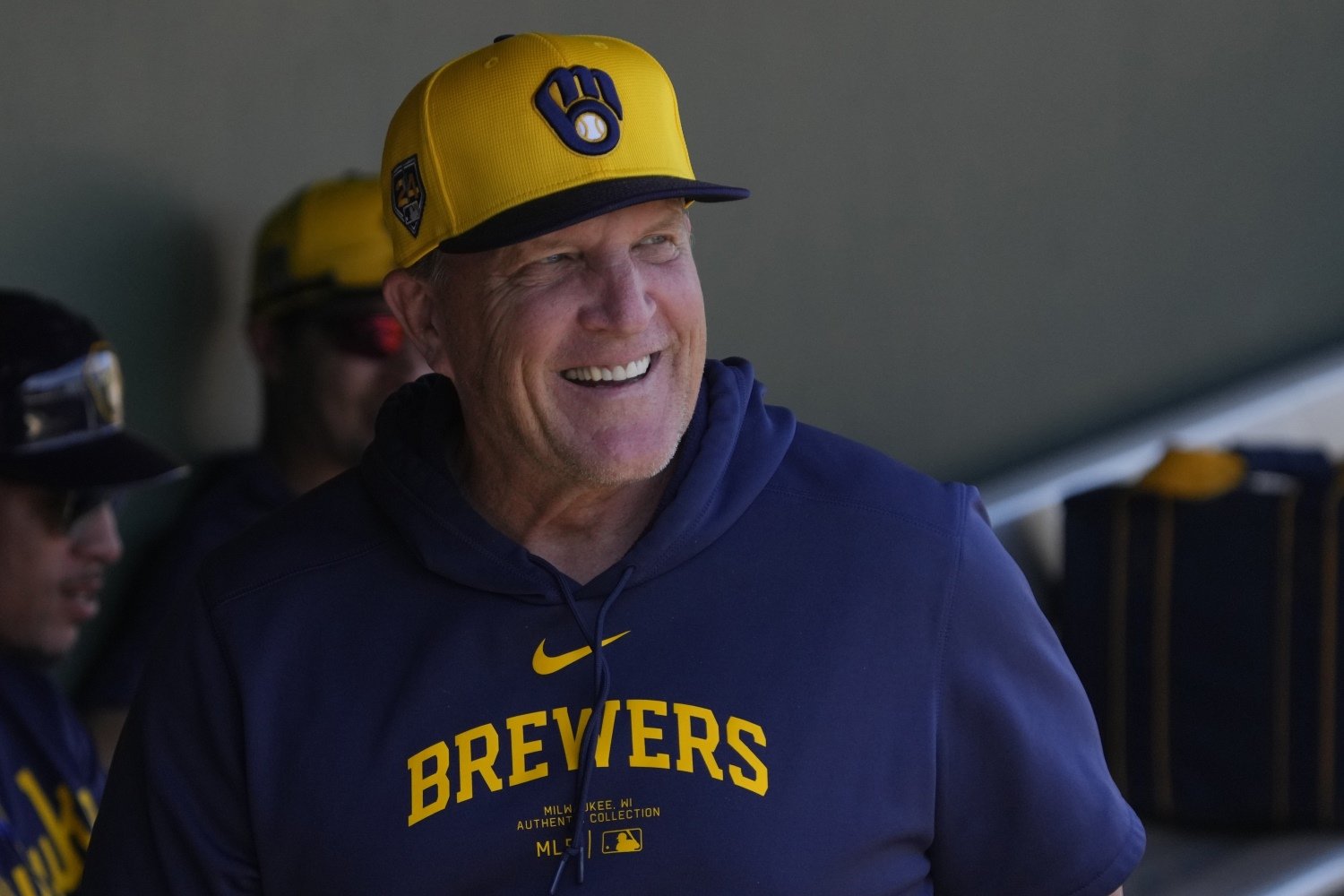
While winning remains a priority, this feels like a season of transition for the Milwaukee Brewers. As such, many fans and media members have tried to attach an identity (old or new) to the 2024 squad. Those can be reductive, though, and Pat Murphy won't have that.
The greatest sin in baseball managing is to be confined to a single plan. If you don't know what you're going to do when the thing you most want to do doesn't work, you're doomed, before the game even begins. Pat Murphy cuts a sometimes comic figure, and his age militates against anyone thinking of him as the next brilliant tactician in the dugout, but his is a multi-track, multidisciplinary baseball mind, and while he's perfectly capable of piercing analysis, he prefers synthesis as his mode of thought.
"You get too separated on things," he said last week in Maryvale, of the dangers that come with trying to emphasize or optimize one facet of his team by running out the best possible defense. "You’ll hear me say this a lot, but if you just focus on defense—there’s our defense, and then there’s our offense, and then there’s our pitching, and you can break that into starting and relievers—I like to say, it all affects each other. So if the defense has the potential where we can put three center fielders and three shortstops in the game, that’s not necessarily the recipe. The soup has to taste good, and you just keep stirring it."
You could hear a hint of that in his praise (cut with a bit of caution) of Tyler Black later in the week, when he said he sees the non-roster invitee and top prospect as a great part of the team's future but that he's doesn't trust him yet in the field, at either infield corner. Ditto as recently as Tuesday, when he seized upon the Journal-Sentinel's Todd Rosiak's question about a good day at the plate for Jackson Chourio to point out the improvements he still expects on defense.
Interesting comments from Pat Murphy after the game today. While happy with Jackson Chourio's 3-for-3 performance at the plate, Murphy wants to see more defensively.
— Todd Rosiak (@Todd_Rosiak) March 5, 2024
"I think he's going to be fine, but he's got to play a complete game on both sides. I think he will. "
At various points last week, Murphy talked about the challenges of balancing the strengths and weaknesses of his young and highly modular team, rather than leaning into any particular strength at the expense of something else.
"A little bit of this, a little bit of this, too much of this can make you really exposed over there," Murphy said, gesturing semi-broadly to indicate the pieces moving around his imaginary chessboard. "So I think that, because the pitching is so inexperienced in their current roles, that there might be reason to be really mindful of more defensive capabilities, but you gotta take care of everything. You can’t be a football team that just runs the option. You’ve gotta be able to be diverse. We might have to give up some defense to get something somewhere else. How much is enough?"
Rarely will Murphy be captive to a single moment or matchup. He talked about times when he might eschew removing a given player to optimize one plate appearance's odds, not only because the incumbent might come up later in the game to greater advantage, but because sometimes, he would want certain players to feel empowered and involved--that winning a given game was just one piece of a larger puzzle, and that incrementally increasing the chances of one win would be folly if it incrementally decreased the chances of several by making a player lose confidence or connection within the clubhouse.
The team is awash in players (especially infielders) who might play multiple positions, and Murphy is grateful for the flexibility that versatility will lend him, but he was also careful to note the obstacles that kind of nomadism can put in the paths of young players.
"Especially young players. It’s hard," he said midweek. "I’d rather just say, ‘Hey Oliver Dunn’---which I might do—'just concentrate on third.' Christian Arroyo, who’s not a younger player, he can handle it. A guy like [Joey] Ortiz, we’ve gotta keep an eye on that. He’s so confident in his defense, although he hasn’t played much third, that I think he’s got a better chance to move and not be affected by it than most young players that aren’t as confident."
Dunn has played third almost exclusively since then, as Murphy tries to make a sound evaluation of what's best for both the individual player and the team.
I had a question that sat in my notebook for a couple of days, once I realized how Murphy thinks about lineups. I wanted to ask him about the fascinating findings of Tom Tango, last fall, that having one or two left-handed teammates in the lineup makes right-handed batters more effective against left-handed starters. In other words, the whole really is greater than the sum of its parts, in a delightfully tangible way, because the presence of even a couple left-handed batters forces a southpaw starter out of the comfortable rhythm and repertoire with which they assail righties.
And then, in response to a totally different question... he just... started talking about it.
"I happen to believe that a lot of lefty starters don’t want to face lefties," Murphy said, taking a tangential detour the broader subject of pursuing platoon advantages for his own pitchers. "I know that’s crazy, but I’ve talked to a lot of lefty starters in my years. They don’t like facing righties and lefties, righties and lefties. But when you look at the actual matchup, who’s a better matchup? Usually, it’s the opposite hand over a period of time, if it’s measured.
"It’s more of an uncomfortableness. They can’t get into their groove as easily. You can’t ever measure it, because they might get the lefty out. But it screws up your rhythm going forward, because when you’re facing nine righties, you can just get in this pattern that you do. You can feel comfortable, you have space [to the arm side]."
That's an excellent example of the way Murphy seems to approach everything. As I wrote in another dispatch from the desert, he's a firm believer that even lived experience and wisdom has to be falsified by good information, and that the gut is to be overruled when good evidence is presented. Yet, he doesn't zero in on any one decision, because to him, they're all concatenated. They don't matter without one another; they barely exist without one another.
For a skipper entering his first full season on the top step in MLB, there's a soupcon of peril in this approach. Hard, atomic data specific to a given plate appearance or game can be a valuable life preserver when the seas of the season get rough, and Murphy's desire to consider the thing more molecularly could make him less likely to find a good grip when the water surges over his head.
On balance, though, he's the kind of person you want managing a team like this. He'll resist the temptation to make rash choices, or to default to conservatism. He won't run out a player with a .450 OPS for a month straight, and he won't push buttons out of panic or obligation. If he can actualize the building of shared purpose and trust that has been his top priority by the time the team breaks camp, the Crew will have the right mix of talent and mental toughness to not only repeat as NL Central champions, but clear the hurdle that has tripped them early in recent postseasons.
Do you approve of Brewers' ownership?

Follow Brewer Fanatic For Milwaukee Brewers News & Analysis



-
 2
2
-
 1
1


Recommended Comments
Create an account or sign in to comment
You need to be a member in order to leave a comment
Create an account
Sign up for a new account in our community. It's easy!
Register a new accountSign in
Already have an account? Sign in here.
Sign In Now