


Brewers Video
"It started off coming up all traditional, up on both feet, and that's the only way I knew how to catch," the Brewers' veteran backup catcher said. Throughout the last two seasons, he has transitioned to modern techniques and transformed his capabilities as a receiver.
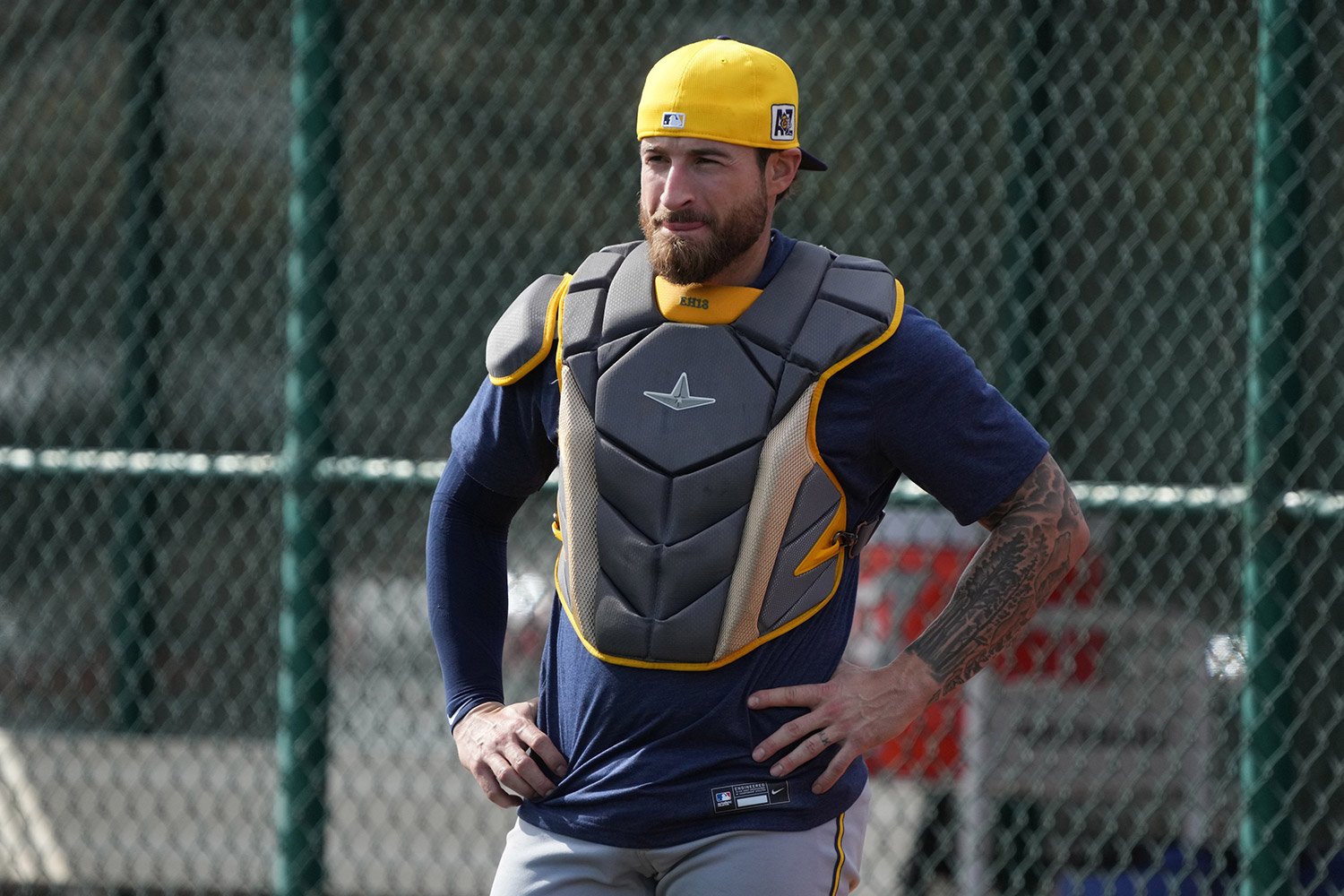
He’ll tell you that his mentality of taking nothing for granted remains unchanged, but Eric Haase finds himself in a much different situation this spring than he did a year ago.
Last March, Haase was fighting an uphill battle to break camp with the Brewers as a third catcher, a roster hurdle over which not even his fantastic performance could vault him. Fast forward a year, and a guaranteed pairing of William Contreras and Haase at catcher was one of the few positions already settled before spring training commenced.
Drafted out of high school in 2011, the 32-year-old has seen firsthand the evolution of receiving techniques during the last decade-plus. After doing his part in recent years to keep up, he’s improved on his longstanding reputation as a bat-first catcher and suspect defender. Most notably, Haase has reversed what was once one of his greatest weaknesses: framing pitches.
For most of his career, Haase set up behind the plate in a traditional squat and graded as a poor receiver. That began to change in 2023 when he started experimenting with a one-knee setup. Haase kicked out his other leg mid-pitch to get closer to the ground, which was supposed to help him better frame low pitches.
“It felt good at the bottom of the zone,” he said. “Lower center of gravity, just working up through everything.”
Haase’s receiving improved dramatically at the bottom of the zone but remained below average everywhere else, so he felt he had room to refine his mechanics further. After he signed with the Brewers, Walker McKinven et al. encouraged him to eliminate the leg kick most of the time in favor of a calmer and more upright one-knee stance.
“Their big thing was, ‘Hey, you're very athletic. You're not really using your athleticism. Here are some different stances or angles or whatnot to put you back into a more athletic position,’” Haase recalled. “And then I guess my natural glove patterns and loads started coming out a little bit better.”
With the adjustment, Haase joined a long list of backstops to transform their framing under the tutelage of Milwaukee’s catching instruction team. According to TruMedia, between Triple-A and the big leagues, he accrued a career-high 5.1 Count-Adjusted Framing Runs Above Average last season, up from -0.1 in 2023 and his career-worst of -9.9 runs in 2021.
“I'm a little bit more stable going side to side,” Haase explained when asked how the new setup helps him. “Not just one pitch, kind of selling out for at the bottom, kind of how I was before. But it just allows me to be a lot more athletic.”
With increased control and receiving range throughout the entire strike zone, most of Haase’s improvement came on high pitches, where he graded as an elite framer last year. The leg kick previously hampered his ability to present the ball up there.
“When I was on a knee and kicking out every time, I was taking my head below the top of the strike zone,” he said. “So even if there (were) pitches at the top that were strikes, it's above my head, and that's just a bad look for (the umpire). So just staying on one knee, not kicking out, staying a little bit taller, knowing I can still get to the bottom, really helped me out at the top.”
Developed in the minor leagues when traditional receiving still reigned supreme, Haase has successfully transitioned to modern framing. It’s an active process with plenty of glove movement, with the key being to have the proper movement that best presents the pitch. Today’s catchers are setting up increasingly closer to the back of home plate and going to get the ball as it approaches the plate. The idea is not to pull that pitch back into the strike zone but to work around and through the ball with the mitt so that it appears to have crossed well over the plate.
“I mean, that's the whole thing with receiving,” Haase said. “You're not really tricking the guy behind you as much as just trying to give them the best look possible. These days, there's so much tracking technology, the days of catching a ball here and moving it there and hoping you trick the guy is probably not going to happen anymore, you know? Those umpires are getting their reports, they can see exactly where pitches are, and those are the best in the world at what they do.”
Giving umpires the best look possible requires knowing how to handle different pitchers with a wide range of pitch shapes and varying degrees of command. It’s easiest to catch a pitcher with predictable movement who hits his spots, Haase admitted, but that’s not always the task he’s assigned.
“Some guys, their stuff moves a lot more than other guys, even if it could be the same pitch. It's just a constant battle of, ‘How much plate do I need to give them? What angles do I give them? Height of the target?’ And we go ad nauseam about that with pitchers’ meetings and these guys throwing side bullpens and things, so there's a lot of crossover before you're actually on the field, things you can iron out before you get out there.”
Fighting that battle is an all-hands-on-deck effort.
“Oh, it's a lot,” Haase replied with widened eyes when asked how many individuals contribute to the process. “I mean, shoot, off the top of my head, three, four catching coaches, two, three pitching coaches, and Charlie Greene in the bullpen. Murph’s got his input on stuff. So obviously, there's a lot of areas that you're taking it in from. You're trying to bottleneck and get it down to the product on the field.”
While beginning in an upright stance with a knee down has proven to be the best way to control his center of mass and present the ball most of the time, Haase stressed that he’ll never commit to a single constant setup. He is always willing to tweak things based on immediate in-game variables and the continuous evolution of his position.
“I could be back on two feet next year,” he said. “I think about it more as just tools in my tool belt, rather than just, ‘Okay, this is my stance, and this is how I do it.’ It's whatever the game is calling for, I try to position myself into that.”
Haase’s defense remains far from perfect. He’s made significant strides, though, and now has a hard-earned opportunity to showcase them in the big leagues. Most importantly, he’ll continue putting in the work to adapt as the game demands it.





Recommended Comments
There are no comments to display.
Create an account or sign in to comment
You need to be a member in order to leave a comment
Create an account
Sign up for a new account in our community. It's easy!
Register a new accountSign in
Already have an account? Sign in here.
Sign In Now