


Brewers Video
With Gary Sánchez gone and Jeferson Quero needing more development time, Eric Haase is now behind William Contreras on the depth chart. Can he fill that role successfully?
For months, Eric Haase has appeared to be the leading candidate to back up William Contreras in 2025. Squeezing him onto the roster in the second half despite nearly nonexistent playing time as a third catcher allowed the Brewers to retain control of Haase through arbitration, and the sides agreed to a one-year deal ahead of Friday’s tender deadline. An additional acquisition could change plans, but Haase will likely begin the year second on the catching depth chart. The question is how the Brewers will utilize him in that capacity, and how effectively he’ll fill the role.
Contreras shouldered a heavy workload (at his own request) for much of the season, but Pat Murphy eased that burden down the stretch with more starts as the DH and full days off. Doing that more frequently to save Contreras from himself should be a priority moving forward, which would leave more starts for Haase than the 43 he and Gary Sánchez combined to start in 2024.
The last time Haase was effective in a role at least that extensive was in 2022. He struggled mightily in 2023, hitting .201/.247/.281, for a 43 wRC+. After spending most of the first half of 2024 in Triple A, he drew just 69 plate appearances with the Brewers. Haase made a nice impact in that minuscule sample, though, slugging .515, smacking five home runs, and posting a 125 wRC+. He’s unlikely to recreate those results in a larger sample next year. Beneath Haase’s strong surface-level output, the red flags that have hampered him in the past remained.
Haase has always had excellent raw power, but he’s an aggressive hitter with significant issues making contact. Since reaching the big leagues in 2018, Haase has struck out 30.1% of the time while walking at just a 6.3% rate. Among hitters with at least 1,000 plate appearances during that span, his 4.79 strikeout-to-walk ratio is in the seventh percentile, and his 74.9% in-zone contact rate is in the third percentile.
The swing-and-miss is still a glaring issue. Haase struck out at a 32.9% clip for Nashville, with a nearly identical whiff rate. With the Brewers, he punched out at an alarming 40.6% rate, with a 39.4% whiff rate. He relied on unsustainable damage on balls in play (a BABIP of .386 in Triple A and .394 in the big leagues) to compensate for his lack of consistent contact.
When he did make contact, Haase looked more like the hitter who combined for a 105 wRC+ across the 2021 and 2022 seasons. His hard-hit rate in Triple A was 48.4%, and his average exit velocity was 90.5 mph. He also tempered his aggressiveness, cutting his chase rate to just above the league average at 27.3%. Even so, he’s due for significant regression.
Haase profiles as a below-average hitter, but he could still provide some timely home runs throughout next season. The offensive bar for a productive backup catcher is pretty low; if Haase keeps his offense above an 85 wRC+, he’ll be doing fine for his role.
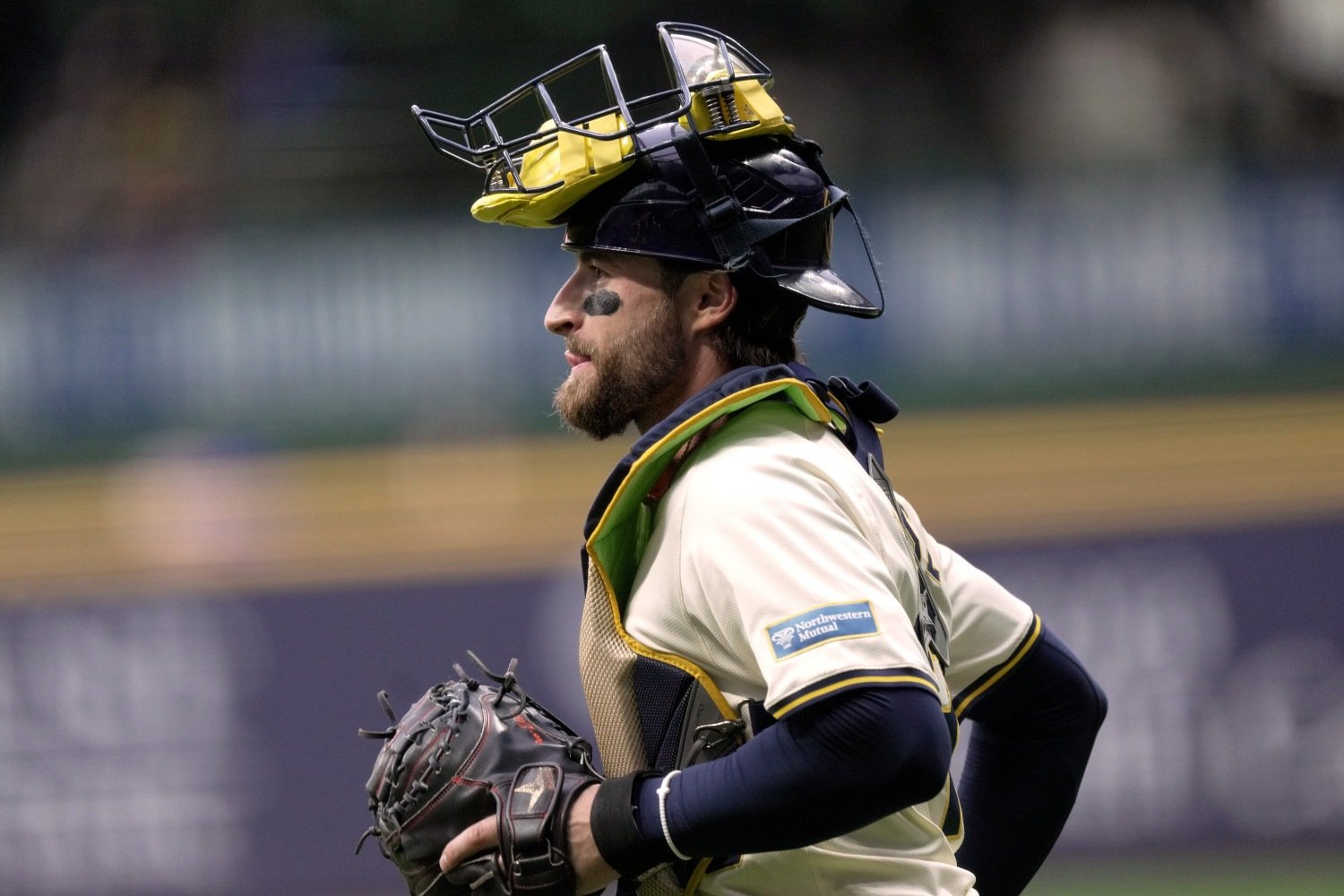
More intriguing is how Haase will fare behind the plate. He became the latest backstop to transform from a poor pitch framer to a solid one after joining the Brewers. Because Statcast offers Triple-A pitch-tracking data, public framing metrics have a larger sample to consider than his sporadic big-league appearances.
.png.7e6c908d2fdaf4870000c6bb45681da3.png)
Haase already improved his framing ability at the bottom of the zone in 2023, by switching to a one-knee stance that positioned him closer to the ground, but he remained one of baseball’s worst framers at the top. In 2024, he transformed into one of the best.

A quick video search indicates that Haase set more high targets for Brewers pitchers than he did in Detroit. If true, that would mean he often had the easier task of framing at executed locations, instead of elevated misses. However, most of the improvement stems from adjustments to his setup.
Here are a couple of Haase’s unsuccessful frame attempts around the top of the zone from 2023.
Constant motion is the theme in these examples. Haase was constantly shifting his weight around behind the plate and would often reposition his left leg as the pitcher began his motion. He was on one knee, but he was not taking advantage of the added stability that the one-knee setup is supposed to provide. This was a weakness Matt Trueblood highlighted when Haase signed last winter and named as one thing the Brewers would work to correct.
Here’s how Haase framed pitches at the top of the zone as a Brewer.
Instead of nonstop movement, what stands out now is how little Haase moves while receiving these pitches. Once he gets his base knee down, there’s no shuffling. As the pitch comes in, Haase appears more focused on using his hand and wrist to guide it toward the corners instead of his entire arm.
While the growing popularity of the one-knee stance has helped catchers steal strikes at the bottom of the zone, framing pitches at the top remains more elusive. If Haase has unlocked a legitimate knack for doing so after toning things down, it gives the Brewers a backstop uniquely equipped for catching at least a couple of their starters. Freddy Peralta and Aaron Civale live at the top of the zone with their fastballs, and Tobias Myers and Brandon Woodruff also show plenty of elevated four-seamers. Haase stealing extra strikes up there would be valuable for those hurlers.
Blocking has been a struggle for Haase throughout his career. He was not successful at controlling the running game in 2024 but previously graded out well in that regard. Framing holds the most weight among the quantitative aspects of catching, so Haase’s growth on that front boosts his defensive value.
Plate discipline is most likely to make or break Haase’s season. If his strikeouts come in under an unplayable extreme and he adequately limits wild swings on pitches outside the zone, his combination of power and improved receiving will make him a solid backup to Contreras.
Are you optimistic about the Brewers right now?

Follow Brewer Fanatic For Milwaukee Brewers News & Analysis



-
 1
1


Recommended Comments
Create an account or sign in to comment
You need to be a member in order to leave a comment
Create an account
Sign up for a new account in our community. It's easy!
Register a new accountSign in
Already have an account? Sign in here.
Sign In Now