


Brewers Video
Jacob Misiorowski so dominated over his first 11 innings in the major leagues that he rarely even needed much help from his defense. He didn't rack up strikeouts at an extraordinary rate, but the contact he did yield was so unthreatening that most of the plays were routine for Brewers fielders. In the bottom of the fifth Friday night, however, he did need help—and he got it.
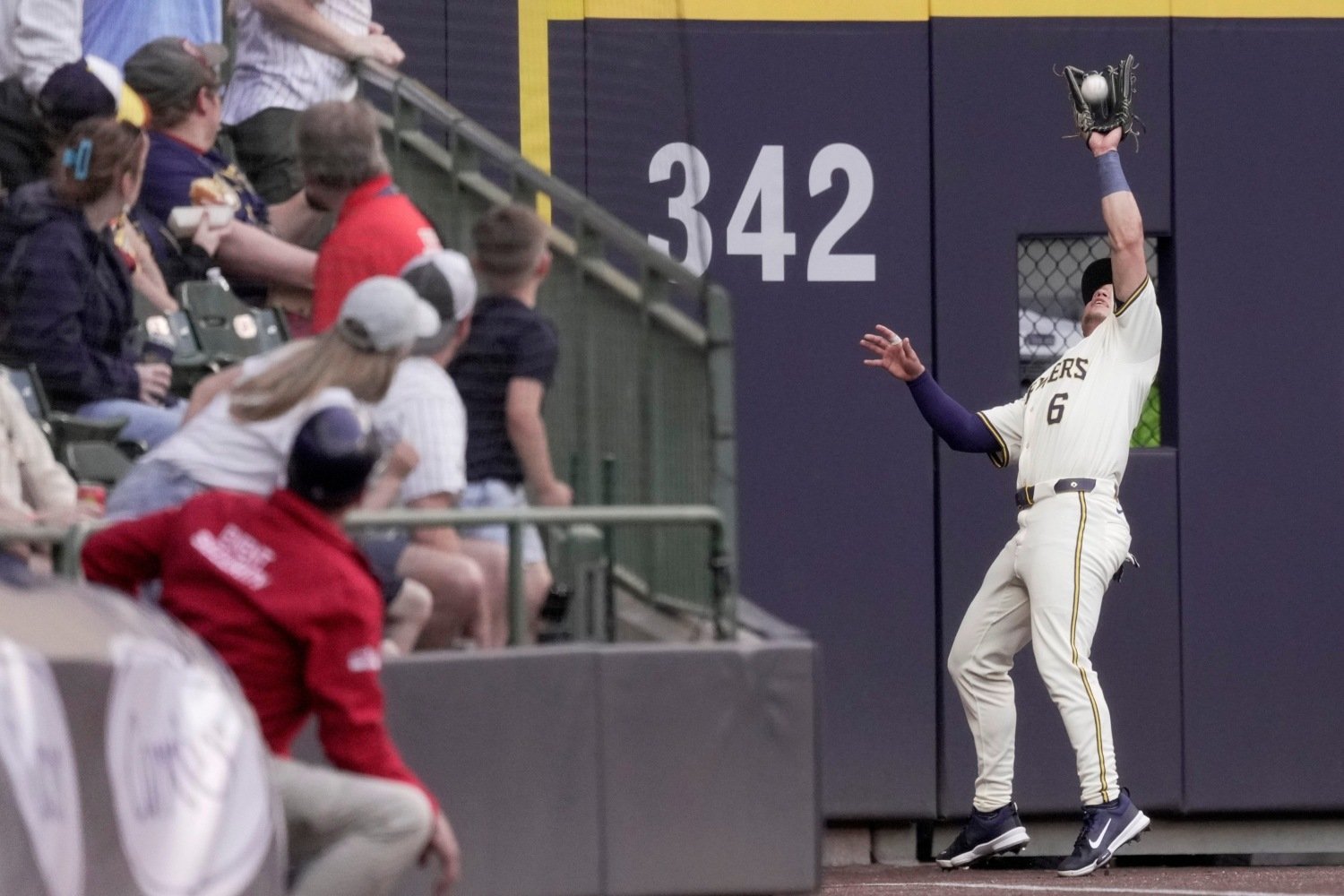
On a 1-1 pitch from Misiorowski (a 93-mph slider down and away), Twins designated hitter Ryan Jeffers hit a line drive with an exit velocity of 102.8 miles per hour. It was a low, sinking drive, and Statcast gave Isaac Collins only a 30% chance to catch it. As most humans do, though, Statcast was underestimating Collins.
This is the 10th season of Statcast measuring outfielders' Jumps—how quickly they get going when the ball leaves the bat, how well they accelerate during the middle segment of the flight of a well-struck liner or fly ball, and how efficient a route they take to the ball. In the broad scope of baseball history, 10 years is nothing, but in another sense, 10 years is a long time. It still feels a bit foolish to refer to the Statcast Era, but when that phrase first entered the baseball vernacular, it was strictly as a joke. Now, you can use it at least half-seriously. We've been measuring outfielders' jumps quantitatively for longer than Pat Murphy has been part of the Brewers organization.
When I tell you, then, that Isaac Collins is breaking the scale for outfielders' first step (the portion of their Jump labeled as 'Reaction' on Baseball Savant), it's not an entirely trivial observation. Is it likely that Collins is a whole new breed of outfielder, altering the very paradigm of playing defense in the grass? No. Has anyone, in the last 10 years, even been close to as good as Collins has been at getting a jump on the ball? Also no. That counts for something.
After barely 300 innings played in left field, Collins has already been worth 4 Defensive Runs Saved (DRS), according to Sports Info Solutions. That's not off any charts. However, the speed at which Collins gets going in the direction of the ball when it leaves opponents' bats very much is so.
Statcast divides its evaluation of a fielder's Jump into three parts:
- Reaction: Feet covered in the first 1.5 seconds after the ball leaves the bat
- Burst: Feet covered in the window from 1.5 to 3.0 seconds after the ball leaves the bat
- Route: The efficiency of each of the above, relative to a direct line from the player's starting position to the projected landing spot of the ball.
Each of the three is expressed in feet above or below average. A very, very good defensive outfielder might gain five feet on the ball, relative to the average peer, across the three categories. Burst tends to capture a player's raw athleticism fairly cleanly; it expresses how much ground a player covers once they've had time to get up to speed. Where Reaction and Route are concerned, however, there's a natural tradeoff. To get underway quickly, you almost inevitably give up a bit of accuracy. That's been true of Collins, just like everyone else—but it hasn't mattered much, because he's the best at getting underway quickly that we've seen in at least a decade.
Here's a scatter plot showing Reaction and Route grades for all outfielders with a modicum of plays attempted this year.

In fairness to the graphics people at Baseball Savant, it's rare that a player even strains the existing constraints of this chart—and unprecedented that one breaks out of it altogether. That's how good Collins has been at getting moving when the ball meets the bat.
The secret? He doesn't have to shake off that pesky ground as he starts the process, the way most outfielders do.
"Last year, I was just like, you know, on the infield, you pretty much want to have both feet in the air when the ball’s crossing the plate, so why not do the same in the outfield?" Collins said Saturday, inside the Brewers' clubhouse at Target Field. "I’m just really timing my hop when the ball’s crossing the plate. Making sure both feet are in the air, so I can read the swing, read the pitch, and then base your jump off of that."
That sounds fundamental, and it is—but not for the position Collins plays now. As he notes, it's common for infielders (especially middle infielders) to time a step and hop to their pitcher's delivery, trying to be very slightly airborne when the ball enters the hitting zone. That gives them the best chance of an instantaneous jump toward the ball, which is often coming at them with triple-digit velocity and might require multiple steps and a dive to be reached. In the outfield, though, you'll rarely see a player go through the same pre-pitch set of moves as Collins. Even great outfielders famous for their glovework, like Byron Buxton and Harrison Bader (counterparts to Collins this weekend in Minneapolis) tend to have both feet on the ground when the ball is hit. They still move before the pitch, to prepare themselves to take off quickly, but they think more about the push off. Collins is focused on the freedom to explode in the direction of pursuit he perceives as necessary.
The plays on which that pays off most clearly are ones like the Jeffers liner, where Collins has a very short time to cover ground. However, we've also seen him show up in a range normally far beyond the boundaries of a left fielder's territory.
That play isn't even a testament to Collins's greatness in the field, really. Jackson Chourio would have caught that, if Collins hadn't. It's just an example of how far he can stretch his own range, by being so fast out of his place at the crack of the bat. Here he is not quite getting the angle right, initially, but having left himself so much time by breaking quickly that he could adjust and still make a fine play.
As the Jeffers play showed, he's at his very best coming in on the ball; going through the pre-pitch routine of an infielder prepares him to charge forward on the ball particularly well.
The downside, naturally, is the same as the reason why you don't see many outfielders do it the way Collins does: it's harder to get moving back on long flies when you start with the hop. That's not an issue for infielders, who only give ground on the ball occasionally and make almost all their tough plays either by charging the ball or by moving as fast as possible to the side. For outfielders, the traditional approach is a drop step: read the ball, turn your hips and take that first step backward at the same time, turning the body as you move away from the plate. That rhythm takes an extra quarter-beat after the Collins hop, which has made him disproportionately good on balls hit in front of him or to his side. He acknowledged as much, but believes his approach is worth it.
"It just depends, each guy. There’s a little give and take there," he said. "You don’t want to make a jump and have it be the wrong read. I think that’s a big thing, out in the outfield, especially on those liners right at you. You want to make a good jump on the ball, but you also want to make sure you’re making the right read. So every guy is different, everyone has their own little routine, but obviously, mine’s been paying off."
Indeed, the way Collins starts is working brilliantly. A former high-level high school running back, he also has the acceleration needed to close on the ball after getting moving. He can, over time, use that to make up for the inefficiency of his start on deep balls. In part, he'll just need to develop the same confidence in pursuing those that he feels on balls hit in front of him—and he'll have to learn to navigate the wall.
"That’s the biggest room for growth for me, 100%," Collins said. "You see guys like Sal, and Perkins and Mitchell, their wall awareness is so natural to them, and that is not easy. They make it look very easy, and that’s something I can definitely work on, That’s what I’ve been trying to work on, is just getting more comfortable on balls over my head, balls near the wall."
Having seen how far he's come already, Collins's manager believes that will be no problem. Pat Murphy reminisced Sunday about the first two balls hit toward Collins in the outfield this spring, which he misplayed. At the time, he was dealing with a rib injury, so the team tried to remain patient with him, but they certainly didn't foresee that he would get from there to here.
"He had been training in the infield, because my vision for him is he's a super-utility guy, he can play everywhere," Murphy said. "And because we have Mitchell and Perkins, he wasn't gonna play—if he makes the team."
Once those two players got hurt, though, Collins got a chance, and what he's done with it has wowed even his coaches and teammates. Murphy, for his part, no longer feels an urge to rush Collins back into a utility role—and with Mitchell likely down considerably longer after injuring his shoulder on a slide during his rehab assignment, there's little pressure building to push Collins.
"I think someday I envision him that way, but right now, how can you take him out of there?" Murphy asked, rhetorically.
Collins's literal jump is one of the new sources of fuel for the endlessly efficient and powerful Brewers run prevention machine. Friday night, it preserved a bit of history, and it's shown up even in tense moments, all year. While neither Collins nor the team consider him a finished product, the value the rookie provides in the outfield is impossible to ignore. It's also a fun reminder that there are endless ways to succeed in baseball, for those with the right combination of talent and willingness to try something unusual.
Do you approve of the job Pat Murphy is doing as Brewers manager?

Follow Brewer Fanatic For Milwaukee Brewers News & Analysis



-
 2
2


Recommended Comments
Create an account or sign in to comment
You need to be a member in order to leave a comment
Create an account
Sign up for a new account in our community. It's easy!
Register a new accountSign in
Already have an account? Sign in here.
Sign In Now