


Brewers Video
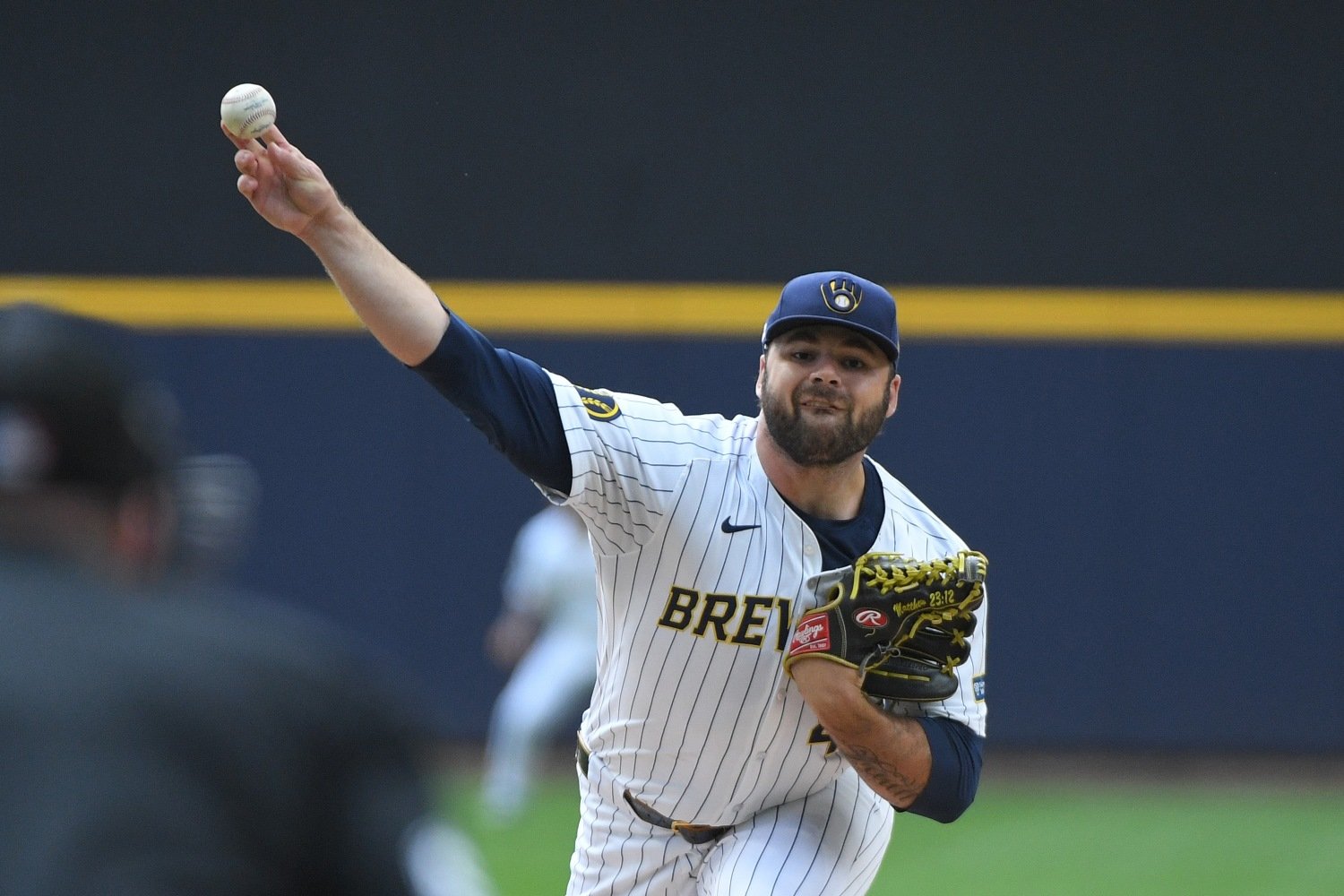
Since the start of last season, Bryse Wilson has an ERA of 3.15. His ERA- is 75, meaning he's allowed roughly 25 percent fewer earned runs than you'd expect, adjusting for the league and park contexts in which he's pitched. His bulk appearance Saturday against the Reds pushed him to 140 innings pitched in a Brewers uniform, and they've been fabulously successful--despite a lack of new strikeout stuff or any one identifiably excellent skill.
Last fall, I wrote about how Wilson's sinker-cutter mix was working to induce a large volume of harmless fly balls. It's a hard way to live, because it requires a pitcher to be pretty fine and a little bit lucky, but even as he's been asked to stretch back out and pitch as a starter most of the time this year, Wilson has again met the challenge. His ERA is 3.84 for the season, and it's just 3.62 since he was moved into the rotation back in mid-April.
One reason for that: he continues to avoid the roughest types of contact, if only by a little bit. Unlike some of his teammates, when Wilson gives up hard contact, he gets hitters to strike it to the center of the diamond. That means fewer of those hard-hit balls turn into extra-base hits, especially home runs.

The best end of this chart to be at is the top left end, where you're not allowing opponents to pull the ball with authority and you are getting a lot of that hard contact to go out to center field, or back at you. Wilson is perched in just that position.
That's a thin explanation for how he's avoided being hit harder, though, and no cause to believe especially strongly that he'll sustain this success going forward. Let's try to make the latter case, and see where it goes.
Firstly, though his pitch mix feels like a globular, kitchen-sink approach, Wilson is really two distinct pitchers--as most of them are. Against righties, he focuses heavily on the combination of his sinker and his cutter, and the way they interact with one another.

To speak more precisely (and to catch the most interesting feature of the above), Wilson is going very sinker- and cutter-heavy early in counts, then trying to put hitters away with his four-seamer and his curveball. Against lefties, meanwhile, he's much more diverse and unpredictable, right from the start of an at-bat.

As you'd expect, the sinker becomes a secondary pitch for Wilson against lefties, unless and until he's way behind in a count. You might not have expected, though, that it would stick around, acting as a fourth partner in the effort to get outs against lefties, who have crushed Wilson throughout his career. It does. Wilson isn't going four-seamer, then curveball and attacking lefties totally differently than he does righties. The differences are more granular than that.
Note that for both handednesses, Wilson uses the four-seamer as a putaway pitch. He throws that version of his fastball much more often with two strikes, and when he does, he's pretty much always aiming for the top edge of the zone.

He doesn't actually get many whiffs with it, and probably needs to alter this pattern, because he's given up a home run in each month on two-strike four-seamers. It's how he's trying to give hitters a different look from his sinker or cutter, though, and in a certain way, it is working.
As we can infer from the above charts by count, Wilson's sinker and cutter are two different pitches, based on who's batting. Against righties, for instance, the cutter is a pitch meant to get a lean across and a wave at an offering away.

Against lefties, though, Wilson is much less willing to go inside to attack. That's partially reasonable, in that his cutter works more like a breaking ball than like a hard, on-plane heater, and it leads him to try to fill up the zone with what he hopes will be frustrating backdoor offerings to an opposite-handed batter.

Something similar happens with sinkers. Against righties, it's the pitch that gets him ahead in the count, and with which he can push in on their hands, forcing them to pull those hands in and try to fend off what is increasingly mid-90s heat.

For lefties, though, Wilson's sinker is a setup pitch. It claims plenty of the zone, and not just because he most often throws it when way behind in the count. He's setting up his other offerings.

These shifts are about staying out of the nitro zones for opposing hitters from each side, but they're also about Wilson's unique curveball. It's a pitch with a ton of horizontal break, by modern standards, and very little actual vertical drop. If it were even a tick or two harder, it would surely be labeled a sweeper; that's the kind of pitch it is.
To work off that, Wilson has to have the sinker working, to both sides. He also has to set hitters up to see stuff with plenty of room to move the way his curve does and still be a strike. The best option is to keep the pressure on and try to fool batters with his unique combination of size and mound setup, because he doesn't do it with raw movement.
There's still no out pitch in this arsenal, at all. That's why Wilson has a low strikeout rate (and a higher walk rate than we might prefer), even as he keeps beating batters. What does exist here, in abundance, is a feel for pitching, and for the space where a hitter might get to a ball but won't truly blast it.
Given his gargantuan dimensions (6-foot-7, 272 pounds, officially), his unassuming pitching style, and his no-nonsense ease in the clubhouse, I think Wilson should inherit a nickname that should always be in MLB circulation, anyway: Big Daddy. Rick Reuschel, who bore that nickname for nearly two full decades in the big leagues, was about the same size as Wilson, for his era. He, too, specialized in simply getting outs, rather than winning style points with punchouts or GIF-worthy individual offerings. Wilson is a worthy successor, even if he's a Tar Heel by birth, rather than a corn-fed farm kid from Illinois, like Reuschel was. He's unlikely to scale the heights Reuschel occasionally reached, in what was a quietly excellent career, but Wilson embodies what fans affectionately meant when they called Reuschel by that sobriquet. He takes care of the whole team, in the only ways he knows.
In that light, then, we wish Wilson a happy Fathers Day. Lately, it seems like every time he takes the mound is another such happy occasion. Wilson is a FIP-defying, underwhelming, overgrown swingman, but in a season when the team has needed a stabilizing force in the rotation desperately, Big Daddy has been there. If he can find it in his heart to try sequencing the sinker, the cutter, and the curveball a little more creatively, he might even start seeing his peripheral numbers trend better, rather than seeing any of his solid real stats trend worse.





Recommended Comments
Create an account or sign in to comment
You need to be a member in order to leave a comment
Create an account
Sign up for a new account in our community. It's easy!
Register a new accountSign in
Already have an account? Sign in here.
Sign In Now