


Brewers Video
Put another way, because this is the real crux of it: Do guys throwing bad, flat fastballs in spring training find some shape on it once the season begins?
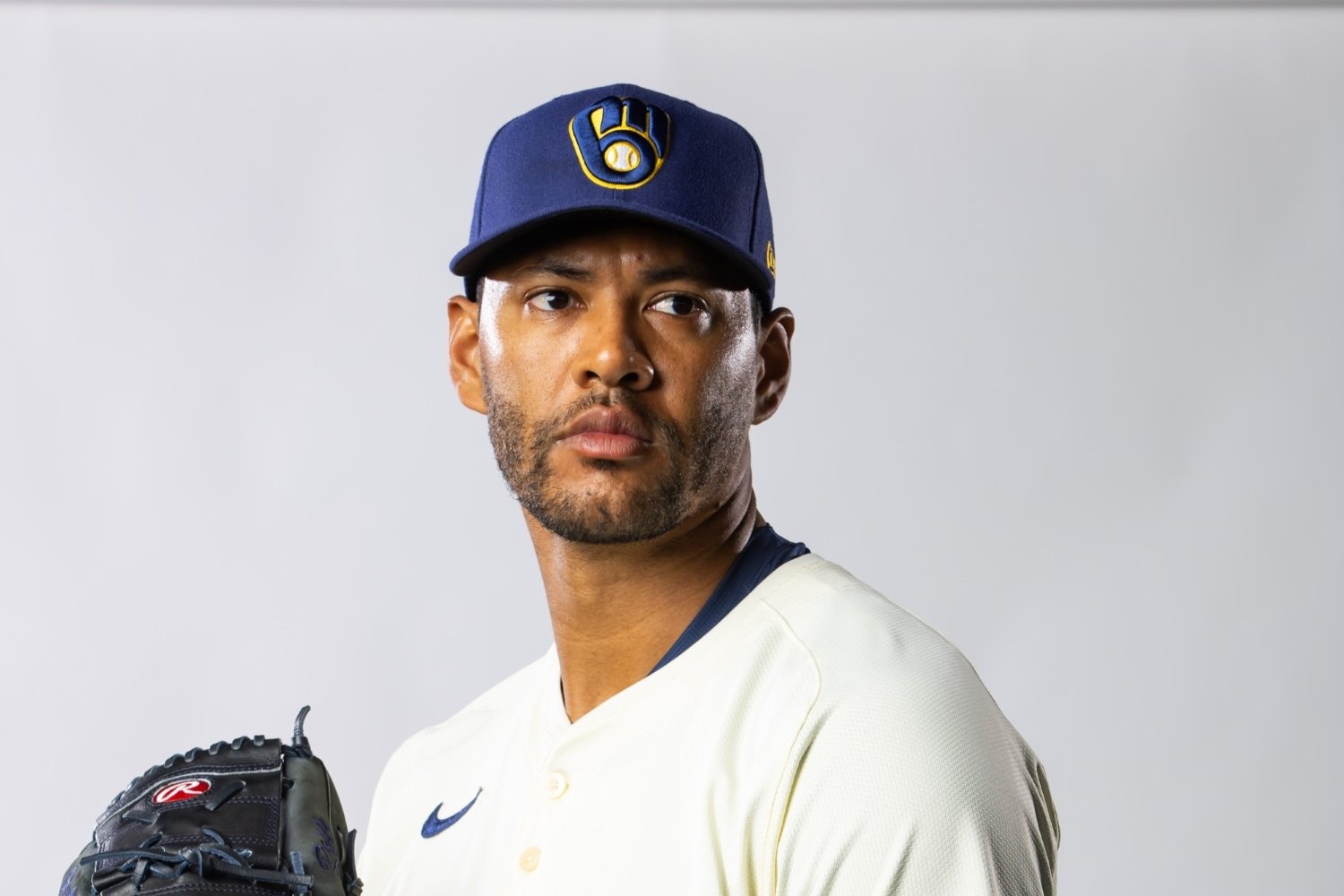
While he's been reluctant to grant the same status to higher-dollar free agent signee Jakob Junis, Pat Murphy has been quick to say that he thinks "the front end" of the game is the best place for Joe Ross in the Milwaukee Brewers' 2024 pitching mix. Part of that, to be sure, is Murphy's willingness--almost his eagerness--to use that staff creatively, meaning that Ross might not pitch deep into most games. Another part, certainly, is that Ross's long and luckless injury history makes it more desirable to use him as a starter, where he can maintain a gameday routine that maximizes his chances for success.
The big drawback of doing things that way, though, is that Murphy might find opposing managers employing the very strategy he celebrates the ability to neutralize through nimble use of guys like Junis, Robert Gasser, and Bryse Wilson, among others: loading the lineup with opposite-handed batters. And Ross, unlike Gasser or Wilson, seems not to have any way to effectively combat that tactic.
Let's talk about Ross's arsenal, because this spring, he's talked (to Dom Cotroneo of WTMJ, for instance) about a four-pitch mix. The Brewers are treating him as a full-fledged starter on the basis of his having a four-pitch mix. In reality, though, he doesn't have a four-pitch mix--at least not in any traditional sense, where a hurler has at least three pitches that are near or above average for MLB and another he can show opposing hitters in select situations without getting hurt.
No, despite Ross's personable nature and Murphy's effusiveness about him, what Ross has is a very good two-pitch mix, and then two offerings that are going to get him tagged in the big leagues. Here's how his stuff is moving and looking this spring.

This might be immediately obvious, or it might not be, but that is a gorgeous, tight, devastating slider. It's a pitch that plays right off his sinker and just wrecks a right-handed batter, and in a vacuum, it has an equal potential to overmatch lefties. It's not a sweeping slider; it can tunnel off a four-seamer too.
Therein, as the bard would tell us, lies the rub. Ross is, as he alludes to in the video above, trying to throw more four-seamers, but it's not working at all. That pitch is flat, and not in the good, vertical-approach-angle way. It's a pitch without hop or life, and it only comes in at an average of around 92 miles per hour. Nor is this a new problem. It's been exacerbated, but Ross wasn't exactly getting the extra yard on his four-seam heaters even over the previous couple of years.

A fastball without plus velocity, a highly unusual release point, or consistent and freakish lateral movement (none of which Ross can boast) needs to have at least 15 inches of induced vertical break (IVB) to get outs in the big leagues. Ross's averaged 12.4 inches last year, and has sagged to 10.9 inches this year. As a pitch in the low to mid-90s, that's just not going to cut it. It doesn't set up the slider well enough, because lefty batters can spot the spin differential between the two pitches earlier than righties can distinguish between his sinker and his slider, and the slider doesn't have enough movement separation from the fastball to miss bats off of it. Ross's changeup is too firm and doesn't have enough depth or run on it, even as he's worked on the pitch, to earn whiffs that way, either.
Ross just doesn't have the weapons to do anything effectively against lefty batters right now. Because he's been hurt so much the last few years, it's hard to corroborate that process-based information with results, but let's try. Since the start of 2022, across all levels of competition, he's faced 38 left-handed batters. They've batted .370/.526/.481, with four strikeouts and eight walks. That's a laughably small sample, so let's go all the way back to 2020. That's a sample of 300 lefty batters faced, and Ross has been battered to the tune of .266/.371/.444.
I did a quick research study, to figure out whether pitchers sometimes add ride to their fastball after the conclusion of spring training. We hear, all the time, about guys working on things, focusing on mechanics, and modulating their effort. Could that mean that spring training IVBs undersell what we'll see in the regular season?
No. I studied 108 pitchers who had at least 50 four-seamers captured by Statcast cameras in spring training and at least 250 of them in the regular season last year, and the correlation between the IVBs (given the small sample I accepted for the spring training data) was very, very strong.

Ross's current Cactus League IVB on fastballs would be way, way over on the left side of this graph, where we'd expect the corresponding regular-season mark to be in the 12-13 inch range, on the high end. There are two notable outliers who did gain a bunch of ride on their heat from spring to summer, here, but they don't constitute good news for Ross. They are Bryce Elder, of Atlanta, and Cade Povich, a prospect in the Orioles system, each of whom basically reinvented their fastballs on the fly and gave the pitch a whole new shape. Ross, with his litany of recent maladies and his 31st birthday coming in May, is not a great bet to mimic the changes we saw from two harder throwers in their early 20s last year.
The good news, here, is that Ross is still very much a viable sinker-slider out-getter, when you can leverage him against some righty-heavy lineup patches. The bad news is that that's not the role he's still hoping to earn, or one with which Murphy and the Brewers infrastructure seem comfortable for him. Nor is it one that tends to jibe with the kind of arm care a team ought to prioritize for a pitcher with Ross's background.
Let's imagine a scenario in which Devin Williams has to open the season on the injured list, thanks to his suddenly suspect back. In that case, Ross might be able to find a home in the bullpen, despite his usage limitations and the inability to option him to the minor leagues. It's not hard to envision him being a good seventh-inning guy in the mold of Elvis Peguero, but with a bit more in the way of whiff potential. The big question would be whether he could comfortably stretch out to two or three innings of relief work within one outing, were he to shift into a reliever's regimen. If so, he could be even more valuable, and come very close to working at the front end of games, but Murphy would probably need to shield him from opponents by starting someone like Gasser, Aaron Ashby, or even Hoby Milner.
A numbers game looms for the Brewers pitching staff, whether Williams or Wade Miley are ready to go when the season begins or not. Ross is just one of the boats being tossed around in that brewing storm, and because of some of the weaknesses in his game, it's hard to take seriously the degree of faith Murphy would have us ascribe to his veteran hurler. Instead, this feels like one of those times when (despite signing a big-league deal relatively early in the winter) a player might have only a short stay with the Brewers.
In order to stick around longer, Ross will need a new grip on his changeup, a new shape to his fastball, or an emergency cutter implantation from Chris Hook and his cutter-loving bunch. It's hard to justify giving a guy with a 2.29 WHIP across seven spring innings a designated rotation spot to begin the season, but without some concrete reason to believe he's not the guy those numbers and the pitch data say he is, "hard" becomes "impossible".
Are you optimistic about the Brewers right now?

Follow Brewer Fanatic For Milwaukee Brewers News & Analysis



-
 2
2


Recommended Comments
Create an account or sign in to comment
You need to be a member in order to leave a comment
Create an account
Sign up for a new account in our community. It's easy!
Register a new accountSign in
Already have an account? Sign in here.
Sign In Now