

.thumb.png.97a48f5e988eb5cd844bab443feb771d.png)
Brewers Video
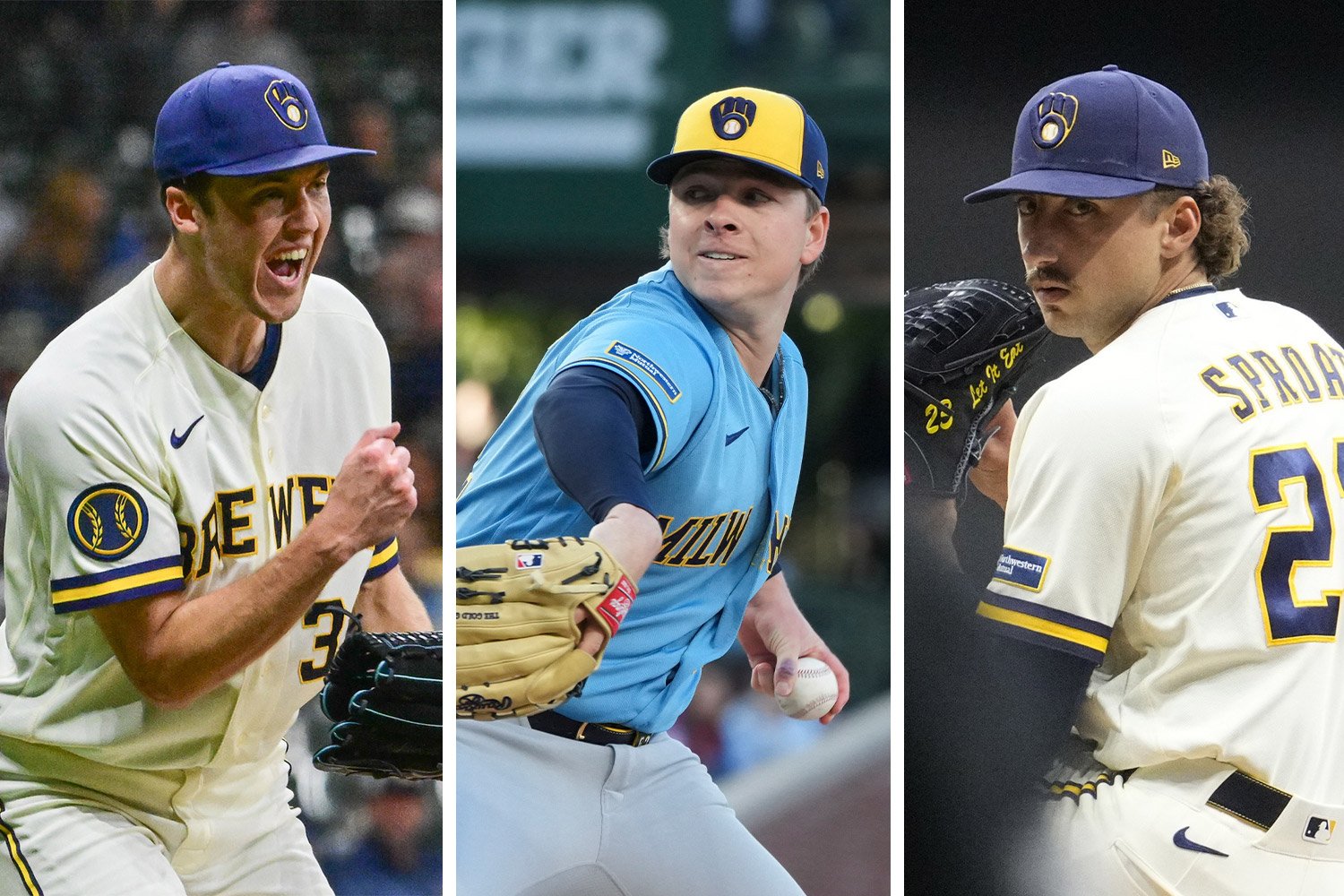
The Milwaukee Brewers are not building a dominant rotation around a single pitch. They are building it around an entire laboratory of elite weapons.
While much of MLB remains obsessed with pure velocity or extreme “stuff” arsenals, Milwaukee is developing something far more complex: a collection of pitches that dominate in completely different ways. Some destroy plate appearances through nearly unsustainable swing-and-miss rates. Others survive through contact manipulation, constant discomfort, or the inability of hitters to elevate the baseball with authority.
And perhaps the most interesting part is that the collective results are now beginning to tell a historic story.
Stats in this article are through Friday, August 22nd.
The Brewers reached Game 47 of the 2026 season at 29-18, marking the ninth time in franchise history they have led the division at this point of the year. But when compared to the other eight Brewers teams that also occupied first place after 47 games, something even more revealing appears: none combined such a high winning percentage (.617) with such dominant run prevention (3.18 ERA).
That matters.
Because every previous team on that list eventually played meaningful October baseball. From the division champions of 2011, 2018, 2021, 2023, 2024, and 2025, to the 1982 American League pennant winner, each of those starts evolved into a legitimately competitive season. And this current group is outperforming nearly all of them in the area that most consistently sustains real success: pitching.
|
Span Started |
Span Ended |
Final Record |
Rank |
Postseason |
G |
W |
L |
WL% |
ERA |
HR% |
SO% |
BB% |
|
26/3/2026 |
20/5/2026 |
29-18 |
1 |
|
47 |
29 |
18 |
.617 |
3.18 |
2.0% |
26.8% |
9.2% |
|
29/3/2018 |
20/5/2018 |
96-67 |
1 |
Division Champ |
47 |
28 |
19 |
.596 |
3.47 |
2.7% |
22.7% |
9.4% |
|
29/3/2024 |
20/5/2024 |
93-69 |
1 |
Division Champ |
47 |
27 |
20 |
.574 |
4.02 |
3.2% |
21.0% |
9.0% |
|
11/4/1981 |
1/6/1981 |
62-47 |
1 |
Division Champ |
47 |
27 |
20 |
.574 |
3.61 |
1.4% |
12.1% |
7.3% |
|
30/3/2023 |
22/5/2023 |
92-70 |
1 |
Division Champ |
47 |
25 |
22 |
.532 |
4.23 |
3.7% |
20.6% |
8.9% |
|
1/4/2021 |
24/5/2021 |
95-67 |
1 |
Division Champ |
47 |
24 |
23 |
.511 |
3.79 |
3.4% |
27.7% |
9.2% |
|
31/3/2011 |
22/5/2011 |
96-66 |
1 |
Division Champ |
47 |
24 |
23 |
.511 |
3.73 |
2.4% |
20.5% |
7.8% |
|
9/4/1982 |
1/6/1982 |
95-67 |
1 |
AL Pennant |
47 |
23 |
24 |
.489 |
4.08 |
2.1% |
11.8% |
8.0% |
|
27/3/2025 |
18/5/2025 |
97-65 |
1 |
Division Champ |
47 |
22 |
25 |
.468 |
4.14 |
3.0% |
21.0% |
9.9% |
The difference shows up even deeper inside the secondary numbers. This staff is striking out 26.8% of opposing hitters — one of the best marks of any team on this list — while suppressing home-run damage better than almost every modern Brewers club before it. This does not feel like a first-place team built on opportunistic offense or a favorable stretch of scheduling luck. It looks like a roster whose entire identity begins on the mound.
And that is where a closer look at their best pitches begins to explain why Milwaukee feels different.
The slider of Jacob Misiorowski is performing as the most valuable breaking ball in baseball through pure physical intimidation. Kyle Harrison dominates with two opposite weapons: a four-seam fastball built on swing-and-miss and a slurve that almost completely erases hard contact. Chad Patrick has transformed an apparently less explosive cutter into one of the most efficient pitches in MLB. Trevor Megill, meanwhile, is throwing a curveball at an absurd frequency without hitters finding answers.
What connects all of those pitches is not shape. It is outcome.
Milwaukee is not simply collecting good arms, the organization is building one of the most fascinating pitching ecosystems in the league, where every pitch seems to solve the same problem from a completely different geometric angle.
Pitch Type: Slider
Top-40 Run Value Pitchers: Jacob Misiorowski (1)
Jacob Misiorowski’s slider does not merely lead Brewers pitchers. Right now, by Run Value, it is literally the most valuable slider in all of baseball. And the most impressive part is that it does so without necessarily dominating every traditional category usually associated with a devastating pitch.
First place in Run Value (+10) already places him ahead of names like Jacob deGrom, Dylan Cease, and Chris Sale. But once you dig deeper into the details, something even more interesting appears: Misiorowski creates run prevention through an extremely rare combination of weak contact, aggressive command, and difficulty allowing hitters to elevate the ball.
His 23.4% hard-hit rate allowed is one of the best marks anywhere on the leaderboard and clearly superior to most elite sliders surrounding him. Among pitchers with significantly positive Run Value, very few combine that level of contact suppression with such overwhelming overall effectiveness. Even dominant arms like Chase Burns, Andrés Muñoz, or Max Meyer allow considerably more hard contact.
And that is one of the defining characteristics of this slider: it does not need to rely exclusively on whiffs to destroy plate appearances. His 25.8% whiff rate is excellent, but not historically absurd. In fact, it sits well below monsters like Mason Miller or Chase Burns, both comfortably above 50%. Yet Misiorowski turns the slider into an elite weapon because hitters simply cannot damage it when they do make contact.
A .102 batting average allowed, and .169 slugging percentage against are outrageous numbers for a secondary pitch thrown nearly 25% of the time. Even more revealing: the expected metrics fully support the dominance. This does not look fluky. The xSLG (.227) and xwOBA (.186) continue to place him among the absolute elite.
The difference may lie in how the pitch feels inside an at-bat. Many sliders dominate through accumulated swings and misses. Misiorowski’s also dominates through intimidation. Hitters rarely elevate it with authority, rarely square it up out front, and consistently seem more focused on surviving the plate appearance than attacking the pitch. That combination is often what defines truly special pitches.
Pitch Type: Four-Seam Fastball
Top-40 Run Value Pitchers: Kyle Harrison (11), Jacob Misiorowski (18)
The most interesting part is not simply that Kyle Harrison ranks 11th and Jacob Misiorowski 18th in total Run Value among four-seam fastballs. What is truly revealing is that they arrived there through completely different paths.
Harrison has a more “stable” four-seam fastball built around contact suppression. Misiorowski has a four-seamer that functions like pure physical violence.
Harrison’s fastball produces better traditional contact results: a .227 batting average allowed, .330 slugging percentage, and .292 wOBA. The hard-hit rate allowed is also remarkably low (31.6%), especially for someone throwing the pitch nearly 60% of the time. That speaks to a very difficult combination to find: volume, confidence, and relatively controlled damage.
But the real heart of Harrison’s profile lies in the swing-and-miss ability. His 33.5% whiff rate and 36.7% strikeout rate turn that four-seamer into a direct dominance tool. It is not merely a fastball designed to get ahead in counts. It is a fastball capable of ending at-bats by itself.
The contrast with Misiorowski is fascinating.
Because Misiorowski allows more slugging (.296), more wOBA (.290), and far more hard contact (42.9%). In theory, that should dramatically reduce the pitch’s value. Instead, the opposite happens: the four-seam fastball remains elite because the swing-and-miss level is absurd.
His 45.1% whiff rate is one of the most extreme marks anywhere in baseball. And the 47.2% strikeout rate against the pitch feels pulled directly from a video game. Those are numbers that usually belong to devastating sliders, not a fastball thrown more than 60% of the time.
That is the fundamental conceptual difference between the two:
- Harrison owns a dominant four-seam fastball because he blends whiffs with healthy contact suppression.
- Misiorowski owns a dominant four-seam fastball because he simply removes hitters before they can inflict meaningful damage.
And that explains why the risk profiles differ as well.
Harrison appears statistically more sustainable. His expected numbers align with the actual production, and the hard contact allowed remains manageable. There are clear structural foundations behind the success.
With Misiorowski, everything exists on the edge of chaos. Even his expected metrics remain excellent (.195 xBA and .275 xwOBA), but the level of hard contact allowed suggests that when hitters do connect, they usually hit the ball very hard. The entire model depends on the fastball remaining nearly impossible to reach consistently.
And honestly, that may be enough.
Because a four-seam fastball generating whiffs above 45% simply breaks normal evaluation rules. At that point, you are no longer discussing “a good fastball.” You are talking about a weapon that completely alters the geometry of the plate appearance.
What makes it even more impressive is that both pitchers arrived in the same statistical neighborhood using opposite roads: Harrison through contact management and efficiency; Misiorowski through pure aerial destruction.
Pitch Type: Cutter
Top-40 Run Value Pitchers: Chad Patrick (4), Brandon Sproat (18)
Chad Patrick’s cutter belongs in an entirely different category. It does not dominate through explosive raw stuff, but through the combination of location, angle, and weak contact. And yet the result remains among the best in the league.
Patrick ranks fourth in MLB in total Run Value among cutters with at least 130 pitches thrown, and the profile perfectly explains why. Hitters are batting just .155 against it while producing only a .207 slugging percentage — absurdly low numbers for a pitch he throws 41.4% of the time. That matters tremendously: this is not a situational cutter used to steal strikes. It is one of the foundational pillars of his entire arsenal.
The most fascinating aspect is how two worlds coexist inside the pitch. On one hand, it generates legitimate swing-and-miss: a 33.1% whiff rate and 26.4% put-away rate. But it also suppresses damage extremely well when hitters make contact. The hard-hit rate allowed sits at only 34.1%, clearly below many elite cutters around baseball. That combination is rare. Normally, cutters that miss this many bats eventually pay for it with loud contact when hitters connect. Patrick is avoiding both outcomes simultaneously.
It also helps that the expected metrics support much of the production. A .250 xwOBA remains excellent, even if it sits somewhat above the actual .193 mark. This does not look like a pitch surviving solely on luck.
The case of Brandon Sproat is completely different. His cutter still carries positive Run Value and ranks 18th in MLB, but the profile is far more unstable. The 24.7% whiff rate is solid, though far from Patrick’s impact, and hitters have inflicted considerably more damage upon contact: a .469 slugging percentage and .339 wOBA allowed.
What is interesting is that the expected metrics do suggest room for improvement. His xBA (.238) and xwOBA (.331) are better than the actual outcomes, a sign he has probably allowed somewhat more damage than deserved. But even then, the cutter still does not show the same consistent ability to suppress hard contact or dominate counts.
The primary difference between the two lies in stability. Patrick’s cutter already functions as a fully consolidated elite-level weapon. Sproat’s still feels like a pitch with brilliant flashes that has not yet fully mastered contact quality when hitters avoid the swing-and-miss.
Pitch Type: Slurve
Top-40 Run Value Pitchers: Kyle Harrison (1)
Kyle Harrison’s slurve not only leads MLB in total Run Value among pitchers with at least 150 offerings of the pitch. It also owns one of the most destructive profiles in the league, regardless of breaking ball category.
Hitters are batting just .116 against it and slugging only .140, nearly absurd numbers for a pitch that Harrison throws 27.4% of the time. This is not some hidden secondary weapon reserved for certain counts. It is a central component of his repertoire, and still nobody is punishing it.
The most impressive aspect is probably the blend of swing-and-miss and total hard-contact suppression. His 30.3% whiff rate and 32.6% strikeout rate show real put-away ability, but the truly outrageous figure appears in the hard-hit rate: just 10.7%.
That number is almost surreal in today’s offensive environment. Even many of MLB’s best breaking balls allow significantly more loud contact when hitters manage to connect. Harrison is eliminating both outcomes simultaneously: swings and misses and damage on balls in play.
And the expected metrics fully support the dominance. The .161 xBA, .188 xSLG, and .188 xwOBA are absolute elite-tier indicators. There do not appear to be meaningful regression signals hiding beneath the surface.
Compared to the league’s other high-value slurves, the difference becomes obvious. Michael Soroka generates elite swing-and-miss numbers — 36.9% whiffs and a 38.7% strikeout rate — but allows substantially more hard contact and overall damage when hitters connect. Sean Newcomb actually falls into negative Run Value territory despite maintaining some whiff ability.
Harrison, meanwhile, combines everything simultaneously: swings and misses, strikeouts, weak contact, and dominant expected outcomes. That is what transforms the slurve into one of the single most effective pitches anywhere in MLB this season.
Pitch Type: Curveball
Top-40 Run Value Pitchers: Trevor Megill (6)
Trevor Megill’s curveball may be one of the least discussed pitches among MLB’s dominant relievers this season. The numbers suggest it deserves far more attention.
Megill ranks sixth in total Run Value among all curveballs in baseball, but the underlying profile is even more impressive than the ranking itself. Hitters are batting just .125 against the pitch and slugging only .156, while producing a ridiculous .157 wOBA.
And the most striking part is that this is not an occasional curveball used merely to disrupt timing. Megill throws it 42% of the time — an extraordinarily high usage rate for such a dominant breaking ball. That completely changes the conversation. Hitters know it is coming; they see it constantly, and they still cannot damage it.
The swing-and-miss profile lives in absolute elite territory. His 48.4% whiff rate is one of the most extreme figures anywhere in baseball among high-volume curveballs, paired with a 37.1% strikeout rate and 29.5% put-away rate. Essentially, when Megill needs to finish an at-bat, the curveball becomes the primary weapon.
But perhaps the most important detail is that the dominance does not rely solely on whiffs. The expected metrics fully sustain the performance: a .119 xBA, .147 xSLG, and .151 xwOBA. Those are absurdly low figures even inside the league’s elite breaking-ball group.
In fact, when compared with other top curveballs around the leaderboard, Megill stands out because of the pitch’s complete balance. Ben Brown generates more overall whiffs, Spencer Arrighetti allows even less hard contact, and Tyler Glasnow posts an outrageous strikeout rate, but very few combine usage volume, swing-and-miss ability, and total damage prevention the way Megill currently does.
That is what makes this curveball far more than a quality secondary pitch. It is functioning as one of the most dominant individual offerings in all of MLB, regardless of role or pitcher archetype.
Pitch Type: Sinker
Top-40 Run Value Pitchers: DL Hall (36), Abner Uribe (39)
DL Hall’s sinker does not rank among the league’s most dominant offerings because of whiffs or strikeouts, but it does show intriguing signs of damage suppression. Opponents are batting just .150 against it and have produced virtually no extra-base damage (.150 SLG), which helps explain why the pitch maintains positive Run Value despite far less favorable underlying metrics.
In fact, the contrast is sharp: the xwOBA climbs all the way to .418 and the xSLG to .403, signals that the contact quality allowed has been considerably more dangerous than the surface numbers indicate. Even so, Hall has managed to avoid catastrophic damage while keeping the hard-hit rate at a respectable 33.3%.
The case of Abner Uribe appears more stable and aligns more closely with what teams usually seek from a power reliever’s sinker. His 64.1% usage rate clearly establishes it as the centerpiece of his arsenal, and while the numbers are not spectacular, they remain solid across multiple areas: a .233 batting average allowed, .301 wOBA, and respectable ability to generate swings and misses (17.7%) and strikeouts (19.1%).
He does not dominate the league in weak contact, either, but the 38.2% hard-hit rate remains manageable considering the violence of the repertoire. Between the two, Uribe’s sinker appears more sustainable; Hall’s, meanwhile, still seems to rely more heavily on current outcomes than on underlying contact-quality indicators.
Behind Milwaukee’s best start in decades (29-18, 3.18 ERA) sits a pitching arsenal that is dominating MLB from every possible angle. With seven unique pitchers spread across six distinct pitch types inside the Top 40 — including the most valuable slider in baseball (Misiorowski, +10), the top slurve in its category (Harrison, .116 average allowed), an elite cutter (Patrick, .155 average allowed), and a curveball producing a microscopic .157 wOBA (Megill) — the Brewers are not building around a single pitch.
They are building an entire laboratory where every weapon solves the same problem from a different geometric direction.
Do you approve of the job the Brewers' front office is doing?

Follow Brewer Fanatic For Milwaukee Brewers News & Analysis



-
 2
2



Recommended Comments
There are no comments to display.
Create an account or sign in to comment
You need to be a member in order to leave a comment
Create an account
Sign up for a new account in our community. It's easy!
Register a new accountSign in
Already have an account? Sign in here.
Sign In Now