


Brewers Video
As he manages a staff of young starters, Pat Murphy frequently muses aloud about how pitching development and strategy have evolved throughout his time in baseball.
"In the old days, guys would come out and throw their heater the first time around because they could locate their heater," Murphy said during a pregame media session earlier this month. "They'd come out and throw their heater and rarely show you something secondary. Second time around, they show you the second pitch. You don't see a changeup until the third time around."
In an era where technology and physics have made pitch design a science, more pitchers have expanded their arsenals and know exactly which pitch types to throw based on their motor preferences. That's left fewer hurlers reliant on four-seam fastballs, particularly since the turn of the decade. In 2026, 30.4% of pitches thrown have been four-seamers. It's still the most prevalent pitch in the game, but the standard fastball is being thrown at the lowest rate in the pitch-tracking era, which began in 2008. Instead, the game has entered an era of meticulously crafting and utilizing pitch shapes.
"The game's just changed," Murphy said. "Now, you might show all your pitches on the first hitter. It's the way the game has changed because command is different. Now it's stuff."
The Brewers have diverged somewhat from most of the league in this department, throwing fastballs 65.2% of the time this year, compared to the league average of 54.5%. That number is a bit misleading, though. While much of baseball is mixing entire arsenals of pitches more evenly, the Brewers are mixing four-seamers, sinkers, and cutters. Their 31.5% four-seamer usage rate is comparable to the rest of MLB; it's the two other flavors of fastball they throw unusually often.
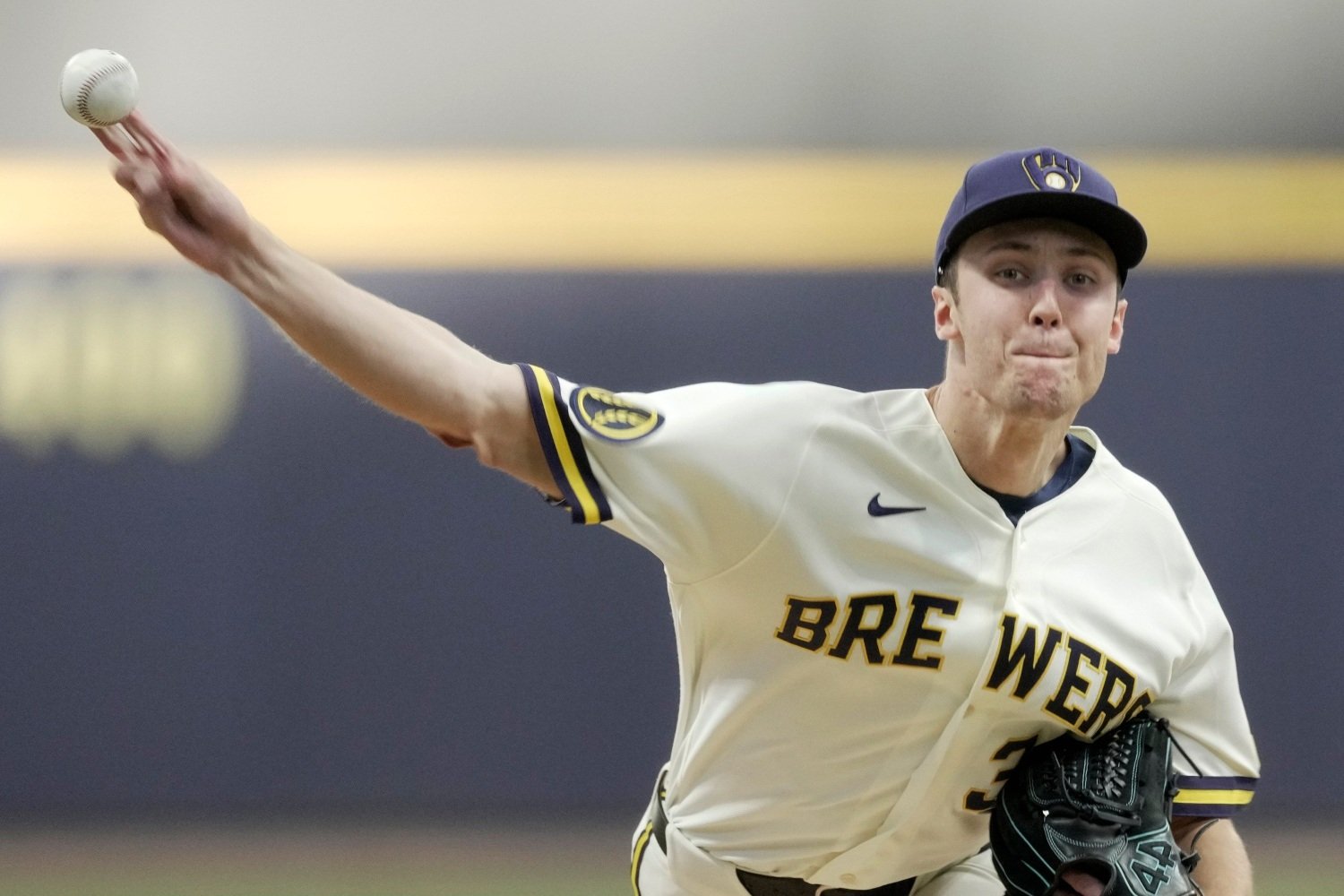
Milwaukee's top two starters, however, are eschewing both versions of the mix-it-up approach. Jacob Misiorowski has thrown his four-seamer 62.3% of the time, the highest rate among pitchers who have thrown at least 50 innings this season. Kyle Harrison ranks second, throwing his four-seamer 58.9% of the time.
It's hard to argue with the results. Misiorowski boasts a 1.83 ERA, 1.89 FIP, and 53 DRA- in 11 starts. Harrison isn't far behind, posting a 1.57 ERA, 2.46 FIP, and 76 DRA-. Those numbers give the pair a statistical case as the best one-two punch atop any rotation in baseball.
Misiorowski can supplement that fastball with a full arsenal that also includes a cutter, slider, curveball, and changeup. Harrison has improved at executing his slurve, which he used a season-high 42.4% of the time on Tuesday night when he didn't have his best fastball. But much of the time, neither has needed those secondary pitches to carve through opposing lineups. Misiorowski struck out a season-high 12 on Monday while throwing 76% four-seamers. Last week, Harrison punched out 11 at Wrigley Field while throwing 68.1% heaters.
"It's both their bread and butter," Murphy said. "I think you've got to go with it and not shy away from it."
According to Statcast, both fastballs have been worth 8 runs, tying them for fourth among four-seamers. Many hitters keep seeing one heater after another from both pitchers, and they've been unable to square them up. They've slugged just .268 against Misiorowski's four-seamer while whiffing on 45.2% of swings, and they've slugged .318 with a 30.8% whiff rate against Harrison's.
Mixing speeds and locations is often cited as one of the keys to effective pitching. At the end of the day, though, a pitcher's goal is to prevent hitters from making contact on time and on the barrel, whether the result is a whiff, a ground ball, or a lazy flyout. Misiorowski and Harrison can do that with such heavy doses of fastballs because they have unusual movement and enter the zone at deceptive angles.
"They're both unique fastballs," said pitching coordinator Jim Henderson.
Both hurlers release the ball closer to the ground than many pitchers, from crossfire deliveries. Misiorowski throws his fastball from an average arm angle of 29 degrees, and even though he stands 6-foot-7, his release height is just 5.25 feet off the ground. At 34 degrees, Harrison's arm slot is a bit higher, but his average release height of 5.04 feet is even lower.
Generally speaking, the lower the release height of a pitch, the less "carry" or "rise"—measured as induced vertical break—a hitter expects it to have. That's because the lower a pitcher's arm slot, the more the seam orientation of a baseball shifts, so it spins in a direction that counteracts gravity less and creates less of that perceived rise as it interacts with the air around it.
Misiorowski and Harrison are different. The former averages 15.9 inches of induced vertical break, while the latter averages 15.1 inches. By generating so much carry from a low release height, Misiorowski's fastball has a -3.66° vertical approach angle (VAA, the angle at which the ball enters the hitting zone, relative to an imaginary line parallel to the ground), the lowest among four-seamers thrown by regular starting pitchers. Harrison's four-seamer has a -3.88° VAA, which ranks fourth.
To put that into more practical terms, a low vertical approach angle means a fastball appears "flat" in a good way. Instead of entering the hitting zone on a downhill plane, as a hitter would expect from a pitcher throwing off an elevated mound, the ball appears to stay up or even travel on an uphill plane as it crosses the plate.
Misiorowski adds even more freakish qualities to his fastball. It's the hardest among starting pitchers, averaging 99.8 mph. But because he averages 7.5 feet of extension down the mound, he delivers the ball closer to home plate than any other pitcher in the game. With that reduced reaction time, the average perceived velocity of his fastball is 101.9 mph.
"I'd probably say it's pretty unique with everything that he's able to do, and how he makes it really difficult on guys with the extension, the perceived velocity—all that stuff is probably one of one," Christian Yelich said.
"It's electric stuff," Andrew Vaughn said. "That fastball is probably the best in the game."
Harrison can't quite dial his fastball up to that level, but it can be nearly as untouchable on a given day against certain opponents. It's returned a whiff rate of at least 40% in three of his starts, including that outing against the Chicago Cubs.
"I got onto the bus after the game, and I'm looking at the highlights, and I'm just like, 'That's 95 pitches of Josh Hader,'" Henderson recalled, invoking the same comparison to the fastball-dominant former Brewers reliever as lead pitching coach Chris Hook did before Harrison's season debut.
Misiorowski has become untouchable in May by spotting more fastballs to the glove-side corner, but Harrison's execution has been even simpler. There's an emphasis on elevating his fastball, where it's most effective, but he's thrown the majority of them right down the middle of the zone. For fastballs with their qualities, throwing them in the zone is often good enough.

"It's nice," Henderson said. "They don't have to get so crazy on locations, either, so they can kind of pitch with some more freedom there."
That simplicity of attacking the zone with fastballs isn't the only thing spurring breakouts for Misiorowski and Harrison, but not having to get too cute with their sequencing or game planning has played a significant role. When a hitter does show signs of getting to those fastballs, they have good enough secondary stuff to slow them down.
"When you don't have to mix as much, it simplifies your approach, and you can just kind of get to more of just reading swings," Henderson said. "You can kind of get after your game plan a little bit easier with two pitches sometimes, where you just have to read what the hitter's looking for, and then just kind of adjust from there, instead of trying to trick them."
Misiorowski still has those three additional pitches in his repertoire, should he need them. In addition to his breaking ball, Harrison and the Brewers are still working on honing his kick changeup, and they could also reintroduce a cutter down the line. For now, though, the fastballs are doing the job and then some.
"I think you build a reputation of it, too, that you got to try to get to the heater," Henderson said. "And if it has a little angle, a little bit of movement to it, and you start feeling as a hitter like you have to cheat to it, and it opens up even just one other pitch for you to kind of get through a game with a two-pitch mix. It's just about being unique and having to honor it, really."
Do you approve of the job Pat Murphy is doing as Brewers manager?

Follow Brewer Fanatic For Milwaukee Brewers News & Analysis



-
 2
2



Recommended Comments
Create an account or sign in to comment
You need to be a member in order to leave a comment
Create an account
Sign up for a new account in our community. It's easy!
Register a new accountSign in
Already have an account? Sign in here.
Sign In Now