


Brewers Video
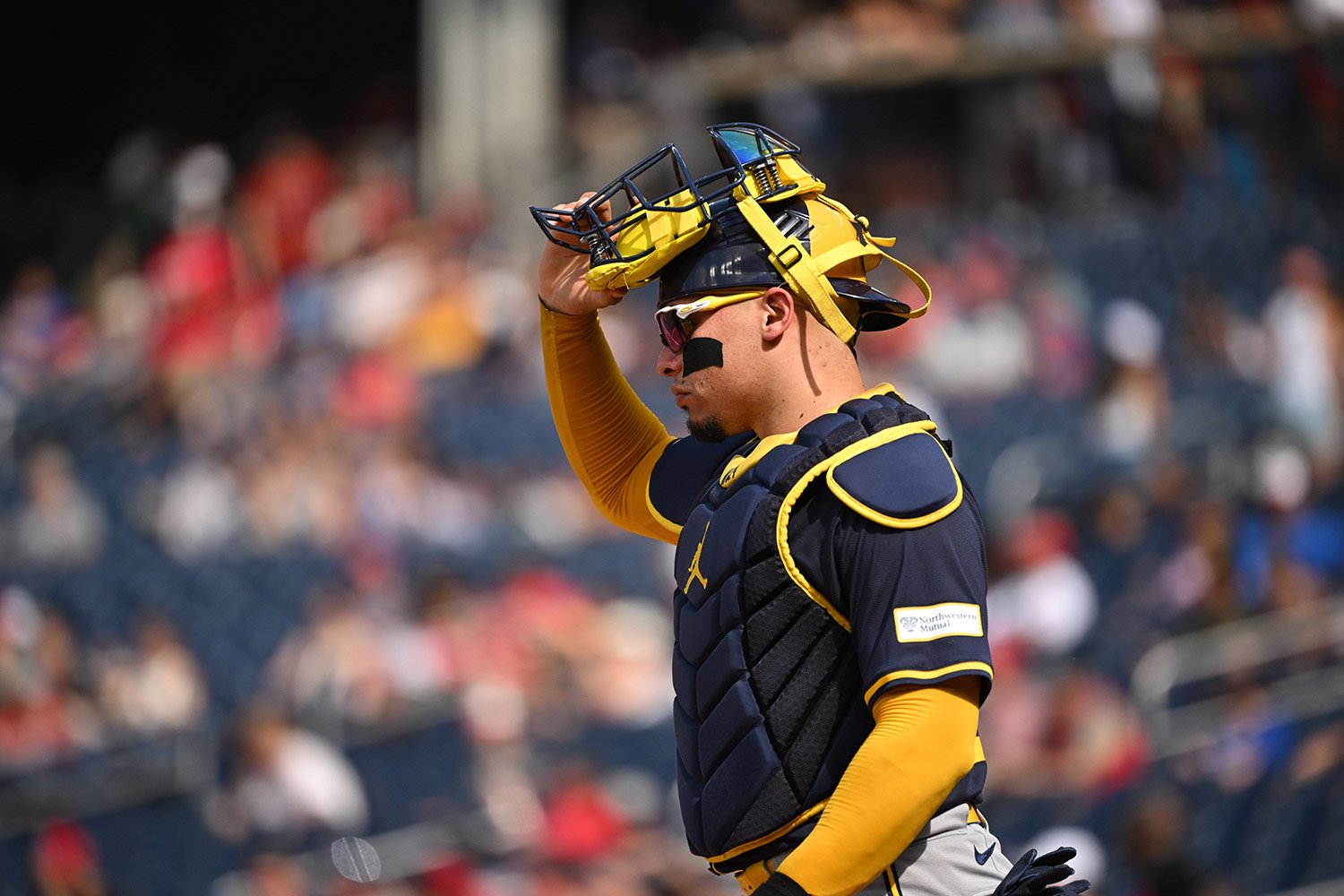
William Contreras calls fastball variations more regularly than any other catcher in baseball outside of Yasmani Grandal. And at least Grandal has the excuse of Jared Jones' and Paul Skenes' elite fastballs to justify it. Contreras has some justification in that pitchers like Colin Rea, Frankie Montas and Aaron Civale have multiple fastball variations in their arsenal but even so, for a team with a dearth of elite fastballs (outside of ace Freddy Peralta), this is an unusual trend.
Perhaps the best way to isolate whether this is a team-wide instruction or just Contreras himself is to compare him to Gary Sanchez. Where Contreras calls these so-called hard pitches 64.5% of the time, Sanchez is at a more manageable 60.4%, which would still place him sixth on the list but also closer in percentage points to the bottom half of the list than to Contreras in second place.
However, fastball calling on its own isn’t necessarily the issue so much as how Contreras doubles up on the fastball. He ranks in the top eight in the league for following one fastball variation in all counts: pitcher’s and pitcher’s counts with two strikes. Out of 71 qualified catchers, here’s where the two rank in doubling up on hard pitches:
|
William Contreras |
Gary Sanchez |
|
|
All Counts |
63.6% (8th) |
59.1% (25th) |
|
All Pitchers Counts |
56.9% (5th) |
51.8% (25th) |
|
Pitcher’s Counts with 2 Strikes |
58.3% (5th) |
54.0% (26th) |
Contreras doesn’t lead the league in any of these categories. Still, it is noticeable how often he’s doubling up on the fastball more than his counterpart behind the dish. With both in the top 30 of the 71 qualified catchers, it seems an organizational approach to be more fastball-heavy. However, those four percentage points make a big difference in effectiveness, particularly (contrary to my expectations) in non-two-strike counts.
The 2024 Milwaukee Brewers have faced over 2,500 batters this season, giving us a large sample size for the following data. When following a four-seam fastball, a sinker, or a cutter, there have been definitively different results for each category of pitch thereafter:

As you can see, following one fastball variation with another has been hit quite hard and consistently throughout the year compared to using different pitch types in those counts. The changeups and splitters have done remarkably well in creating poor-quality contact while breaking pitches have been hard-hit almost 20% less often.
It’s important to have variety in how you pitch in a multitude of counts, and as such, doubling down on pitches is essential, but for these instances to result in 64.9% of pitches ending plate appearances is quite startling.
Part of the success of the changeup comes with how often the Brewers keep it out of the rulebook strike zone at just a 29% clip following a fastball variant, but the breaking pitches are kept in the zone more often while generating more swing and machine. So, how does this play out in two-strike counts?

Interestingly, it plays out quite well. The breaking pitches are getting a little more swing and miss while fewer called strikes, but overall, both strikeout rates are quite comparable in two-strike counts. The results of balls in play are slightly misleading, and the xFIP of the breaking pitches is a good indicator of their overall success. However, it is a positive note and may be one reason the Brewers are leaning so heavily into doubling up on fastballs.
It’s one reason the Brewers have leaned into players with three different fastball variants. They intend to miss barrels with late movement, keep hitters on their toes, and ultimately get outs using their defense while keeping pitch counts relatively under control.
Frankie Montas is a prime example, and the Brewers, as predicted by Matt Trueblood, have leaned heavier on the fastball variants to achieve great success.

Increasing the usage of the cutter and sinker from Montas while pushing aside the pitch he was previously best known for, his splitter seems contrary to success; however, his cutter, sinker, and four seams have quite different movement profiles that allow him to miss a lot more bats. The four-seam, in particular, has an elite 34.6% whiff rate with the Brewers despite a fairly average movement profile, and it’s all because of how the Brewers mix within their fastball arsenals rather than mix between pitch groupings.

Despite this, I can still see a strong argument for Contreras going too far with these fastball calls, particularly given the staff's lack of fastball excellence, especially with pitchers who have just one type of fastball. The most noticeable change has been how Bryan Hudson has been called over his last three starts.
As Lucas notes, that’s an absurdly different strategy for a pitcher whose primary out pitch is an incredible sweeper. To call one in 40 pitches of action is extreme, and it may be down to Hudson feeling uncomfortable with the pitch in warming up; however, even then, you would expect more than a solitary offering even to keep the hitter honest.
It does seem to be a specific call by the Brewers to hone in on heavy fastball usage, and for some, that’s brought about some unmitigated success this season. However, there is a worry that they’re teetering on the edge of the brilliance and insanity line with Contreras behind the plate on some nights. It’s becoming a concern, and they may need to address it before the postseason begins.





Recommended Comments
Create an account or sign in to comment
You need to be a member in order to leave a comment
Create an account
Sign up for a new account in our community. It's easy!
Register a new accountSign in
Already have an account? Sign in here.
Sign In Now