


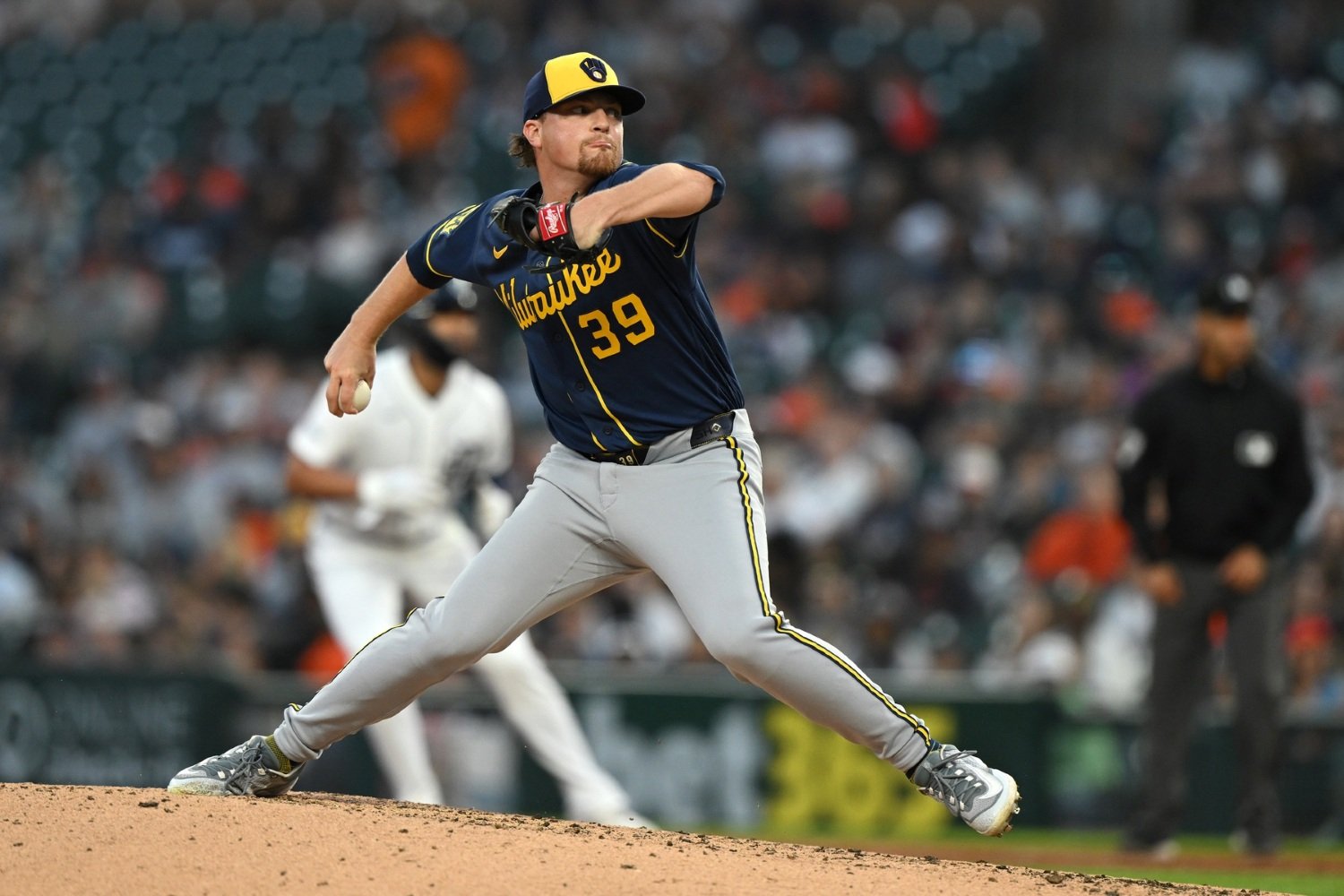
Brewers Video
Just under two weeks ago, I wrote about Chad Patrick, who has found ways to succeed this season by throwing a glove-side sinker. That's an unusual formula, because most pitches are targeted mostly to the side of the plate toward which they move, anyway. Good pitchers find a feel for throwing their pitches to multiple quadrants, but it's hard to consistently land a backdoor curveball or to move that sinker off an opposite-handed batter's front hip and find the inner edge of the zone, without having it drift into the nitro zone.
Which direction you're most likely to miss matters. Which miss direction produces a better chance of avoiding damage and/or getting a strike matters. Most of the time, those indicators nudge a pitcher toward throwing (for instance) their sinker to the arm side of the plate (inside on a same-handed batter), and their cutter or breaking ball to the glove side (toward an opposite-handed batter). Patrick's glove-side sinker was proof of his willingness to find those locations, even though it's hard to do. It also helped us understand how he seemed to be getting such harmlesss contact, and therefore putting up a great ERA despite a too-low strikeout rate.
Entering his start Tuesday night against the Diamondbacks, nothing has changed. Patrick is still running a strikeout rate straight out of the 1980s, but he has a 2.35 ERA in his 23 innings of work. Entering the season, most of the optimism surrounding Patrick centered on the notion that his new slurve would help him miss more bats. The swings and misses haven't come, but neither have the runs for opposing teams. The glove-side sinker gives us some insight on that, but it feels insufficient to explain it. Can looking at the other side of the dish bridge the gap?
.png.dcb8c5e6f09af00c0248f1ba8203a76c.png)
Patrick's bread-and-butter is his cutter, and this season, the reason he's getting outs is the way he's learned to bounce from one lane to the next with it. He's lost a few of the cutters he pulled too much last year, like this one:
With any pitch one throws with glove-side movement, it's natural to yank it occasionally. When Patrick's target with the pitch was already set toward that first-base side of home plate, it tended to show up in bounced cutters, or ones that forced a lefty batter to take evasive action or wear a bruise on the front of their thigh. When he tried to target the third-base edge with it, the result was often even worse: he would throw an accidental meatball.
He got away with the pitch above, to Victor Caratini, but too many of the home runs Patrick gave up as the season wore on were mistakes like that one.
Scroll back up and consider that pair of movement plots, though. This year, Patrick has eliminated some of those hard-sweeping cutters in favor of ones with only relative cut, for such a hard and riding pitch. He's developed a version of the pitch he can allow to slightly move to the arm side, while still looking to the hitter like his cutter. It's opened up the arm side of the plate for him with the cutter, marking a neat and confounding pair with his glove-side sinker skills.
When he can hit the target that well on either side of the plate, the cutter becomes an out pitch—even, as above, occasionally a strikeout pitch. However, it can also be a sneakily valuable way to get back into at-bats. Here's Patrick working from behind in the count, with a pitch Andrés Giménez was never going to swing at.
It's possible to consistently generate a low BABIP and take the sting out of even modern lineups. To do it, though, you have to be able to move the ball east and west and get hitters into a defensive mode. Mixing an unusual set of glove-side sinkers with arm-side cutters has been the secret sauce for Patrick. That doesn't mean he can keep it up, for sure. To feel more confident about that, you'd want to see more strikeouts. However, while his run prevention continues to outpace his peripherals, this dynamic helps us understand how.
Few pitchers are willing to make such a significant change to their go-to pitch. Patrick has been unusually flexible with his. He's changed the whole spin profile of his cutter this year, turning it from a pitch that had more glove-side spin to one that often has closer to pure backspin. He gets cut using his low arm angle, seam orientation and the position of his hand at release. Look at the distribution of his pitches by type based on initial spin direction (on the left) and on observed movement (right), and you can see a change in the starting point and in the diversity of directions the cutter can veer this year.
.png.a096b21f826bfa7d31f1fe38b823010e.png)
Patrick's four-seamer plays better off this version of his cutter, because they look similar a hair longer and the four-seamer can seem to explode on hitters more than its sheer speed or movement would suggest. Again, though, the main benefit is that this tweak to his cutter allows Patrick to work both sides of the plate with it. He hasn't lost the glove side; he's just unlocked the arm side.
He still won't live there with that offering. When he needs to go there, though, he can do so with much more confidence this year than last. That does make a real difference. Unlike most pitchers of this era, who live by the power and the sheer traits of their pitches and stick to a small target area for each offering, he's embracing the old-school notion of using the whole zone with his hard stuff. He had better miss more bats, if he wants to keep his ERA under 3.00. For now, though, this new wrinkle makes him a more complete and balanced pitcher, and a fun one to watch.
Which team do you dislike the most in the NL Central?

Follow Brewer Fanatic For Milwaukee Brewers News & Analysis



-
 1
1


Recommended Comments
Create an account or sign in to comment
You need to be a member in order to leave a comment
Create an account
Sign up for a new account in our community. It's easy!
Register a new accountSign in
Already have an account? Sign in here.
Sign In Now