


Brewers Video
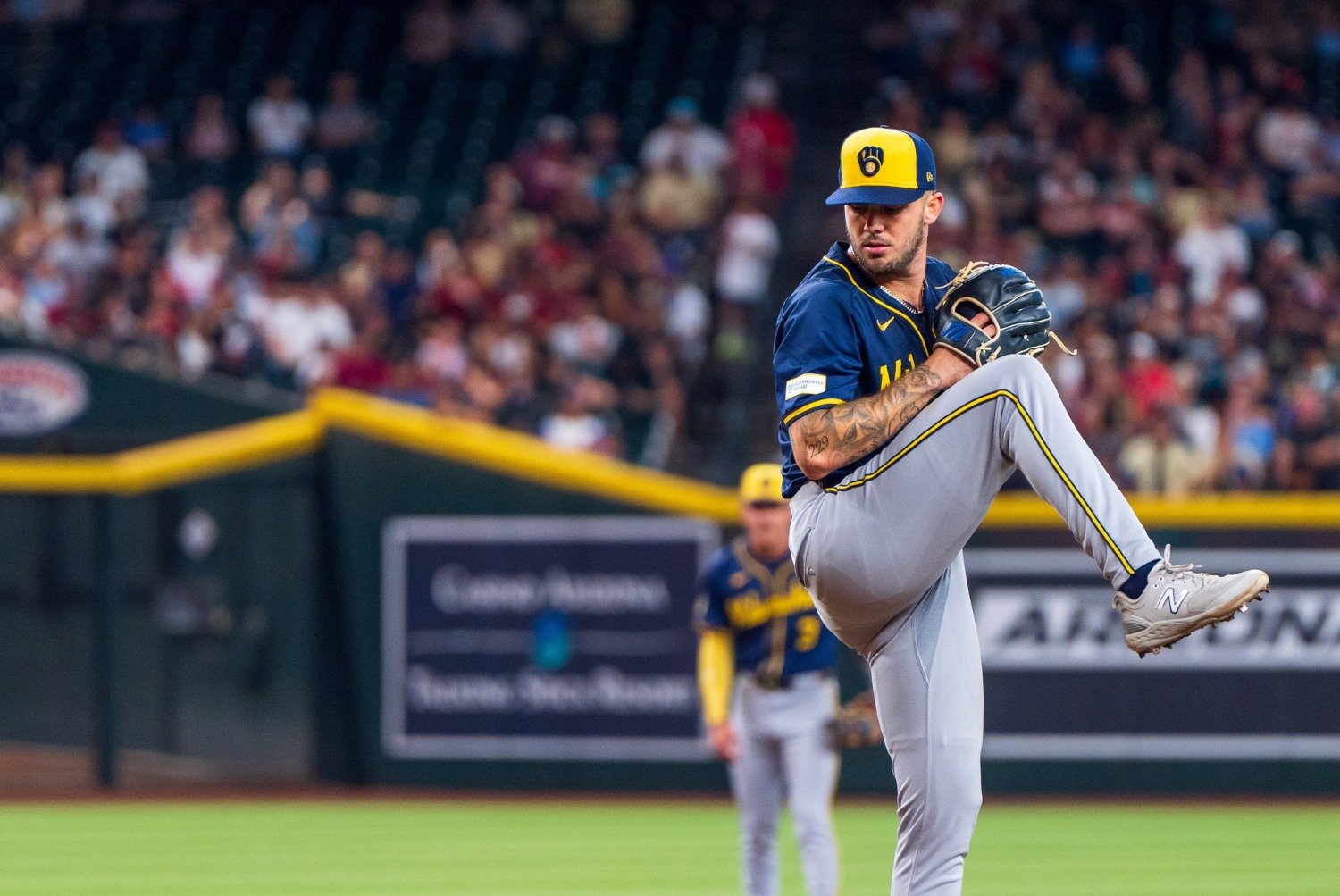
After a difficult start to his Brewers career (consisting of a 7.71 ERA in four injury-marred starts and a three-month rehab filled with speed bumps), DL Hall ended his season on a positive note. In 26 2/3 innings after returning to the big leagues in August, Hall pitched to a 3.38 ERA, 3.28 FIP, and 27.4% strikeout rate.
It was undeniably a step in the right direction. So, too, was Hall’s average fastball velocity jumping from 92.3 mph before his lengthy IL stint to 94.3 mph after his return. That was still a few ticks shy of the upper 90s he consistently flashed as a full-time reliever for the Baltimore Orioles, but it’s where one would expect to see him sit in a bulk role.
However, despite the velocity nudge, Hall’s fastball remained uninspiring in most aspects. It’s concerning, because the heater was billed as his signature pitch when the Brewers acquired him as part of the trade package for Corbin Burnes. In parts of two big-league seasons before the trade, Hall’s fastball induced whiffs on 28% of opponents' swings. In 2023, FanGraphs tagged it with a 70 grade on the 20-80 scouting scale.
At no point during his inaugural season in Milwaukee—before, during, or after injury—did Hall’s fastball resemble a 70-grade pitch. While it avoided barrels down the stretch, it hardly overpowered opponents. Despite the increased velocity, its whiff rate barely improved and remained well below the league average of 22% for four-seamers.
The fastball’s appearance to hitters was still unremarkable. It gained 1.5 inches of induced vertical break but remained short of its average with Hall’s previous team. As such, his vertical approach angle (a measure of the steepness at which a pitch crosses the plate) remained higher and matched that of the league-average four-seamer. Pitch modeling metrics continued to view it as a suboptimal fastball.
| Split | Stuff+ | Velo | Perceived Velo | IVB | VAA | Exit Velo | Hard Hit% | wOBA | xwOBA | Whiff% |
| 2022-2023 | 117 | 95.8 | 97.0 | 15.8 | -4.23 | 81.7 | 13.9% | .294 | .280 | 28.0% |
| 2024 (pre-IL) | 55 | 92.3 | 93.2 | 13.2 | -4.92 | 87.0 | 43.6% | .485 | .434 | 10.5% |
| 2024 (post-IL) | 86 | 94.3 | 95.3 | 14.8 | -4.67 | 82.4 | 33.3% | .408 | .340 | 14.1% |
At its best, a combination of factors—velocity, spin-induced carry, a deceptive delivery, and keeping the ball at the top of the zone—made Hall’s fastball challenging for hitters to reach, producing whiffs and pop-ups. In 2024, he never captured the right mix of variables to recreate anything close to the fastball that enticed the Brewers nine months ago. Instead, it was a flat fastball against which hitters could easily make productive contact.
If those numbers and jargon sound like a mouthful, here’s the concise version: Hall’s fastball was terrible in his first four starts and mediocre down the stretch. It was never close to a 70-grade pitch. Instead, it exhibited many traits of a very hittable fastball.
An entire offseason to work with Milwaukee’s pitching development staff could prove transformational for Hall, who joined the organization just two weeks before pitchers and catchers reported for spring training in February. Perhaps some mechanical tweaks to his lower half and release, along with continued recovery from the MCL damage in his left knee, will restore more of the life and deception his heater once boasted.
If not, the Brewers may have to concede that Hall is not the pitcher they thought they were getting. If his fastball remains below average in a bulk role, it lowers his ceiling and impacts what role he’ll fill moving forward.
If Hall’s fastball only assumes its effective form in short spurts, the Brewers may convert him to a full-time relief role. He's been effective in that capacity before and still presents high-leverage upside. There remains a path for him to be a useful starting pitcher, though. It’s just different and less exciting than the original road map.
In its current incarnation, Hall’s fastball is the weak link in his arsenal as a starter. Instead of building his game around it as initially expected, he must do the opposite, fashioning his approach to mitigate its limitations. That means relying heavily on his secondary pitches.
Hall’s curveball, slider, and changeup all graded well in 2024 and combined to hold opponents to a .260 wOBA and 33.7% whiff rate, while accounting for 33 of his 44 strikeouts. Under this framework, Hall would mix and match with a full arsenal to protect his four-seamer, a strategy the Brewers have successfully enacted for innings-eaters like Colin Rea, Aaron Civale, and Bryse Wilson.
Hall used such an approach in several of his games down the stretch. In four bulk appearances after his return (three traditional starts and a four-inning relief outing), 60% of his pitches were non-fastballs. He was largely effective in those games, posting a 2.89 ERA, 3.07 FIP, and 30.4% strikeout rate. It was a stark contrast from his first four starts, in which he used his fastball about 50% of the time.
The soft- and spin-heavy approach would carry limitations. Hall’s slider and changeup profile best as chase pitches off the plate, and he threw both pitches in the zone less than 40% of the time in 2024. That leaves his curveball as his remaining “land for a strike” pitch to get ahead in counts, and too many curveballs left over the plate can spell disaster. Protecting the four-seamer may require Hall to develop another fastball variant (a cutter or a two-seamer) he can use within the strike zone to set up breaking balls in two-strike counts.
Either way, Hall lacks top-of-the-rotation upside if he does not have a good enough fastball to use aggressively against most opponents. Instead, he’d be an unexciting back-end bulk arm, like Rea, Civale, and Wilson. Recent Milwaukee staffs have showcased how valuable such pitchers can be, but the Brewers were likely hoping for much more when they scouted and acquired Hall.
Matt Arnold said two weeks ago that the club has not decided on Hall’s role for 2025. The best choice is probably to have him prepare as a starter over the offseason and through spring training. If his fastball does not make strides during that time, the organization will find itself at a crossroads with a once-promising left-hander whom they originally slotted behind Freddy Peralta in last year’s rotation.





Recommended Comments
Create an account or sign in to comment
You need to be a member in order to leave a comment
Create an account
Sign up for a new account in our community. It's easy!
Register a new accountSign in
Already have an account? Sign in here.
Sign In Now