


Brewers Video
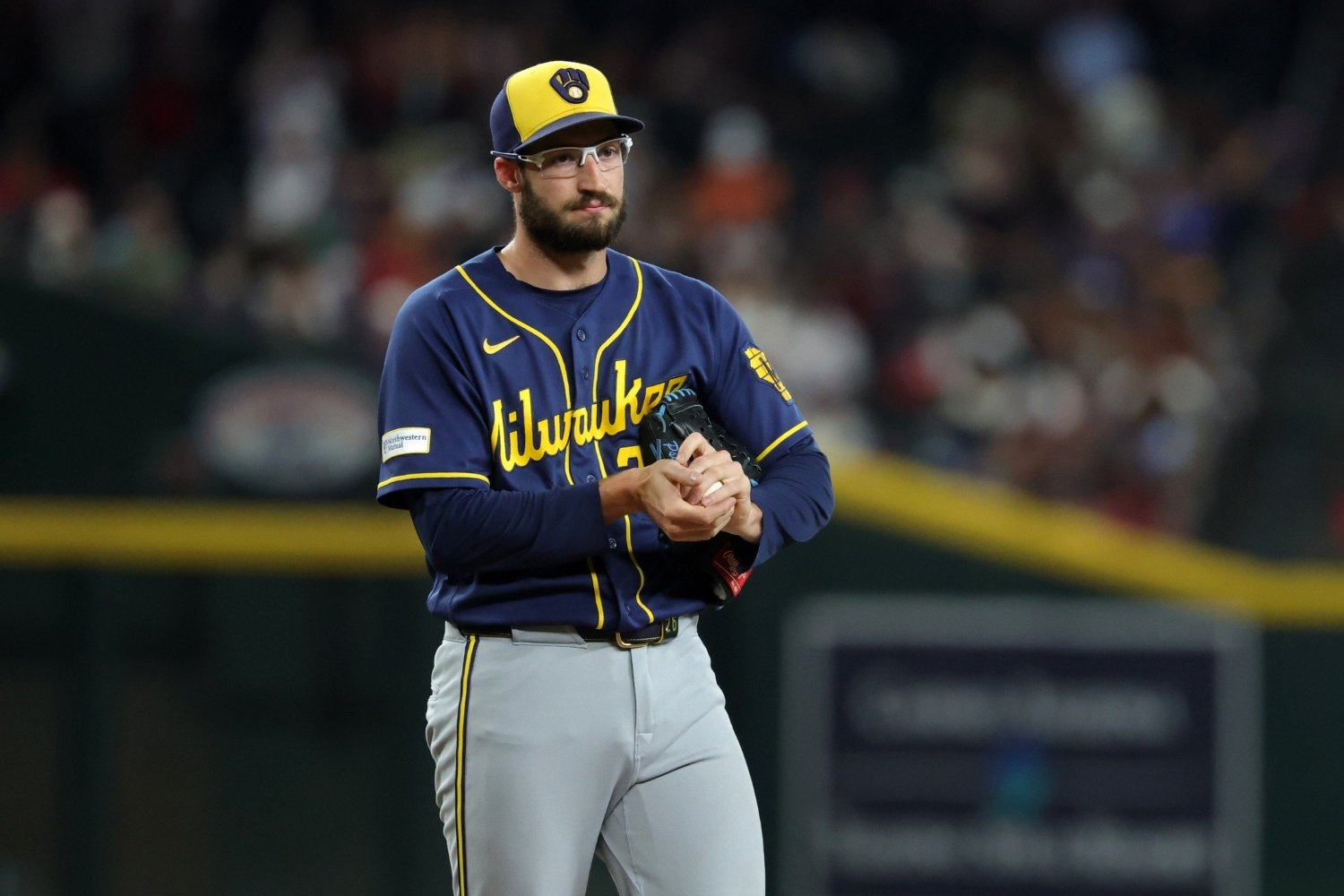
Aaron Ashby has one of the strangest arsenals in the majors, and hitters have looked as uncomfortable against him as they have against just about anyone else. He threw 66 2/3 innings last year, often in multi-inning relief, to the tune of a 2.16 ERA with some of the bendiest pitches you'll see. Ashby has no trouble moving the baseball both ways, a rare commodity. Pitchers usually have a supination or pronation bias that makes it hard for them to move the ball significantly to one side. At high velocity. It's tantalising how close to perfect his pitch mix is from a sheer stuff perspective.
One of his biggest strengths is his ground-ball rate. A pitcher who can generate both strikeouts and ground balls at above-average rates has a lot of advantages in modern baseball, and that pair of skills has been a key factor in Ashby being "effectively wild". Keeping the ball on the ground, Ashby has always been capable of inducing a double play, so even if a hitter does get a free pass, he has a chance to wipe that runner out with a single pitch. That's key, because so far this season, Ashby's ground-ball rate on his primary fastball has decreased sharply. That's directly tied to his results. It's also something the Brewers seem to value, as Abner Uribe, Ashby and Ángel Zerpa all placed top 10 among relief pitchers in double plays induced in 2025.
How Ashby maximized his arsenal is quite different from the traditional methods. The first big difference is his extension, which ranks among the lowest in baseball. With hurlers like Jacob Misiorowski, getting as close to the hitter as possible before releasing the baseball allows the velocity to play up, while also giving the ball less time for gravity to affect it and cause it to drop.
That's a key difference here. Where someone leaning on a four-seam fastball wants to create as much "rise" as possible, a pitcher with a true sinker (not a two-seam fastball, but a genuine bowling-ball sinker) would want the ball to drop as much as possible to get below the barrel of the bat. This same principle applies to breaking pitches and off-speed pitches, trying to get them dropping at as steep a rate as possible by the time it reaches the plate. You can see in the graph below how the shorter a pitcher's stride is, the steeper their vertical approach angle is on a sinker. (Ashby is highlighted.)

The correlation in the graph above isn't quite as exaggerated as I would have thought. It's distorted slightly by the amalgamation of two seamers and sinker fastballs into one pitch category. I dare say if they were separated, the line of best fit would be even steeper here, and a more direct correlation.
There are some nuances within this. Ideally, you want that downward movement to be as steep as possible when it reaches the plate, but also to be breaking as late as possible, or at least at a similar time to the rest of a pitcher's arsenal. It creates extra deception, and prohibits a hitter from aligning his barrel to the pitch mid-swing.
Has his Sinker Changed Shapes?
Ashby's velocity allows him to manage the reduced "perceived velocity" (how fast the pitch actually looks to a hitter, due to the extension) that comes from him releasing the ball over a foot farther from home plate than the MLB average, and lets his raw movement come to the fore. With each of those pitches having a foot further to travel before reaching home plate, the movement he generates is exaggerated. Again, if we refer to the graph above, Ashby is considerably below the line of best fit; his vertical approach angle (VAA) is -0.69° steeper than an expected offering from his extension and release point. That might not sound like much, but it's significant, when the goal is to square the round ball on a round bat.
Fast-forward to this year, however, and that VAA has dropped slightly, to -0.60° vs expected—not a massive change, but a notable one. If we compare Ashby's pitch shapes to last year, two small differences are perhaps combining to limit the drop Ashby is getting on his sinker:
.png.b2219aeb7117c2382b05a6791f22c66a.png)
While Ashby's release height is the same distance from the ground, he's actually striding a little closer to home plate, with his extension jumping from 5.3 ft to 5.5 ft this year. Extending farther down the mound would lower the release height, but this has been offset by Ashby throwing from a slightly higher arm slot. A few degrees of difference here and there aren't usually anything to worry about, but combine the increased extension with the higher arm angle, and you have aslightly less heavy sinker.
That being said, these aren't massive changes. Ashby is getting less vertical drop on his fastball this year, but it's not necessarily because his angle has changed. Instead, let's take a look at the seam-shifted wake, or non-magnus movement on the pitch (if you'd like to understand this phenomenon a little more, I covered the types of movement a baseball has this winter, here):
.png.259e218f43d0781011a66ae1326c2b1e.png)
Pitch Profiler does a fabulous job of separating spin-related movement from non-spin related movement. The shaded circles are where a pitch would be expected to move based on the release traits and characteristics, while the circle outline is where the pitch actually moved. As you can see with Aaron Ashby, both his sinker and changeup drop significantly more than expected. The sinker dropped 4.6" in 2025 more than expected while the changeup dropped 4.9" more than expected. If you want to know why Aaron Ashby has historically been so effective with his sinker, that's the primary reason right there. Good luck elevating either of those two pitches with any regularity.
Fast-forward to this year, and the seam-shifted wake has reduced the drop he's getting on both of these pitches. This calculation accounts for his change in arm angle, and still suggests that Ashby has lost just shy of an inch of seam-shifted wake "drop" in 2026. Again, that may not sound like much, but it's the difference between a barrel and a ground ball.
.png.6170c71fcda8d5ee21f8ae375306f80b.png)
Is Fatigue Hurting Ashby?
These little changes have reduced Ashby's effectiveness slightly this year. He can find ways to stop hitters from sitting on his sinker, whether that means more early-count curveballs (one of the most taken pitches in the league for a first-pitch strike) or mixing in more changeups to keep hitters off the speed of his sinker. The problem is that he's also been struggling to command his entire arsenal this year. Ashby's "edge" percentage—the share of his pitches thrown on the edges of the strike zone—has dropped from 43% to 38%, and hitters are making a lot more contact in zone. His in-zone swing-and-miss rate this season is less than 12%.
On top of that, he's throwing just 43% of pitches inside the strike zone this year, compared to 50% last year. Hitters are being patient with him, working counts, and Ashby has struggled to find the zone often enough to counteract this approach. While we may think this is fatigue, actually, it's been a consistent problem in 2026, and wasn't an issue at all in 2025 with a steady 60% in-zone rate on his sinker and a 55% in-zone rate on his changeup. Looking at the year-on-year changes:
.png.e2c56b14929c1be1d8d6d0a34c98f511.png)
Ashby isn't establishing his sinker as well in 2026, and he's keeping the changeup out of the strike zone at an alarming rate compared to his career norms, which is one of the pitches best suited to protecting his fastball.
So in short, Ashby's made some small changes that are having a big impact in 2026:
- He's got more extension and a higher arm angle; these are both affecting his vertical drop on the sinker.
- He's not getting the same seam-shifted wake from his new release point, again leading to less vertical drop than he's previously been getting
- Most critically, Ashby has lost both control and command of his pitches. He's finding the zone less with his sinker and changeup, two pitches he relied upon to protect each other, and it's letting hitters see the sinker more and wait on it, creating less ground balls than usual.
How Ashby approaches the second half of 2026 will be fascinating. Can he find the command needed to lead the bullpen through October? Or will he continue to be up and down, with flashes of brilliance interspersed with flashes of mediocrity? This one factor could go a long way toward determining the Brewers' success or failure this season.
Do you approve of Brewers' ownership?

Follow Brewer Fanatic For Milwaukee Brewers News & Analysis



-
 1
1


Recommended Comments
There are no comments to display.
Create an account or sign in to comment
You need to be a member in order to leave a comment
Create an account
Sign up for a new account in our community. It's easy!
Register a new accountSign in
Already have an account? Sign in here.
Sign In Now