


Brewers Video
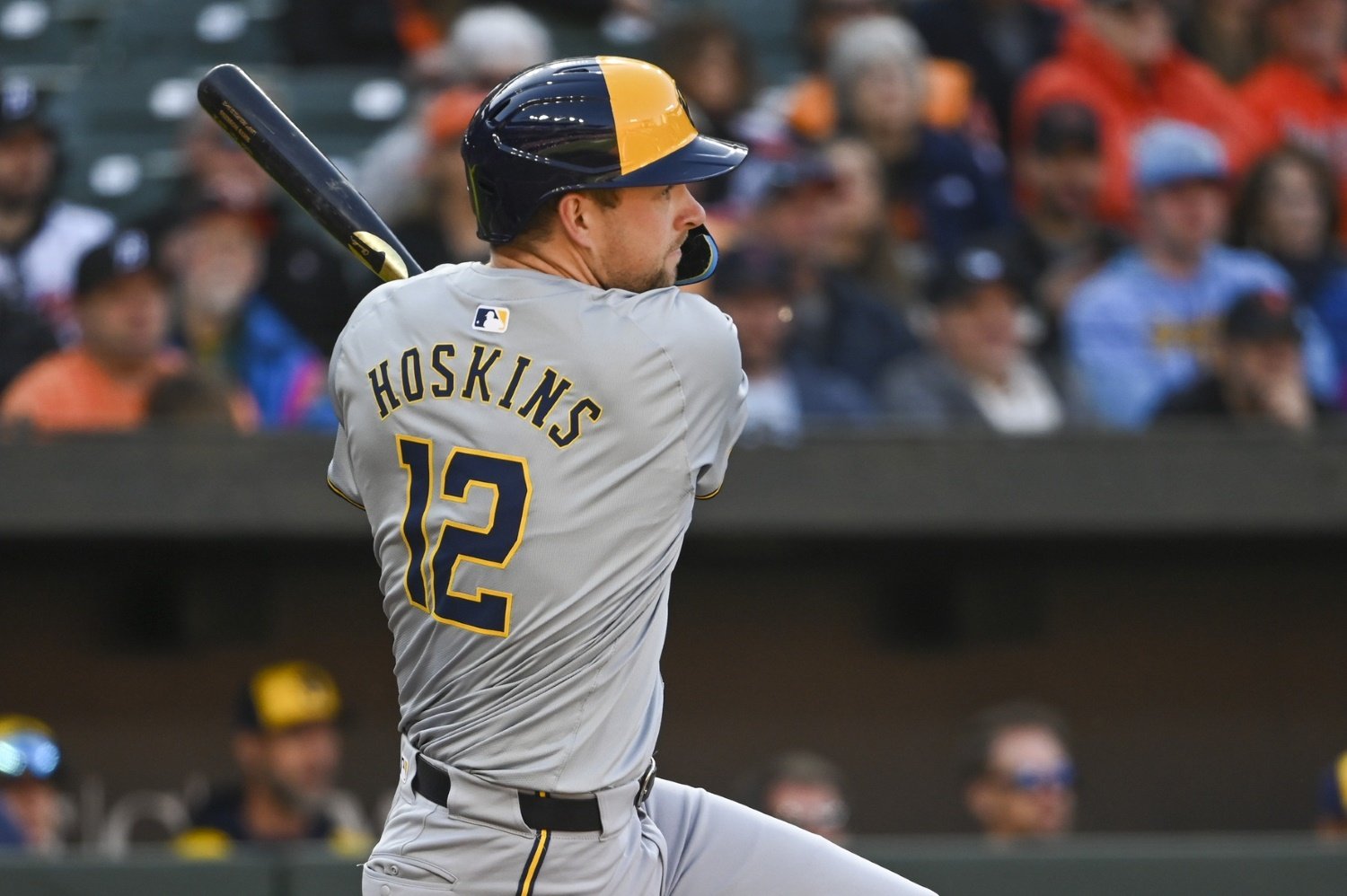
No player is more important to the Milwaukee Brewers' lineup at the moment than the man to whom they committed $34 million this winter. His numbers aren't pretty so far, but that's about to change.
It hasn't been a thunderous start for Rhys Hoskins. His Opening Day entanglement with Jeff McNeil immediately endeared him to Brewers fans, especially because he went on to have a strong first series both in New York and at home against the Twins. Since those first five games, though, Hoskins is hitting .192/,259/.365. He's cracked two home runs and three doubles over that span, but not much is falling in for him, and even this early, that hot start is no longer propping up his overall numbers.
Even the simplest batted-ball data tells us that will correct itself. Hoskins's expected batting and slugging averages on Baseball Savant exceed his actual ones, and his 113 DRC+ at Baseball Prospectus plants him safely north of average. Drill even further down, though, and you find evidence that Hoskins is doing just about everything right. He's not just going to shrug this off. He's going to blast it away, if he keeps doing what he's already doing.
Hoskins's average exit velocity and hard-hit rates are below-average so far. That's discouraging, because he's a power hitter. That's his game. If he's not hitting the ball harder than most people or hitting it fairly hard more often than most people, it's hard for him to sustain above-average value, despite his good patience. He's minimized his strikeouts well so far, but he'll never be elite at that, and anyway, he doesn't have the speed to make much use of singles, let alone ground balls that only become singles if a runner puts pressure on the defense.
Unadjusted averages of batted-ball data can be misleading, though--especially early in seasons, when the samples are small. I created three new ways to break down and understand that data, and each tells us a bit about where Hoskins is right now. Let's take a look at them.
Hard-Hit Launch Angle
This turned out to be a less powerful predictor of overall production than I anticipated, but it's a helpful qualitative reminder to us. For every player, I found the average launch angle not of all his batted balls, but only of those he hit at least 95 miles per hour. This answers the question of whether a hitter is doing real damage when they hit it hard, because someone like Sal Frelick (3.3 degrees), Blake Perkins (3.4) or Brice Turang (0.7) is not actually posing a threat to opposing pitchers even on most of their best exit velocities.
As you'd probably guess, Hoskins is about as unlike that trio of his teammates as you can be, in this regard. His hard-hit launch angle so far this year is 26.5 degrees. Of the 257 batters who have come to bat at least 50 times so far this year, only five (Joey Gallo, Eddie Rosario, Tyler O'Neill, Mike Trout, and Max Muncy) have a higher HHLA than Hoskins's. That's not all good news. While Trout, Muncy, and the home run machine that has been O'Neill hint at which end is better to occupy, the best place to fall on this spectrum is nearer the middle. Hoskins has already made a handful of loud outs because he hit it a tad too high, or not quite hard enough for that trajectory.

Still, this is encouraging. Some of those gray dots will turn blue or red in the warmer air of summer, or in some park more accommodating than Camden Yards or Citi Field. The news only gets better from here.
Sweet Spot Exit Velocity
Flipping the previous concept on its head a bit, I also stripped out all batted balls except those hit within the launch angle band (I chose 10 to 35 degrees) within which well-struck balls tend to be most valuable, then found the average exit velocity on them--rather than taking sheer exit velocity or the percentage of all batted balls hit hard, regardless of launch angle. In short: when you get on plane with the ball and hit it on a line or on the dangerous kind of fly-ball trajectory, how much juice do you put behind it?
This metric better correlates with overall production than does clustering launch angles on well-hit balls, for a couple of reasons. Hoskins does a bit less well by it, because he's a bit more of a launch angle guy (meaning he consciously works to find that good fly-ball launch angle, even if it means hitting the ball 103 miles per hour instead of 108) than an exit velocity guy. Still, he scores well so far. His 95.8 SSEV would be tied for the second-best mark of his career to date, alongside his electrifying rookie campaign in 2017, and 1.3 miles per hour behind 2021, the best full year of his career in terms of actual value.
Hoskins ranks 55th of the aforementioned 257 hitters in SSEV. It's not our focus right now, but for the record, William Contreras leads MLB, at 102.5. Not only that, but the gap between Contreras and second-place Juan Soto is larger than that between Soto and 11th-place Seiya Suzuki. Contreras (unsurprisingly, to Brewers fans) has a single-digit HHLA, but when it comes to hitting balls hard within that launch angle span, no one is better so far in 2024. Contreras is a legitimate MVP contender.
Weighted SSEV
Finally, I sought a way to at least acknowledge the necessity of an interaction between these two pursuits. A good SSEV is valuable, but it becomes more so if the hitter also tends to hit more of those sweet-spot batted balls in the first place. Thus, I created a version of SSEV that weights that number for the frequency with which a hitter makes contact in the 10-35-degree launch angle window. This ends up being similar to Barrel Rate, but it bears some important differences, and based on data from 2015-23 for hitters with at least 250 plate appearances in a given season, it's more predictive of overall production (wOBA) than Barrel Rate is.
Here's where Hoskins really shines. He ranks 23rd in wSSEV in 2024, at 92.8. It's too early to say that that number will hold, but if it does, it'll be the highest of his career. The only other seasons in which he's been north of 88.0 in wSSEV are those halcyon campaigns of 2017 and 2021. The league leaders in wSSEV for 2023 were Corey Seager, Luis Arráez, Mookie Betts, Ronald Acuña Jr., and Aaron Judge. For 2024, the early leaders are Shohei Ohtani and Marcell Ozuna. This metric nicely captures overall dangerousness at the plate, by blending the ability to hit the ball hard when elevating it with the ability to square it up and avoid either slamming the ball into the dirt or popping up helplessly.
Hoskins, though not yet being fully rewarded for it, is doing just that. He's also putting the ball in play more often (a fact reflected by wSSEV, since it takes total plate appearances as the denominator in the calculation of sweet-spot contact frequency), and his discerning eye and bat speed have both survived the year he lost to his knee injury. Very soon, he'll break out, and the Brewers will have the more consistent power source their lineup still needs.
Which team do you dislike the most in the NL Central?

Follow Brewer Fanatic For Milwaukee Brewers News & Analysis



-
 2
2



Recommended Comments
There are no comments to display.
Create an account or sign in to comment
You need to be a member in order to leave a comment
Create an account
Sign up for a new account in our community. It's easy!
Register a new accountSign in
Already have an account? Sign in here.
Sign In Now