


Brewers Video
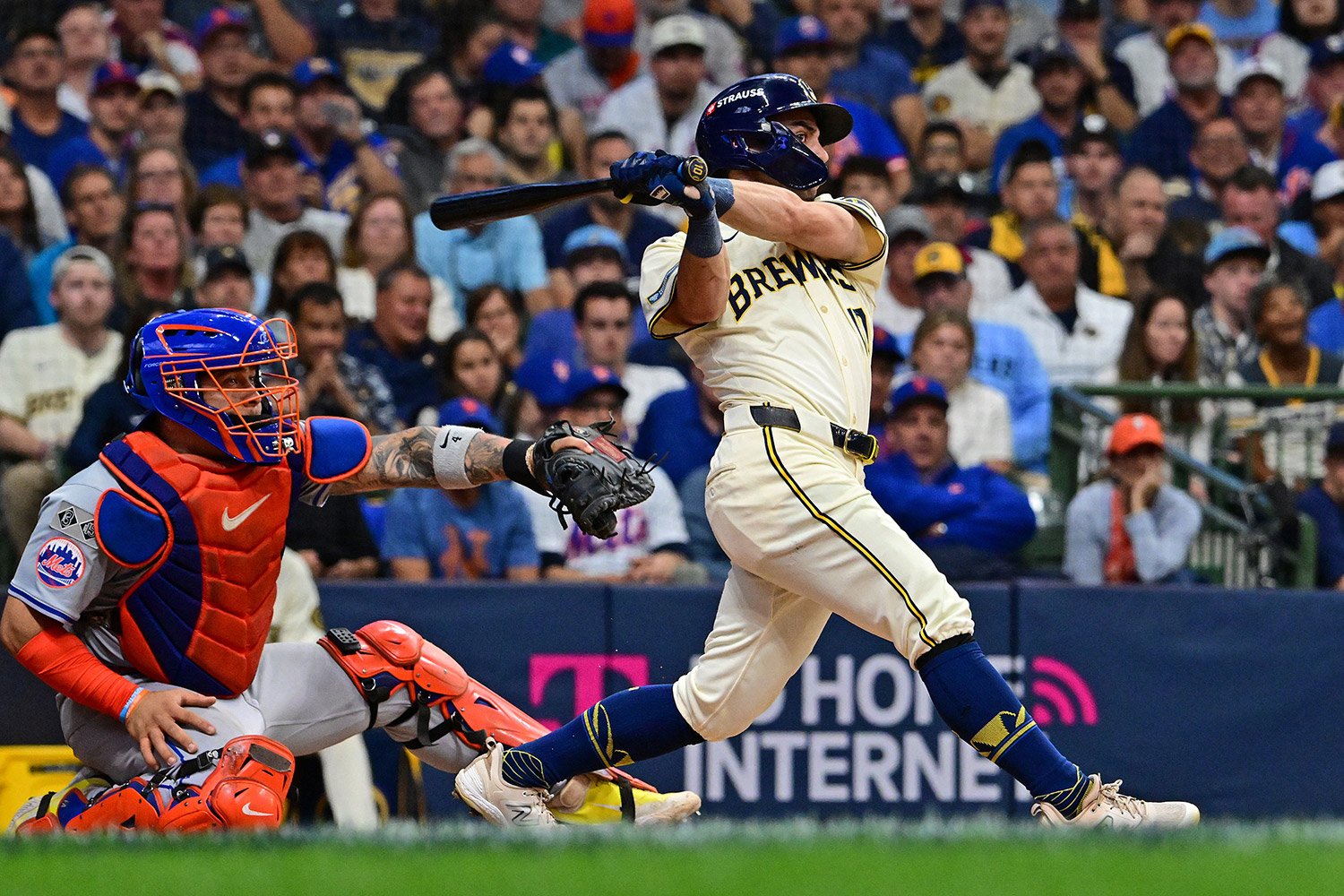
Sal Frelick’s improbable home run in Game 3 of the Wild Card Series didn’t just inspire brief hope for the Milwaukee faithful. It was also a monumental moment for Frelick himself because it was the first time he showed an extra gear of strength that had been absent from his big-league portfolio until that swing.
Heading into the postseason, Frelick’s highest exit velocity on a batted ball was 106.6 mph. The home run left the bat at 107.6 mph. It was also the farthest ball he ever hit, traveling 408 feet for his first no-doubt home run.
It was the result of Frelick unleashing one of the most violent swings of his career. His bat speed was 76.3 mph, his 10th-fastest tracked swing ever. It was also his 10th-longest hack, with his bat head traveling 8.5 feet from his first movement to his point of contact.
It was uncharacteristic of Frelick, whose swing is typically among the most compact in baseball. His average swing speed of 66.3 mph during the 2024 regular season was the seventh-lowest among 214 qualified hitters, and his swing length of 6.9 feet was the 27th-shortest.
Here’s what an average Frelick swing looks like.
Here’s his cut on the home run ball. The eye test alone says that it’s a vastly different swing.
Frelick had shown fleeting glimpses of it before, but his home run was the most prolific illustration that he can swing harder and connect more authoritatively with the ball than he typically has. That particular swing is on the higher end of his ability and not consistently replicable. It should, however, help encourage Frelick and the Brewers to concede some of his compactness through the zone for a couple of extra ticks of bat speed.
While not strongly correlated across hitters, bat speed and swing length are tied together mechanically. Hitters do not swing slowly by design; it’s a byproduct of getting to the ball as directly as possible. Conversely, the more bat speed a hitter wishes to produce, the longer his bat path must be to generate the necessary whip through the zone.
In the first clip, Frelick takes a truncated slash at the ball. In the second, he unloads on a first-pitch fastball with a longer and more explosive swing. The bat head has plenty of momentum behind it at the point of contact.
It’s no coincidence that many hitters with baseball’s fastest swings – including Giancarlo Stanton, Aaron Judge, and Oneil Cruz – stand six-and-a-half feet or taller. They’re strong athletes with long levers; swinging hard with a longer whipping motion through the zone is their best path toward production. Meanwhile, three-time batting champion Luis Arraez stands under six feet tall and has baseball’s slowest and shortest swing.
As a smaller hitter with shorter levers, excellent bat control was always Frelick’s calling card as a prospect. Being so short to the ball has allowed him to get the barrel to it regularly in the big leagues. Statcast considered 31.7% of his contact in the regular season to be “squared-up,” which placed him in the 92nd percentile of hitters.
To keep the explanation brief, that means that on roughly one-third of his batted balls, Frelick generated at least 80% of the possible exit velocity based on the speeds of the pitch and his swing. In layperson’s terms, because his short swing is so precise, he meets the ball at a good spot with his barrel at an elite rate.
Unfortunately, that’s not as beneficial when the barrel is not meeting the ball with much authority. Despite an elite squared-up rate, Frelick finished the year with the worst hard hit (19.7%) and barrel (0.7%) rates among qualified hitters. He slugged .500 with a .141 ISO on squared-up contact. Those respective figures ranked 366th and 388th among 419 hitters who squared up at least 50 batted balls during the regular season. The average hitter slugged .681 with a .303 ISO on squared-up contact.
Frelick’s current combination of swing speed, path, and length has not proven productive in the big leagues. Through 747 regular-season plate appearances, he has posted an underwhelming 88 wRC+.
He could achieve above-average offense by taking his current approach to an even greater extreme and becoming the next Arraez. That’s not a tenable route, though. Arraez is an outlier with irreplicable bat control.
Frelick’s best course of action is to swing harder. That doesn’t mean maxing out his bat speed on every swing to recreate his postseason home run. For a hitter of Frelick’s build, chasing the long ball will only lead to frequent pop-ups and routine flyouts. He needs a better balance of bat control and bat speed to shoot hard line drives into gaps for doubles and triples.
There was no public bat-tracking data during his minor-league career, but Frelick’s results during that time pointed to a hitter whose swing had that proper balance. He hit 11 home runs and 28 doubles in 562 minor-league plate appearances in 2022.
Frelick shouldn’t overhaul his identity as a hitter. Misguided attempts to become a power threat would likely tank his floor and could cause his offense to crater. Instead, he and the Brewers should be willing to experiment with some give-and-take within the framework of his strengths.
That means swinging a little harder more often, even if it means adding a bit of length to his swing and conceding his ability to fight off certain pitches late in their trajectory. Frelick can still be a solid bat-to-ball hitter while adding a couple of ticks to his average swing speed. If he meets the barrel a little less but hits the ball harder, it would be a worthwhile tradeoff.
Do you approve of Brewers' ownership?

Follow Brewer Fanatic For Milwaukee Brewers News & Analysis



-
 1
1


Recommended Comments
Create an account or sign in to comment
You need to be a member in order to leave a comment
Create an account
Sign up for a new account in our community. It's easy!
Register a new accountSign in
Already have an account? Sign in here.
Sign In Now