


Brewers Video
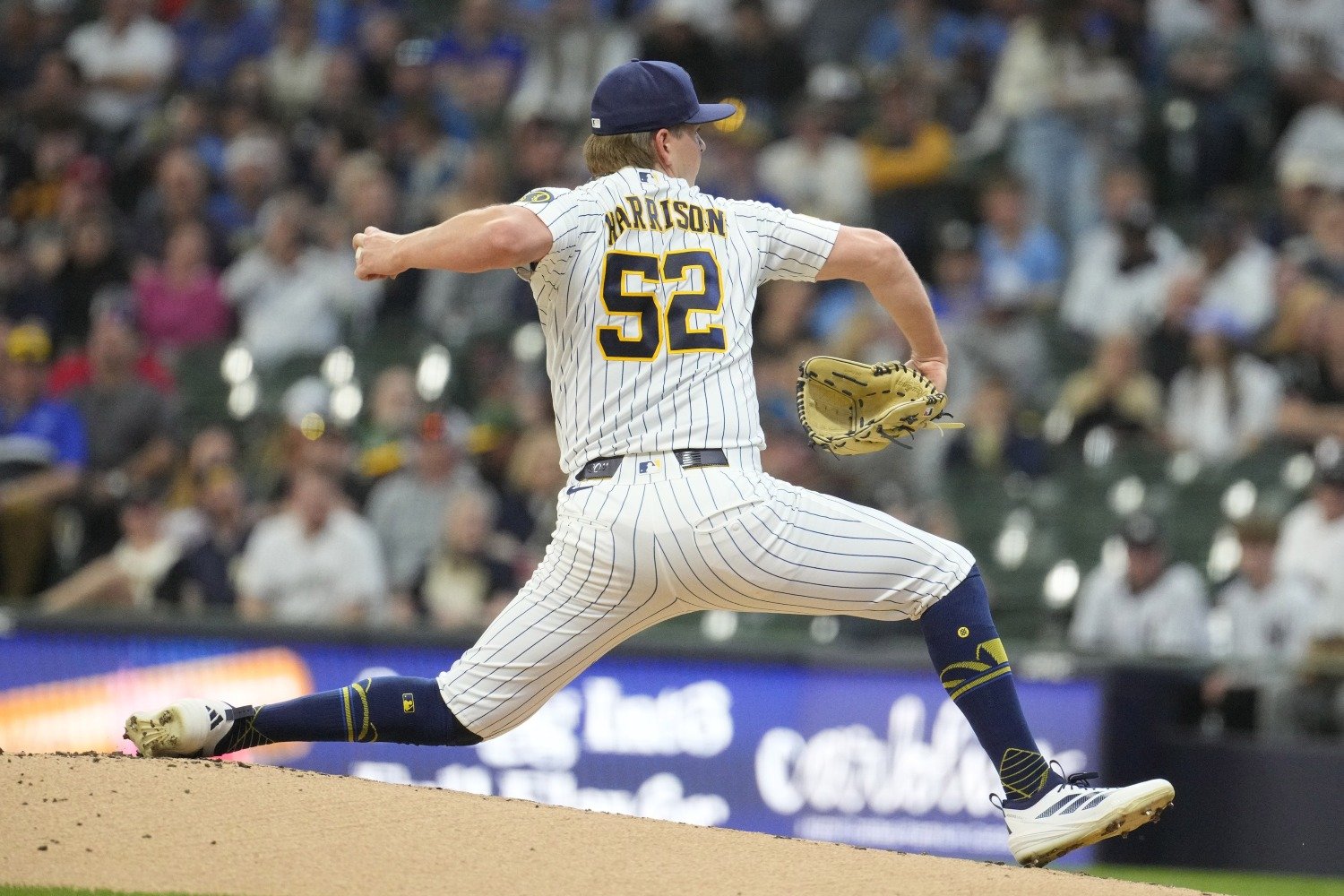
When people ask Chris Hook about Kyle Harrison, he talks up the fact that Harrison has a low arm angle. He says it gives his pitches deceptive movement, especially when he can find lift on his fastball. But Harrison had a low arm angle (27°) last year, when he was an up-and-down guy and was traded from the Giants to the Red Sox. He had an even lower one (24°) in 2024, when he pitched to a 4.56 ERA in the pitcher-friendly environs of San Francisco. In fact, you know what? His arm angle is actually up quite a bit this year, to 33°. That's not a complete mechanical overhaul, but it's noticeable.
"Yeah, it's just how the ball is coming out [best]," Harrison said Sunday, inside the visitors' clubhouse at Target Field in Minneapolis. "I'm staying behind the ball a little better up there. I think it's helped the shape on the fastball, helped the changeup after I changed that grip, I think the curveball tunnels a little better from there."
What gives, though? Shouldn't this adjustment—however good it feels for the southpaw—be compromising something important? Hook has insisted that the combination of fastball movement and arm slot is the key to Harrison's success, because it cues the hitter to expect something other than what they get. That's not how things are playing out.
Well, firstly, there's more than one way to get low and cause trouble for your opponent. Here are side-by-side shots of Harrison at release on a four-seam fastball, in 2024 and earlier this season.

You can see how much higher the slot is now. But the hitter only gains information with which to intuit expected movement based on the arm angle. The vertical release point—the raw distance between one's hand and the ground, especially relative to the eventual location of the pitch as it crosses home plate—controls vertical approach angle, which is the source of much of Harrison's power over opposing batters. To release a pitch from down low, you can throw from a sidearm angle, but you can also drive farther down the mound and get deeper into your legs at delivery. As you can see above, Harrison is doing more of that this year.
His raw release height is still up a bit this year; raising the slot made that unavoidable.

However, because the slot is still low three-quarters (not standard three-quarters or overhand) and because he gets so low with his drop-and-drive mechanics, the 6-foot-2 Harrison releases the ball barely over 5 feet above the ground. Of the 248 pitchers who have thrown at least 100 four-seam fastballs this year, only 14 have a lower average release height than Harrison, so he remains capable of throwing that high fastball with an exceptionally flat VAA, even from a higher slot.
Harrison is right, too, that the higher slot is getting his hand behind the baseball better. The induced vertical break (IVB) on his heater is up about three inches this year, which makes it much more effective at the top of the zone. Batters might expect that extra carry, because his slot is higher, but that doesn't mean they can contend with it, given how flat it is as it steams through the zone. It doesn't hurt that Harrison threw the hardest pitches of his career in his last outing against the Padres, almost touching 98 MPH, and that he now sits comfortably at or above 95.
Being behind the ball has given him more backspin on the four-seamer, which now mirrors the spin on his slurve just about perfectly. Meanwhile, the depth on his changeup is getting better all the time, thanks to that same combination of movement direction and hand position.

Seeing Harrison benefit so much from a slight but noticeable rise in his arm angle, I was forcibly reminded of the old pitching saw: You want to be a Ferris wheel, not a merry-go-round. Even pitchers who use low arm slots get this advice at some point, because it's not solely about slot. It's also about working down the mound well, and making sure one's energy flows directly toward the target. I asked Harrison whether he thinks that's why he's better from up higher, despite the benefits of being down low.
"Actually, I had an old pitching coach—that's so interesting, that you say that, because he used to say that I'm halfway between a Ferris wheel and a merry-go-round," Harrison said, flattening his hand and holding it at a 45° angle. "In terms of what the hitter gets, I'm in between those in a way that's hard to pick up."
Aha! I think we've hit on something.
Do you remember the Gravitron? If you haven't been to a county fair or a pop-up carnival recently, you might not, but the Gravitron is one of the best portable thrill rides such events offer. It lines riders up along the outer walls of a round platform, then uses centrifugal force to hold them in place as it spins increasingly fast—and as the platform slowly tilts upward. Plastered to the barrier, riders experience roughly three times the ordinary force of gravity, and they're held in place even as the ride sometimes spins them almost at a Ferris wheel's angle, before the mechanical arm brings them back down.
Kyle Harrison is Gravitron. His low release height and unique hand position at release let him manipulate gravity on hitters in ways that leave them looking as slow and helpless as if they're suddenly three times their usual weight. That shows up in the fastball, and in that devastating new kick-change, and in his slurve. Harrison feels he's concretized all of that by moving across to the first-base side of the rubber, too, which forces him to be more direct with his fastball placement.
"In the past," he said, "when I would try to throw the fastball in on righties, it would sometimes run a little bit too much and just leak back over the middle of the plate, which is never what you want. So now, being on the other side of the rubber, it kind of forces me to get out front and across more, and throw it on a straight line at them. I think that's also where the tunneling comes in better, with the [slurve]."
Opponents probably agree. Harrison has a 30% strikeout rate and a 2.09 ERA in eight starts. He's a tough combination of traits to guess against. He's a good athlete tapping into that better than ever. He's the advanced course, not the one for beginners. He's neither a Ferris wheel nor a merry-go-round; he's the more exciting next step. He's Gravitron.
Do you approve of Brewers' ownership?

Follow Brewer Fanatic For Milwaukee Brewers News & Analysis



-
 2
2


Recommended Comments
Create an account or sign in to comment
You need to be a member in order to leave a comment
Create an account
Sign up for a new account in our community. It's easy!
Register a new accountSign in
Already have an account? Sign in here.
Sign In Now