


Brewers Video
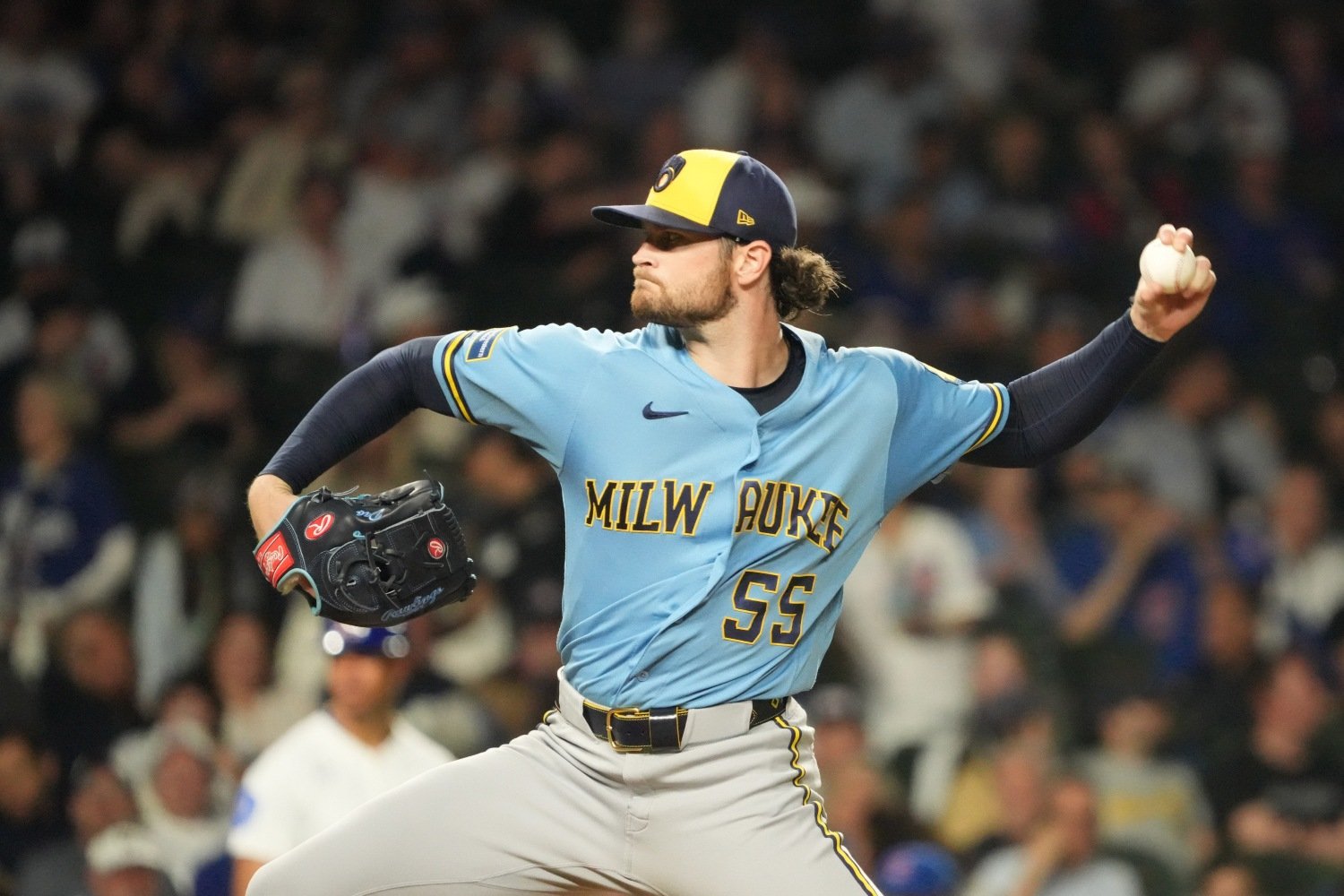
Although his debut in Boston went pear-shaped, Shane Drohan has been pretty darn good ever since. He got the win after pitching 4 1/3 strong innings of relief Monday night at Wrigley Field, and now has a 1.47 ERA in seven appearances since his return to the majors on April 24. In that span, he's faced 72 batters, fanned 18, and walked just two, He hasn't given up a home run in the majors yet.
Most of that is attributable to the stuff and the maturity that Drohan brought with him from the Boston organization, whence the Brewers acquired him in February's Caleb Durbin trade. The team took an interest in his mid-90s heat from the left side and a compelling array of pitch shapes, and they had him stay ready to work as a starter this spring despite some temptation to move him into a relief role like the one in which DL Hall is now toiling. Ultimately, of course, Drohan landed in a role much like Hall's, but he's been a weapon for manager Pat Murphy, deployable in a variety of ways.
Drohan's main stuff is unchanged. He's slightly altered the movement profile on his four-seamer, but his high-riding cutter remains intact. His slider and curveball, like the cutter, have an unusual shape for his arm slot, which the team was bound to love. Milwaukee has helped Drohan add a sinker to his mix, and it shows modest promise, but it's a complementary piece. He's a three-fastball guy now, but not a materially different one than the hurler who was racking up whiffs in the high minors for the Red Sox last summer.

There is, however, one pitch I haven't mentioned yet: the changeup. Therein, as Josh Bard would say, lies the rub.
When Drohan made his debut on April 8 against the Red Sox, his changeup had some potential. On balance, though, it deviated too much from his fastball to be useful. This is an underdiscussed danger for guys who want to throw a good cambio: You might create so much of a gap in velocity and movement that, despite your best efforts to use the same arm slot and mimic the arm speed of the fastball, the hitter is able to tell the difference early and can spit on a pitch you'd rather he tried to hit. Pitchers who are excellent at manipulating the spin of the ball can sometimes work around the problem of spinning it the opposite way from their breaking balls, but find that the resulting offering moves too much because of its active spin.
That's not a bad pitch, and had the Brewers challenged it, it would have resulted in Strike 3. Overall, though, the changeup didn't fool the Red Sox. Drohan needed something different to round out his arsenal.
During his time back in Nashville, he seems to have found it. Here's the (Statcast-labeled) changeup on which he struck out Nico Hoerner during Monday's victory:
That pitch is much firmer, and it has more vertical depth, but it doesn't run to the arm side nearly as much as his old one. It shouldn't necessarily work well, but because of his slot and the array of other looks he gives batters, it does.
How did the change happen? It's hard to tell for certain on video, but it's pretty clear that Drohan is now throwing some version of a splitter or split-change, rather than the circle-change he was throwing before. His average changeup spin rate in Boston over a month ago was 1,590 RPM. In every outing since returning to the bigs, Drohan has averaged under 1,200 RPM with that pitch, and it's sometimes been under 1,000. The splitter works because a pitcher's grip kills the spin on the ball as it leaves their hand, giving the pitch its trademark tumble. It also tends not to run as much to the arm side as other changeups. Drohan has moved to a splitter (or splitter variant), and the results are excellent. He hasn't given up a hit on the changeup, and it's earning plenty of whiffs, even from great contact hitters like Hoerner.
This is not the defining pitch for Drohan. He's a spin-and-speed artist, and overpowered the Cubs with a heater that touched the high side of 96 MPH and sat around 95 Monday night. The changeup is a spare part, at least unless and until he returns to a true starting role. This is an important adjustment, though, in that it testifies to Drohan's coachability (a key trait for any Brewers contributor) and to the sense on the part of the coaching staff that all they needed to do was add the finishing touches for him. He's a valuable arm with big upside. This change to his change is a capstone to a career of adjustment and progress; the Brewers just helped him identify the best version of himself.
Do you approve of Brewers' ownership?

Follow Brewer Fanatic For Milwaukee Brewers News & Analysis



-
 1
1
-
 1
1


Recommended Comments
Create an account or sign in to comment
You need to be a member in order to leave a comment
Create an account
Sign up for a new account in our community. It's easy!
Register a new accountSign in
Already have an account? Sign in here.
Sign In Now