


Brewers Video
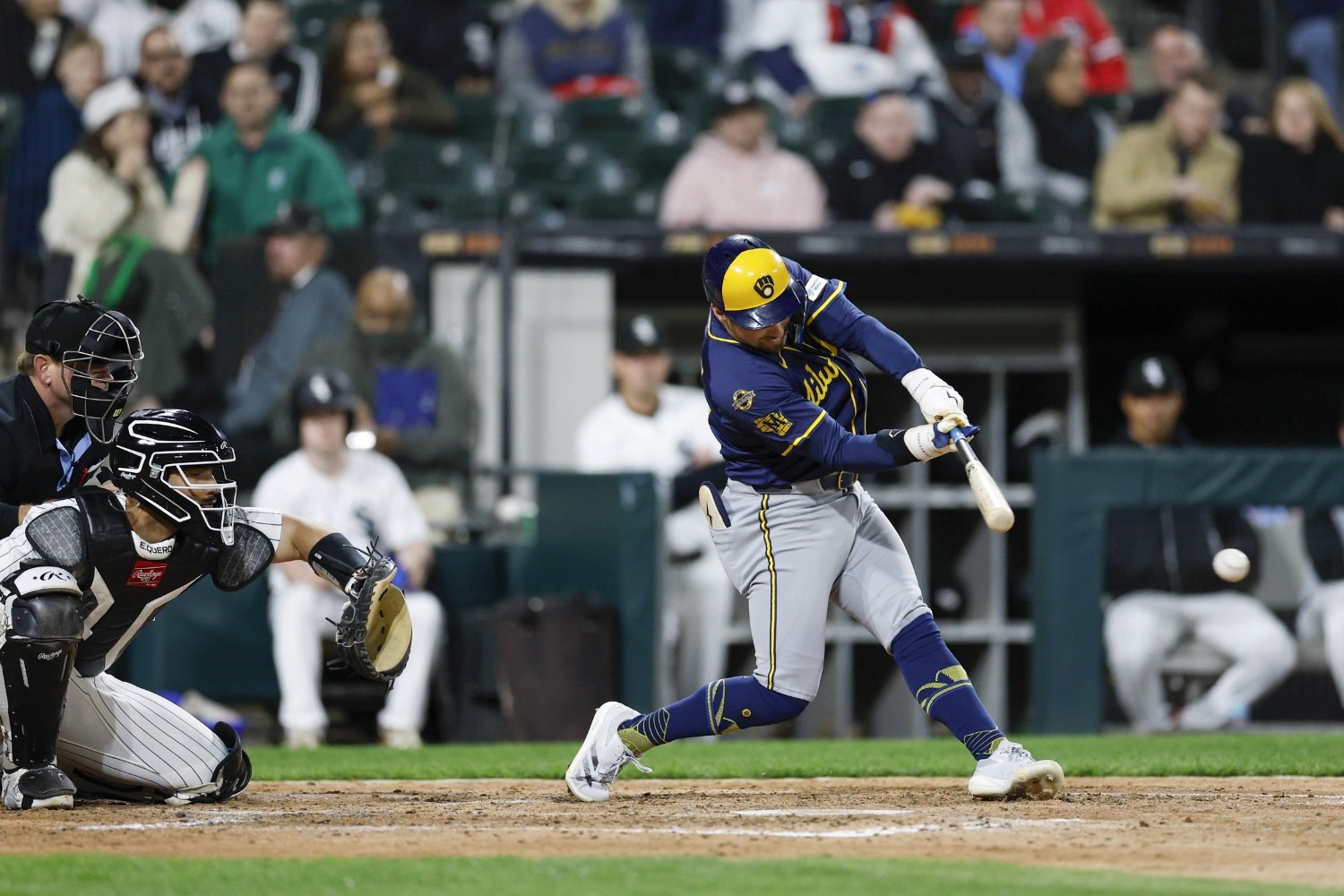
In his first 41 plate appearances in the major leagues, Caleb Durbin has just two strikeouts. He's been hit by pitches twice as many times as he's had to carry his bat back to the rack. Pitchers can't punch him out. On the other hand, he's only managed three extra-base hits, and while one was a reasonably well-measured home run in San Francisco, the other two were a ground-ball double tucked so improbably inside the first-base line as to feel irreproducible and a bloop single on which no Cardinals infielder covered second.
Durbin is short, but he's stoutly built. Consistently hitting the ball hard has never been part of his game, but he did find a modicum of power in each of the last two seasons in the minors, mostly by pulling the ball in the air more than most of his peers. He has enough bat speed to be dangerous, not because of that speed itself, but because he so frequently makes flush contact. Statcast rates 37.9% of his swings as resulting in squared-up contact (meaning the exit velocity on the ball was at least 80% of the maximum possible, given the speed of the swing and the incoming pitch), which ranks Durbin 15th out of the 387 hitters with at least 50 tracked swings this year. He's elite at making contact, and not just by managing to brush the ball with the end of his bat.
To get there, though, Durbin has taken an extremely contact-focused approach since arriving in the majors. Specifically, his mechanics say he's prioritizing the head stillness and the stability that result in lots of contact over the kinds of moves that create more momentum and torque, unlocking hitters' power.
It's easy to spot the big leg kick in Durbin's swing, but not all leg kicks are created equal. Durbin's is not an aggressive move to stride toward the pitcher. Rather, it's about timing and rotation. Watch that clip again, and notice how early the foot gets down—and how, despite traveling a good distance inward and backward as he counterrotated, it comes down very close to where it started. Notice, too, the back foot, which never fully gives up his weight. This is not a power swing. Guys who are trying to drive the ball push off their back side and land much more firmly on their front foot, after a longer stride. That's how they generate the force required to hit it hard.
Here's an easier way to visualize Durbin's swing, especially in contrast with some ostensibly similar hitters. Using Statcast's new data on batter stances and intercept points, we can see Durbin's average stride from overhead. The black footprints here are where his feet start; the red ones show where they are when he reaches his contact point.

In a vacuum, this probably doesn't look especially strange. If you can envision the animations offered at Baseball Savant, where an intermediate blue set of footprints briefly shows the player's feet positions when the pitcher releases the ball, it makes even more sense. There, you see the way Durbin's front foot swings all the way to the inside line of the batter's box, only to steadily come back to that final position.
Now, though, let's compare Durbin's move to those of some other right-handed hitters with similarly open stances and leg kicks. We can start with teammates. Here's Isaac Collins.

Obviously, that's a much more aggressive stride. We knew that. Collins has a history of hitting the ball hard in the minors. He's not, however, an elite contact hitter. He wants to go get the ball, with his bat up to a dangerous speed. Durbin just wants to meet it squarely.
Joey Ortiz isn't doing either thing well this year, but he has the same basic movement pattern, in terms of starting open and using a leg kick to time his swing.

Jake McKibbin recently did a great dive into Ortiz's diminished confidence and the way it shows up in his stride. Still, he's striding a good distance forward. His leg kick is meant to create some space and some speed—to attack the ball. That's different from what Durbin is doing.
The Dodgers' Chris Taylor, like Durbin, starts with his feet very slightly angled away from the pitcher, to remind himself of the need to use the ground for leverage and rotate through the ball. He's far, far more aggressive in the way he strides into the ball, though.

Tyler Freeman is the last comparable player we should study. Like Durbin, he's relatively short; a mid-20s right-handed batter and infielder; and an open-stance guy who keeps his feet about shoulder-width apart. His stride pattern, though, is much farther-reaching.

All four of these guys stride much farther with their front foot than does Durbin. All four also let their back foot come off the ground, or at least drag forward on their toe. Durbin, with that more anchored back foot and that incredibly short stride, isn't going to hit the ball as hard as any of these guys—not even when he gets to one a bit early and catches it out in front, for a pulled fly ball and a potential homer. However, he's also not going to whiff nearly as often as any of them. He's a marvel of physical minimalism in the box. His swing isn't as short as those of guys like Steven Kwan and Luis Arraez. Instead, he achieves his elite contact skills by being so stable that he sees the ball better and longer than most of his peers. It costs him thump, but he's been willing to make that tradeoff, so far.
Eventually, especially after the league adjusts to him a bit and he's forced to make an answering set of changes, Durbin might be wise to get slightly more aggressive in his lower half. That's the only way he'll hit even for 10-homer power or rack up doubles and triples at the rate generally required of a modern hitter. For now, however, it's hard to argue with the way he's organized his swing. If he can keep drawing walks (two so far) and being plunked at a rate totaling three times that at which he strikes out, he doesn't have to hit for any power to have value.





Recommended Comments
Create an account or sign in to comment
You need to be a member in order to leave a comment
Create an account
Sign up for a new account in our community. It's easy!
Register a new accountSign in
Already have an account? Sign in here.
Sign In Now