


Brewers Video
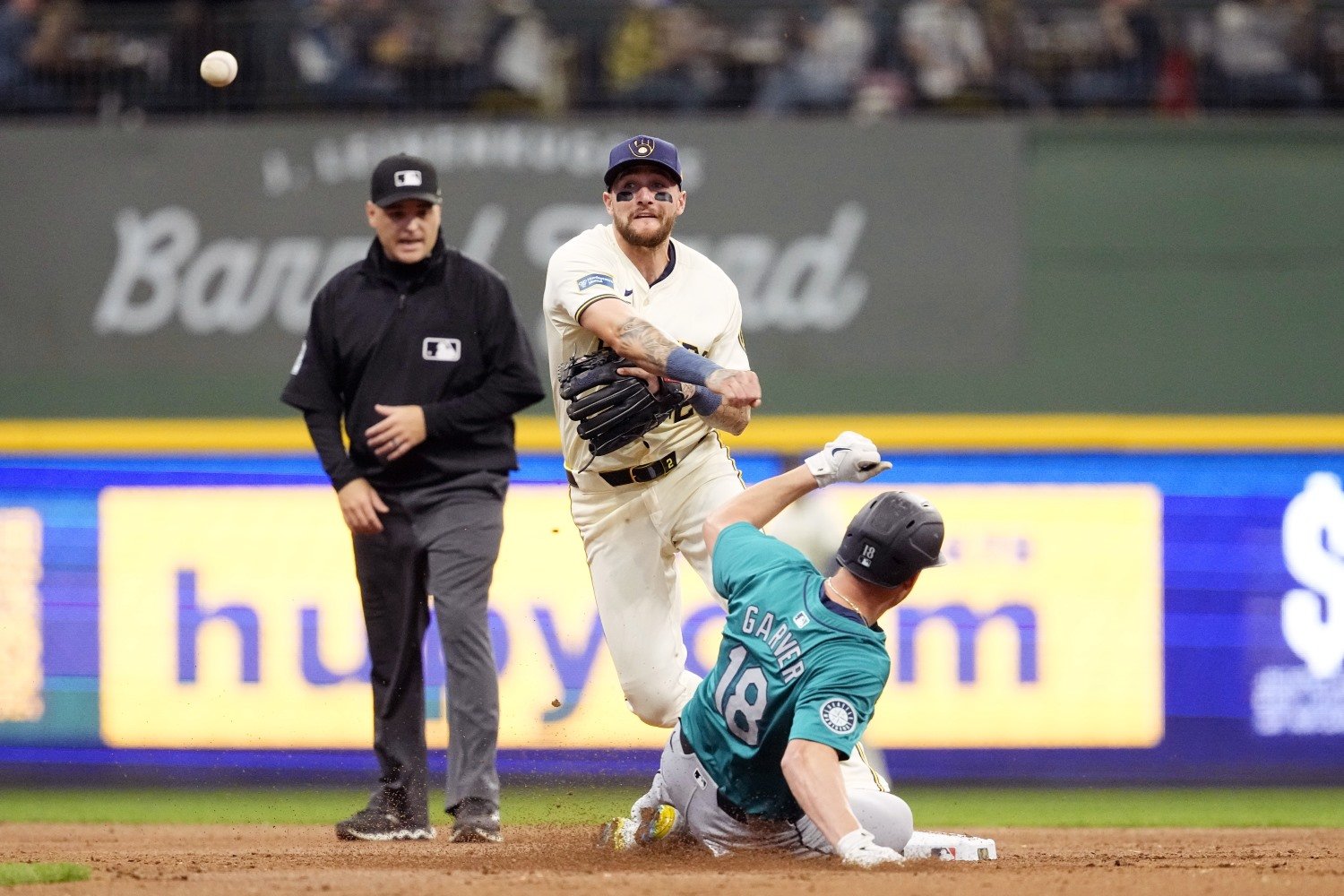
There might not be a better defensive middle infield than that of the Milwaukee Brewers. Both sides of the keystone feature an extremely athletic, polished, aggressive defender. Yet, they're a below-average team at turning double plays. Why?
This season, Brewers pitchers have induced 38 ground balls that were fielded by an infielder, in a situation (runner on first base, zero or one out) in which a double play was possible. The Crew's deservedly vaunted defense, led by Willy Adames and Brice Turang, has converted 19 of those opportunities into actual double plays. That 50% success rate is good for just 18th-best in MLB. Given how good Adames and Turang both are (based both on defensive metrics and on the eye test), that's pretty surprising. Why aren't these stellar defenders reaping as many outs as their pitchers seem to be sowing?
To be sure, the samples are quite small. We're barely over a month into the season. One play made or not can move a team up and down the rankings a little bit. Equally surprisingly, though, the Brewers were 16th in baseball in converting double play chances last year (54.1%), and 24th in 2022 (49.0%). So, let's treat this as real enough to talk about, even as we acknowledge the limitations of it. What is stopping Adames and Turang from delivering the double plays that would go a small but meaningful extra distance toward killing opponents' rallies?
First of all, there's a problem with the ground balls their pitchers are getting. On grounders converted into any number of outs in double play situations this year, the Brewers have induced the slowest (81.1 miles per hour) and second-lowest (-18.1 degrees) batted balls, on average. It's hard to convert a weakly hit ball into a double play, and it's hard to convert one hit straight into the ground into a double play. The Brewers' hurlers are getting a lot of balls hit right into the dirt in front of home plate, which is a good thing most of the time, but if your objective is to turn two, paradoxically, it becomes a partially bad thing.
Here, let's use an example.
Padres rookie Jackson Merrill is a fast runner, anyway, so this was never going to be an easy play. If he only had to get one on it, though, Adames still would have made the play routinely, by charging it. The ball is hit straight down, and reaches him on two long, looping hops. With a good runner getting up the line, you can't get two on this ball if you wait back on it the way Adames did.
In this situation, late in a game that wasn't especially close, Adames also had no reason to force the issue. Let's say he had had such a reason, though. What could he have done differently? If you come in and cut the ball off short on the second hop, it's a tougher play, with a greater risk of mishandling. Worse, your momentum carries you right past the base, so you have to flip it backward or turn and flip quickly to your pivot man to start the relay. It's a low-percentage play. Adames was right to stay back, but in so doing, he forfeited any real chance for the double play.
The problem with that explanation is, there's no fixing it, and mostly, you wouldn't want to fix it even if you could. From a pure batted-ball data perspective, double play ground balls look more like hits than they do like regular groundouts. Here's the average exit velocity for the league since the start of 2022, in double play situations, for:
- Hits or errors; no outs recorded;
- Groundouts or fielder's choices, not including double plays; and
- Double plays
| Outcome | Exit Vel. | Launch Angle |
| Hit or Error | 91.8 | -5.9 |
| Groundout or FC | 83.7 | -15.3 |
| Double Play | 88.6 | -9.3 |
If you ask a pitching staff to start trying to induce slightly faster, slightly flatter grounders, you're unlikely to be successful. They'll either fail to make that adjustment, or they'll make it, but give up a bunch of extra hits instead of keeping all the old outs and adding some new ones.
While we're here, though, we could talk a bit about pitch selection in double play situations. Count and sequence and the batter's tendencies all matter, of course, but in a vacuum, what types of pitches make for the easiest conversions of grounders into double plays? This is a different question than, "What pitch is most likely to get you a ground ball?" It's about which pitches might be most likely to get a double play-friendly ground ball. Again, I used a three-year league-wide sample to ensure we were getting good data. I found the double play conversion rate on grounders hit in these situations, divvied up by pitch type.
They're mostly what you'd expect.
| Pitch Type | GDP Opp Conv. % | Pitch Type |
GDP Opp. Conv. %
|
| Four-Seamer | 54.9 | Sweeper | 51,2 |
| Sinker | 55.5 | Curveball | 49.1 |
| Cutter | 52.4 | Changeup | 51 |
| Slider | 52.7 | Splitter | 51 |
There is, at least, an interesting finding here. Remember, the denominator for these percentages is ground balls fielded by an infielder, so it's not wise to select a pitch based purely on them. However, say the bases are loaded with one out, and you can't have the run score from third base. A four-seamer might be the right pitch. Not only is that pitch more likely to get a whiff than a sinker, and not only is it more likely to get a pop-up or other weak fly ball than is a sinker, but it's almost as likely to yield a ground ball on which the infield can turn two to escape the frame as a sinker is, when we restrict the sample to playable grounders.
Practically speaking, though, the Brewers are doing as much as they can for their fielders in this area. A lot of the balls hit straight into the ground in these situations this year have been on sinkers. The Crew just have harder, often heavier sinkers than most pitchers, so hitters get even more inaccurate with their barrel against them than against most. As you can see, offspeed pitches are the worst to induce a double play, but then, you already know that the Brewers throw few of those, anyway.
Let's stop blaming the pitchers, then. What about coaches? A few times this year, the Brewers have been out of position for a double play, because they were playing such a shaded alignment against a batter. Here, look.
This is one of those medium-speed, a bit higher grounders that are supposed to lend themselves to double plays, and Carlos Santana is slow. As it played out, though, Willy Adames had to almost pancake the ball to control it, and only took the out at first. Why? Part of it is that the ball stayed down with topspin after hopping just to the left of the mound, forcing Adames to get all the way down on it as he charged, but another part is that Adames was way over in the hole, and pretty deep.
It happens against left-handed batters, too, in a couple of different ways.
Under more traditional double-play depth positioning, with both infielders slightly shallower and pinched toward the bag, this grounder would probably have led Turang right to the bag. Then again, given such positioning, this grounder would have had a better chance of getting through altogether than it did with the alignment they used. The second hop is off the top of the mound, and even Adames has to adjust his route to the ball a bit, giving more ground than he first wanted to.
The Brewers' defensive positioning emphasizes getting an out in these situations, rather than pursuing the best possible chance for a double play. That's usually good math--for the same reason why an offense should rarely sacrifice bunt, a fielding unit should rarely eschew a likely out to chase a less likely pair of them. That's an interesting juxtaposition with the personalities of Adames and Turang, though, because they're about the greediest and most aggressive out-seekers among the league's middle infielders.
Adames is famous for occasionally ranging all the way to the right-field foul line to be the relay man when one is needed. He's thrown to third base to cut down the automatic runner on grounders his way in extra innings as often as any shortstop in baseball. Adames is a central midfielder stuck on a baseball diamond instead of a soccer pitch. He wants to make plays from foul pole to foul pole. In fact, that's one place where the Brewers are losing a few double plays: Because he calls them off and because they're mostly young and inexperienced, Brewers third basemen are letting a few balls on which they should make the play and throw to Turang with their momentum going straight toward second base go to Adames instead.
This used to be an issue between Nolan Arenado and Troy Tulowitzki, when they starred together on the left side of the Rockies infield. Tulowitzki was too insistent on taking anything he could get to, when Arenado might have been the better one to make it. We think about (and see) this more often in the outfield, but with the converted shortstop Joey Ortiz at third right now and Adames always in an attacking mode when there's a ball in his area code, it's very relevant for the Brewers right now. The position at which their conversion rate on double play chances is best--that is, the place where the highest rate of balls fielded have turned into twin killings, both in absolute terms and relative to the rest of the league--is the hot corner. Adames might need to learn to trust Ortiz and Oliver Dunn a bit more.
Here's one more example of that, for our general edification. It's not the only other one; these are just the two clearest.
Only two of the 10 balls Turang has fielded in double play situations have actually turned into double plays. For the most part, though, Turang looks great on the tape. There are a couple plays where a right-handed batter mishit a ball to the right side, and Turang had to make a play going away from second, because he'd been heavily shaded up the middle. That goes back to the positioning issue we discussed above, but we needn't revisit the question of whether those positioning decisions are right. Placed where he is at the start of those plays, Turang does all he can. He's very aggressive about taking the lead runner on balls hit to his left, even when he was already shaded toward the hole on the right side. No second baseman in baseball gets the man at second more consistently on such plays. In fact, on a couple such plays, it's Adames who's at fault for not getting two, not Turang; the shortstop just isn't as quick on the exchange and release when turning the double as Turang is when it's going the other way.
Let me ask one slightly weird question, though: when a lefty does hit the ball toward the hole in these spots, should some second baseman (Turang would be a great candidate) actually go to first base to maximize the chances of a double play? It sounds counterintuitive, but watch with me.
Yes, it's crazy, but taking the lead runner here was difficult and a bit risky in itself, and the chances of a double play were virtually nil. The first throw here is about 75 feet, after Turang fielded the ball and reverse spun toward the outfield. That just takes too long, unless the backup catcher is running and the starting catcher is getting a piggyback ride from him.
If Turang had thrown to first base there, could the Crew have still gotten a double play, with a throw to second and attempted tag? Probably not, in this example, because Rhys Hoskins was playing first base. Imagine the same play--same pace on the grounder, same runners, same situation--but with Jake Bauers at first. Bauers has a good arm and the confidence to use it. Adames is an adept tagger. I think that would have given them a better chance at getting two on the play above, if that had been their focus. Maybe this is something more infields should practice and/or attempt.
One more example of the same idea.
We're not in too much of a hurry here to stop and appreciate the balletic feet of Turang. What a charge, pick, spin, and throw. That was pretty. Now: should he have thrown to first base instead? It was the speedy Willi Castro heading for first (just as it was in the previous clip), so there was no chance at all of a 4-6-3 double play. I don't think Turang even thought about that, though. He only thinks about whether he can get the lead runner, and in this case, he could.
Had he made the same charge but then a strong toss to first, though, they might have had a shot at the aged, plodding Carlos Santana at second, even needing to tag him to do it. These aren't criticisms of Turang's actual choices; they're in line with the Brewers' defensive philosophy and the conventional wisdom. They're better plays than about 10 second basemen would have made on each; below-average fielders would have taken only the out at first on each, allowing a runner to move up into scoring position.
If the Brewers are hunting for places to steal an extra few outs in key situations, though, these are the places they might look. Slightly more aggressive positioning (based on potential payoffs, instead of purely on probabilities) is one step. Another could be slight changes in pitch selection, if the pitcher and batter are just the right fit for that. Most of all, Adames should continue thinking aggressively, but trust his teammates a bit more. He could also get quicker on the pivot, when his turns to do that come. Turang is already plenty good, and the chances to get two just haven't been there for him yet. The only window for some improvement from him lies in the radical notion of starting a double play by going to first and losing the force out.
Double plays are just one small, situational aspect of good infield defense, and as we've seen, double-play grounders are only pitchers' best friends when things break just right. The Brewers can be a playoff-caliber defensive unit without getting any better at this small slice of their jobs. Since they rightfully take great pride in their infield defense, though, they might as well try to take this aspect of it from below average to above, and those improvements are possible.





Recommended Comments
Create an account or sign in to comment
You need to be a member in order to leave a comment
Create an account
Sign up for a new account in our community. It's easy!
Register a new accountSign in
Already have an account? Sign in here.
Sign In Now