


Brewers Video
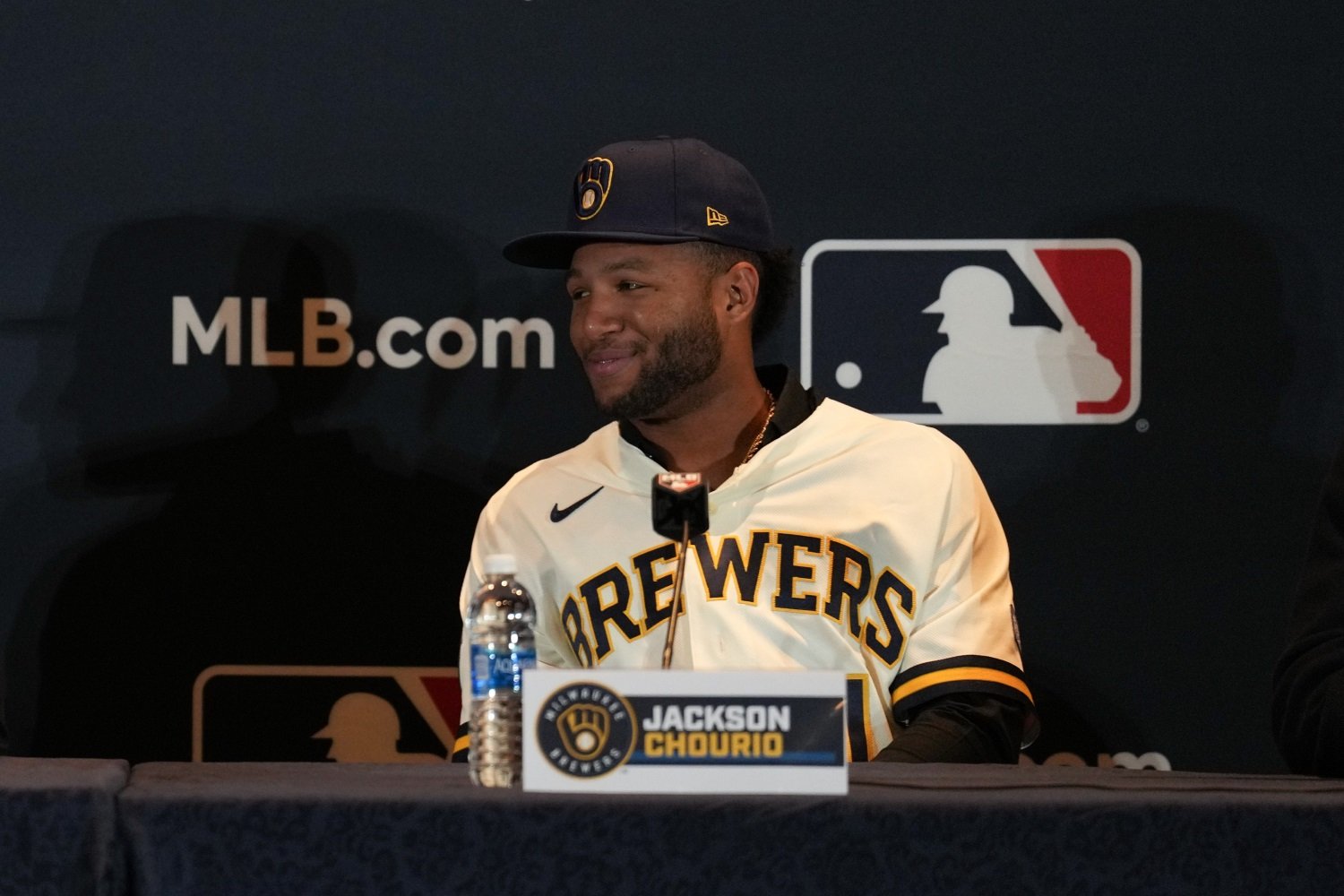
It's hard not to draw some narrative connections between the contract on which Jackson Chourio and the Brewers agreed last weekend, and the one on which Shohei Ohtani and the Dodgers agreed Saturday. Almost exactly a week after the smallest-market team in MLB signed a record contract for a player without any MLB service time, the league's biggest, boldest spender committed to a deal about nine times larger.
The comparison isn't apples-to-apples, of course, so much as apples-to-Apple Jacks. Ohtani signed a supermassive deal because he's earned each of the last three American League MVPs (and actually won two of them), and because he's served his time and earned free agency. Under baseball's wait-and-see salary structure, Chourio had no way to get anywhere close to this kind of payday, so he took what he could get. It all makes sense. There's an unassailable logic to Ohtani getting far more guaranteed money than Chourio, since one has proved himself to be one of the best players in baseball history and one had an .805 OPS in the minor leagues last year.

Still, there are plenty of people who are upset about one of these contracts, or even about both. In Ohtani's case, the objection is simply a matter of perceived fairness, and of scale. Those criticisms aren't unfair. We can prattle on endlessly, if we choose, about the fact that Mark Attanasio has tons of money and could spend more of it on the Brewers if he wanted, but it would be farcical to pretend that he could afford that anywhere near as easily as the Dodgers (with their huge advantages in revenue in both the present and the future) can afford to do what they do. When there are opportunities that a few teams can actually seize but which other teams can't even fathom, something is amiss.
Does that mean baseball needs a salary cap? Not in and of itself, no. It does suggest, though, that the league should be more aggressive in ensuring revenue-sharing and other means by which to level the playing field for small-market teams. Ohtani's deal signifies a widening of the gap between rich and poor in the sport, and that gap should be closing, instead.
The other objection to Ohtani's deal is that $700 million is far too much to be paying to any ballplayer, and I find that to be a perfectly reasonable one, too. Somewhere along the way, in a fervent and well-intentioned rush to support players at the expense of much richer, much less deserving owners, fans lost their perspective and their sense of scale. Many denizens of the baseball internet believe that billionaires simply should not exist, and I share that belief. Alas, some of those very baseball people have been so eager to support labor instead of capital that they've accidentally ended up being ok with deals like Ohtani's, which will certainly make him a billionaire within several years.
The fault isn't on the player, or even on the Dodgers, though I also think this deal is a bad baseball decision that will haunt them in half a decade or so. The fault lies with fans, in too many places and at too many times, letting the fact that they really like baseball and want to consume it override their rational decision-making. Owners aren't charging obscene prices for parking, admission, concessions, and souvenirs because they need to pay their players. They're doing it because they kept raising prices over a period of several decades, and fans have not responded with a sufficiently firm rejection of that inflation.
Players are only getting megadeals because the owners can't find a better way to spend all the money fans keep shoving at them. For many years, fans gladly paid exorbitant cable bills to keep watching their favorite teams. Now that bubble has burst, but many fans are gladly turning to paying the team directly for streaming rights, and the prices are fairly huge. All this fan allegiance has also allowed owners to work over states and municipalities for billion-dollar boondoggles, in the form of new ballparks and major ballpark renovations financed by taxpayers.
In other words, Ohtani's deal is a symptom of a huge and nasty problem, or perhaps a few of them in combination. It should make you flinch, but not for any reason having to do directly or individually with Ohtani. It should underscore for us all the systemic issues at hand. That brings us to Chourio's contract.
Every time a young player far from free agency signs a long-term, team-friendly deal like Chourio's, there are many people who say that it's a pernicious thing--a reinforcement of the corrupt system that brings players (especially international free-agent teenagers) into the machinery of professional baseball. They're almost right.
There's almost nothing good about the way MLB lets amateurs join its organizations. Hard caps on draft and international free-agent spending since 2011 have exaggerated the unfairness, but it was there even before those ceilings came down. Many players are treated like chattel from unconscionably young ages, shuttled around to tryouts and showcases, given terrible advice, and groomed to yield the greatest possible signing bonus before they turn 20. That happens in the United States, as well as in Latin America.
This way of doing things helps produce the arm injuries now endemic to pro ball. It drives the still-too-high incidence of performance-enhancing drug usage by players from the Dominican Republic. It keeps multiple countries economically dependent on the United States in an unhealthy way, and discourages the creation or pursuit of good secondary education options. It even leads to some human trafficking. It's an immoral nightmare, tailored to maximize the profits of the owners.
Deals like Chourio's, though, just aren't even a symptom of that problem. Inevitably, deals like these get decried as manipulative, or criticized because they stunt the player's earning power. Chourio could have gotten as much as $320 million out of the 10 years he sold to the Brewers for no more than $142 million, and for some, that's indicative of the unfairness and predation of it.
I reject that. There is not any meaningful difference, for any family, between having $82 million and having $182 million. There is no meaningful difference between having $100 million and $600 million. Anyone who says otherwise has lost touch with reality and is too used to reading these numbers on a screen. They're treating them like batting averages. It's not like that.
I'm very glad Jackson Chourio and his entire family (a generation in each direction) are set for life. I want a better, fairer compensation system for professional baseball, one that takes a lot of money out of the pockets of the Dodgers' and Cubs' owners and gives it to the Royals and Brewers, on the condition that that money be spent on their teams. I want a fairer system that thwarts a deal like Ohtani's and gives half that much money to minor-leaguers and minimum-salary big-leaguers, instead. However, while Ohtani's deal represents a macro-level imbalance and a genuine problem, Chourio's is more like the silver lining of a cloud. Chourio's deal doesn't perpetuate an unfair system; it just happens to exist within it. Let's celebrate it.
Which team do you dislike the most in the NL Central?

Follow Brewer Fanatic For Milwaukee Brewers News & Analysis



-
 1
1


Recommended Comments
Create an account or sign in to comment
You need to be a member in order to leave a comment
Create an account
Sign up for a new account in our community. It's easy!
Register a new accountSign in
Already have an account? Sign in here.
Sign In Now