


Brewers Video
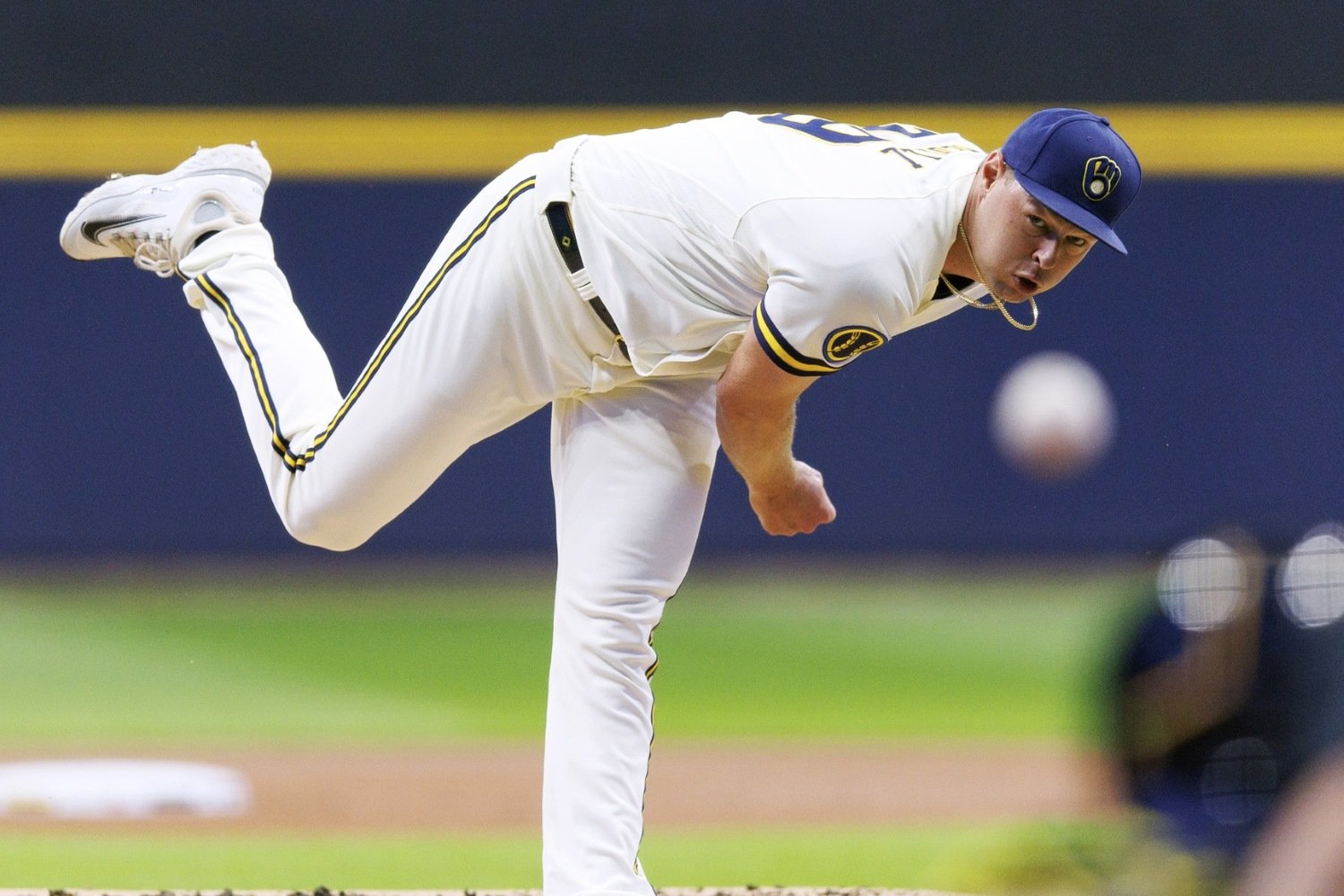
By the end of the 2022 season, Trevor Megill was sitting at around 98.5 miles per hour on an average fastball, and he was touching 100 often enough to be very intimidating on the mound. Far from stopping there, though, he doubled down on adding velocity. From Aug. 1 onward, more of his fastballs were harder than 99.8 miles per hour than were softer than that. He touched 101 five times, across four appearances. According to Megill, he and the Brewers made some mechanical adjustments that made it a bit easier to throw hard and still find the strike zone.
"Being a little shorter," Megill described it Friday in Maryvale. "I feel like that's the direction people head later in their careers: try and get more compact through the years. That was the focus [in the 2022-23] offseason, and throughout the [2023] season it just progressively got better. It was a conscious effort, for sure."
Megill said he did not change where he sets up on the rubber, so when you spot the difference in his release point from the first half of last season to the second, know that it's a product of the difference in his arm path, not in his starting point.

"I started falling off [the mound] a little bit extra," Megill said. "Everybody's a power pitcher these days, and it's hard to be a power pitcher when you're trying to field ground balls every single time. So, it was about letting my body go where it needs to go."
Where it went was toward the strike zone much more consistently, with greater power from that more compact yet less reserved delivery. Megill's zone rate was higher in the second half, and he compelled opponents to swing much more--up from 40 percent in the first half to 50.7 percent.

Even when he wasn't in the zone, though, batters chased more in that second half, as he totally took off. That's thanks to being around the zone more, to be sure, but it's also because Megill's curveball is uniquely deceptive. From his overhand delivery, the curve comes out of his hand actually going downward, rather than having the hump that most pitchers' have, which the hitter can sometimes spot. It's a key reason why he got dazzling whiff rates on that pitch in 2023.

"When I start on the right line, they don't have hump," Megill said. "If I don't hit a fastball in a certain spot early in an at-bat, the curveball will stick out, but it's my job to make that a little more concealed. The curveballs I do land in the zone have a smidge of pop, but it's not what it used to be."
In the second half last year, hitters started chasing Megill's curves outside the zone almost twice as much as they had in the first half--over 45 percent, up from 25. Much of that was about better achieving that deception with the more compact delivery and superior fastball command, but Megill also did a good job of setting hitters up for the hook.
"You have organizations that are fastball-dominant and trying to jump you within the first three pitches. Other organizations take [pitches] a lot more. They're gonna try to get rid of the lower half of the zone for me.
You've gotta adjust to the lineups and understand where the organization you're playing is at. Some I have to land it [in the strike zone] more, where others I can get away with throwing it 58 feet."
Knowing the team approach of the players in the opposing dugout is helpful, but Megill said it's also about mentally preparing and knowing the scouting reports of individual hitters when they get to the batter's box.
"There are plenty of guys in the league where it stands out that a curveball that can tunnel off your fastball is good enough. It doesn't have to be in the zone," Megill said. "You have to know those guys. Being in the bullpen is a game of who's more prepared to see who. You see three batters a night, but it's your job to think about it for four hours before the game."
Megill made some physical and mechanical refinements, and he's now winning those mental battles, too. He's the more prepared person in the fight more often, and even if he weren't, the sheer stuff would be almost impossible to hit. After one spring outing, he said he still felt like he had the improvements he made last year locked in. That's bad news for the rest of the league, but great news for Milwaukee's relief corps.
Research assistance provided by TruMedia.
Which team do you dislike the most in the NL Central?

Follow Brewer Fanatic For Milwaukee Brewers News & Analysis



-
 2
2



Recommended Comments
Create an account or sign in to comment
You need to be a member in order to leave a comment
Create an account
Sign up for a new account in our community. It's easy!
Register a new accountSign in
Already have an account? Sign in here.
Sign In Now