


Brewers Video
Pitcher-batter matchups are often framed as a handedness thing. Generally speaking, a same-sided matchup is more favorable for the pitcher, while an opposite-handed matchup favors the hitter. Left-handed hitters are better against right-handed pitchers, and right-handed hitters are better against left-handed pitchers. The left-on-left matchup is particularly tough for hitters, partially because lefties see fewer southpaws than righties do fellow righties.
In reality, it's more complex than that. Matchups are really about the angle at which the hitter sees the pitch. Handedness usually determines much of that angle. Most pitchers throw from a three-quarters arm slot or lower, and they run, cut, or sweep their pitches. Those right-handed pitchers release the ball closer to a right-handed hitter, making it tougher to pick up out of the hand. Add some late run barreling in on them or late break sweeping away, and it gets even more uncomfortable. A lefty, meanwhile, gets a clearer window to see that pitcher's release.
That's not always the case, though. For over-the-top pitchers with riding four-seamers, 12-6 curveballs, and straight changeups, the horizontal angles of their pitches don't change much from one side to the other. These pitchers can sometimes be platoon neutral or even have reverse splits. Different swing paths also line up better or worse against different pitch shapes. Simplifying things to handedness makes sense because it usually tells most of the story, but it doesn't explain everything.
For those reasons, Pat Murphy and the Brewers don't automatically default to the most obvious matchup when they write lineups or make pitching changes. Murphy believes in and abides by reverse splits when they can be explained by a pitcher's arsenal or a hitter's swing. He starts Andrew Vaughn and Joey Ortiz against righties who throw mostly four-seamers, but not against those who throw sinkers and sliders.
On Friday night, the Brewers faced Texas Rangers southpaw Cody Bradford, who owns reverse splits throughout his big-league career. Righties entered the night with a .707 OPS against him, while lefties had a .731 OPS. That's not a statistical fluke. Bradford throws from a higher arm slot, and more than 85% of his pitches this year have been a straight fastball with occasional slight cut and a changeup.

Here's what a right-handed hitter sees from Bradford, visualized with Statcast's 3D ball tracking. The fastball and changeup are nearly inseparable by the time he must decide whether to swing.

Flip those same pitches to a lefty point of view, and that separation becomes much easier to see.

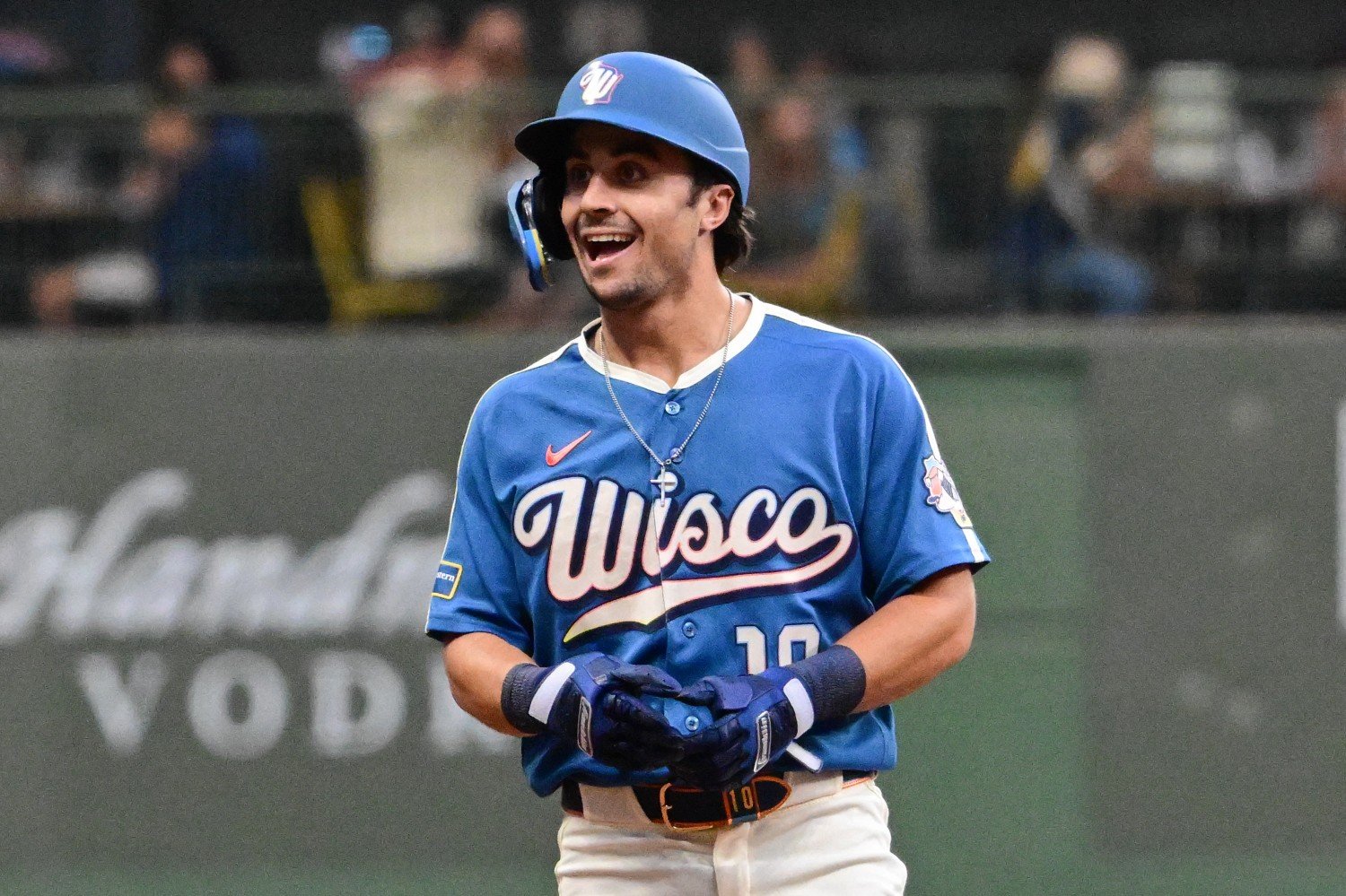
That was part of the calculus when Murphy rolled out his usual lineup of left-handed hitters against Bradford. Christian Yelich, Jake Bauers, Garrett Mitchell, Sal Frelick, and David Hamilton all started.
"The way we look at it, it's not any lefty versus any lefty, but there are times when that guy's kind of a reverse-split guy, there's times when we leave our lefties in there," he said.
There was even more to it than the hitting matchups. Murphy and the Brewers also felt their left-handed hitters were better positioned to bunt for hits against Bradford. As a lefty, he falls off toward third base as he delivers the ball, making a drag bunt down the first-base line difficult to defend. Lefty hitters can also take an early step toward first while dropping down that bunt, getting them down the line faster and forcing Bradford to make an even quicker play.
"Sometimes it's easier to bunt left-on-left with that guy falling off the other way," Murphy said.
It worked right from the get-go. Brice Turang led off the bottom of the first by bunting toward first, stepping into the bunt and springing out of the box as he made contact. After Bradford redirected his momentum and spun around, he misfired the ball down the line, allowing Turang to advance to second.
Turang advanced to third on Jackson Chourio's flyout, then scored on William Contreras's groundout. Yelich then one-hopped an RBI double off the wall in left-center to score Bauers, who reached base on a walk. Hamilton added insurance in the sixth, lining a left-on-left fastball up the middle to score Mitchell.
After Bradford left the game, Murphy stuck with his lefties against lefty reliever Adam Macko in the eighth, and they continued to take advantage. Frelick and Hamilton bunted for back-to-back singles to lead off the eighth. Both later scored to make it a 6-1 game, allowing another day of rest for Trevor Megill after a rare multi-inning appearance in New York.
"We executed that three or four times perfectly," Murphy said. "So, yeah, sometimes you leave lefties in."
Murphy and the Brewers didn't play conventional matchups, and it created most of their offense on Friday night. It was the latest example of winning on the margins both on the field and in the dugout, which has made Milwaukee the most successful regular-season team in baseball for the second year in a row.
Do you approve of the job the Brewers' front office is doing?

Follow Brewer Fanatic For Milwaukee Brewers News & Analysis



-
 2
2
-
 1
1


Recommended Comments
Create an account or sign in to comment
You need to be a member in order to leave a comment
Create an account
Sign up for a new account in our community. It's easy!
Register a new accountSign in
Already have an account? Sign in here.
Sign In Now