


Brewers Video
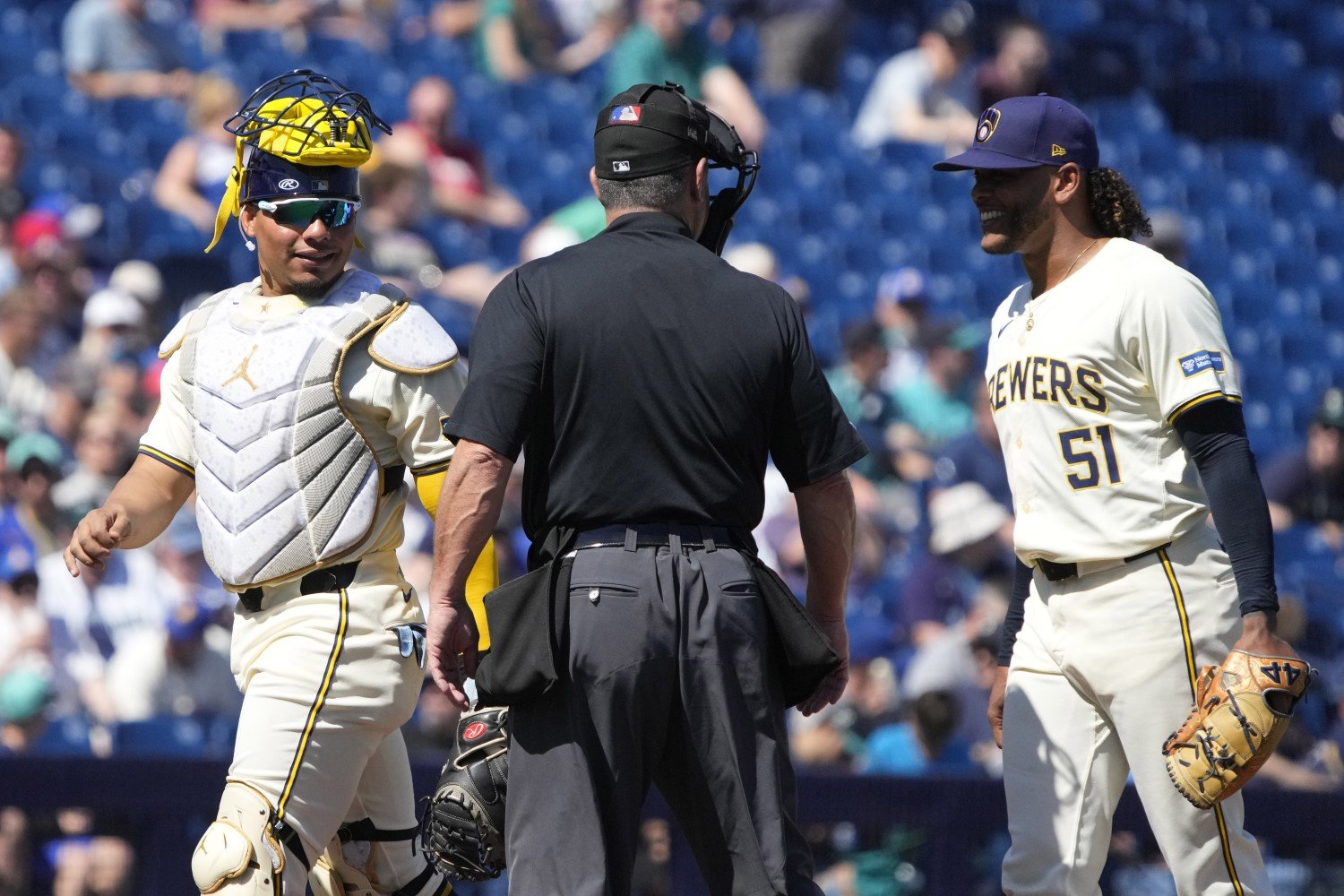
No one in MLB teaches pitch framing better than the Milwaukee Brewers, and their success with the young star catcher for whom they traded prior to 2023 was one of the keys to their season. Is the magic still there?
It's hard to articulate any reason why the Brewers would be struggling with developing great receivers. They're more formidable than ever, in a sense, because Charlie Greene got the call-up to the big-league coaching staff this winter, joining Walker McKinven and Nestor Corredor there. They're the three-headed monster who work together to instruct and hone the team's catchers, and they only have easier access to William Contreras this spring.
No catcher in baseball is more dedicated to the position than Contreras. He's a tenacious worker, and he wants to be in the lineup and behind the plate virtually every day, despite the enormous physical demands and risks of his chosen position. Last year, his work ethic and open-mindedness met the genius of the Crew's catching coaches, and the result was a huge forward stride in his framing numbers. He'd been a subpar framer with Atlanta, but became one of the league's best in his first campaign with the Brewers.
It's too early to put full faith in the catcher framing numbers for 2024, but not too early to at least peek at them. Because the sample sizes (essentially, every pitch at which a batter doesn't swing, and in practice, at least a majority of them--those near any of the edges or corners of the zone) rapidly get very large, framing stats become telling much earlier than most other statistics in a baseball season. Maybe the best way to put it is, we're still in the space where any alert we issue is like a storm watch, rather than a storm warning.
But there does seem to be a storm a-brewin'.
Of the 35 backstops who have caught for at least 100 plate appearances on the young year, only two (the Cubs' Yan Gomes and the White Sox's Martín Maldonado) have been worse than Contreras by Adjusted Strikes Looking (SL+), the proprietary metric by which TruMedia evaluates pitch framing. It's an indexed stat, where 100 is average and higher is better. Contreras comes in at 93.1. Because he's caught as much as anyone in baseball, he's cost the Brewers more actual value (1.1 runs, against average) than any other backstop has cost their team in this area so far in 2024.
Now, again, there are a number of reasons to modulate any concern about this. Baseball Prospectus, whose suite of catcher stats is the state of the art in the industry and who first brought the concept into focus on a national stage, only has Contreras as 0.2 runs worse than average. That's just because their models are more conservative--he's still second-worst of 29 qualifying catchers on their leaderboard--but it's a reminder that we should hedge heavily on any conclusions we're tempted to draw this early in the going.
In just two series, opposing lineups, umpires, and the mix of pitchers with whom each catcher has worked are big sources of noise. Those quiet down quickly, but not this quickly, so we can allow for the possibility that Contreras caught in front of an unfriendly umpire or two, and/or that the patient Mets and Twins made his job harder. Only three teams have seen opponents chase outside the zone less often than the Brewers, and while inducing chase (via good game calling) is part of a catcher's job, too, it's not one neatly reflected in these numbers, at least in a small sample. No team has thrown a higher percentage of its pitches within the zone, as Contreras has been characteristically aggressive with his hurlers in attacking hitters, so he's had more chances to lose strikes than to delicately frame should-be balls.
This is still bad news. Directionally, a lot of the names we'd expect lead and trail these leaderboards already. Austin Hedges (who is only in the league because he excels at this skill) leads all catchers in both systems' estimation. Maldonado was the worst in baseball at framing last year, so it's no surprise that he's bringing up the rear again. That's just two examples, but the gist is that most catchers are already falling into about the range where you'd expect to find them, based on their statistical track records and their reputations as framers. Not so with Contreras.
He's noticeably noisier behind the plate this year than he was in 2023. It might just be that he has a few mechanical things to iron out, or that adrenaline has gotten the better of him at times during the early going. He's still framing well on the lateral edges, but he's stopped shaping the top and bottom of the zone effectively.

That's probably fixable. Here's Contreras stealing Colin Rea a strike on a sweeper last summer.
The essential trait there--the difference-maker--is how smoothly he catches and extends through the ball. Yes, it's a big-looking movement from where the ball reaches him to where he stops his mitt, but it looks natural and fluid. Now, here's a 1-1 sweeper he lost for Rea on Sunday.
The upward swoop of the mitt is more pronounced here, principally because it's not done in rhythm. Contreras struggled with this specific issues (waiting long enough and anticipating the big break of some sliders, sweepers, and curves) even last year, and few catchers do it well. The more movement a pitch has, the harder it is to anticipate its location, beat the ball to its spot, and cleanly show it to the umpire well inside the zone. When there's also a big velocity differential between the pitch and that hurler's fastball, it doubles the difficulty for the catcher, because those hitches of the mitt are always red flags for umpires.
I feel confident that Contreras will clean up the mess of the first handful of games, from a framing perspective. While the sweeper problem is hard to solve and might require tweaks to how pitchers set their targets or in what sequences Contreras calls them, he can fix the issues he's had with holding fastballs along the top and bottom of the zone in place just by better anticipating and sticking to the mechanical cues he learned last year. If that doesn't happen, though, it will spell big trouble for the Crew. They need good pitch framing. It's a key part of their run-prevention plan.





Recommended Comments
Create an account or sign in to comment
You need to be a member in order to leave a comment
Create an account
Sign up for a new account in our community. It's easy!
Register a new accountSign in
Already have an account? Sign in here.
Sign In Now