Jump to content
Brewer Fanatic
  • Brewers News & Analysis

    Without Elevation, Milwaukee Brewers Offense Loses All Pretense of Potency


    Jake McKibbin

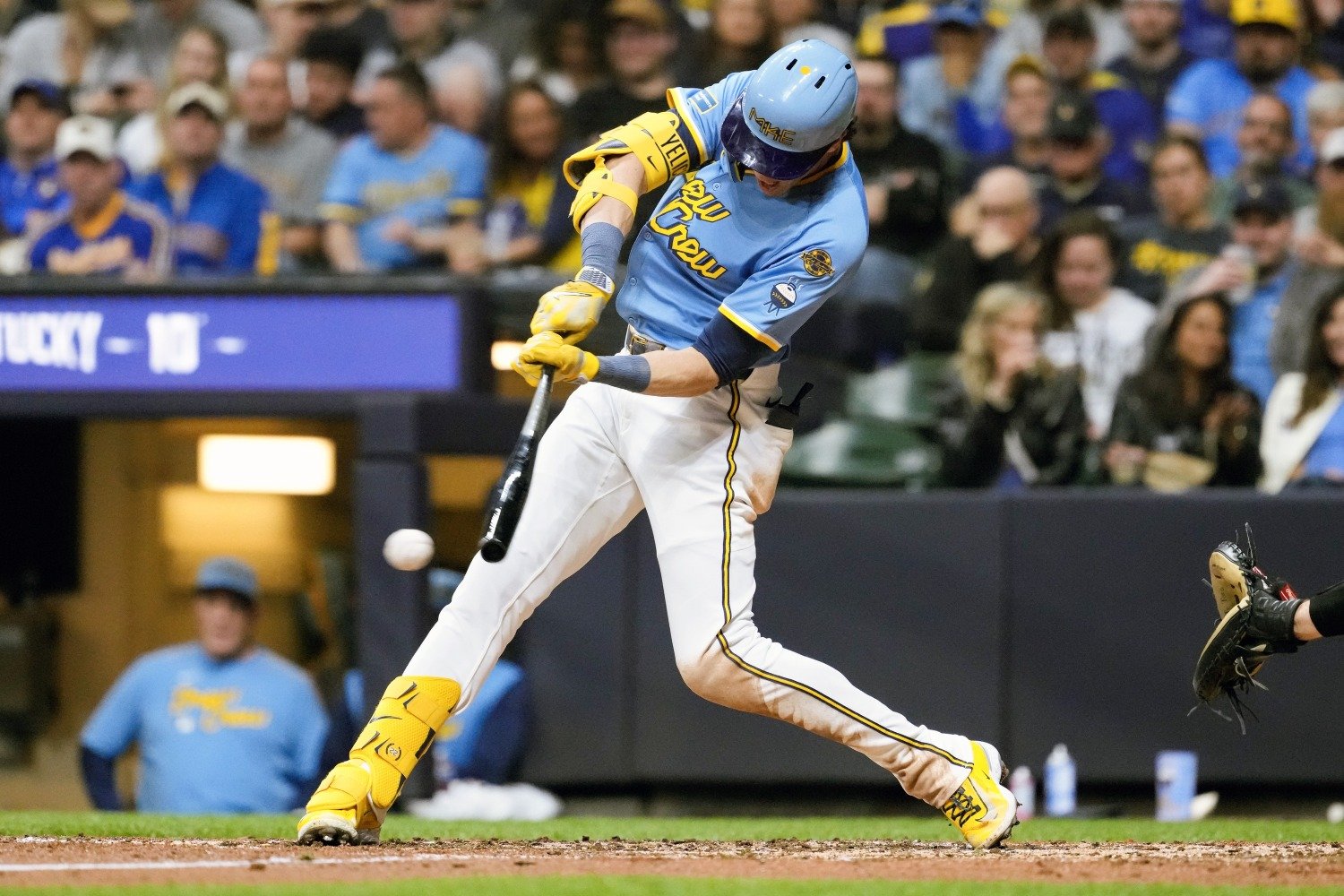
    The Milwaukee Brewers have the second-highest ground ball rate in the majors, a profile creating knock-on effects that reduce their consistency, limit their slugging and result in too many double plays. Can they succeed with this approach?

    Image courtesy of © Jeff Hanisch-Imagn Images

    Brewers Video

    In the first 30 games of the season, the Brewers have a ground ball rate (as a team) of over 50%. That's five percentage points higher than the one they had in 2024. Worse, a lot of those grounders are coming from the hitters in the heart of their order—the veterans most relied upon to produce runs. Almost everyone is seeing a bump in their ground ball rate, already at an elevated level in 2024, and it's killing the offense.

    Yes, William Contreras and Christian Yelich hit the ball hard enough that their BABIP (batting average on balls in play) is likely to improve, but even so, getting the ball off the ground will help. Through the first month of baseball, the Brewers have been feast-or-famine offensively, showcasing what they can manage when they do elevate the ball versus what happens when they can't—which is to say, getting stymied over and over again.

    Without elevating the ball, their offensive production will become streaky, dependent on batted-ball luck in all the wrong ways. The question is, without change, is some regression to the mean coming, or will the Brewers simply struggle to produce runs in 2025?

    Power Is King
    The Brewers don't have a lot of innate power within their lineup. They were looking to modest but plausible power increases from Christian Yelich, Sal Frelick, Garrett Mitchell and others to collectively replace the power lost due to Willy Adames's departure. The problem is that they can't do that unless these hitters can catch the ball out in front more often. Of the names above, only Mitchell has reduced his ground ball rate (admittedly, aided by being pummelled in the upper third of the strike zone).

    image.png

    Four of the top five in the Brewers order on a regular basis are hitting more ground balls than ever. Hitting 60% of pitches on the ground is a recipe for disaster. Hard-hit ones will result in rally-killing double plays for Yelich and Contreras. Frelick's spike has paid off short-term with some batted-ball luck, but it's unlikely to fare so well as the season progresses. When you factor in Jackson Chourio and his swing-happy approach (which brings its own inconsistency), it's clear why the Brewers are struggling to produce pressure and runs from one game to the next.

    image.png

    As a unit, the Brewers are over eight percentage points (or a 20% jump) from average in ground ball rate, a category in which they ranked third-highest in 2024 with 45.4%. Rhys Hoskins has arguably provided the highest-quality at-bats, with a high walk rate, low strikeout rate and hardly any ground balls.

    Can It Be Fixed?
    The biggest factor that will drive consistency is for one of the players in the heart of the Brewers order to resolve their current issues. The issue with that is that Yelich and Contreras are well-known ground-ball hitters over their careers. Whenever either can get their ground ball rate under 50%, they become a terrifying proposition, but it can be streaky for both of them. It's typically the last thing to come for Yelich when returning from injury, and he struggles to catch it in his sweet spot. Contreras demonstrated in 2024 how he can go from a black hole to a dominant slugger in the flash of an eye. Both have shown improvements so far from their early form, but that's been in the form of less swing-and-miss, rather than a better batted-ball distribution.

    Enter Chourio, who has chased more than anyone else in the league but Adolis García (min 100 PA)—and has somehow pushed that rate even higher over his recent sample of pitches faced. When pitchers are silly enough to attack Chourio in the strike zone, he's punishing them, but eventually, they'll begin to take the Javier Báez approach and give him nothing near the heart of the plate. 

    image.png

    Over his last 40 pitches, Chourio is chasing over 50% of the pitches he sees outside the strike zone, and appears to be guessing at the plate. The best quality Chourio has, however, is an ability to adjust and learn more quickly than almost any other player his age. He took two months to suss out pitching last year, and went on a tear beginning when the calendar flipped to June. He'll probably manage to do the same here. His chase rates decreased each year in the minors as he adapted to each level, which makes the current issues something of an anomaly—but not one that we should anticipate he won't overcome. He's never played at a level this long before. He's into rounds of adjustments he's never had to make.

    If Chourio can force pitchers into his wheelhouse through an improved eye at the plate, he's showing every other sign of a monstrous season. The Brewers need consistency from their big names in the lineup. Can they find it as the months start to warm up, or will a continued series of ground balls derail their offense? Let us know your thoughts in the comments below!

    Follow Brewer Fanatic For Milwaukee Brewers News & Analysis

    Recent Brewers Articles

    Recent Brewers Videos

    Brewers Top Prospects

    Brandon Sproat

    Milwaukee Brewers - MLB, RHP
    Sproat had a rough first appearance in a Brewers uniform (3 IP, 7 ER, 3 HR). On Thursday, he gave up one run on 4 hits and a walk over 6 2/3 innings. He struck out six Blue Jays batters.

    User Feedback

    Recommended Comments

    Featured Comments

    It's funny.  People were saying the same thing 15 years ago with the Braun and Fielder lineup that was predicated on winning with power.  Offense was streaky and we couldn't string together runs. 

    While I don't disagree with the GB issue, it is odd to complain about an offense that is tied for 5th in runs scored.

    Jake McKibbin
  • Brewer Fanatic Contributor
  • Posted

    1 hour ago, CheezWizHed said:

    It's funny.  People were saying the same thing 15 years ago with the Braun and Fielder lineup that was predicated on winning with power.  Offense was streaky and we couldn't string together runs. 

    While I don't disagree with the GB issue, it is odd to complain about an offense that is tied for 5th in runs scored.

    True! My issue is less with the runs, and more the streakiness of them. Inherently that is part of baseball, and putting balls in play will help that in some regard.

    For example, I think it's probably a good thing Frelick is hitting more ground balls, he doesn't have the juice to make as much out of fly balls and we saw a lot of aerial shots pulling up shy of the warning track last season on good contact.

    For Yelich and Contreras however, increasing already high numbers, the effect is a real knock to the power that this offense is kind of relying on them for. The Brewers, as currently constructed, don't have a lot of sources to clear the fence, and so having Yelich, Contreras and Chourio with good seasons is going to be pivotal to their offensive output.

    The starting rotation has been pretty nails so far, especially considering the injuries, but the inconsistent nature of how they're pressuring opposing teams in the batters box and relying perhaps too heavily on small ball, infield singles and going base to base in this era (as happened with the white Sox last night) isn't sustainable long term.

    Funnily enough, when they have gotten under the ball, they've exploded for runs. Very feast or famine (and that's not exactly groundbreaking, it's the same for most teams, air = good) but some more consistency in that regard would be very helpful


    I would much rather watch this offense that gets RBIs with ground balls and bunts, instead of pop ups and warning track flyouts like Counsell’s teams. 
    Our strikeout rate has improved from 8.73 to 7.87/game from ’23 to ‘25. 
    And you’re comparing apples to oranges without Adames. 

    The Brewers use a lot of situational hitting -- bunting, contact plays, etc. Based on my flawed anecdotal observations, even Contreras and Hoskins have been looking for RBI by going the other way, even if it means softer contact.

    The elevation doesn't bother me as much as their collective passivity (5th lowest Zone Swing %, 3rd lowest Swing%), which routinely puts them in two-strike counts. They are 5th in the league in OBA in 2-strike counts, which mitigates the passivity slightly, but being so selective, they are struggling to do damage on good pitches, ranking dead-last in barrel rate, and 3rd lowest in average exit velocity.

    With that said, 2-strike counts are often deep counts, increasing the likelihood of a walk. Also, their lineup is littered with guys whose games are built on making contact and running. Perhaps the organization and the dugout staff are simply coaching players to play to their individual strengths rather than trying to elevate. If that is accurate, the low launch-angles could be a criticism better aimed at roster construction.

    To be fair, though, I'm a launch-angle denier. I'm a big believer in hitting the ball hard, regardless of launch angle. Some players' swings/strengths/weaknesses are better served by learning to hit a variety of pitches in a variety of locations and counts, rather than gearing their swings for launch angle.

    2 hours ago, Jake McKibbin said:

    True! My issue is less with the runs, and more the streakiness of them. Inherently that is part of baseball, and putting balls in play will help that in some regard.

    But is offense really less streaky when comparing "launch angle" ball vs small ball? 

    Maybe anecdotal evidence on my part, but when we had the big HR hitters, streakiness was still an issue. Often the complaint was we only had single HRs.  Or just a bunch of Ks. 

    I'm with @Playing Catch, if you are hitting the ball hard...good things will happen.  Weak ground balls are as bad as weak fly balls.  (Although a few of those weak ground balls scored runs last night...😂 We agree that we wouldn't want to live off those.) 

    Jake McKibbin
  • Brewer Fanatic Contributor
  • Posted

    12 minutes ago, CheezWizHed said:

    But is offense really less streaky when comparing "launch angle" ball vs small ball? 

    Maybe anecdotal evidence on my part, but when we had the big HR hitters, streakiness was still an issue. Often the complaint was we only had single HRs.  Or just a bunch of Ks. 

    I'm with @Playing Catch, if you are hitting the ball hard...good things will happen.  Weak ground balls are as bad as weak fly balls.  (Although a few of those weak ground balls scored runs last night...😂 We agree that we wouldn't want to live off those.) 

    Statistically, it is less productive on the whole, and the more productive any outcome can be on a one to one basis, the less streaky it will be. For example, a hitter hitting .900 is less streaky because it's unlikely two outs follow simultaneously (10%×10%=1%) whereas a .200 hitter is more likely to miss 20 times in a row before that .900 hitter misses twice (80%×80%^20)

    As fly balls and line drives are statistically more productive, they are also less streaky.

    Line drives had a WoBA of .640, Fly balls of .420 and ground balls of .228 in 2024n

    I'll go back into my nerd cave 😂

    Jake McKibbin
  • Brewer Fanatic Contributor
  • Posted

    4 hours ago, Playing Catch said:

    I may be mistaken, but I believe wOBA presumes all hitters have the same baserunning value?

    It does, however that would be quite a marginal change to factor in compared to a jump of almost.200 points between each category.

    Just to be clear, I'm not saying hard hit grounders are awful, more that the levels the Brewers are doing it at currently is not sustainable to be a productive offense, and especially not from players who they're heavily relying on providing that long ball threat (both of whom are hitting more ground balls than ever)

    22 hours ago, Jake McKibbin said:

    Statistically, it is less productive on the whole, and the more productive any outcome can be on a one to one basis, the less streaky it will be. For example, a hitter hitting .900 is less streaky because it's unlikely two outs follow simultaneously (10%×10%=1%) whereas a .200 hitter is more likely to miss 20 times in a row before that .900 hitter misses twice (80%×80%^20)

    As fly balls and line drives are statistically more productive, they are also less streaky.

    Line drives had a WoBA of .640, Fly balls of .420 and ground balls of .228 in 2024n

    I'll go back into my nerd cave 😂

    Well you walked into the nerd cave where I live. 😏

    You are generalizing with probabilities, but that doesn't mean an offense is less streaky; meaning (to me at least) if you can consistently score runs from day to day.  So not only scoring a lot of runs, but being able to do it vs LHP and RHP; vs flamethrowers and soft-tossers; vs All-Stars and AAAA pitchers... 

    I think if you wanted to prove an offense was less streaky would be to show a distribution curve of the daily runs scored on a "small ball offense" vs an "elevation" offense to see which one has less daily variation. I'm going to guess that neither offense has an inherent advantage in being less streaky. 

    I'll also postulate that the type of offense (elevation vs small ball) might even be a microcosm of the Moneyball concept (i.e. finding market advantages by going against the general trend).  When elevation focus started, pitchers were pitching a certain "way" and elevation started crushing it.  So everyone quickly adopted that focus.  Then pitchers started altering their pitching methods and I think (not validated with numbers but just observation), the tide has turned a bit and neutralized the advantage a bit.  

    Now the market seemed to swing a bit back towards steals and defense.  And here we have the Brewers with a very unimpressive offensive squad, scoring 5th most (as of yesterday) runs in MLB and 6th in scoring last year.  

    Jake McKibbin
  • Brewer Fanatic Contributor
  • Posted

    15 hours ago, CheezWizHed said:

    Well you walked into the nerd cave where I live. 😏

    You are generalizing with probabilities, but that doesn't mean an offense is less streaky; meaning (to me at least) if you can consistently score runs from day to day.  So not only scoring a lot of runs, but being able to do it vs LHP and RHP; vs flamethrowers and soft-tossers; vs All-Stars and AAAA pitchers... 

    I think if you wanted to prove an offense was less streaky would be to show a distribution curve of the daily runs scored on a "small ball offense" vs an "elevation" offense to see which one has less daily variation. I'm going to guess that neither offense has an inherent advantage in being less streaky. 

    I'll also postulate that the type of offense (elevation vs small ball) might even be a microcosm of the Moneyball concept (i.e. finding market advantages by going against the general trend).  When elevation focus started, pitchers were pitching a certain "way" and elevation started crushing it.  So everyone quickly adopted that focus.  Then pitchers started altering their pitching methods and I think (not validated with numbers but just observation), the tide has turned a bit and neutralized the advantage a bit.  

    Now the market seemed to swing a bit back towards steals and defense.  And here we have the Brewers with a very unimpressive offensive squad, scoring 5th most (as of yesterday) runs in MLB and 6th in scoring last year.  

    Haha yep, very much so but I like to use generalizing to emphasize the nature of how statistical probabilities work (especially for things involving averages). You're entirely right with all the dynamics at play, but due to the large sample size of league wide batted balls and the marked discrepancy between WOBA's of those batted balls.

    There are also a difference in ground balls and GROUND Balls, in the 0 to -5° range are inherently more dangerous than those at lower angles, but taking that aside we could say the same for line drives above 10°.

    I wish I could model something as such, unfortunately not quite in my wheelhouse like some of the coders I like to share, but it would be fascinating.

    I'm not wholeheartedly advocating for an entirely aerial offense. As mentioned before, Sal Frelick and Brice Turang are two examples of players who will do better keeping the ball on the ground than in fly balls, however the Brewers do need home run output from somewhere in their lineup and if two main potential contributors of that threat are just bashing it on the ground, they'll struggle to put up hose game breaking innings. Adames' plethora of three run bombs last season were invaluable and unlikely, and it's a lot of RBi's to replace this season.

    You're right, it probably is a market inefficiency the Brewers targeted (or more what they felt they could draft and develop well several years ago) , but there are weaknesses to this unless you can do what the Red Sox appear to have excelled in which is adding significant bat speed

    Loving the nerdy debate my friend! We may have to agree to disagree, but a very interesting dive into the topic!

    • Like 1


    Create an account or sign in to comment

    You need to be a member in order to leave a comment

    Create an account

    Sign up for a new account in our community. It's easy!

    Register a new account

    Sign in

    Already have an account? Sign in here.

    Sign In Now

×
×
  • Create New...