



Jason Wang
-
Posts
955 -
Joined
-
Last visited
-
Days Won
1
Content Type
Profiles
Forums
Blogs
Events
News
2026 Milwaukee Brewers Top Prospects Ranking
Milwaukee Brewers Videos
2022 Milwaukee Brewers Draft Picks
Milwaukee Brewers Free Agent & Trade Rumors, Notes, & Tidbits
Guides & Resources
2023 Milwaukee Brewers Draft Picks
2024 Milwaukee Brewers Draft Picks
The Milwaukee Brewers Players Project
2025 Milwaukee Brewers Draft Pick Tracker
2026 Milwaukee Brewers Draft Tracker: Picks & Bonuses
Store
Downloads
Gallery
Everything posted by Jason Wang
-
 The Brewers extend their losing streak to five games as they drop the first game of the series against the San Francisco Giants. The Brewers extend their losing streak to five games as they drop the first game of the series against the San Francisco Giants. Box Score Starting Pitcher: Corbin Burnes - 6.0 IP, 4 H, 2 ER, 3 BB, 5 K, 94 pitches, 56 strikes (59.6%) Home Runs: None Top 3 WPA: Tyrone Taylor (.193), Willy Adames (.108), Owen Miller (.078) Bottom 3 WPA: Corbin Burnes (-.349), Christian Yelich (-.187), Brian Anderson (-.109) Win Probability Chart (via FanGraphs) Let’s Face It - Bur nes Just Isn’t The Same Brewers fans have been waiting patiently for their usually dominant ace to return to his usual form but that seems to be more and more wishful thinking with each subsequent start. While he wasn’t credited with all five runs that occurred during his start, his WPA tells a different story. After walking LaMonte Wade Jr, Burnes gave up a crucial 2-RBI home run to J.D. Davis in the first inning. These were the two earned runs as noted by the official scorer. Davis had some interesting post-game comments regarding what he was looking for and how the hanging cutter ended up in the seats. The fifth inning started off with a flyout by Joey Bart before things got quite out of hand. Brett Wisely hits a single. Brett Wisely steals second. Cal Stevenson reaches on a throwing error by Willy Adames, allowing him to get to second base while advancing Wisely to third LaMonte Wade Jr. strikes out Thairo Estrada hits a single to score Wisely and advance Stevenson to third. J.D. Davis walks, advancing Estrada to second and loading the bases. Joc Pederson hits a single to score Stevenson and Estrada but gets thrown out trying to snag an extra base, ending the inning. If Adames had made the out of Stevenson, the strikeout of Wade would have ended the inning and avoided the damage. If Burnes had struck out Estrada or gotten him to ground out, the inning would have ended. There are several different “ifs” where we could’ve put this all behind us but if "ifs" and "buts" were candy and nuts, the Brewers would be in the World Series every year. There have been several articles on this site trying to diagnose what has caused Burnes’ regression this year, citing his inability to utilize the entirety of the strike zone and an altered pitch mix as possible causes. His percentile rankings are all above average and hovering within the ballpark of last season, except his strikeout rate which has dropped to the 33rd percentile, significantly down from the 89th percentile strikeout rate he had in 2022. All in all, it’s clear that a Burnes start is no longer the free win to which we had grown accustomed in years past. Running Out Of Steam There were some shake-ups to the batting order today, with Contreras batting leadoff and hitting a double to start things strong. Owen Miller and Willy Adames would then hit back-to-back singles to score the first run of the game and give the Brewers an early lead. Miller would score the second run of the inning before Brian Anderson would get caught stealing and end a productive offensive push. Milwaukee scoring would be quiet until the fifth inning where two back-to-back singles by Tyrone Taylor and Joey Wiemer followed by both guys stealing a base would put two base runners in scoring position. A throwing error by Joey Bart would help Taylor score the Brewers’ third run of the game and a sacrifice fly by Owen Miller would allow Wiemer to score the Brewers’ fourth run of the game. The Brewers held a 4-2 lead before the Giants would bounce back with three runs of their own to take the lead at 5-4, but a comeback didn’t seem out of the realm of possibility. In the final four innings of the game, just two Brewers would get on base. Willy Adames hit a single in the seventh inning and Jesse Winker had a crucial walk in the ninth, none of which materialized into runs. It didn’t help that Giants closer Camilo Doval has been averaging a 100 mph cutter which he utilizes 33% of the time. Winker's great at-bat showed off what continues to be his best quality, plate discipline, but it was too much for Luke Voit, Victor Caratini, and Rowdy Tellez. Milwaukee pitching has been its own issue as of late, but the lineup has also struggled to make offensive pushes late into games, preventing them from regaining leads and leading to sad faces in the dugout. The Bullpen Is Back…? Maybe? Don’t Quote Me On the bright side, Brewers relievers had their first solid performance in what seems like eons, giving up just one hit and one earned run across two innings. Bryse Wilson had a scare by giving up two consecutive walks in his one inning of relief but after what seemed to be a crucial mound visit, he was able to lock it in and escape the jam by getting a lineout and a groundout. Hoby Milner, who is deeply struggling and holds a 5.11 ERA, gave up a home run to Wilmer Flores in the eighth inning. As Milwaukee’s only lefty reliever, there is a chance he swaps places with Ethan Small, who currently holds a 2.70 ERA with the Nashville Sounds over 13.1 innings pitched. Jake Cousins was optioned prior to the series and replaced by Bennett Sousa, another lefty who has a 5.40 ERA in 5.0 total innings so far this season. He saw 20 major league innings with the Chicago White Sox in 2022, but hopefully his 8.41 ERA is not something he brought over from the Windy City. What’s Next? Colin Rea will duel Alex Cobb as the Brewers aim to return to the winning ways of the start of the season in the second game of the Giants series. While it seems like the offense has slowly started to return to form, the pitching will need to straighten itself out if the team truly hopes to make its mark on the division. Luckily, the Pittsburgh Pirates also lost today so Milwaukee is still just 1.5 games behind. In fact, the whole NL Central seems to have forgot how to win baseball games so the playoff implications haven't been drastically affected. According to FanGraphs, the Brewers still have a 60.9% chance to go to the postseason and a 51.6% chance to win the division, the most likely division leader by far. Postgame Interviews Bullpen Usage Spreadsheet MON TUE WED THU FRI TOT Strzelecki 0 10 0 27 0 37 Payamps 0 14 0 21 0 35 Cousins 0 0 33 0 0 33 Milner 0 0 12 0 17 29 Peguero 0 0 16 0 11 27 B Wilson 0 0 0 0 18 18 Miller 0 0 0 12 0 12 Williams 0 0 0 0 0 0 Tweet Highlight View full article
 -
Box Score Starting Pitcher: Corbin Burnes - 6.0 IP, 4 H, 2 ER, 3 BB, 5 K, 94 pitches, 56 strikes (59.6%) Home Runs: None Top 3 WPA: Tyrone Taylor (.193), Willy Adames (.108), Owen Miller (.078) Bottom 3 WPA: Corbin Burnes (-.349), Christian Yelich (-.187), Brian Anderson (-.109) Win Probability Chart (via FanGraphs) Let’s Face It - Bur nes Just Isn’t The Same Brewers fans have been waiting patiently for their usually dominant ace to return to his usual form but that seems to be more and more wishful thinking with each subsequent start. While he wasn’t credited with all five runs that occurred during his start, his WPA tells a different story. After walking LaMonte Wade Jr, Burnes gave up a crucial 2-RBI home run to J.D. Davis in the first inning. These were the two earned runs as noted by the official scorer. Davis had some interesting post-game comments regarding what he was looking for and how the hanging cutter ended up in the seats. The fifth inning started off with a flyout by Joey Bart before things got quite out of hand. Brett Wisely hits a single. Brett Wisely steals second. Cal Stevenson reaches on a throwing error by Willy Adames, allowing him to get to second base while advancing Wisely to third LaMonte Wade Jr. strikes out Thairo Estrada hits a single to score Wisely and advance Stevenson to third. J.D. Davis walks, advancing Estrada to second and loading the bases. Joc Pederson hits a single to score Stevenson and Estrada but gets thrown out trying to snag an extra base, ending the inning. If Adames had made the out of Stevenson, the strikeout of Wade would have ended the inning and avoided the damage. If Burnes had struck out Estrada or gotten him to ground out, the inning would have ended. There are several different “ifs” where we could’ve put this all behind us but if "ifs" and "buts" were candy and nuts, the Brewers would be in the World Series every year. There have been several articles on this site trying to diagnose what has caused Burnes’ regression this year, citing his inability to utilize the entirety of the strike zone and an altered pitch mix as possible causes. His percentile rankings are all above average and hovering within the ballpark of last season, except his strikeout rate which has dropped to the 33rd percentile, significantly down from the 89th percentile strikeout rate he had in 2022. All in all, it’s clear that a Burnes start is no longer the free win to which we had grown accustomed in years past. Running Out Of Steam There were some shake-ups to the batting order today, with Contreras batting leadoff and hitting a double to start things strong. Owen Miller and Willy Adames would then hit back-to-back singles to score the first run of the game and give the Brewers an early lead. Miller would score the second run of the inning before Brian Anderson would get caught stealing and end a productive offensive push. Milwaukee scoring would be quiet until the fifth inning where two back-to-back singles by Tyrone Taylor and Joey Wiemer followed by both guys stealing a base would put two base runners in scoring position. A throwing error by Joey Bart would help Taylor score the Brewers’ third run of the game and a sacrifice fly by Owen Miller would allow Wiemer to score the Brewers’ fourth run of the game. The Brewers held a 4-2 lead before the Giants would bounce back with three runs of their own to take the lead at 5-4, but a comeback didn’t seem out of the realm of possibility. In the final four innings of the game, just two Brewers would get on base. Willy Adames hit a single in the seventh inning and Jesse Winker had a crucial walk in the ninth, none of which materialized into runs. It didn’t help that Giants closer Camilo Doval has been averaging a 100 mph cutter which he utilizes 33% of the time. Winker's great at-bat showed off what continues to be his best quality, plate discipline, but it was too much for Luke Voit, Victor Caratini, and Rowdy Tellez. Milwaukee pitching has been its own issue as of late, but the lineup has also struggled to make offensive pushes late into games, preventing them from regaining leads and leading to sad faces in the dugout. The Bullpen Is Back…? Maybe? Don’t Quote Me On the bright side, Brewers relievers had their first solid performance in what seems like eons, giving up just one hit and one earned run across two innings. Bryse Wilson had a scare by giving up two consecutive walks in his one inning of relief but after what seemed to be a crucial mound visit, he was able to lock it in and escape the jam by getting a lineout and a groundout. Hoby Milner, who is deeply struggling and holds a 5.11 ERA, gave up a home run to Wilmer Flores in the eighth inning. As Milwaukee’s only lefty reliever, there is a chance he swaps places with Ethan Small, who currently holds a 2.70 ERA with the Nashville Sounds over 13.1 innings pitched. Jake Cousins was optioned prior to the series and replaced by Bennett Sousa, another lefty who has a 5.40 ERA in 5.0 total innings so far this season. He saw 20 major league innings with the Chicago White Sox in 2022, but hopefully his 8.41 ERA is not something he brought over from the Windy City. What’s Next? Colin Rea will duel Alex Cobb as the Brewers aim to return to the winning ways of the start of the season in the second game of the Giants series. While it seems like the offense has slowly started to return to form, the pitching will need to straighten itself out if the team truly hopes to make its mark on the division. Luckily, the Pittsburgh Pirates also lost today so Milwaukee is still just 1.5 games behind. In fact, the whole NL Central seems to have forgot how to win baseball games so the playoff implications haven't been drastically affected. According to FanGraphs, the Brewers still have a 60.9% chance to go to the postseason and a 51.6% chance to win the division, the most likely division leader by far. Postgame Interviews Bullpen Usage Spreadsheet MON TUE WED THU FRI TOT Strzelecki 0 10 0 27 0 37 Payamps 0 14 0 21 0 35 Cousins 0 0 33 0 0 33 Milner 0 0 12 0 17 29 Peguero 0 0 16 0 11 27 B Wilson 0 0 0 0 18 18 Miller 0 0 0 12 0 12 Williams 0 0 0 0 0 0 Tweet Highlight
-
The Brewers extend their losing streak to five games as they drop the first game of the series against the San Francisco Giants. Box Score Starting Pitcher: Corbin Burnes - 6.0 IP, 4 H, 2 ER, 3 BB, 5 K, 94 pitches, 56 strikes (59.6%) Home Runs: None Top 3 WPA: Tyrone Taylor (.193), Willy Adames (.108), Owen Miller (.078) Bottom 3 WPA: Corbin Burnes (-.349), Christian Yelich (-.187), Brian Anderson (-.109) Win Probability Chart (via FanGraphs) Let’s Face It - Bur nes Just Isn’t The Same Brewers fans have been waiting patiently for their usually dominant ace to return to his usual form but that seems to be more and more wishful thinking with each subsequent start. While he wasn’t credited with all five runs that occurred during his start, his WPA tells a different story. After walking LaMonte Wade Jr, Burnes gave up a crucial 2-RBI home run to J.D. Davis in the first inning. These were the two earned runs as noted by the official scorer. Davis had some interesting post-game comments regarding what he was looking for and how the hanging cutter ended up in the seats. The fifth inning started off with a flyout by Joey Bart before things got quite out of hand. Brett Wisely hits a single. Brett Wisely steals second. Cal Stevenson reaches on a throwing error by Willy Adames, allowing him to get to second base while advancing Wisely to third LaMonte Wade Jr. strikes out Thairo Estrada hits a single to score Wisely and advance Stevenson to third. J.D. Davis walks, advancing Estrada to second and loading the bases. Joc Pederson hits a single to score Stevenson and Estrada but gets thrown out trying to snag an extra base, ending the inning. If Adames had made the out of Stevenson, the strikeout of Wade would have ended the inning and avoided the damage. If Burnes had struck out Estrada or gotten him to ground out, the inning would have ended. There are several different “ifs” where we could’ve put this all behind us but if "ifs" and "buts" were candy and nuts, the Brewers would be in the World Series every year. There have been several articles on this site trying to diagnose what has caused Burnes’ regression this year, citing his inability to utilize the entirety of the strike zone and an altered pitch mix as possible causes. His percentile rankings are all above average and hovering within the ballpark of last season, except his strikeout rate which has dropped to the 33rd percentile, significantly down from the 89th percentile strikeout rate he had in 2022. All in all, it’s clear that a Burnes start is no longer the free win to which we had grown accustomed in years past. Running Out Of Steam There were some shake-ups to the batting order today, with Contreras batting leadoff and hitting a double to start things strong. Owen Miller and Willy Adames would then hit back-to-back singles to score the first run of the game and give the Brewers an early lead. Miller would score the second run of the inning before Brian Anderson would get caught stealing and end a productive offensive push. Milwaukee scoring would be quiet until the fifth inning where two back-to-back singles by Tyrone Taylor and Joey Wiemer followed by both guys stealing a base would put two base runners in scoring position. A throwing error by Joey Bart would help Taylor score the Brewers’ third run of the game and a sacrifice fly by Owen Miller would allow Wiemer to score the Brewers’ fourth run of the game. The Brewers held a 4-2 lead before the Giants would bounce back with three runs of their own to take the lead at 5-4, but a comeback didn’t seem out of the realm of possibility. In the final four innings of the game, just two Brewers would get on base. Willy Adames hit a single in the seventh inning and Jesse Winker had a crucial walk in the ninth, none of which materialized into runs. It didn’t help that Giants closer Camilo Doval has been averaging a 100 mph cutter which he utilizes 33% of the time. Winker's great at-bat showed off what continues to be his best quality, plate discipline, but it was too much for Luke Voit, Victor Caratini, and Rowdy Tellez. Milwaukee pitching has been its own issue as of late, but the lineup has also struggled to make offensive pushes late into games, preventing them from regaining leads and leading to sad faces in the dugout. The Bullpen Is Back…? Maybe? Don’t Quote Me On the bright side, Brewers relievers had their first solid performance in what seems like eons, giving up just one hit and one earned run across two innings. Bryse Wilson had a scare by giving up two consecutive walks in his one inning of relief but after what seemed to be a crucial mound visit, he was able to lock it in and escape the jam by getting a lineout and a groundout. Hoby Milner, who is deeply struggling and holds a 5.11 ERA, gave up a home run to Wilmer Flores in the eighth inning. As Milwaukee’s only lefty reliever, there is a chance he swaps places with Ethan Small, who currently holds a 2.70 ERA with the Nashville Sounds over 13.1 innings pitched. Jake Cousins was optioned prior to the series and replaced by Bennett Sousa, another lefty who has a 5.40 ERA in 5.0 total innings so far this season. He saw 20 major league innings with the Chicago White Sox in 2022, but hopefully his 8.41 ERA is not something he brought over from the Windy City. What’s Next? Colin Rea will duel Alex Cobb as the Brewers aim to return to the winning ways of the start of the season in the second game of the Giants series. While it seems like the offense has slowly started to return to form, the pitching will need to straighten itself out if the team truly hopes to make its mark on the division. Luckily, the Pittsburgh Pirates also lost today so Milwaukee is still just 1.5 games behind. In fact, the whole NL Central seems to have forgot how to win baseball games so the playoff implications haven't been drastically affected. According to FanGraphs, the Brewers still have a 60.9% chance to go to the postseason and a 51.6% chance to win the division, the most likely division leader by far. Postgame Interviews Bullpen Usage Spreadsheet MON TUE WED THU FRI TOT Strzelecki 0 10 0 27 0 37 Payamps 0 14 0 21 0 35 Cousins 0 0 33 0 0 33 Milner 0 0 12 0 17 29 Peguero 0 0 16 0 11 27 B Wilson 0 0 0 0 18 18 Miller 0 0 0 12 0 12 Williams 0 0 0 0 0 0 Tweet Highlight View full article
-
The Brewers blew a 92.6% chance to win in the final three innings of one of the most tragic games of the season thus far. Image courtesy of © Ron Chenoy-USA TODAY Sports The Brewers blew a 92.6% chance to win in the final three innings of one of the most tragic games of the season thus far. Box Score Starting Pitcher: Wade Miley - 6.0 IP, 6 H, 3 ER, 2 BB, 2 K, 90 pitches, 59 strikes (65.6%) Home Runs: Christian Yelich (4), Rowdy Tellez (9), Tyrone Taylor (1) Top 3 WPA: Wade Miley (.100), Brian Anderson (.063), Christian Yelich (.063) Bottom 3 WPA: Peter Strzelecki (-.332), Willy Adames (-.147), Joel Payamps (-.140) Win Probability Chart (via FanGraphs) Miley Goes A Tad Too Long Wade Miley started strong, pitching his first six innings without giving up a run. He’s been great at inducing soft contact, with 10 of his batted balls in today’s game having an exit velocity under 75 miles per hour. Miley has never been a power pitcher; his highest season-average fastball velocity clocked in at 91.4 mph when he was with the Orioles in 2017. To address this, he’s been using a cutter more frequently, which averages just 86 mph. He trades strikeouts for ground balls and shallow pop-ups, which explains his typical low-strikeout stat line. His changeup is also quite nifty, and relies more on movement than a velocity difference, since its average velocity of 82 mph is just 4 mph slower than his cutter. Unfortunately, it seemed that he was kept in the game a little too long. When he took the mound in the seventh, he immediately gave up three consecutive hits - two singles and a double. Ezequiel Tovar’s double batted in the Rockies’ first two runs and promptly led Craig Counsell to replace Miley with Joel Payamps before he was able to log a single out in the inning. Payamps Struggles… If I were to sum up the second half of today’s game with a single action, it would be a heavy sigh beneath a furrowed brow. Joel Payamps had a chaotic relief appearance, inheriting a single base runner and then giving up a single to Brenton Doyle, which put Rockies runners on the corners. Then he allegedly balked. Allegedly is probably the most accurate way to describe the call, since it was at best an extremely strict interpretation of the balk rule, but it allowed Tovar to score the Rockies third run. A sacrifice fly by Elias Diaz would score Doyle and tie the game at four runs each. …But Strzelecki Struggles Even Harder Before this game, Peter Strzelecki had a 1.23 ERA and a WHIP of 0.886. By the end of his eighth inning relief appearance, his ERA rose to 4.20 and his WHIP to 1.13. So what happened? Let’s take a look: Kris Bryant struck out. C.J. Cron hit a single. Mike Moustakas hit a double. Harold Castro hit a single to score Ryan McMahon, Cron’s pinch runner, and Moustakas. The Rockies are now up 6-4. Ezequiel Tovar is hit by a pitch. Brenton Doyle walks, loading the bases. Strzelecki is replaced by Tyson Miller Elias Diaz hits a sacrifice fly (again?) to score Castro. The Rockies are now up 7-4. Charlie Blackmon hit a single to score Tovar and Doyle. The Rockies are now up 9-4. Jurickson Profar lines out, finally ending the suffering. Of the three hits that Strzelecki surrendered, two were on his changeup and one was on his slider. He also seemed to have trouble controlling his four-seam fastball, with seven balls and zero called strikes. Well At Least We Hit The Ball, Right Guys? The cheesehead made three pate appearances, as Christian Yelich, Rowdy Tellez, and Tyrone Taylor all hit home runs in this game. A Brian Anderson triple followed by a Victor Caratini RBI single would bring the lead to 4-0 and for a moment, it seemed that Milwaukee would avoid being swept. Brian Anderson’s triple had seemingly conflicting batted ball data, having an xBA of just .100 but also ending up as a home run in 27/30 ballparks, the three exceptions being Fenway Park, Coors Field, and Kauffman Stadium. After the bullpen began to collapse, the lineup made a valiant effort to win back the game. Brice Turang led off the ninth with a walk, then advanced to second base on defensive indifference. Yelich scored him with a single, before scoring a run himself on a single by Jesse Winker. The Brewers had closed the deficit to three runs and Winker was on base. In an ideal world, Adames would’ve gotten on base, Tellez would have tied it, and then Anderson would have hit the go-ahead home run. But much to the chagrin of Brewers fans everywhere, Adames instead hit a weak ground ball, ending what should’ve been a straightforward victory with the final twist of defeat's blade. What’s Next? The Brewers are traveling to the Bay Area to face off against the San Francisco Giants. Corbin Burnes will make his seventh start of the season against lefty Sean Manaea and the team as a whole will look to snap this recent four-game skid. On the bright side, the Pirates have also been losing consistently, so the Brewers are still just 1.5 games behind the current division leader and three games ahead of the Cubs. Postgame Interviews Bullpen Usage Spreadsheet SUN MON TUE WED THU TOT Cousins 16 0 0 33 0 49 Payamps 5 0 14 0 21 40 Strzelecki 0 0 10 0 27 37 Milner 19 0 0 12 0 31 Miller 19 0 0 0 12 31 Peguero 0 0 0 16 0 16 B Wilson 0 0 0 0 0 0 Williams 0 0 0 0 0 0 Tweet Highlight View full article
-
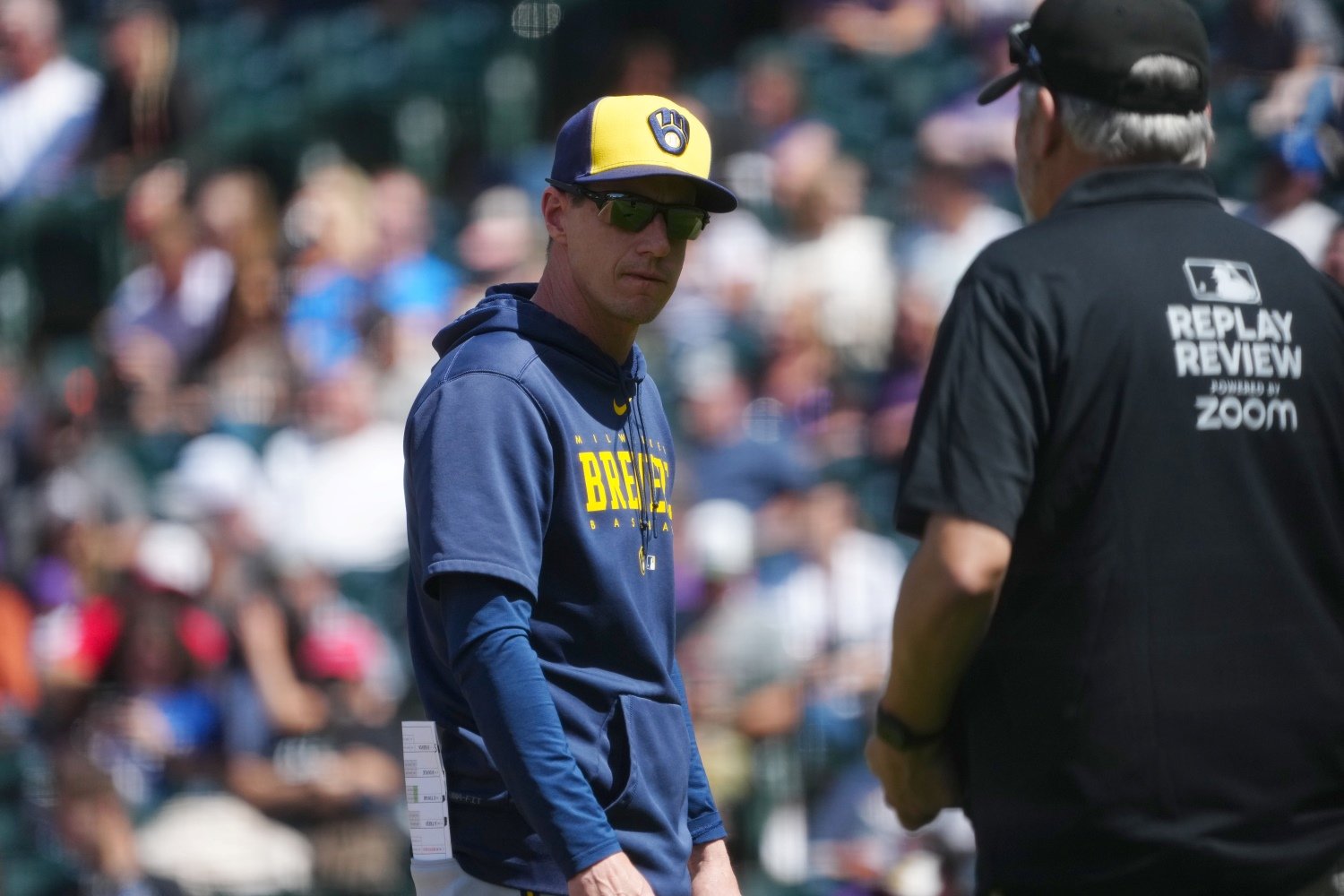 Box Score Starting Pitcher: Wade Miley - 6.0 IP, 6 H, 3 ER, 2 BB, 2 K, 90 pitches, 59 strikes (65.6%) Home Runs: Christian Yelich (4), Rowdy Tellez (9), Tyrone Taylor (1) Top 3 WPA: Wade Miley (.100), Brian Anderson (.063), Christian Yelich (.063) Bottom 3 WPA: Peter Strzelecki (-.332), Willy Adames (-.147), Joel Payamps (-.140) Win Probability Chart (via FanGraphs) Miley Goes A Tad Too Long Wade Miley started strong, pitching his first six innings without giving up a run. He’s been great at inducing soft contact, with 10 of his batted balls in today’s game having an exit velocity under 75 miles per hour. Miley has never been a power pitcher; his highest season-average fastball velocity clocked in at 91.4 mph when he was with the Orioles in 2017. To address this, he’s been using a cutter more frequently, which averages just 86 mph. He trades strikeouts for ground balls and shallow pop-ups, which explains his typical low-strikeout stat line. His changeup is also quite nifty, and relies more on movement than a velocity difference, since its average velocity of 82 mph is just 4 mph slower than his cutter. Unfortunately, it seemed that he was kept in the game a little too long. When he took the mound in the seventh, he immediately gave up three consecutive hits - two singles and a double. Ezequiel Tovar’s double batted in the Rockies’ first two runs and promptly led Craig Counsell to replace Miley with Joel Payamps before he was able to log a single out in the inning. Payamps Struggles… If I were to sum up the second half of today’s game with a single action, it would be a heavy sigh beneath a furrowed brow. Joel Payamps had a chaotic relief appearance, inheriting a single base runner and then giving up a single to Brenton Doyle, which put Rockies runners on the corners. Then he allegedly balked. Allegedly is probably the most accurate way to describe the call, since it was at best an extremely strict interpretation of the balk rule, but it allowed Tovar to score the Rockies third run. A sacrifice fly by Elias Diaz would score Doyle and tie the game at four runs each. …But Strzelecki Struggles Even Harder Before this game, Peter Strzelecki had a 1.23 ERA and a WHIP of 0.886. By the end of his eighth inning relief appearance, his ERA rose to 4.20 and his WHIP to 1.13. So what happened? Let’s take a look: Kris Bryant struck out. C.J. Cron hit a single. Mike Moustakas hit a double. Harold Castro hit a single to score Ryan McMahon, Cron’s pinch runner, and Moustakas. The Rockies are now up 6-4. Ezequiel Tovar is hit by a pitch. Brenton Doyle walks, loading the bases. Strzelecki is replaced by Tyson Miller Elias Diaz hits a sacrifice fly (again?) to score Castro. The Rockies are now up 7-4. Charlie Blackmon hit a single to score Tovar and Doyle. The Rockies are now up 9-4. Jurickson Profar lines out, finally ending the suffering. Of the three hits that Strzelecki surrendered, two were on his changeup and one was on his slider. He also seemed to have trouble controlling his four-seam fastball, with seven balls and zero called strikes. Well At Least We Hit The Ball, Right Guys? The cheesehead made three pate appearances, as Christian Yelich, Rowdy Tellez, and Tyrone Taylor all hit home runs in this game. A Brian Anderson triple followed by a Victor Caratini RBI single would bring the lead to 4-0 and for a moment, it seemed that Milwaukee would avoid being swept. Brian Anderson’s triple had seemingly conflicting batted ball data, having an xBA of just .100 but also ending up as a home run in 27/30 ballparks, the three exceptions being Fenway Park, Coors Field, and Kauffman Stadium. After the bullpen began to collapse, the lineup made a valiant effort to win back the game. Brice Turang led off the ninth with a walk, then advanced to second base on defensive indifference. Yelich scored him with a single, before scoring a run himself on a single by Jesse Winker. The Brewers had closed the deficit to three runs and Winker was on base. In an ideal world, Adames would’ve gotten on base, Tellez would have tied it, and then Anderson would have hit the go-ahead home run. But much to the chagrin of Brewers fans everywhere, Adames instead hit a weak ground ball, ending what should’ve been a straightforward victory with the final twist of defeat's blade. What’s Next? The Brewers are traveling to the Bay Area to face off against the San Francisco Giants. Corbin Burnes will make his seventh start of the season against lefty Sean Manaea and the team as a whole will look to snap this recent four-game skid. On the bright side, the Pirates have also been losing consistently, so the Brewers are still just 1.5 games behind the current division leader and three games ahead of the Cubs. Postgame Interviews Bullpen Usage Spreadsheet SUN MON TUE WED THU TOT Cousins 16 0 0 33 0 49 Payamps 5 0 14 0 21 40 Strzelecki 0 0 10 0 27 37 Milner 19 0 0 12 0 31 Miller 19 0 0 0 12 31 Peguero 0 0 0 16 0 16 B Wilson 0 0 0 0 0 0 Williams 0 0 0 0 0 0 Tweet Highlight
 -
The Brewers blew a 92.6% chance to win in the final three innings of one of the most tragic games of the season thus far. Image courtesy of © Ron Chenoy-USA TODAY Sports Box Score Starting Pitcher: Wade Miley - 6.0 IP, 6 H, 3 ER, 2 BB, 2 K, 90 pitches, 59 strikes (65.6%) Home Runs: Christian Yelich (4), Rowdy Tellez (9), Tyrone Taylor (1) Top 3 WPA: Wade Miley (.100), Brian Anderson (.063), Christian Yelich (.063) Bottom 3 WPA: Peter Strzelecki (-.332), Willy Adames (-.147), Joel Payamps (-.140) Win Probability Chart (via FanGraphs) Miley Goes A Tad Too Long Wade Miley started strong, pitching his first six innings without giving up a run. He’s been great at inducing soft contact, with 10 of his batted balls in today’s game having an exit velocity under 75 miles per hour. Miley has never been a power pitcher; his highest season-average fastball velocity clocked in at 91.4 mph when he was with the Orioles in 2017. To address this, he’s been using a cutter more frequently, which averages just 86 mph. He trades strikeouts for ground balls and shallow pop-ups, which explains his typical low-strikeout stat line. His changeup is also quite nifty, and relies more on movement than a velocity difference, since its average velocity of 82 mph is just 4 mph slower than his cutter. Unfortunately, it seemed that he was kept in the game a little too long. When he took the mound in the seventh, he immediately gave up three consecutive hits - two singles and a double. Ezequiel Tovar’s double batted in the Rockies’ first two runs and promptly led Craig Counsell to replace Miley with Joel Payamps before he was able to log a single out in the inning. Payamps Struggles… If I were to sum up the second half of today’s game with a single action, it would be a heavy sigh beneath a furrowed brow. Joel Payamps had a chaotic relief appearance, inheriting a single base runner and then giving up a single to Brenton Doyle, which put Rockies runners on the corners. Then he allegedly balked. Allegedly is probably the most accurate way to describe the call, since it was at best an extremely strict interpretation of the balk rule, but it allowed Tovar to score the Rockies third run. A sacrifice fly by Elias Diaz would score Doyle and tie the game at four runs each. …But Strzelecki Struggles Even Harder Before this game, Peter Strzelecki had a 1.23 ERA and a WHIP of 0.886. By the end of his eighth inning relief appearance, his ERA rose to 4.20 and his WHIP to 1.13. So what happened? Let’s take a look: Kris Bryant struck out. C.J. Cron hit a single. Mike Moustakas hit a double. Harold Castro hit a single to score Ryan McMahon, Cron’s pinch runner, and Moustakas. The Rockies are now up 6-4. Ezequiel Tovar is hit by a pitch. Brenton Doyle walks, loading the bases. Strzelecki is replaced by Tyson Miller Elias Diaz hits a sacrifice fly (again?) to score Castro. The Rockies are now up 7-4. Charlie Blackmon hit a single to score Tovar and Doyle. The Rockies are now up 9-4. Jurickson Profar lines out, finally ending the suffering. Of the three hits that Strzelecki surrendered, two were on his changeup and one was on his slider. He also seemed to have trouble controlling his four-seam fastball, with seven balls and zero called strikes. Well At Least We Hit The Ball, Right Guys? The cheesehead made three pate appearances, as Christian Yelich, Rowdy Tellez, and Tyrone Taylor all hit home runs in this game. A Brian Anderson triple followed by a Victor Caratini RBI single would bring the lead to 4-0 and for a moment, it seemed that Milwaukee would avoid being swept. Brian Anderson’s triple had seemingly conflicting batted ball data, having an xBA of just .100 but also ending up as a home run in 27/30 ballparks, the three exceptions being Fenway Park, Coors Field, and Kauffman Stadium. After the bullpen began to collapse, the lineup made a valiant effort to win back the game. Brice Turang led off the ninth with a walk, then advanced to second base on defensive indifference. Yelich scored him with a single, before scoring a run himself on a single by Jesse Winker. The Brewers had closed the deficit to three runs and Winker was on base. In an ideal world, Adames would’ve gotten on base, Tellez would have tied it, and then Anderson would have hit the go-ahead home run. But much to the chagrin of Brewers fans everywhere, Adames instead hit a weak ground ball, ending what should’ve been a straightforward victory with the final twist of defeat's blade. What’s Next? The Brewers are traveling to the Bay Area to face off against the San Francisco Giants. Corbin Burnes will make his seventh start of the season against lefty Sean Manaea and the team as a whole will look to snap this recent four-game skid. On the bright side, the Pirates have also been losing consistently, so the Brewers are still just 1.5 games behind the current division leader and three games ahead of the Cubs. Postgame Interviews Bullpen Usage Spreadsheet SUN MON TUE WED THU TOT Cousins 16 0 0 33 0 49 Payamps 5 0 14 0 21 40 Strzelecki 0 0 10 0 27 37 Milner 19 0 0 12 0 31 Miller 19 0 0 0 12 31 Peguero 0 0 0 16 0 16 B Wilson 0 0 0 0 0 0 Williams 0 0 0 0 0 0 Tweet Highlight View full article
-
The Brewers struggled to get their offense together, and the pitching suffered the Coors Field curse in the second of a three-game Rockies series. Hey, weren't we supposed to win these games? Image courtesy of © Isaiah J. Downing-USA TODAY Sports The Brewers struggled to get their offense together, and the pitching suffered the Coors Field curse in the second of a three-game Rockies series. Hey, weren't we supposed to win these games? Box Score Starting Pitcher: Eric Lauer - 4.2 IP, 4 H, 0 ER, 4 BB, 6 K, 84 pitches, 48 strikes (57.1%) Home Runs: None Top 3 WPA: Brice Turang (.040), Elvis Peguero (.031), Owen Miller (.005) Bottom 3 WPA: Eric Lauer (-.129), Willy Adames (-.079), Tyrone Taylor (-.074) Win Probability Chart (via FanGraphs) Peralta Loves Coors Field, Lauer Does Not Before the game, I saw a worrying tweet that stated that Eric Lauer had the worst ERA of all active pitchers at Coors Field, with a minimum of 100 batters faced. Now, past performance is not perfectly indicative of future results, but in this case, they weren’t too far off. Lauer started off strong, conceding zero runs in the first three innings of his start while fanning three. He started the fourth inning strong, striking out Jurickson Profar, before cracks began to show. After Kris Bryant reached base on an error by Mike Brosseau, CJ Cron doubled to put two runners in scoring position. Elias Diaz hit an RBI single to score Bryant, and would be pushed into scoring position himself by a Randal Grichuk walk to load the bases. Lauer bounced back by striking out Ryan McMahon, but gave up a bases-clearing double to Alan Trejo. When the dust cleared, the Rockies had gone up 4-0. It should be noted that official scoring tagged Lauer with no earned runs in this start, and he did have six strikeouts, so perhaps the game wasn't actually his fault. Despite just one official error allowing Bryant on-base, all four of these runs were considered unearned. Sadness In The Seventh (and Eighth) After Lauer’s early exit in the fifth inning, Elvis Peguero worked the remainder of the fifth inning and the entirety of the sixth, giving up just one hit. Hoby Milner took over at the start of the seventh. After getting Charlie Blackmon to ground out, he faced the top of the Rockies order. He gave up a double to Profar and a rare Coors Field home run to Bryant, ending his brief night and allowing the score to balloon to 6-0 in favor of the Rockies. Milner was replaced by Jake Cousins, who started by loading the bases on a walk and two consecutive hits. Luckily, a flyout and a laser of a throw by Tyrone Taylor helped secure a crucial double play, preventing Colorado from running up the score any more. Cousins kept cruising in the eighth before giving up a solo home run to Blackmon, putting the Rockies up by seven runs. Missing: Have You Seen The Brewers Offense? In yesterday’s game recap, I noted that the Brewers had the second-lowest OPS against lefties in MLB. Today’s game was a good example of that. Lefty Kyle Freeland had his way with the Milwaukee lineup, giving up just three hits and no walks in his five-inning start. Despite the Rockies bullpen being a mix of both righties and lefties, it just seemed like the Brewers were out of their element, unable to make solid contact. In today’s episode of Batted Balls That Should’ve Been Home Runs But Ended Up As Doubles, Brice Turang (who has seen some offensive struggles as of late), hit a 418-foot rocket to enter field that had an expected batting average of .560 and would’ve been a home run in 22/30 ballparks. What’s Next? Wade Miley will pitch against Connor Seabold in the final game of this somewhat disheartening series. In 37 1/3 innings pitched at Coors Field, he’s averaged an ERA of 5.79 and based on his tOPS+ of 135, batters hit 35% more effectively against him than his average performance. Coors Field is his third-worst ballpark, so we’ll see if he can defy the odds in his next start. Pitching aside, the Brewers need to rediscover what made their hitting so exciting at the beginning of the season. Over the last seven days, they are the worst-hitting team in the NL and the second-worst in MLB, slashing .191/.279/.270 for an OPS of .549. Postgame Interviews Bullpen Usage Spreadsheet SAT SUN MON TUE WED TOT Cousins 0 16 0 0 33 49 Peguero 23 0 0 0 16 39 Milner 0 19 0 0 12 31 Strzelecki 12 0 0 10 0 22 Miller 0 19 0 0 0 19 Payamps 0 5 0 14 0 19 B Wilson 7 0 0 0 0 7 Williams 4 0 0 0 0 4 Tweet Highlight View full article
-
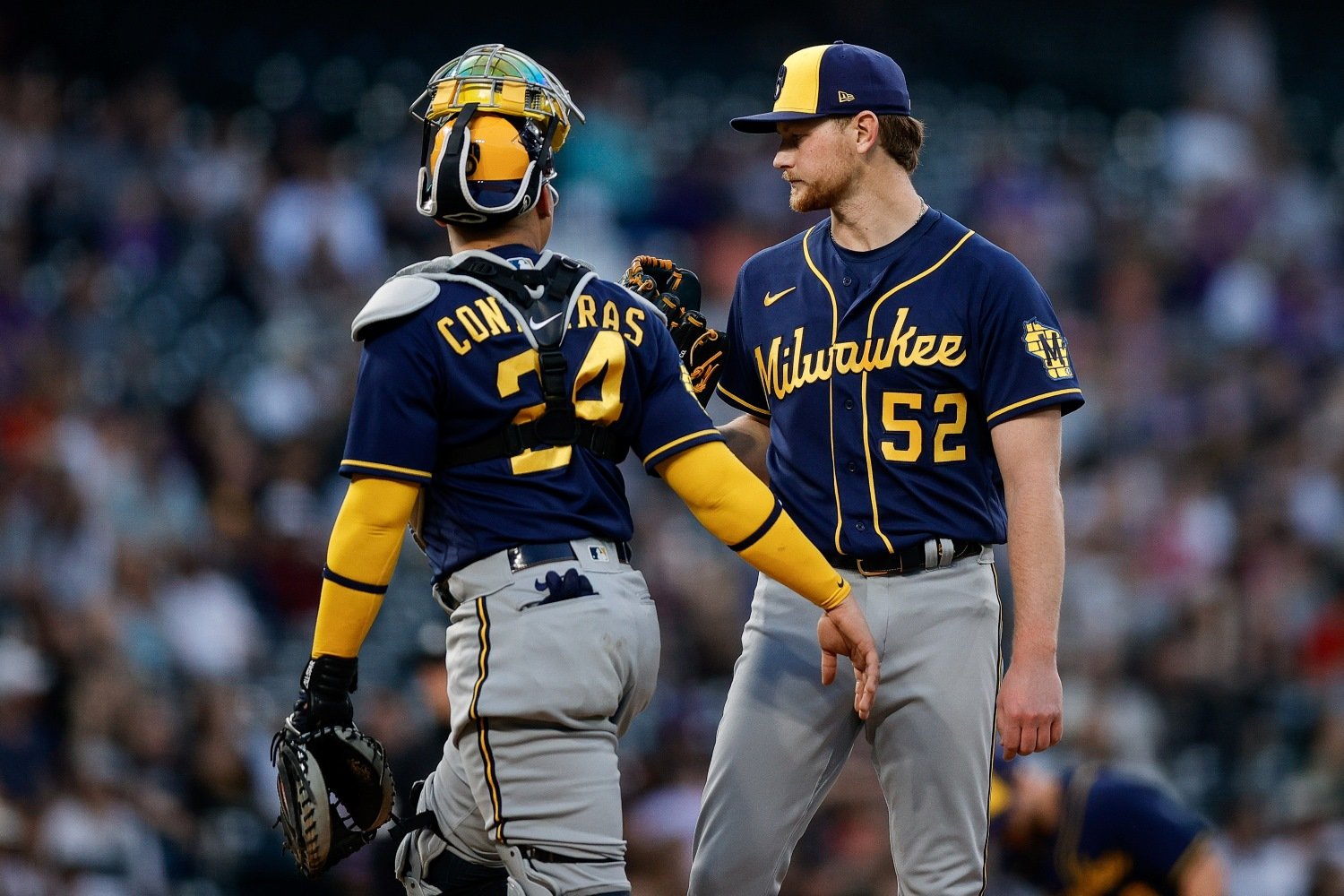 Box Score Starting Pitcher: Eric Lauer - 4.2 IP, 4 H, 0 ER, 4 BB, 6 K, 84 pitches, 48 strikes (57.1%) Home Runs: None Top 3 WPA: Brice Turang (.040), Elvis Peguero (.031), Owen Miller (.005) Bottom 3 WPA: Eric Lauer (-.129), Willy Adames (-.079), Tyrone Taylor (-.074) Win Probability Chart (via FanGraphs) Peralta Loves Coors Field, Lauer Does Not Before the game, I saw a worrying tweet that stated that Eric Lauer had the worst ERA of all active pitchers at Coors Field, with a minimum of 100 batters faced. Now, past performance is not perfectly indicative of future results, but in this case, they weren’t too far off. Lauer started off strong, conceding zero runs in the first three innings of his start while fanning three. He started the fourth inning strong, striking out Jurickson Profar, before cracks began to show. After Kris Bryant reached base on an error by Mike Brosseau, CJ Cron doubled to put two runners in scoring position. Elias Diaz hit an RBI single to score Bryant, and would be pushed into scoring position himself by a Randal Grichuk walk to load the bases. Lauer bounced back by striking out Ryan McMahon, but gave up a bases-clearing double to Alan Trejo. When the dust cleared, the Rockies had gone up 4-0. It should be noted that official scoring tagged Lauer with no earned runs in this start, and he did have six strikeouts, so perhaps the game wasn't actually his fault. Despite just one official error allowing Bryant on-base, all four of these runs were considered unearned. Sadness In The Seventh (and Eighth) After Lauer’s early exit in the fifth inning, Elvis Peguero worked the remainder of the fifth inning and the entirety of the sixth, giving up just one hit. Hoby Milner took over at the start of the seventh. After getting Charlie Blackmon to ground out, he faced the top of the Rockies order. He gave up a double to Profar and a rare Coors Field home run to Bryant, ending his brief night and allowing the score to balloon to 6-0 in favor of the Rockies. Milner was replaced by Jake Cousins, who started by loading the bases on a walk and two consecutive hits. Luckily, a flyout and a laser of a throw by Tyrone Taylor helped secure a crucial double play, preventing Colorado from running up the score any more. Cousins kept cruising in the eighth before giving up a solo home run to Blackmon, putting the Rockies up by seven runs. Missing: Have You Seen The Brewers Offense? In yesterday’s game recap, I noted that the Brewers had the second-lowest OPS against lefties in MLB. Today’s game was a good example of that. Lefty Kyle Freeland had his way with the Milwaukee lineup, giving up just three hits and no walks in his five-inning start. Despite the Rockies bullpen being a mix of both righties and lefties, it just seemed like the Brewers were out of their element, unable to make solid contact. In today’s episode of Batted Balls That Should’ve Been Home Runs But Ended Up As Doubles, Brice Turang (who has seen some offensive struggles as of late), hit a 418-foot rocket to enter field that had an expected batting average of .560 and would’ve been a home run in 22/30 ballparks. What’s Next? Wade Miley will pitch against Connor Seabold in the final game of this somewhat disheartening series. In 37 1/3 innings pitched at Coors Field, he’s averaged an ERA of 5.79 and based on his tOPS+ of 135, batters hit 35% more effectively against him than his average performance. Coors Field is his third-worst ballpark, so we’ll see if he can defy the odds in his next start. Pitching aside, the Brewers need to rediscover what made their hitting so exciting at the beginning of the season. Over the last seven days, they are the worst-hitting team in the NL and the second-worst in MLB, slashing .191/.279/.270 for an OPS of .549. Postgame Interviews Bullpen Usage Spreadsheet SAT SUN MON TUE WED TOT Cousins 0 16 0 0 33 49 Peguero 23 0 0 0 16 39 Milner 0 19 0 0 12 31 Strzelecki 12 0 0 10 0 22 Miller 0 19 0 0 0 19 Payamps 0 5 0 14 0 19 B Wilson 7 0 0 0 0 7 Williams 4 0 0 0 0 4 Tweet Highlight
 -
My Mental Health Journey
Jason Wang replied to Sean Franken's topic in Brewer Fanatic Front Page News
The unfortunate reality is that many men struggle to be vulnerable and seek help in tough times. There's been a "push" for more men to seek therapy but to me, it's a false narrative used to belittle men even further. I see a lot of jokes made about how all men "need therapy" because of seemingly innocuous things they do or say. It doesn't address the fact that in many areas (like Seattle, where I live), there is an extreme shortage of available therapists or the fact that therapy is extremely pricey and can be inaccessible for many. Sean, I relate a lot to your story. Every few months, I get in the same state. I feel that I'll never get the respect I want or deserve and that there is no hope. When I try to tell others about how I feel, they always just tell me to "get therapy" or to "change the way I see the world," the equivalent of telling people with depression to "just be happy." I've been to therapy for a while but it hasn't been effective for me thus far. I'm hoping to find a more productive solution down the line but for now, I've more or less had to depend on myself and a few very close friends. I'm glad you surfaced this and I hope that you know that if nothing else, there is a small but enthusiastic community of cheesehead-wearing people on this site that will have your back if you find yourself back in the trenches. -
Caratini low-key been pounding at the plate too. Small sample size (just 27 PAs over the past month) but .958 OPS over that span is very respectable for a catcher.
-
The Brewers came up short in Denver, dropping the first game of the series with the Rockies. Despite the end result, there were a lot of things to like on Tuesday night. Image courtesy of © Isaiah J. Downing-USA TODAY Sports The Brewers came up short in Denver, dropping the first game of the series with the Rockies. Despite the end result, there were a lot of things to like on Tuesday night. Box Score Starting Pitcher: Freddy Peralta - 6.0 IP, 7 H, 2 ER, 3 BB, 10 K, 94 pitches, 61 strikes (64.9%) Home Runs: None Top 3 WPA: Freddy Peralta (.142), Jesse Winker (.107), Rowdy Tellez (.076) Bottom 3 WPA: Willy Adames (-.212), Brian Anderson (-.206), Peter Strzelecki (-.185) Win Probability Chart (via FanGraphs) Peralta Overcomes Early Struggles En Route to 10 Strikeouts Freddy Peralta has a special relationship with Coors Field. On Mother’s Day in 2018, Peralta made his major-league debut and struck out 13 batters while allowing no hits until the sixth inning. He set a new Brewers record for strikeouts in a game as a rookie, and became just the fifth pitcher since 1908 to have 13 or more in his first game. Today, he had a (ahem) rockier start. He gave up two home runs, one to Ezequiel Tovar in the third inning and one to Elias Diaz in the fourth. After a few mound visits from William Contreras and a few encouraging gestures, Peralta seemed to figure things out, allowing no more earned runs through the remainder of his start and becoming the first Brewers starter to crack double digits with a strikeout total this year. He also recorded a tremendous 25 swings and misses, mostly thanks to some truly filthy moment from his slider and curveball. The importance of this start was to see if Peralta would be able to work his way through tough early innings to flex his stuff. His fastest pitch of the start was a 97.6-mph four-seam fastball, his 80th pitch, showing an ability to maintain velocity deep into games. Out of the active rotation, Peralta has the second-best ERA at 3.63--trailing only Wade Miley, who stands at an exceptional 1.86. Doubles Are Pretty Much The Same As Homers, Right? While Milwaukee wasn’t able to hit any balls into the seats, they came pretty darn close. Rowdy Tellez himself hit two doubles, one in the first inning and one in the sixth. Christian Yelich also hit a lead-off double in the sixth inning, with some particularly interesting batted-ball data. Many of us know that Coors Field is the most hitter-friendly park in baseball, due to its high-altitude location that allows balls to fly higher and farther than usual. However, this advantage is slightly offset by the sheer size of its outfield. Yelich’s double had an exit velocity of 109.5 mph, a launch angle of 20 degrees, a total distance of 421 feet, and an expected batting average of .870. In 24 out of 30 ballparks, it would’ve been a home run. Just a particularly interesting batted-ball anomaly in tonight’s game. Contreras joined the party in the ninth inning, hitting a key automatic double to left-center field in the ninth inning while the Brewers were down by a run. A groundout by Brian Anderson allowed pinch-runner Mike Brosseau to advance to third base, but a Brice Turang strikeout was the nail in the coffin. Oh wait, did I mention that Contreras's batted ball went 408 feet and would've been a home run in 28 ballparks? The two exceptions: Coors Field and PNC Park. That also makes two batted-ball anomalies in what is supposed to be a hitter-friendly park. Who broke a mirror before the game? Winker Dazzles While Flexing New Ice We all know that baseball players love chains, but nowadays, they mostly look the same: some form of gold links, sometimes bedazzled with diamonds if the contract extension signed in the offseason was long enough. Today, Winker bucked that trend by showing off a 1-of-1 curb chain designed by his daughter, just a day late to be shown on the Met Gala red carpet. As if imbued by the powers of parenthood, Winker got on base three times, with two hits and one walk. It might’ve been four times if not for a somewhat controversial pitch clock violation that led to his only strikeout of the night. Craig Counsell seemed particularly careful after being recently ejected and quickly pulled Winker into the dugout to avoid further trouble. After all, there are few things more intimidating than a Winker donning a bead necklace arguing pitch clock violations. What’s Next? Eric Lauer will face Kyle Freeland in a lefty-on-lefty matchup for the second game of this series. The Rockies have an OPS of .652 against lefties this season, a slight decrease from their OPS against righties of .712. The Brewers, on the other hand, have the second-worst OPS against lefty pitching at just .623, while holding an OPS against righty pitching of .738. But who needs stats, when they don't suit our biases? Postgame Interviews Bullpen Usage Spreadsheet FRI SAT SUN MON TUE TOT Strzelecki 15 12 0 0 10 27 Peguero 0 23 0 0 0 23 Payamps 14 0 5 0 14 19 Milner 0 0 19 0 0 19 Miller 0 0 19 0 0 19 Williams 13 4 0 0 0 17 Cousins 0 0 16 0 0 16 B Wilson 0 7 0 0 0 7 Tweet Highlight View full article
-
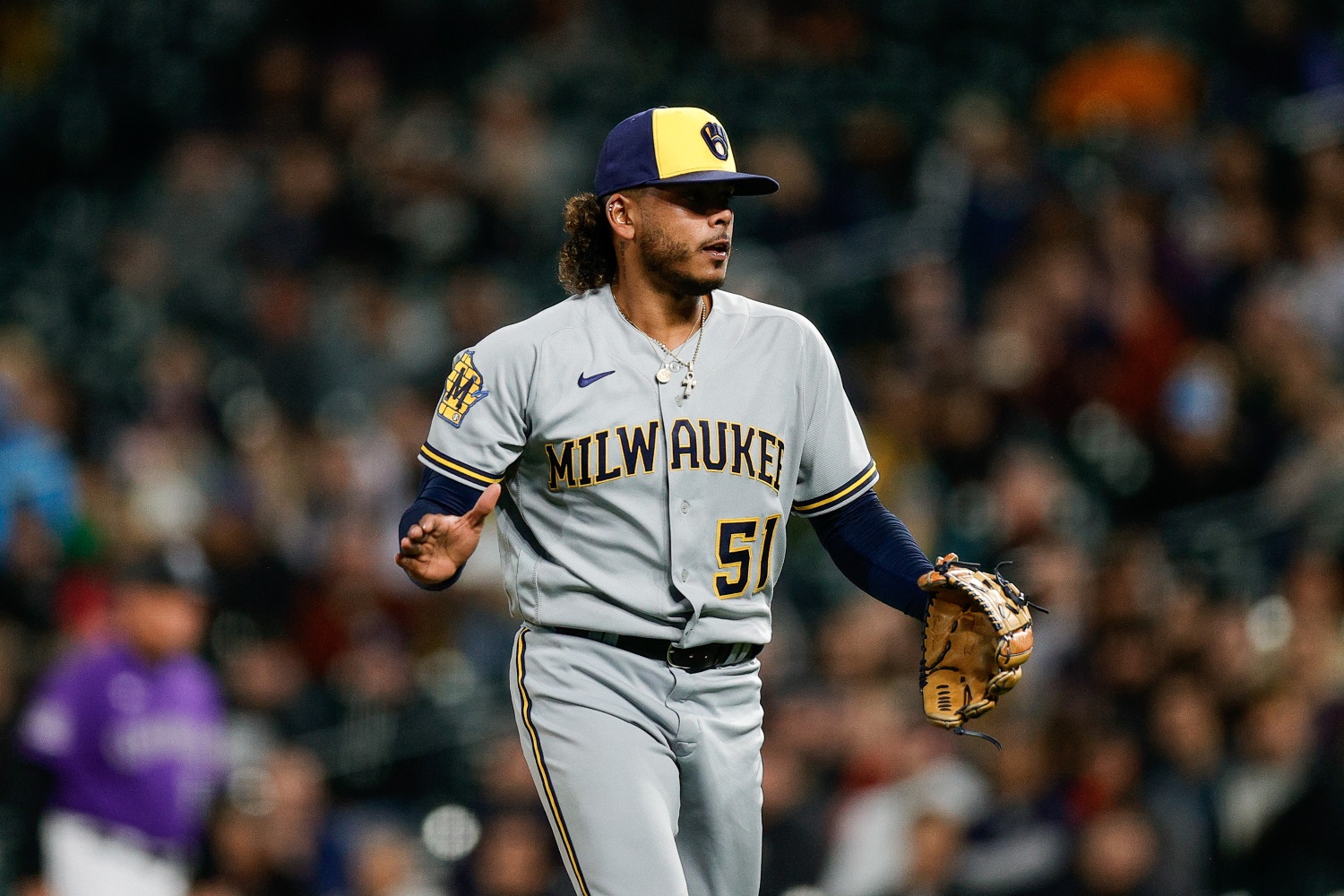 Box Score Starting Pitcher: Freddy Peralta - 6.0 IP, 7 H, 2 ER, 3 BB, 10 K, 94 pitches, 61 strikes (64.9%) Home Runs: None Top 3 WPA: Freddy Peralta (.142), Jesse Winker (.107), Rowdy Tellez (.076) Bottom 3 WPA: Willy Adames (-.212), Brian Anderson (-.206), Peter Strzelecki (-.185) Win Probability Chart (via FanGraphs) Peralta Overcomes Early Struggles En Route to 10 Strikeouts Freddy Peralta has a special relationship with Coors Field. On Mother’s Day in 2018, Peralta made his major-league debut and struck out 13 batters while allowing no hits until the sixth inning. He set a new Brewers record for strikeouts in a game as a rookie, and became just the fifth pitcher since 1908 to have 13 or more in his first game. Today, he had a (ahem) rockier start. He gave up two home runs, one to Ezequiel Tovar in the third inning and one to Elias Diaz in the fourth. After a few mound visits from William Contreras and a few encouraging gestures, Peralta seemed to figure things out, allowing no more earned runs through the remainder of his start and becoming the first Brewers starter to crack double digits with a strikeout total this year. He also recorded a tremendous 25 swings and misses, mostly thanks to some truly filthy moment from his slider and curveball. The importance of this start was to see if Peralta would be able to work his way through tough early innings to flex his stuff. His fastest pitch of the start was a 97.6-mph four-seam fastball, his 80th pitch, showing an ability to maintain velocity deep into games. Out of the active rotation, Peralta has the second-best ERA at 3.63--trailing only Wade Miley, who stands at an exceptional 1.86. Doubles Are Pretty Much The Same As Homers, Right? While Milwaukee wasn’t able to hit any balls into the seats, they came pretty darn close. Rowdy Tellez himself hit two doubles, one in the first inning and one in the sixth. Christian Yelich also hit a lead-off double in the sixth inning, with some particularly interesting batted-ball data. Many of us know that Coors Field is the most hitter-friendly park in baseball, due to its high-altitude location that allows balls to fly higher and farther than usual. However, this advantage is slightly offset by the sheer size of its outfield. Yelich’s double had an exit velocity of 109.5 mph, a launch angle of 20 degrees, a total distance of 421 feet, and an expected batting average of .870. In 24 out of 30 ballparks, it would’ve been a home run. Just a particularly interesting batted-ball anomaly in tonight’s game. Contreras joined the party in the ninth inning, hitting a key automatic double to left-center field in the ninth inning while the Brewers were down by a run. A groundout by Brian Anderson allowed pinch-runner Mike Brosseau to advance to third base, but a Brice Turang strikeout was the nail in the coffin. Oh wait, did I mention that Contreras's batted ball went 408 feet and would've been a home run in 28 ballparks? The two exceptions: Coors Field and PNC Park. That also makes two batted-ball anomalies in what is supposed to be a hitter-friendly park. Who broke a mirror before the game? Winker Dazzles While Flexing New Ice We all know that baseball players love chains, but nowadays, they mostly look the same: some form of gold links, sometimes bedazzled with diamonds if the contract extension signed in the offseason was long enough. Today, Winker bucked that trend by showing off a 1-of-1 curb chain designed by his daughter, just a day late to be shown on the Met Gala red carpet. As if imbued by the powers of parenthood, Winker got on base three times, with two hits and one walk. It might’ve been four times if not for a somewhat controversial pitch clock violation that led to his only strikeout of the night. Craig Counsell seemed particularly careful after being recently ejected and quickly pulled Winker into the dugout to avoid further trouble. After all, there are few things more intimidating than a Winker donning a bead necklace arguing pitch clock violations. What’s Next? Eric Lauer will face Kyle Freeland in a lefty-on-lefty matchup for the second game of this series. The Rockies have an OPS of .652 against lefties this season, a slight decrease from their OPS against righties of .712. The Brewers, on the other hand, have the second-worst OPS against lefty pitching at just .623, while holding an OPS against righty pitching of .738. But who needs stats, when they don't suit our biases? Postgame Interviews Bullpen Usage Spreadsheet FRI SAT SUN MON TUE TOT Strzelecki 15 12 0 0 10 27 Peguero 0 23 0 0 0 23 Payamps 14 0 5 0 14 19 Milner 0 0 19 0 0 19 Miller 0 0 19 0 0 19 Williams 13 4 0 0 0 17 Cousins 0 0 16 0 0 16 B Wilson 0 7 0 0 0 7 Tweet Highlight
 -
Brewers Pitcher of the Month - April 2023
Jason Wang replied to Jake McKibbin's topic in Brewer Fanatic Front Page News
No Joel Payamps enjoyers? He's definitely got one of the coolest names (park-adjusted, of course) in MLB.- 2 replies
-
- 1
-

-
- wade miley
- corbin burnes
- (and 2 more)
-
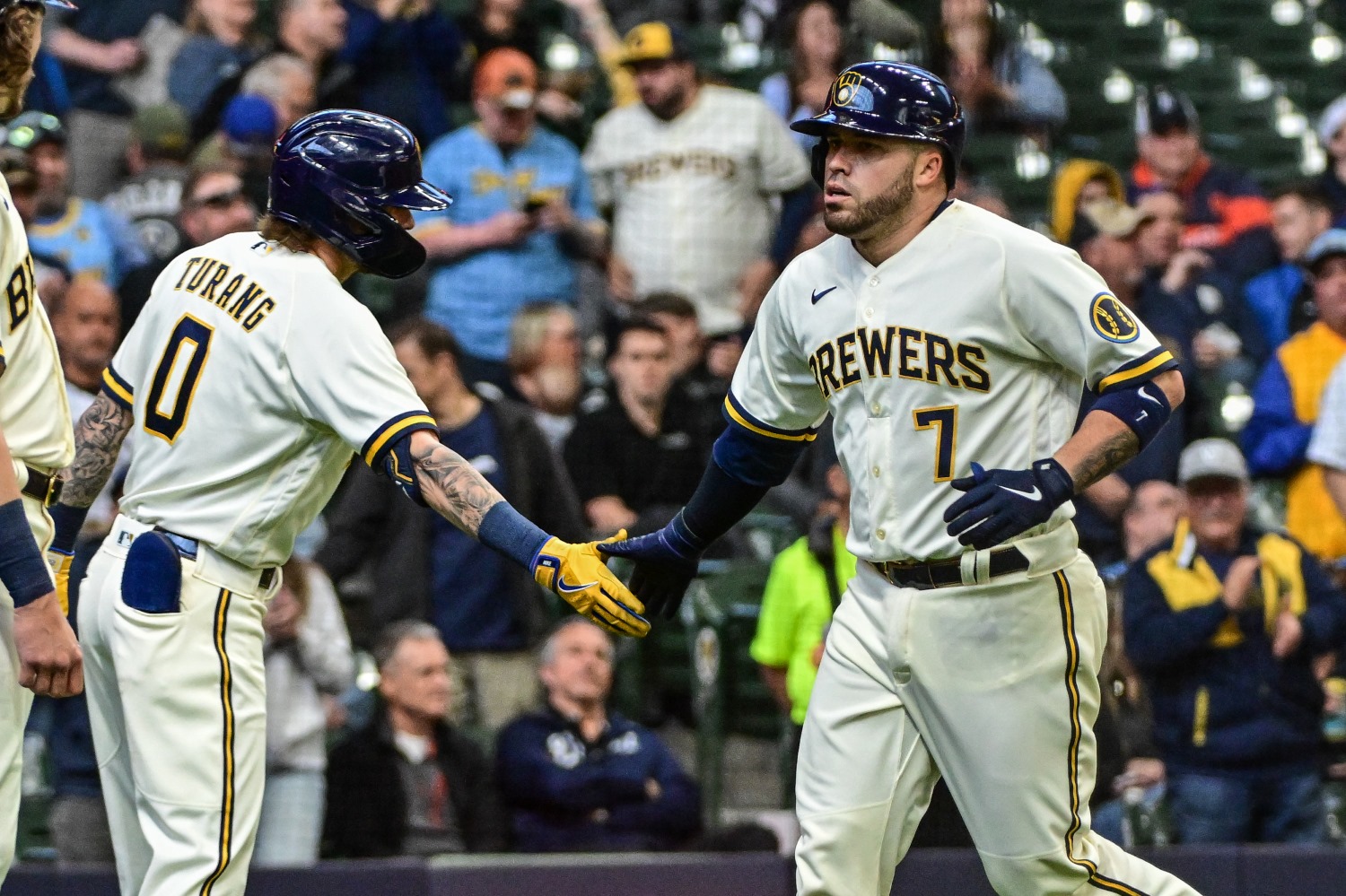 WEEKLY SNAPSHOT Record Last Week: 3-3 Runs Scored: 20 Runs Surrendered: 19 Standing: 2nd in NL Central (1.5 GB) Game 23 | MIL 2, DET 4 Game 24 | MIL 3, DET 4 Game 25 | MIL 6, DET 2 Game 26 | MIL 2, LAA 1: Brewers 2, Angels 1: Tell 'Em, Tellez Game 27 | MIL 7, LAA 5: Brewers 7, Angels 5: Insert Cruel Angels Joke Here Game 28 | MIL 0, DET 3: Brewers 0, Angels 3: It's Okay, We Already Won The Series NEWS AND NOTES Losing a series to the Detroit Tigers is probably not the best way to start a week, and it showed in the team’s offense. Run scoring was down from the week before, putting up 11 fewer runs in the same number of games. It seemed like the lineup as a whole struggled to put bat to ball and hit with authority and the Brewers had the second lowest OPS in Major League Baseball. AVG OBP SLG OPS .183 .269 .323 .592 Both catchers had standout performances this week, with Victor Caratini logging an astounding OPS of 1.625 and William Contreras coming in at a not-too-shabby .821. Rowdy Tellez also had some high-quality at-bats, slashing .313/.353/.563 for an OPS of .916. The same could not be said about Willy Adames and Brian Anderson. Adames struck out 11 times and batted a measly .105 over 19 ABs this week, really slumping from his offensive surge earlier in the season and posting a .524 OPS. Anderson put up similar numbers, striking out ten times and posting an OPS of .425, with an OBP of just .208 for the week. Team pitching was a mixed bag. The Brewers had the fifth-best ERA in MLB, mostly thanks to their lights-out relievers. New additions to the bullpen Jake Cousins and Tyson Miller joined Joel Payamps, Peter Strzelecki, and Devin Williams in holding batters to zero earned runs. Starting pitching was a little less dominant, with Eric Lauer and Colin Rea giving up several important earned runs in their respective starts against the Detroit Tigers. Rea would come back in strong fashion against the Angels, striking out nine in the final game of the week. ERA BB SO WHIP 3.17 13 47 1.20 INJURY REPORT Sal Frelick had UCL repair surgery on Tuesday to resolve issues he’s been having with his left thumb Brandon Woodruff is targeting a return by the end of June based on positive MRI results on his right shoulder Garrett Mitchell was moved from the 15-day IL to the 60-day IL, potentially signaling the end of his 2023 season as a result of shoulder surgery Gus Varland and Adrian Houser are in Low A and Triple A for their respective rehab assignments HIGHLIGHTS Joey Wiemer’s diving catch Rowdy Tellez's go-ahead RBI single Jesse Winker's two-run single Craig Counsell and Willy Adames ejected over a batter’s pitch clock violation LOOKING AHEAD The Rockies and Giants might not be the most difficult opponents the Brewers have had, but that’s what many said last week when they were slated to play the Tigers and Angels. Given how the offense has looked very recently, this is a chance for them to regain the momentum they had built up in the beginning of the season and close the current 1.5-game gap in the NL Central standings. TUESDAY, 5/2: Brewers @ Rockies - RHP Freddy Peralta vs. RHP Ryan Feltner WEDNESDAY, 5/3: Brewers @ Rockies - LHP Eric Lauer vs. LHP Kyle Freeland THURSDAY, 5/4: Brewers @ Rockies - LHP Wade Miley vs. TBD FRIDAY, 5/5: Brewers @ Giants - TBD vs. TBD SATURDAY, 5/6: Brewers @ Giants - TBD vs. TBD SUNDAY, 5/7: Brewers @ Giants - TBD vs. TBD
 -
The Brewers went 3-3 against the Detroit Tigers and the Los Angeles Angels, showing the effects of a somewhat depleted roster due to injury. Let's look back at the highs and the lows. Image courtesy of © Benny Sieu-USA TODAY Sports The Brewers went 3-3 against the Detroit Tigers and the Los Angeles Angels, showing the effects of a somewhat depleted roster due to injury. Let's look back at the highs and the lows. WEEKLY SNAPSHOT Record Last Week: 3-3 Runs Scored: 20 Runs Surrendered: 19 Standing: 2nd in NL Central (1.5 GB) Game 23 | MIL 2, DET 4 Game 24 | MIL 3, DET 4 Game 25 | MIL 6, DET 2 Game 26 | MIL 2, LAA 1: Brewers 2, Angels 1: Tell 'Em, Tellez Game 27 | MIL 7, LAA 5: Brewers 7, Angels 5: Insert Cruel Angels Joke Here Game 28 | MIL 0, DET 3: Brewers 0, Angels 3: It's Okay, We Already Won The Series NEWS AND NOTES Losing a series to the Detroit Tigers is probably not the best way to start a week, and it showed in the team’s offense. Run scoring was down from the week before, putting up 11 fewer runs in the same number of games. It seemed like the lineup as a whole struggled to put bat to ball and hit with authority and the Brewers had the second lowest OPS in Major League Baseball. AVG OBP SLG OPS .183 .269 .323 .592 Both catchers had standout performances this week, with Victor Caratini logging an astounding OPS of 1.625 and William Contreras coming in at a not-too-shabby .821. Rowdy Tellez also had some high-quality at-bats, slashing .313/.353/.563 for an OPS of .916. The same could not be said about Willy Adames and Brian Anderson. Adames struck out 11 times and batted a measly .105 over 19 ABs this week, really slumping from his offensive surge earlier in the season and posting a .524 OPS. Anderson put up similar numbers, striking out ten times and posting an OPS of .425, with an OBP of just .208 for the week. Team pitching was a mixed bag. The Brewers had the fifth-best ERA in MLB, mostly thanks to their lights-out relievers. New additions to the bullpen Jake Cousins and Tyson Miller joined Joel Payamps, Peter Strzelecki, and Devin Williams in holding batters to zero earned runs. Starting pitching was a little less dominant, with Eric Lauer and Colin Rea giving up several important earned runs in their respective starts against the Detroit Tigers. Rea would come back in strong fashion against the Angels, striking out nine in the final game of the week. ERA BB SO WHIP 3.17 13 47 1.20 INJURY REPORT Sal Frelick had UCL repair surgery on Tuesday to resolve issues he’s been having with his left thumb Brandon Woodruff is targeting a return by the end of June based on positive MRI results on his right shoulder Garrett Mitchell was moved from the 15-day IL to the 60-day IL, potentially signaling the end of his 2023 season as a result of shoulder surgery Gus Varland and Adrian Houser are in Low A and Triple A for their respective rehab assignments HIGHLIGHTS Joey Wiemer’s diving catch Rowdy Tellez's go-ahead RBI single Jesse Winker's two-run single Craig Counsell and Willy Adames ejected over a batter’s pitch clock violation LOOKING AHEAD The Rockies and Giants might not be the most difficult opponents the Brewers have had, but that’s what many said last week when they were slated to play the Tigers and Angels. Given how the offense has looked very recently, this is a chance for them to regain the momentum they had built up in the beginning of the season and close the current 1.5-game gap in the NL Central standings. TUESDAY, 5/2: Brewers @ Rockies - RHP Freddy Peralta vs. RHP Ryan Feltner WEDNESDAY, 5/3: Brewers @ Rockies - LHP Eric Lauer vs. LHP Kyle Freeland THURSDAY, 5/4: Brewers @ Rockies - LHP Wade Miley vs. TBD FRIDAY, 5/5: Brewers @ Giants - TBD vs. TBD SATURDAY, 5/6: Brewers @ Giants - TBD vs. TBD SUNDAY, 5/7: Brewers @ Giants - TBD vs. TBD View full article
-
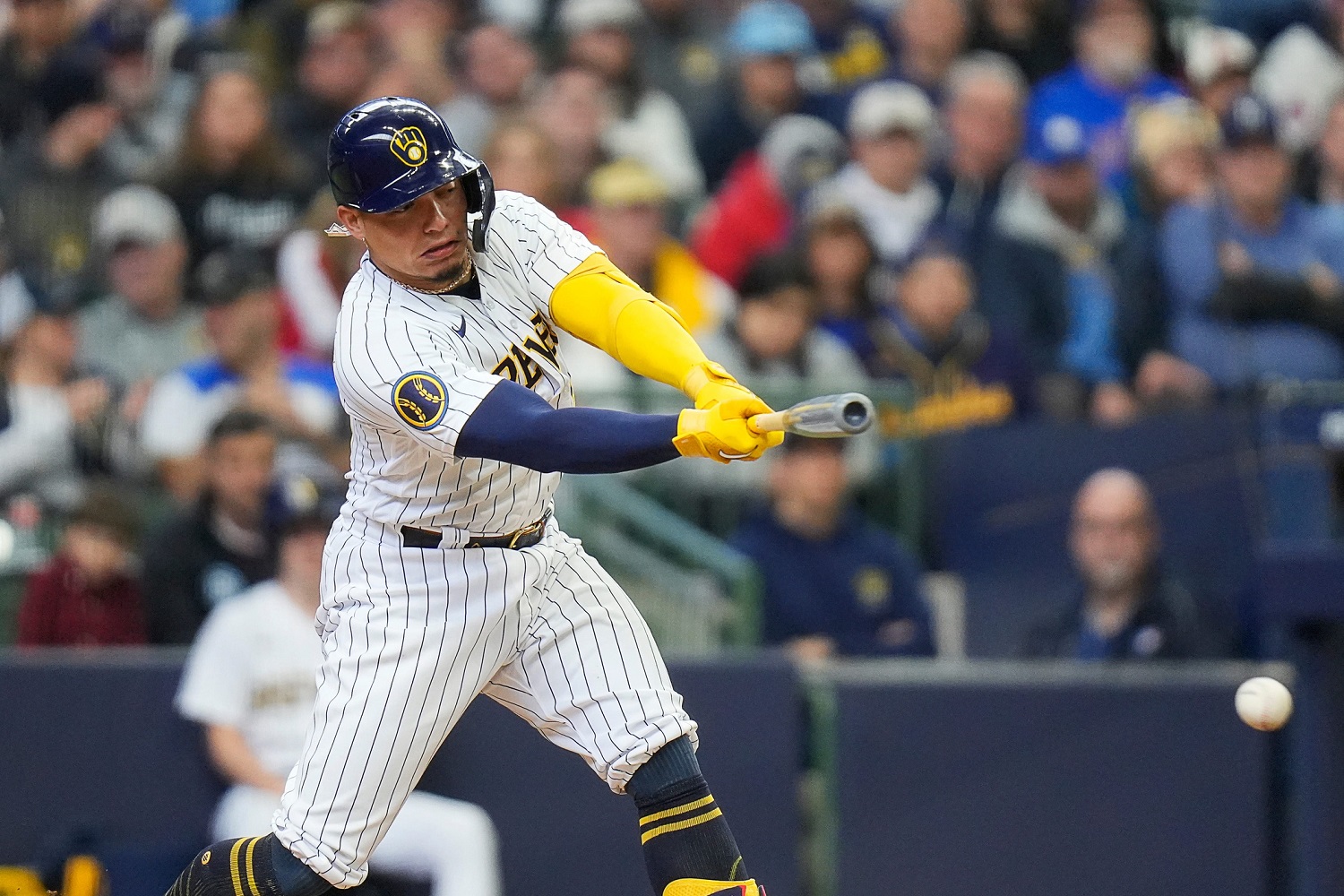 Box Score Starting Pitcher: Colin Rea - 5.0 IP, 3 H, 2 ER, 1 BB, 9 K, 86 pitches, 57 strikes (66.3%) Home Runs: None Top 3 WPA: Jake Cousins (.052), Brian Anderson (.026), Tyson Miller (.022) Bottom 3 WPA: Blake Perkins (-.129), Mike Brosseau (-.095), William Contreras (-.094) Win Probability Chart (via FanGraphs) Homers Happen, But Rea Recovers Colin Rea made a strong start, striking out nine in his five-inning start. Other than two home runs hit by Jake Lamb and Shohei Ohtani, he was able to avoid any major scoring trouble. More importantly, he had eight swinging strikes in the first inning while facing Mike Trout and Ohtani. While he’s still got a lot to improve, Colin Rea has been a serviceable replacement for Brandon Woodruff thus far and seemingly has incredible potential to hold down a long-term spot in this rotation. We’ll see how the team decides his fate upon Woodruff’s return from the IL. Lazy Sunday in Wisconsin The Brewers totaled just three hits, two of which were doubles by Brian Anderson and Joey Wiemer. Angels starter Jose Suarez struck out six batters in five innings and set the pace for the remainder of the game. The one highlight of the hitting performance today was a flyout by Mike Brosseau which had an exit velocity of 99.0 mph, a launch angle of 25 degrees, and a total distance of 363 feet. This doesn’t seem particularly out of the ordinary, but it is worth noting that in four ballparks (Wrigley Field, Minute Maid Park, Citizens Bank Park, and Petco Park), it would’ve counted as a home run. Goes to show the importance of park-adjusted OPS and other statistics. Cousins & Co Finish Strong In his second major league game this season, Jake Cousins pitched 1 1/3 innings in relief, giving up zero hits. While he didn’t record any strikeouts, he was able to pick off Shohei Ohtani to retire the side in the sixth inning. In a somewhat controversial decision, Craig Counsell would replace Cousins with Hoby Milner who would go on to give up two hits and a walk, culminating in a third run for the Angels. Tyson Miller, a recent call-up from the Nashville Sounds and Alex Claudio’s replacement, took on the final two innings of relief and gave up just one walk, a strong Milwaukee debut for the right-handed 27-year-old. What’s Next? After a much-needed off-day, the Brewers will face the Colorado Rockies at Coors Field. Freddy Peralta will make the start while the Rockies have yet to announce which poor sap will be responsible for throwing to the Milwaukee lineup in the most altitude-friendly ballpark in Major League Baseball. Postgame Interviews Bullpen Usage Spreadsheet WED THU FRI SAT SUN TOT Strzelecki 5 0 15 12 0 32 Milner 12 0 0 0 19 31 Williams 9 0 13 4 0 26 Peguero 0 0 0 23 0 23 Payamps 0 0 14 0 5 19 Miller 0 0 0 0 19 19 B Wilson 11 0 0 7 0 18 Cousins 0 0 0 0 16 16 Tweet Highlight
 -
The Angels shutout the Brewers in the third and final game of the series as the Milwaukee bats get a case of the Sunday Scaries. Image courtesy of Jovanny Hernandez / Milwaukee Journal Sentinel / USA TODAY NETWORK The Angels shutout the Brewers in the third and final game of the series as the Milwaukee bats get a case of the Sunday Scaries. Box Score Starting Pitcher: Colin Rea - 5.0 IP, 3 H, 2 ER, 1 BB, 9 K, 86 pitches, 57 strikes (66.3%) Home Runs: None Top 3 WPA: Jake Cousins (.052), Brian Anderson (.026), Tyson Miller (.022) Bottom 3 WPA: Blake Perkins (-.129), Mike Brosseau (-.095), William Contreras (-.094) Win Probability Chart (via FanGraphs) Homers Happen, But Rea Recovers Colin Rea made a strong start, striking out nine in his five-inning start. Other than two home runs hit by Jake Lamb and Shohei Ohtani, he was able to avoid any major scoring trouble. More importantly, he had eight swinging strikes in the first inning while facing Mike Trout and Ohtani. While he’s still got a lot to improve, Colin Rea has been a serviceable replacement for Brandon Woodruff thus far and seemingly has incredible potential to hold down a long-term spot in this rotation. We’ll see how the team decides his fate upon Woodruff’s return from the IL. Lazy Sunday in Wisconsin The Brewers totaled just three hits, two of which were doubles by Brian Anderson and Joey Wiemer. Angels starter Jose Suarez struck out six batters in five innings and set the pace for the remainder of the game. The one highlight of the hitting performance today was a flyout by Mike Brosseau which had an exit velocity of 99.0 mph, a launch angle of 25 degrees, and a total distance of 363 feet. This doesn’t seem particularly out of the ordinary, but it is worth noting that in four ballparks (Wrigley Field, Minute Maid Park, Citizens Bank Park, and Petco Park), it would’ve counted as a home run. Goes to show the importance of park-adjusted OPS and other statistics. Cousins & Co Finish Strong In his second major league game this season, Jake Cousins pitched 1 1/3 innings in relief, giving up zero hits. While he didn’t record any strikeouts, he was able to pick off Shohei Ohtani to retire the side in the sixth inning. In a somewhat controversial decision, Craig Counsell would replace Cousins with Hoby Milner who would go on to give up two hits and a walk, culminating in a third run for the Angels. Tyson Miller, a recent call-up from the Nashville Sounds and Alex Claudio’s replacement, took on the final two innings of relief and gave up just one walk, a strong Milwaukee debut for the right-handed 27-year-old. What’s Next? After a much-needed off-day, the Brewers will face the Colorado Rockies at Coors Field. Freddy Peralta will make the start while the Rockies have yet to announce which poor sap will be responsible for throwing to the Milwaukee lineup in the most altitude-friendly ballpark in Major League Baseball. Postgame Interviews Bullpen Usage Spreadsheet WED THU FRI SAT SUN TOT Strzelecki 5 0 15 12 0 32 Milner 12 0 0 0 19 31 Williams 9 0 13 4 0 26 Peguero 0 0 0 23 0 23 Payamps 0 0 14 0 5 19 Miller 0 0 0 0 19 19 B Wilson 11 0 0 7 0 18 Cousins 0 0 0 0 16 16 Tweet Highlight View full article
-
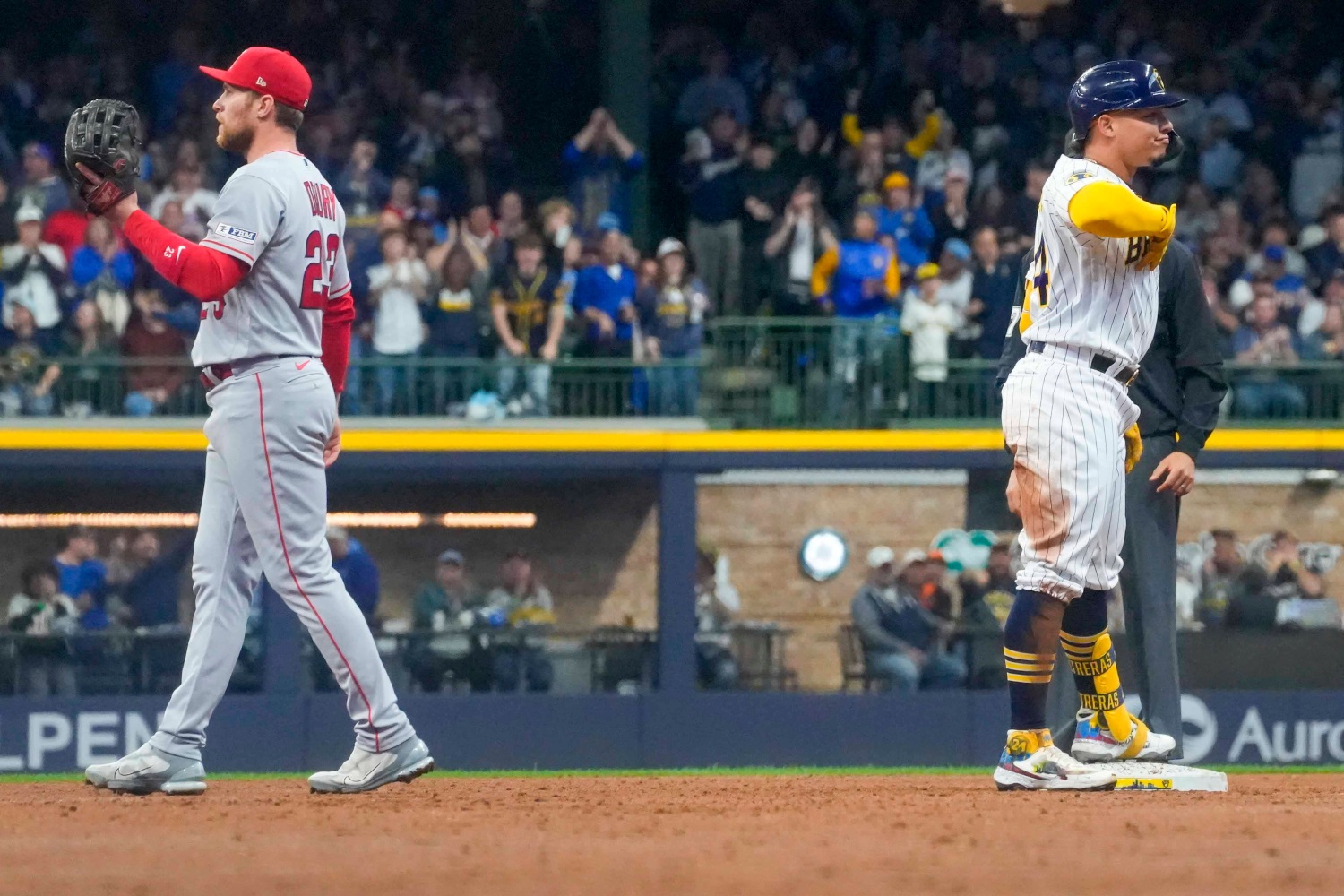 Box Score Starting Pitcher: Corbin Burnes - 6.0 IP, 5 H, 1 ER, 1 BB, 5 K, 91 pitches, 59 strikes (64.8%) Home Runs: None Top 3 WPA: Corbin Burnes (.184), Owen Miller (.129), William Contreras (.118) Bottom 3 WPA: Elvis Peguero (-.085), Mike Brosseau (-.040), Luke Voit (-.030) Win Probability Chart (via FanGraphs) O Burnes, Where Art Thou For the past three years, Brewers fans have been spoiled by having a dominant ace on the mound. Corbin Burnes owns a 2.62 ERA and 11.9 K/9 from 2020-2022. In fact, we’ve been spoiled so much that a five-strikeout performance is still somewhat disappointing, even if it meant conceding just one earned run in a six-inning outing. Burnes showed flashes of greatness, pairing a savage cutter with a sickening slider to strike out Taylor Ward and Hunter Renfroe, but we’re still waiting with bated breath for a return to his true, peak form. Compared to his stats from 2020-2022, his ERA and K/9 for 2023 currently stand at 4.01 and 7.22. Angels Mistakes Save The Day Like the first game of the series, this was a close one. Unlike the first game of the series, there was plenty of scoring to go around. Milwaukee really only strung together offense in the third and fifth innings, but in those frames, they did plenty. After a Victor Caratini walk and a double by Owen Miller, Joey Wiemer hit a groundout to allow Caratini to score, followed by an RBI single by Willy Adames to score Miller and an RBI double by William Contreras to score Adames. In the fifth inning, third baseman and bane of the Athletics’ fanbase Anthony Rendon made a crucial fielding error to allow Christian Yelich to reach, loading the bases and allowing a Contreras walk to score the first run of the inning. Jesse Winker then hit a two-run single to left field, bringing the score to 6-1. The Brewers loaded the bases on a Brian Anderson hit-by-pitch, before another Caratini walk made the score 7-1, a comfortable lead for the Brewers to ride through to the end of the game. The sixth inning got a little heated, however, as Adames and Craig Counsell were ejected for arguing an umpire’s refusal to grant Adames time and calling a pitch clock violation instead. But it’s okay because in the first half of the inning, Wiemer made this gracious diving to retire the side and get a toothy smile from Corbin. Brewers Bullpen Gives Angels Fans False Hope In the recap of the first game of this series, I wrote about how underrated the bullpen has been this season, showing up when needed most and getting crucial outs to secure victory in close games. Of course, even good units have bad days. At the beginning of the eighth inning, Milwaukee had a six-run lead and was on cruise control, with a 99.3% probability of winning the game. While facing his former teammate Mike Trout, relative newcomer Elvis Peguero gave up a two-run home run to close the lead slightly. In the ninth inning, a sense of deja vu fell over American Family Field as Mike Trout hit another two-run home run against Bryse Wilson. While Wilson had already earned two outs and the Brewers needed just one more to close the show, Milwaukee brought out Devin Williams after Ohtani hit a single just in case. He was able to keep his spotless ERA and avoid a potentially embarrassing blown lead. What's Next? Colin Rea will take the mound across from lefty Jose Suarez, the third consecutive left-handed starter the Brewers lineup will face. The team is still two wins behind the Pittsburgh Pirates, who currently lead the division with a 20-8 record. They are tied with the Atlanta Braves for the second-most wins in the National League and seem competitive for a playoff spot, barring any major injuries or regressions in performance. Let’s hope they keep up the good work! Postgame Interviews Bullpen Usage Spreadsheet ` TUE WED THU FRI SAT TOT Peguero 34 0 0 0 23 57 Payamps 31 0 0 14 0 45 Strzelecki 10 5 0 15 12 42 Williams 0 9 0 13 4 26 B Wilson 0 11 0 0 7 18 Milner 0 12 0 0 0 12 Cousins 0 0 0 0 0 0 Claudio 0 0 0 0 0 0 Tweet Highlight
 -
Even 5 RBI by Mike Trout weren't enough to stop the Brewers from claiming quick victory in the best-of-three series against the Angels. A seven-run outburst against Los Angeles pitching positioned the Crew for a chance to sweep on Sunday. Image courtesy of © Ebony Cox / Milwaukee Journal Sentinel / USA TODAY NETWORK Even 5 RBI by Mike Trout weren't enough to stop the Brewers from claiming quick victory in the best-of-three series against the Angels. A seven-run outburst against Los Angeles pitching positioned the Crew for a chance to sweep on Sunday. Box Score Starting Pitcher: Corbin Burnes - 6.0 IP, 5 H, 1 ER, 1 BB, 5 K, 91 pitches, 59 strikes (64.8%) Home Runs: None Top 3 WPA: Corbin Burnes (.184), Owen Miller (.129), William Contreras (.118) Bottom 3 WPA: Elvis Peguero (-.085), Mike Brosseau (-.040), Luke Voit (-.030) Win Probability Chart (via FanGraphs) O Burnes, Where Art Thou For the past three years, Brewers fans have been spoiled by having a dominant ace on the mound. Corbin Burnes owns a 2.62 ERA and 11.9 K/9 from 2020-2022. In fact, we’ve been spoiled so much that a five-strikeout performance is still somewhat disappointing, even if it meant conceding just one earned run in a six-inning outing. Burnes showed flashes of greatness, pairing a savage cutter with a sickening slider to strike out Taylor Ward and Hunter Renfroe, but we’re still waiting with bated breath for a return to his true, peak form. Compared to his stats from 2020-2022, his ERA and K/9 for 2023 currently stand at 4.01 and 7.22. Angels Mistakes Save The Day Like the first game of the series, this was a close one. Unlike the first game of the series, there was plenty of scoring to go around. Milwaukee really only strung together offense in the third and fifth innings, but in those frames, they did plenty. After a Victor Caratini walk and a double by Owen Miller, Joey Wiemer hit a groundout to allow Caratini to score, followed by an RBI single by Willy Adames to score Miller and an RBI double by William Contreras to score Adames. In the fifth inning, third baseman and bane of the Athletics’ fanbase Anthony Rendon made a crucial fielding error to allow Christian Yelich to reach, loading the bases and allowing a Contreras walk to score the first run of the inning. Jesse Winker then hit a two-run single to left field, bringing the score to 6-1. The Brewers loaded the bases on a Brian Anderson hit-by-pitch, before another Caratini walk made the score 7-1, a comfortable lead for the Brewers to ride through to the end of the game. The sixth inning got a little heated, however, as Adames and Craig Counsell were ejected for arguing an umpire’s refusal to grant Adames time and calling a pitch clock violation instead. But it’s okay because in the first half of the inning, Wiemer made this gracious diving to retire the side and get a toothy smile from Corbin. Brewers Bullpen Gives Angels Fans False Hope In the recap of the first game of this series, I wrote about how underrated the bullpen has been this season, showing up when needed most and getting crucial outs to secure victory in close games. Of course, even good units have bad days. At the beginning of the eighth inning, Milwaukee had a six-run lead and was on cruise control, with a 99.3% probability of winning the game. While facing his former teammate Mike Trout, relative newcomer Elvis Peguero gave up a two-run home run to close the lead slightly. In the ninth inning, a sense of deja vu fell over American Family Field as Mike Trout hit another two-run home run against Bryse Wilson. While Wilson had already earned two outs and the Brewers needed just one more to close the show, Milwaukee brought out Devin Williams after Ohtani hit a single just in case. He was able to keep his spotless ERA and avoid a potentially embarrassing blown lead. What's Next? Colin Rea will take the mound across from lefty Jose Suarez, the third consecutive left-handed starter the Brewers lineup will face. The team is still two wins behind the Pittsburgh Pirates, who currently lead the division with a 20-8 record. They are tied with the Atlanta Braves for the second-most wins in the National League and seem competitive for a playoff spot, barring any major injuries or regressions in performance. Let’s hope they keep up the good work! Postgame Interviews Bullpen Usage Spreadsheet ` TUE WED THU FRI SAT TOT Peguero 34 0 0 0 23 57 Payamps 31 0 0 14 0 45 Strzelecki 10 5 0 15 12 42 Williams 0 9 0 13 4 26 B Wilson 0 11 0 0 7 18 Milner 0 12 0 0 0 12 Cousins 0 0 0 0 0 0 Claudio 0 0 0 0 0 0 Tweet Highlight View full article
-
The Brewers did just what they needed, nothing more, in the first game of the series against the Los Angeles Angels (of Anaheim). Image courtesy of © Jeff Hanisch-USA TODAY Sports The Brewers did just what they needed, nothing more, in the first game of the series against the Los Angeles Angels (of Anaheim). Box Score Starting Pitcher: Wade Miley - 6.0 IP, 7 H, 1 ER, 0 BB, 2 K, 84 pitches, 54 strikes (64.3%) Home Runs: Willy Adames (5) Top 3 WPA: Rowdy Tellez (.293), Wade Miley (.229), Devin Williams (.160) Bottom 3 WPA: Luke Voit (-.215), Brian Anderson (-.073), Christian Yelich (-.047) Win Probability Chart (via FanGraphs) Miley Dashes Angels Hopes Over And Over Wade Miley needed just two strikeouts to keep the Angels to one run across his six-inning start. While he gave up seven hits, none of these were for extra bases and for the most part, they were spread across several innings, which explains the limited scoring. Other than the little pitch clock hiccup that occurred in the second inning, it was a strong start. Given his veteran tenure, the pitch clock violation isn't surprising, but it was pretty funny. Nonetheless, it was another strong start for Miley, whose ERA currently sits at 1.86 across five starts and 29 total innings pitched. Work Smarter, Not Harder When Willy Adames went yard early and hit a 406-foot bomb to left field off of Tyler Anderson, it seemed like the start of another bombastic offensive showcase for Milwaukee. But Tyler Anderson had a great start, tossing 109 pitches in 6.2 innings and earning 20 swings and misses. The Brewers were able to load the bases in the second inning and had two runners in scoring position in the fourth inning, but Anderson was able to get himself out of trouble both times. After multiple three-batter innings, the Brewers finally got to work in the eighth. With William Contreras and Brian Anderson on base, Rowdy Tellez hit a crucial go-ahead single to put the Brewers on top. While this would ultimately be the team’s final hit of the game, it was just enough to squeak by with the win after passing the torch to Devin Williams. Don’t Sleep On This Bullpen Milwaukee relievers quietly have the third-best ERA in the major leagues and the best ERA in the national league at 2.70. Part of this is due to some weaker performers being pulled, with Javy Guerra being designated for assignment and Matt Bush being placed on the 15-day IL with rotator cuff tendinitis. Alex Claudio and Jake Cousins have been called up and made very brief appearances at the major league level thus far, but we’ll see if they can add value to this highly underrated set of relievers. Oh, by the way, Devin Williams, after marking his ninth inning pitched today, has yet to give up an earned run. In case you were wondering. What’s Next? The series against the Angels continues with Corbin Burnes facing off against lefty Reid Detmers. Burnes hasn’t looked like himself this season, recording just one game with more than five strikeouts. His current ERA of 4.55 is hopefully just indicative of a rough start and not a more concerning sign of regression, but we’ll have to wait and see until then. Postgame Interviews Bullpen Usage Spreadsheet MON TUE WED THU FRI TOT Payamps 0 31 0 0 14 45 B Wilson 28 0 11 0 0 39 Cousins 38 0 0 0 0 38 Peguero 0 34 0 0 0 34 Strzelecki 0 10 5 0 15 30 Williams 0 0 9 0 13 22 Milner 0 0 12 0 0 12 Claudio 4 0 0 0 0 4 View full article
-
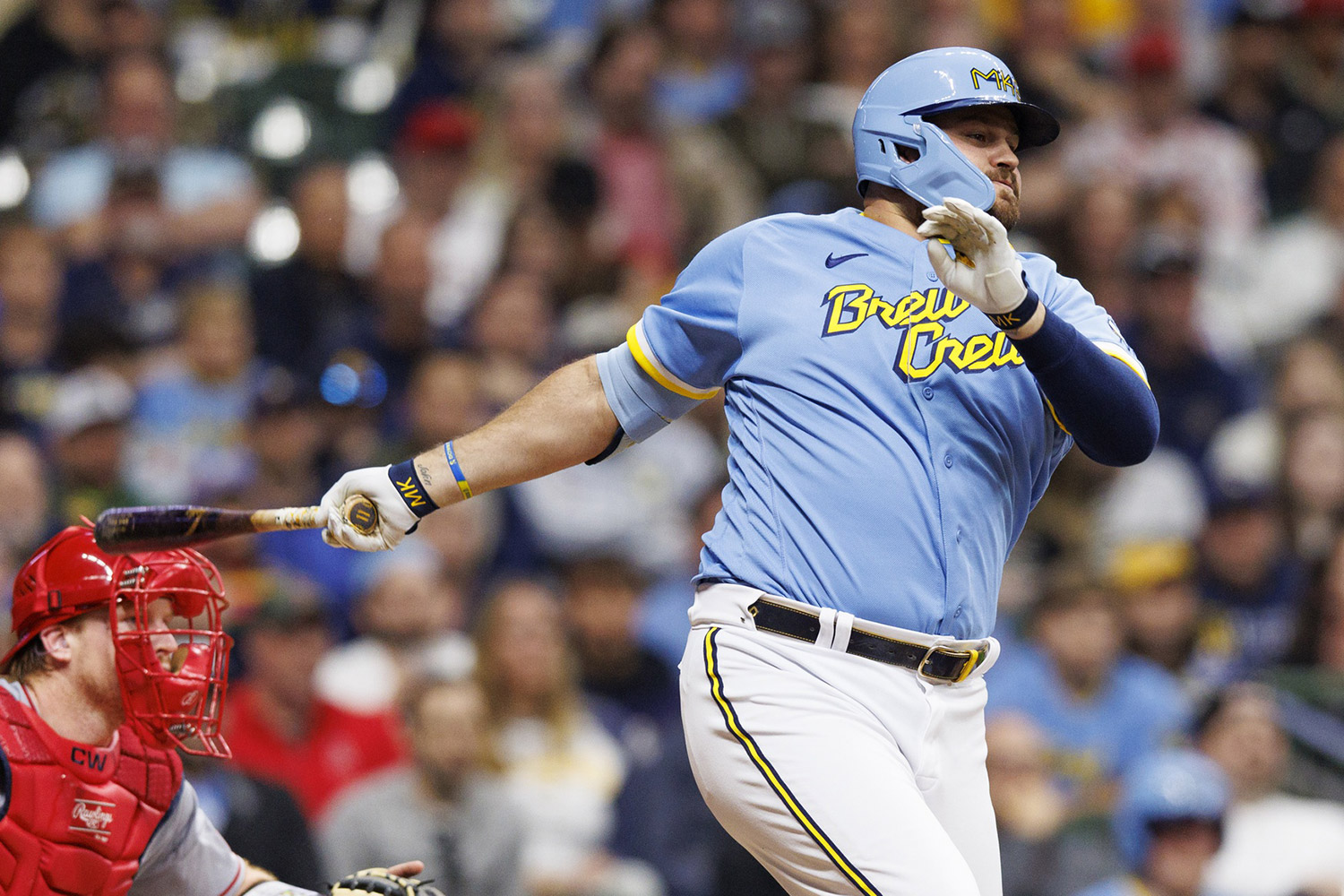 Box Score Starting Pitcher: Wade Miley - 6.0 IP, 7 H, 1 ER, 0 BB, 2 K, 84 pitches, 54 strikes (64.3%) Home Runs: Willy Adames (5) Top 3 WPA: Rowdy Tellez (.293), Wade Miley (.229), Devin Williams (.160) Bottom 3 WPA: Luke Voit (-.215), Brian Anderson (-.073), Christian Yelich (-.047) Win Probability Chart (via FanGraphs) Miley Dashes Angels Hopes Over And Over Wade Miley needed just two strikeouts to keep the Angels to one run across his six-inning start. While he gave up seven hits, none of these were for extra bases and for the most part, they were spread across several innings, which explains the limited scoring. Other than the little pitch clock hiccup that occurred in the second inning, it was a strong start. Given his veteran tenure, the pitch clock violation isn't surprising, but it was pretty funny. Nonetheless, it was another strong start for Miley, whose ERA currently sits at 1.86 across five starts and 29 total innings pitched. Work Smarter, Not Harder When Willy Adames went yard early and hit a 406-foot bomb to left field off of Tyler Anderson, it seemed like the start of another bombastic offensive showcase for Milwaukee. But Tyler Anderson had a great start, tossing 109 pitches in 6.2 innings and earning 20 swings and misses. The Brewers were able to load the bases in the second inning and had two runners in scoring position in the fourth inning, but Anderson was able to get himself out of trouble both times. After multiple three-batter innings, the Brewers finally got to work in the eighth. With William Contreras and Brian Anderson on base, Rowdy Tellez hit a crucial go-ahead single to put the Brewers on top. While this would ultimately be the team’s final hit of the game, it was just enough to squeak by with the win after passing the torch to Devin Williams. Don’t Sleep On This Bullpen Milwaukee relievers quietly have the third-best ERA in the major leagues and the best ERA in the national league at 2.70. Part of this is due to some weaker performers being pulled, with Javy Guerra being designated for assignment and Matt Bush being placed on the 15-day IL with rotator cuff tendinitis. Alex Claudio and Jake Cousins have been called up and made very brief appearances at the major league level thus far, but we’ll see if they can add value to this highly underrated set of relievers. Oh, by the way, Devin Williams, after marking his ninth inning pitched today, has yet to give up an earned run. In case you were wondering. What’s Next? The series against the Angels continues with Corbin Burnes facing off against lefty Reid Detmers. Burnes hasn’t looked like himself this season, recording just one game with more than five strikeouts. His current ERA of 4.55 is hopefully just indicative of a rough start and not a more concerning sign of regression, but we’ll have to wait and see until then. Postgame Interviews Bullpen Usage Spreadsheet MON TUE WED THU FRI TOT Payamps 0 31 0 0 14 45 B Wilson 28 0 11 0 0 39 Cousins 38 0 0 0 0 38 Peguero 0 34 0 0 0 34 Strzelecki 0 10 5 0 15 30 Williams 0 0 9 0 13 22 Milner 0 0 12 0 0 12 Claudio 4 0 0 0 0 4
 -
The Milwaukee Pain Train made a stop in Seattle and claimed victory in dominant fashion, with pretty much everyone lending a helping hand. Alas, even the Brewers themselves had to incur their share. Image courtesy of © Stephen Brashear-USA TODAY Sports The Milwaukee Pain Train made a stop in Seattle and claimed victory in dominant fashion, with pretty much everyone lending a helping hand. Alas, even the Brewers themselves had to incur their share. Box Score SP: Corbin Burnes - 5.1 IP, 3 H, 2 ER, 2 BB, 3 K, 85 pitches, 52 strikes (61.2%) Home Runs: Brice Turang (2) Top 3 WPA: Corbin Burnes (.168), Luke Voit (.139), Brian Anderson (.116) Bottom 3 WPA: Garrett Mitchell (-.071), Christian Yelich (-.035), Peter Strzelecki (-.022) Win Probability Chart (via FanGraphs) Burnes Limits The Damage In the team’s first series against an American League opponent, Corbin Burnes was able to hold the Mariners to just two earned runs. He still didn’t seem like his dominant self, striking out just three batters, and Burnes was heavily reliant on his defense. He struggled to paint the edges of the zone with his cutter the way he normally would. Also aided by a generous strike zone, Burnes still gave up just one tally, on a home run in the second inning by Cal Raleigh. He did have a somewhat flashy defensive play to catch Eugenio Suarez stealing third base to end the fourth inning. Maybe he doesn’t need strikeouts, after all. In the sixth inning, though, that play took on a sinister new significance. After a four-pitch walk to J.P. Crawford, Burnes got Julio Rodriguez to fly out to center field, but started calling for the training staff the moment the ball settled in Garrett Mitchell's glove. Manager Craig Counsell said after the game that the team diagnosed Burnes with a left pectoral strain. It's believed to be very mild, and Burnes might even make his next scheduled start, but the nervousness among Brewers fans will only die down if and when it becomes clear that Burnes will avoid the injured list. Teamwork Wins Games Rather than one or two players putting the team on their backs, it felt good to watch everyone chip in. Six different players contributed an RBI, with a seventh run being attributed to an error by J.P Crawford. Of the 10 players who had plate appearances, eight of them recorded at least one hit, and the two players who weren’t able to get a hit (Christian Yelich and Joey Wiemer) still recorded at least one walk apiece. Brice Turang also hit his second home run of the season, a solo shot to right center field on the first pitch he saw from Penn Murfee. Overall, the Brewers seemed like a cohesive, well-rounded, dangerous team with no free outs. Everything was clicking, and everyone did what was required of them to get the first win of the series. Brian Anderson Has A Productive Night While he batted in just one run, Brian Anderson went 3-for-5 at the plate. Two of his batted balls had exit velocities greater than 95 mph and if he had been able to get a little steeper of a launch angle, they might have landed for extra bases. Anderson has been making more consistent contact this year, with his batting average sitting at .298 as opposed to his career average of .256. His highest full-season batting average was .273, and that came in 2018 with the Miami Marlins, so we’ll see if this is a short-term trend or a sign of overall improvement. What’s Next? The Brewers have two more games against the Seattle Mariners, the next one featuring a pitching showdown between right-handers Colin Rea and Logan Gilbert. Rea looked exceptional in his first start for the Brewers, and hopes to continue performing at the highest level while filling Brandon Woodruff’s spot in the rotation. Postgame Interviews Bullpen Usage Spreadsheet THU FRI SAT SUN MON TOT B Wilson 0 50 0 0 0 50 Williams 16 0 0 33 0 49 Milner 0 0 27 0 20 47 Strzelecki 22 0 0 8 13 43 Payamps 15 0 12 0 15 42 Bush 27 0 0 0 11 38 Guerra 0 0 19 0 0 19 Varland 0 0 15 0 0 15 Tweet Highlight A few days ago, Rowdy Tellez said that he could beat Luke Voit in a race. After watching this base-running highlight, I'm starting to think that may be true. View full article
-
Brewers 7, Mariners 3: Brewers Bring The Pain To The Pacific Northwest
Jason Wang posted an article in Brewers
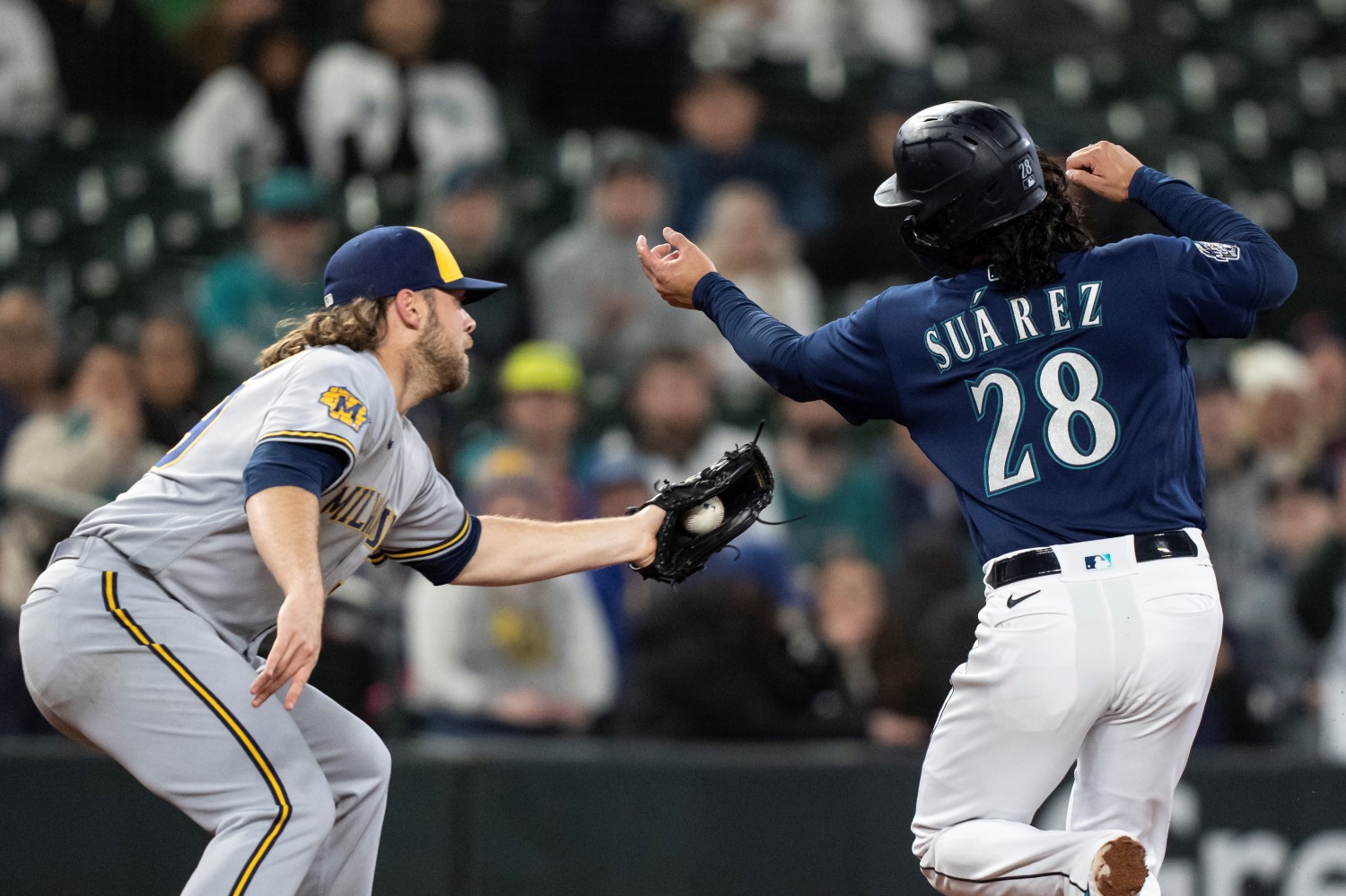 Box Score SP: Corbin Burnes - 5.1 IP, 3 H, 2 ER, 2 BB, 3 K, 85 pitches, 52 strikes (61.2%) Home Runs: Brice Turang (2) Top 3 WPA: Corbin Burnes (.168), Luke Voit (.139), Brian Anderson (.116) Bottom 3 WPA: Garrett Mitchell (-.071), Christian Yelich (-.035), Peter Strzelecki (-.022) Win Probability Chart (via FanGraphs) Burnes Limits The Damage In the team’s first series against an American League opponent, Corbin Burnes was able to hold the Mariners to just two earned runs. He still didn’t seem like his dominant self, striking out just three batters, and Burnes was heavily reliant on his defense. He struggled to paint the edges of the zone with his cutter the way he normally would. Also aided by a generous strike zone, Burnes still gave up just one tally, on a home run in the second inning by Cal Raleigh. He did have a somewhat flashy defensive play to catch Eugenio Suarez stealing third base to end the fourth inning. Maybe he doesn’t need strikeouts, after all. In the sixth inning, though, that play took on a sinister new significance. After a four-pitch walk to J.P. Crawford, Burnes got Julio Rodriguez to fly out to center field, but started calling for the training staff the moment the ball settled in Garrett Mitchell's glove. Manager Craig Counsell said after the game that the team diagnosed Burnes with a left pectoral strain. It's believed to be very mild, and Burnes might even make his next scheduled start, but the nervousness among Brewers fans will only die down if and when it becomes clear that Burnes will avoid the injured list. Teamwork Wins Games Rather than one or two players putting the team on their backs, it felt good to watch everyone chip in. Six different players contributed an RBI, with a seventh run being attributed to an error by J.P Crawford. Of the 10 players who had plate appearances, eight of them recorded at least one hit, and the two players who weren’t able to get a hit (Christian Yelich and Joey Wiemer) still recorded at least one walk apiece. Brice Turang also hit his second home run of the season, a solo shot to right center field on the first pitch he saw from Penn Murfee. Overall, the Brewers seemed like a cohesive, well-rounded, dangerous team with no free outs. Everything was clicking, and everyone did what was required of them to get the first win of the series. Brian Anderson Has A Productive Night While he batted in just one run, Brian Anderson went 3-for-5 at the plate. Two of his batted balls had exit velocities greater than 95 mph and if he had been able to get a little steeper of a launch angle, they might have landed for extra bases. Anderson has been making more consistent contact this year, with his batting average sitting at .298 as opposed to his career average of .256. His highest full-season batting average was .273, and that came in 2018 with the Miami Marlins, so we’ll see if this is a short-term trend or a sign of overall improvement. What’s Next? The Brewers have two more games against the Seattle Mariners, the next one featuring a pitching showdown between right-handers Colin Rea and Logan Gilbert. Rea looked exceptional in his first start for the Brewers, and hopes to continue performing at the highest level while filling Brandon Woodruff’s spot in the rotation. Postgame Interviews Bullpen Usage Spreadsheet THU FRI SAT SUN MON TOT B Wilson 0 50 0 0 0 50 Williams 16 0 0 33 0 49 Milner 0 0 27 0 20 47 Strzelecki 22 0 0 8 13 43 Payamps 15 0 12 0 15 42 Bush 27 0 0 0 11 38 Guerra 0 0 19 0 0 19 Varland 0 0 15 0 0 15 Tweet Highlight A few days ago, Rowdy Tellez said that he could beat Luke Voit in a race. After watching this base-running highlight, I'm starting to think that may be true.
 -
The Padres respond with a blowout of their own, overcoming Milwaukees bullpen to tack on a surge of late-inning runs. Image courtesy of Ray Acevedo-USA TODAY Sports The Padres respond with a blowout of their own, overcoming Milwaukees bullpen to tack on a surge of late-inning runs. Box Score SP: Freddy Peralta - 5.0 IP, 9 H, 5 ER, 1 BB, 5 K, 98 pitches, 59 strikes (60.2%) Home Runs: None Top 3 WPA: Victor Caratini (.147), Jesse Winker (.145), Joel Payamps (.025) Bottom 3 WPA: Freddy Peralta (-.374), Brian Anderson (-.127), Willy Adames (-.101) Win Probability Chart (via FanGraphs) Peralta Might Be Human After All Freddy Peralta had his first tough outing of the season, giving up a total five earned runs. Two back-to-back RBI singles by Nelson Cruz and Jake Cronenworth in the first inning got the scoring started early, followed by an RBI single by Manny Machado in the third inning. Things seemed to be calming down until Cronenworth hit a two-run home run in the fifth inning, giving the Padres a 5-3 lead. Peralta’s velocity seemed in line with his season and career averages, and his control led to just one walk. It seemed like the raw talent of the stacked San Diego Padres lineup simply allowed them to make contact when needed. Winker And Caratini Show Up, Others Not So Much Milwaukee started off strong with a two-run first inning, the result of a Jesse Winker double to score Christian Yelich and a Brian Anderson single to score Winker. Winker would put his body on the line for the time in the fourth inning, drawing a hit-by-pitch to earn a run after the bases were loaded by Victor Caratini, Brice Turang, and Joey Wiemer. And then the bats fell asleep. The Brewers would log just four hits in the remaining four innings of play, none of which were able to close the deficit that had ballooned to seven runs by the top of the 9th inning. Despite having 0 RBI, Caratini actually went 4-for-4 at the plate today, bringing his season batting average to a remarkable .438. He also made this flashy defensive play in the bottom of the second inning to prevent a bunt attempt from getting out of hand. Bullpen Has Unfortunate Outing After Peralta’s five-inning start and a one-inning relief appearance from Joel Payamps, Hoby Milner arrived in the seventh inning to keep the game close at 5-3. He promptly walked Juan Soto, gave a single to Xander Bogaerts, a sacrifice fly to Nelson Cruz, and then a two-run RBI to Cronenworth, his second of the game. In the eighth inning, Gus Varland was pitching well until a frightening Manny Machado line drive hit him squarely in the head, causing him to immediately be replaced by Javy Guerra. He was able to leave the field without assistance and Craig Counsell later reported that x-rays of Varland's jaw came up negative and that his hand ended up absorbing most of the ball. Guerra’s control issues began to resurface as he intentionally walked Juan Soto, hit Xander Bogaerts, almost hit Cruz before walking him, and then walked Cronenworth, allowing two runs to score as a result of his struggles to throw strikes. By the time Ha-Seong Kim popped out to end the inning, the Padres had brought the score to a calamitous 10-3. What’s Next? The Brewers will look to prevent the Padres from tying the four-game series tomorrow, sending Wade Miley to duel fellow pitching veteran Yu Darvish on the mound. They are still tied with the Atlanta Braves for the most wins in the National League so far at ten, but the Pittsburgh Pirates have been looking quite competitive and are just one win away at nine. Here’s hoping the Brewers maintain their current divisional lead all the way to the postseason. Postgame Interviews Bullpen Usage Spreadsheet TUE WED THU FRI SAT TOT B Wilson 0 0 0 50 0 50 Payamps 23 0 15 0 12 50 Varland 0 31 0 0 15 46 Milner 0 15 0 0 27 42 Guerra 0 10 0 0 19 29 Bush 0 0 27 0 0 27 Strzelecki 0 0 22 0 0 22 Williams 0 0 16 0 0 16 Tweet Highlight View full article
-
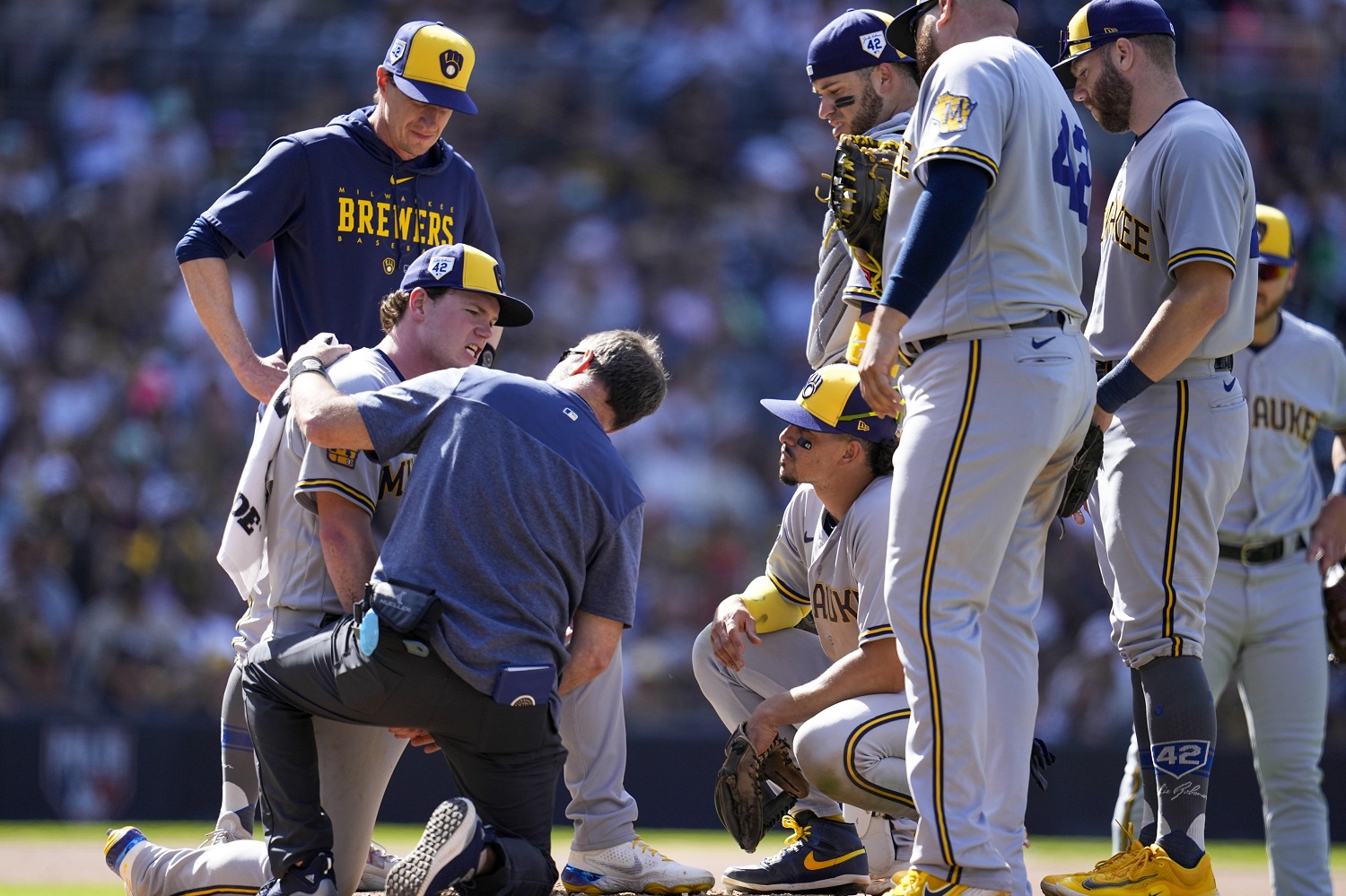 Box Score SP: Freddy Peralta - 5.0 IP, 9 H, 5 ER, 1 BB, 5 K, 98 pitches, 59 strikes (60.2%) Home Runs: None Top 3 WPA: Victor Caratini (.147), Jesse Winker (.145), Joel Payamps (.025) Bottom 3 WPA: Freddy Peralta (-.374), Brian Anderson (-.127), Willy Adames (-.101) Win Probability Chart (via FanGraphs) Peralta Might Be Human After All Freddy Peralta had his first tough outing of the season, giving up a total five earned runs. Two back-to-back RBI singles by Nelson Cruz and Jake Cronenworth in the first inning got the scoring started early, followed by an RBI single by Manny Machado in the third inning. Things seemed to be calming down until Cronenworth hit a two-run home run in the fifth inning, giving the Padres a 5-3 lead. Peralta’s velocity seemed in line with his season and career averages, and his control led to just one walk. It seemed like the raw talent of the stacked San Diego Padres lineup simply allowed them to make contact when needed. Winker And Caratini Show Up, Others Not So Much Milwaukee started off strong with a two-run first inning, the result of a Jesse Winker double to score Christian Yelich and a Brian Anderson single to score Winker. Winker would put his body on the line for the time in the fourth inning, drawing a hit-by-pitch to earn a run after the bases were loaded by Victor Caratini, Brice Turang, and Joey Wiemer. And then the bats fell asleep. The Brewers would log just four hits in the remaining four innings of play, none of which were able to close the deficit that had ballooned to seven runs by the top of the 9th inning. Despite having 0 RBI, Caratini actually went 4-for-4 at the plate today, bringing his season batting average to a remarkable .438. He also made this flashy defensive play in the bottom of the second inning to prevent a bunt attempt from getting out of hand. Bullpen Has Unfortunate Outing After Peralta’s five-inning start and a one-inning relief appearance from Joel Payamps, Hoby Milner arrived in the seventh inning to keep the game close at 5-3. He promptly walked Juan Soto, gave a single to Xander Bogaerts, a sacrifice fly to Nelson Cruz, and then a two-run RBI to Cronenworth, his second of the game. In the eighth inning, Gus Varland was pitching well until a frightening Manny Machado line drive hit him squarely in the head, causing him to immediately be replaced by Javy Guerra. He was able to leave the field without assistance and Craig Counsell later reported that x-rays of Varland's jaw came up negative and that his hand ended up absorbing most of the ball. Guerra’s control issues began to resurface as he intentionally walked Juan Soto, hit Xander Bogaerts, almost hit Cruz before walking him, and then walked Cronenworth, allowing two runs to score as a result of his struggles to throw strikes. By the time Ha-Seong Kim popped out to end the inning, the Padres had brought the score to a calamitous 10-3. What’s Next? The Brewers will look to prevent the Padres from tying the four-game series tomorrow, sending Wade Miley to duel fellow pitching veteran Yu Darvish on the mound. They are still tied with the Atlanta Braves for the most wins in the National League so far at ten, but the Pittsburgh Pirates have been looking quite competitive and are just one win away at nine. Here’s hoping the Brewers maintain their current divisional lead all the way to the postseason. Postgame Interviews Bullpen Usage Spreadsheet TUE WED THU FRI SAT TOT B Wilson 0 0 0 50 0 50 Payamps 23 0 15 0 12 50 Varland 0 31 0 0 15 46 Milner 0 15 0 0 27 42 Guerra 0 10 0 0 19 29 Bush 0 0 27 0 0 27 Strzelecki 0 0 22 0 0 22 Williams 0 0 16 0 0 16 Tweet Highlight

