Matt Breen
-
Posts
9,111 -
Joined
-
Last visited
-
Days Won
1
Content Type
Profiles
Forums
Blogs
Events
News
2026 Milwaukee Brewers Top Prospects Ranking
Milwaukee Brewers Videos
2022 Milwaukee Brewers Draft Picks
Milwaukee Brewers Free Agent & Trade Rumors, Notes, & Tidbits
Guides & Resources
2023 Milwaukee Brewers Draft Picks
2024 Milwaukee Brewers Draft Picks
The Milwaukee Brewers Players Project
2025 Milwaukee Brewers Draft Pick Tracker
2026 Milwaukee Brewers Draft Tracker: Picks & Bonuses
Store
Downloads
Gallery
Everything posted by Matt Breen
-
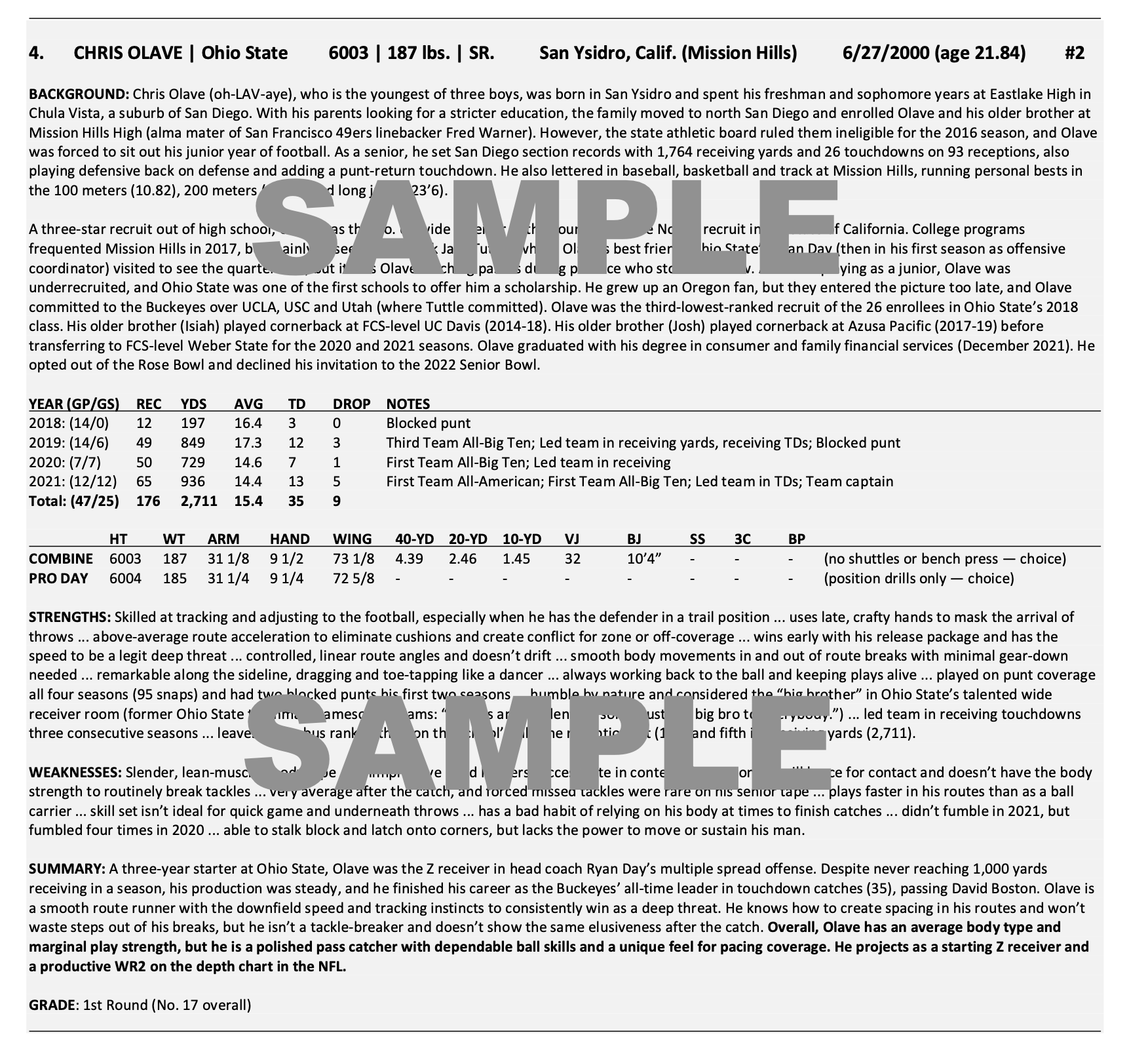
I'm just starting to look at 'the Beast' and it's pretty cool. Obviously, I can't give it to people - but if you are interested in seeing what they do, here's a snippet (Chris Olave's write up). They do this for 400 players. PS - I think you can sign up for a free pass with the Athletic. Or get it cheap for a few months. Or if someone you know has it, they can give you a 30 day pass. They limit the 30 day passes - and I think I've given mine out (but I can check if you have no other options). PS - this is just a snippet of the guide. I think that's cool to post. If not, let me know and I'll remove.
-
I wanted to share that The Athletic has posted their 2022 Draft Guide by Dane Brugler. They call it 'the Beast' - and rightfully so. It's a 288 page guide (a pdf) to hundreds of players. It's really pretty awesome. Of course, the downside is you have to have a subscription to get it. Still, if you do, it's an amazing resource for the draft. https://theathletic.com/3233612/2022/04/07/2022-nfl-draft-guide-the-beast-dane-brugler/
-
Article: Crew Throwback: Mike Felder
Matt Breen replied to Matt Breen's topic in Brewer Fanatic Front Page News
Thank you. -
Article: Crew Throwback: Mike Felder
Matt Breen replied to Matt Breen's topic in Brewer Fanatic Front Page News
Thank you. -
Article: Crew Throwback: Mike Felder
Matt Breen replied to Matt Breen's topic in Brewer Fanatic Front Page News
Thank you. -
Article: Crew Throwback: Mike Felder
Matt Breen replied to Matt Breen's topic in Brewer Fanatic Front Page News
Thank you. -
The Athletic is saying that it's 'widely believed' that the Saints are interested in a QB in the 1st round. The more QBs that go ahead of us - the better as guys we need drop to us (unless we want a QB in the 1st round ? ). The Saints have a lot of needs, but WR and OT is two of their biggest (along with QB). Link (subscription required): https://theathletic.com/3232215/2022/04/06/howe-notebook-inside-the-davante-adams-trade-baker-mayfields-status-saints-maneuvering/
-
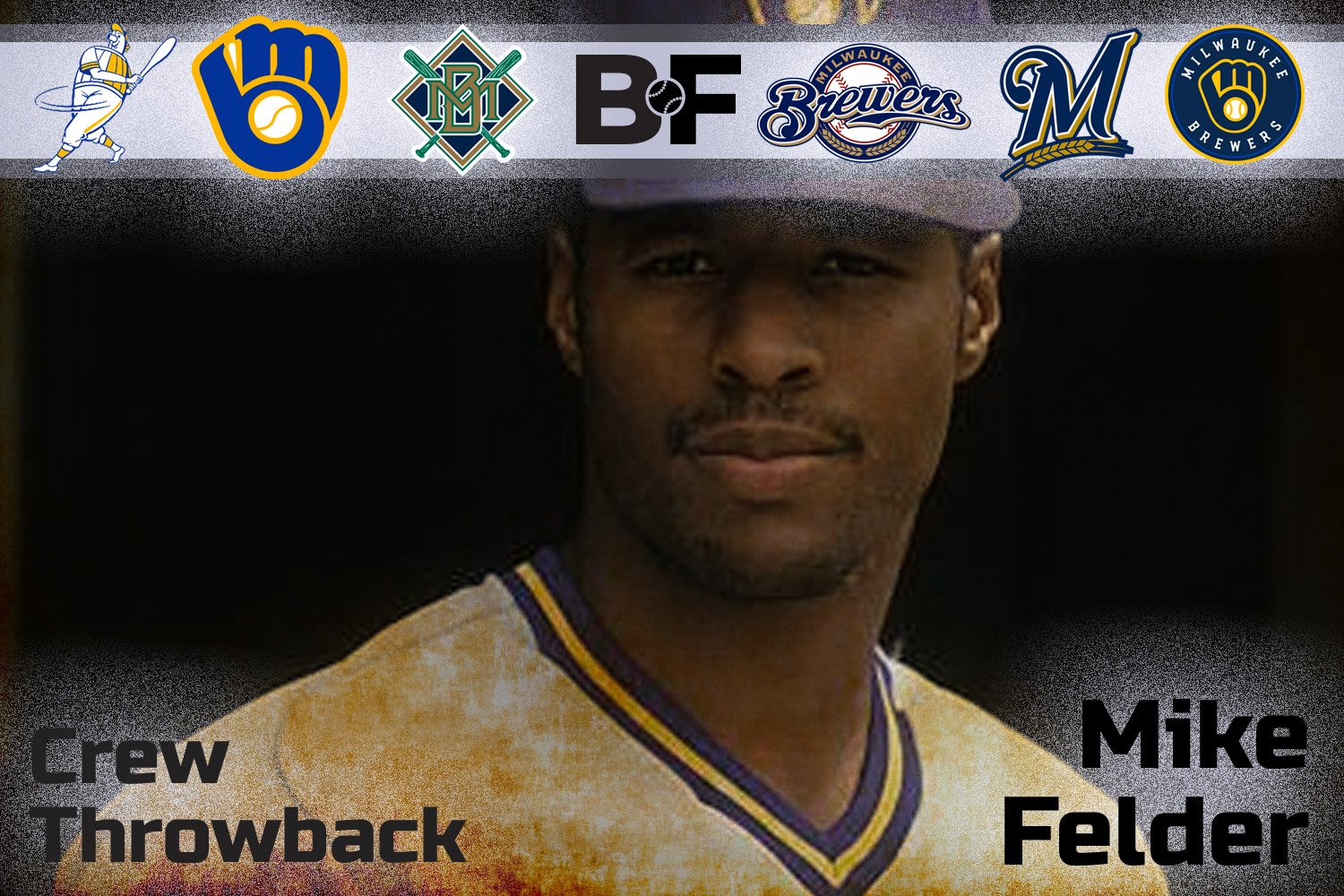 Speed was Mike Felder's game. When the Brewers drafted Felder in the 3rd round of the 1981 draft out of Contra Costa Junior College in California, they were getting one of the most exciting, albeit one dimensional, players in team history. From the moment he arrived in the Brewer organization, the diminutive Bay Area native (nicknamed Tiny) hit the base paths running. Felder led the minors in stolen bases for four straight years from 1982 to 1985 with an astounding 92 stolen bases with Stockton in '82. In addition to stealing truckloads of bases, Felder's hitting improved with each minor league stop. He took his share of walks, and his batting average climbed over .300 in 1985, leading to a cup of coffee with the Brewers. However, what the 5'8" Felder lacked was some thump in his bat. And thus, while Felder's impressive wheels would bring him to the majors, his lack of slugging would limit his upside and playing time; pitchers simply were not afraid of his bat. For parts of six seasons, Felder was an outfielder for the Crew. He appeared in 455 games for the team, hitting .247 and producing a .624 OPS while stealing 108 bases. But Felder never became more than a semi-regular player with Milwaukee (or his subsequent teams). While he didn't strike out often, he simply did not get on base enough, as evidenced by a career OBP of just .301. Felder was a classic one-tool player - all speed. He only hit nine home runs for Milwaukee (in over 1,200 ABs) and only 14 for his entire career. Felder's best season in Milwaukee was his last - 1990 - when he hit .274 and had a .330 OBP in 272 at-bats. But Felder wanted more playing time and at the end of spring training in 1991, he asked for and was granted his release. Felder played another four years with San Francisco, Seattle, and Houston, performing pretty much the same role he had in Milwaukee. He then spent a few more years in independent ball and the Mexican league before retiring after the 1998 season. After retirement, Felder remained in baseball, coaching in the Giants and Expos organizations in 1999 and 2000. He was an assistant baseball coach at the Academy of Art University in San Francisco from 2009-2013. In his career with Milwaukee, Mike Felder was a versatile reserve, playing all of the outfield positions. However, his inability to develop any skills beyond his speed (which was sensational) kept him from being anything more than a part-time player. Still, it allowed him to play 10 years in the majors, a claim few players can make. Please share your remembrances of former Brewer Mike 'Tiny' Felder.
 -
Speed kills. You can't teach speed. Everything else in the game can be taught, but speed is a gift from God.” - NFL Owner Al Davis Speed was Mike Felder's game. When the Brewers drafted Felder in the 3rd round of the 1981 draft out of Contra Costa Junior College in California, they were getting one of the most exciting, albeit one dimensional, players in team history. From the moment he arrived in the Brewer organization, the diminutive Bay Area native (nicknamed Tiny) hit the base paths running. Felder led the minors in stolen bases for four straight years from 1982 to 1985 with an astounding 92 stolen bases with Stockton in '82. In addition to stealing truckloads of bases, Felder's hitting improved with each minor league stop. He took his share of walks, and his batting average climbed over .300 in 1985, leading to a cup of coffee with the Brewers. However, what the 5'8" Felder lacked was some thump in his bat. And thus, while Felder's impressive wheels would bring him to the majors, his lack of slugging would limit his upside and playing time; pitchers simply were not afraid of his bat. For parts of six seasons, Felder was an outfielder for the Crew. He appeared in 455 games for the team, hitting .247 and producing a .624 OPS while stealing 108 bases. But Felder never became more than a semi-regular player with Milwaukee (or his subsequent teams). While he didn't strike out often, he simply did not get on base enough, as evidenced by a career OBP of just .301. Felder was a classic one-tool player - all speed. He only hit nine home runs for Milwaukee (in over 1,200 ABs) and only 14 for his entire career. Felder's best season in Milwaukee was his last - 1990 - when he hit .274 and had a .330 OBP in 272 at-bats. But Felder wanted more playing time and at the end of spring training in 1991, he asked for and was granted his release. Felder played another four years with San Francisco, Seattle, and Houston, performing pretty much the same role he had in Milwaukee. He then spent a few more years in independent ball and the Mexican league before retiring after the 1998 season. After retirement, Felder remained in baseball, coaching in the Giants and Expos organizations in 1999 and 2000. He was an assistant baseball coach at the Academy of Art University in San Francisco from 2009-2013. In his career with Milwaukee, Mike Felder was a versatile reserve, playing all of the outfield positions. However, his inability to develop any skills beyond his speed (which was sensational) kept him from being anything more than a part-time player. Still, it allowed him to play 10 years in the majors, a claim few players can make. Please share your remembrances of former Brewer Mike 'Tiny' Felder. View full article
-
Saints reportedly are interested in WR and OT. The extra pick certainly gives them the ammunition to get someone - such as Olave - and fill the OL need. They have lots of other needs as well - but those two are big areas of weakness. They supposedly like Olave a lot.
-
Hamilton is the exact kind of guy that you don't expect to be there - but if he is - is huge value. I think there are so many options for us at #22 and #28 - I'm pretty happy just letting the best players come to us (although I wouldn't take a QB or RB). We have to address WR at some point. And probably DL, but if the a top 10 player like Hamilton drops - he still fills an area of need (although maybe not as desperately as WR). Gonna be a fun draft.
-
I love all the notes about prospects people provide. Thanks.
-
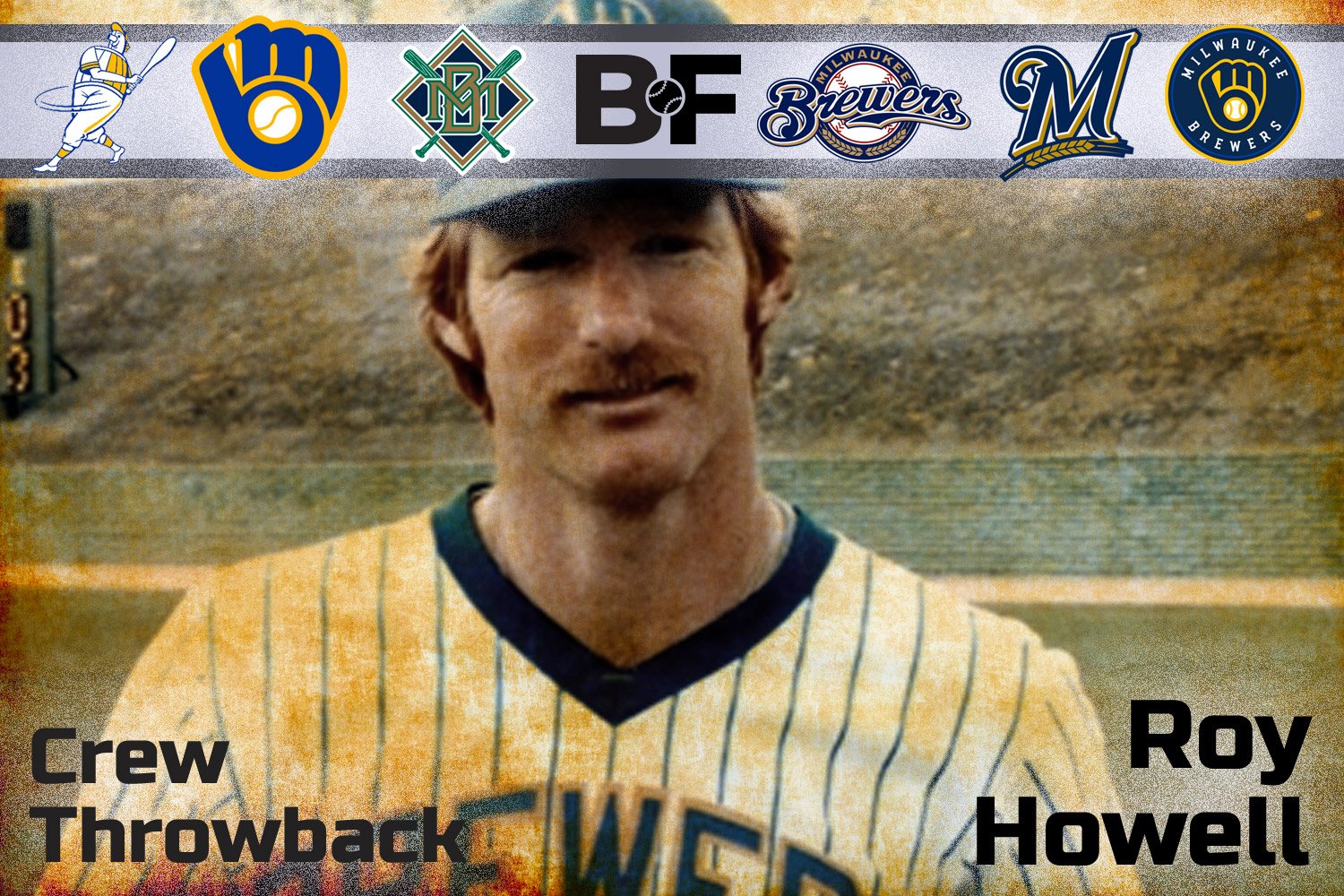 One of those players was the hard-nosed 3B Roy Howell - who would spend four seasons with the Crew (1981-84). Roy Lee Howell was born in California in 1953. A left-handed hitter, he was selected in the first round, fourth overall, by the Texas Rangers in the 1972 MLB Draft. Howell quickly moved up the minor league ladder, displaying a combination of impressive physical tools, good power, and on-base skills. He would reach the majors at the age of 20, getting a cup of coffee with the Rangers. Howell would spend the next six seasons in Texas and Toronto. His bat never quite emerged as the force many had thought it would, but he had some solid seasons, hitting over .300 twice. He was selected for the all-star team in 1978. A free agent after the 1980 season, Howell signed a five-year deal with Milwaukee. The idea was to have him take over for the aging Sal Bando and Don Money. Unfortunately for Howell, his fielding skills - never great to begin with - were eroding due to a variety of injuries. And after another injury in 1981, he was never the same and was reduced to a part-time player. Howell spent four seasons with Milwaukee, playing first base, third base, and DH during that time. His teams made two postseason appearances, reaching the World Series in 1982 (he went 0-14 in the postseason that year). He hit .253 as a Brewer and produced an OPS of .684, unspectacular numbers for the corner infielder. Milwaukee released Howell after the 1984 season. He spent 1985 in the minors before retiring. During his career, Howell produced 9.3 fWAR / 10.9 bWAR while hitting .261 with an OPS of .710 which included nearly 1,000 hits and 80 home runs. Howell was recognizable during his playing days for his red hair and thick mustache and beard (although he was much better groomed during his stint in Milwaukee than in Texas and Toronto). He played the game hard and endeared himself to his teammates and the fans. Sadly, injuries sapped Howell's abilities at an early age. Instead of being a core member of the great Brewer lineups of the early 1980s, he was a minor figure, still contributing, but not in the manner the organization had hoped when he had signed with them. After baseball, Howell stayed in the game as a coach and manager, working for the Padres and Mariners and in independent ball. Please share your memories of former Brewer Roy Howell in the comments below!
 -
The early 1980s featured one of the most explosive lineups in team history - the famed Harvey's Wallbangers. Yount, Molitor, Cooper, Oglivie, Thomas, Money, Simmons, and others headlined a lineup that was one of the most feared in baseball. But there were other guys on the Brewer roster that contributed to the success of that era - which included the team's only World Series appearance. One of those players was the hard-nosed 3B Roy Howell - who would spend four seasons with the Crew (1981-84). Roy Lee Howell was born in California in 1953. A left-handed hitter, he was selected in the first round, fourth overall, by the Texas Rangers in the 1972 MLB Draft. Howell quickly moved up the minor league ladder, displaying a combination of impressive physical tools, good power, and on-base skills. He would reach the majors at the age of 20, getting a cup of coffee with the Rangers. Howell would spend the next six seasons in Texas and Toronto. His bat never quite emerged as the force many had thought it would, but he had some solid seasons, hitting over .300 twice. He was selected for the all-star team in 1978. A free agent after the 1980 season, Howell signed a five-year deal with Milwaukee. The idea was to have him take over for the aging Sal Bando and Don Money. Unfortunately for Howell, his fielding skills - never great to begin with - were eroding due to a variety of injuries. And after another injury in 1981, he was never the same and was reduced to a part-time player. Howell spent four seasons with Milwaukee, playing first base, third base, and DH during that time. His teams made two postseason appearances, reaching the World Series in 1982 (he went 0-14 in the postseason that year). He hit .253 as a Brewer and produced an OPS of .684, unspectacular numbers for the corner infielder. Milwaukee released Howell after the 1984 season. He spent 1985 in the minors before retiring. During his career, Howell produced 9.3 fWAR / 10.9 bWAR while hitting .261 with an OPS of .710 which included nearly 1,000 hits and 80 home runs. Howell was recognizable during his playing days for his red hair and thick mustache and beard (although he was much better groomed during his stint in Milwaukee than in Texas and Toronto). He played the game hard and endeared himself to his teammates and the fans. Sadly, injuries sapped Howell's abilities at an early age. Instead of being a core member of the great Brewer lineups of the early 1980s, he was a minor figure, still contributing, but not in the manner the organization had hoped when he had signed with them. After baseball, Howell stayed in the game as a coach and manager, working for the Padres and Mariners and in independent ball. Please share your memories of former Brewer Roy Howell in the comments below! View full article
-
For my 94 person draft, I ended up with 6 QBs. I automatically picked the highest ranked player on the PFF board when there were no trade offers on the table. My third pick was Carson Strong of Nevada (3rd round, 90th overall). And then four of the last six picks were QBs. I should have traded Rodgers for a bunch of picks. I probably could have gotten 150 players if I had done that.
-
On the PFF draft simulator, I traded down repeatedly - made 34 trades - and drafted 94 players. I simply took the top player on the board the time I picked. It was kind of fun, if silly. I ended up with the following: 2nd Round picks x 2 3rd round picks x 1 4th round picks x 10 5th round picks x 21 6th round picks x 29 7th round picks x 32 I tried to upload the image they provide, but it was too big. I got some Badgers, including Sunburn, Ferguson and Bruss. Plus former Badger Jack Coan (fourth to last pick in the draft).
-
One thing nice about Watson is that he is cold weather tested. Not a huge thing - but nice to know.
-
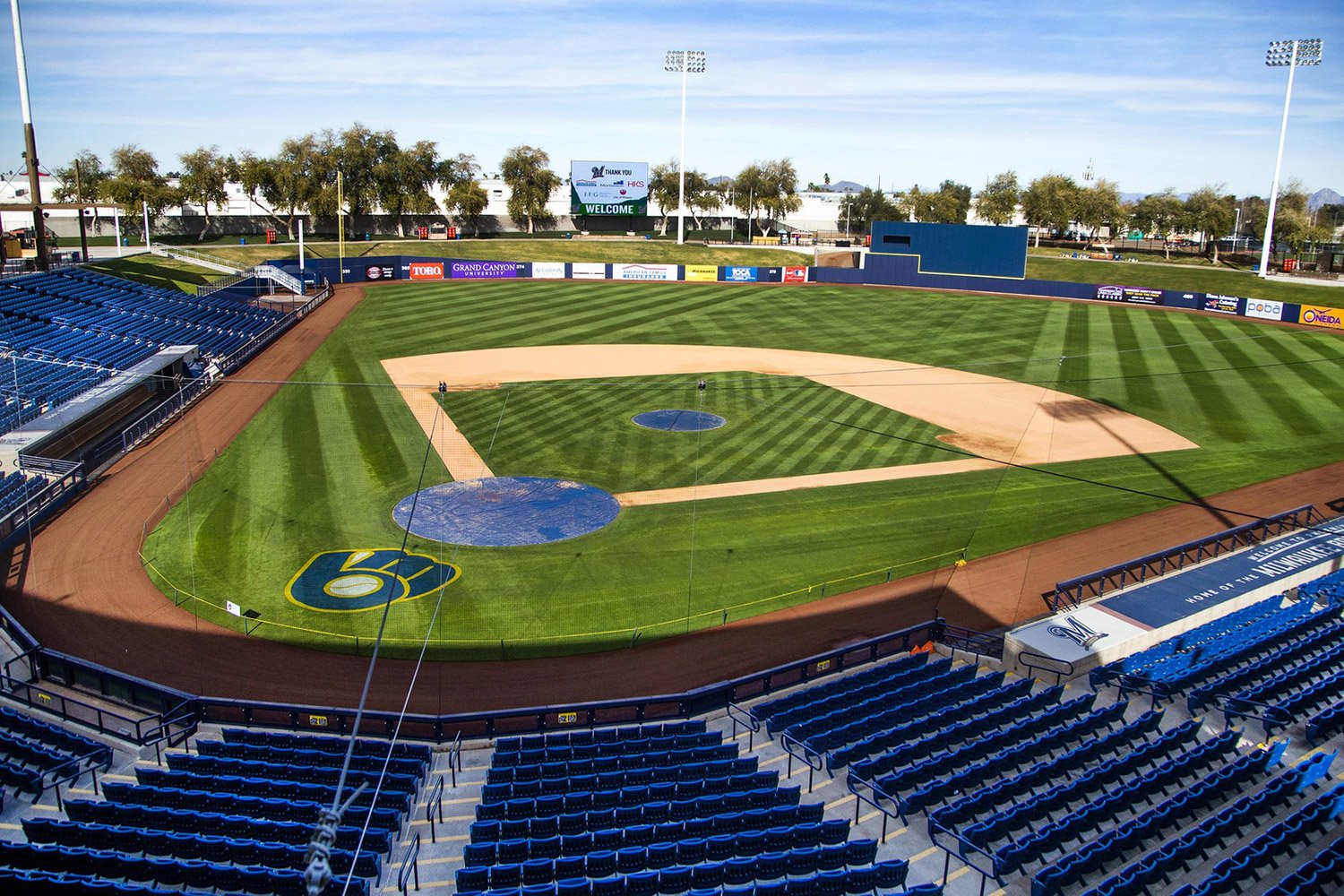 To that end, we held our first Top 25 poll in the summer of 2014 (it was actually a Top 20 poll - but quickly expanded to 25). Jimmy Nelson was our first top prospect. Our yearly poll allows fans of the organization to learn about the team’s prospects and promote the players who they will believe will be a part of Milwaukee's future. You don’t have to an expert in the Brewers minor leagues to participate; feel free to look at other voters’ lists, plus there are links to established prospect analysts - such Fangraphs and the MLB Pipeline. The poll is all in good fun so give the link below a click and join in with the Brewer Fanatic community. The deadline April 4 and you can update your list right up to the deadline. So head on over to the minor league forum to find out more, just click the card below. Or, if you prefer to comment in this article section, here are the rules: Rules 1. Submit your Top 25 prospects (again, a list of 30 is best), in order, by end of day on April 4, 2022. Put the player's full name to avoid any confusion. I appreciate it you would number them. Also, please list your players from #1 to #30. 2. You MUST submit 25 prospects. If there are only 10 or 15 or whatever, your list will not be included. 3. You are encouraged to go beyond pick #25. 30 is best. This way if a player you vote for is released or traded, or you list someone twice, or whatever, we can just bump up your next player. 4. Rankings are determined by total points. The top prospect gets 25 points, second prospect gets 24 points, etc. 4. As noted above, if you submit your list and want to change something, just add the change to the thread via the edit function. I'll accept changes up to the deadline. 5. Within a week or so after the deadline, we'll publish the new BF.net Community Top 25. Eligibility guidelines Rookie eligibility is determined by the same standards as MLB: “A player shall be considered a rookie unless, during a previous season or seasons, he has (a) exceeded 130 at-bats or 50 innings pitched in the Major Leagues; or (b) accumulated more than 45 days on the active roster of a Major League club or clubs during the period of 25-player limit (excluding time in the military service and time on the disabled list).” Note: I have seen some conflicting information on Aaron Ashby. Baseball-Reference lists him as having 46 days of experience - and marks him as having 'exceeded' rookie eligibility. However, every prospect list people have him as being rookie eligible. Thus, I am making him eligible for this poll. - Players graduated from Top 25 list: Jake Cousins - Other players who have exceeded rookie limits: Ángel Perdomo, Miguel Sánchez - Eligible players with ML experience: Justin Topa, Alec Bettinger, Corey Ray, Mario Feliciano, Aaron Ashby - Ineligible players: Ángel Perdomo, Miguel Sánchez, Jake Cousins, J.C. Mejia Best of luck to you all!
 -
Keeping tabs on Brewers prospects has been a key part of BrewerFan since its inception over 20 years ago, now we're asking all of you to come vote for your favorites! To that end, we held our first Top 25 poll in the summer of 2014 (it was actually a Top 20 poll - but quickly expanded to 25). Jimmy Nelson was our first top prospect. Our yearly poll allows fans of the organization to learn about the team’s prospects and promote the players who they will believe will be a part of Milwaukee's future. You don’t have to an expert in the Brewers minor leagues to participate; feel free to look at other voters’ lists, plus there are links to established prospect analysts - such Fangraphs and the MLB Pipeline. The poll is all in good fun so give the link below a click and join in with the Brewer Fanatic community. The deadline April 4 and you can update your list right up to the deadline. So head on over to the minor league forum to find out more, just click the card below. Or, if you prefer to comment in this article section, here are the rules: Rules 1. Submit your Top 25 prospects (again, a list of 30 is best), in order, by end of day on April 4, 2022. Put the player's full name to avoid any confusion. I appreciate it you would number them. Also, please list your players from #1 to #30. 2. You MUST submit 25 prospects. If there are only 10 or 15 or whatever, your list will not be included. 3. You are encouraged to go beyond pick #25. 30 is best. This way if a player you vote for is released or traded, or you list someone twice, or whatever, we can just bump up your next player. 4. Rankings are determined by total points. The top prospect gets 25 points, second prospect gets 24 points, etc. 4. As noted above, if you submit your list and want to change something, just add the change to the thread via the edit function. I'll accept changes up to the deadline. 5. Within a week or so after the deadline, we'll publish the new BF.net Community Top 25. Eligibility guidelines Rookie eligibility is determined by the same standards as MLB: “A player shall be considered a rookie unless, during a previous season or seasons, he has (a) exceeded 130 at-bats or 50 innings pitched in the Major Leagues; or (b) accumulated more than 45 days on the active roster of a Major League club or clubs during the period of 25-player limit (excluding time in the military service and time on the disabled list).” Note: I have seen some conflicting information on Aaron Ashby. Baseball-Reference lists him as having 46 days of experience - and marks him as having 'exceeded' rookie eligibility. However, every prospect list people have him as being rookie eligible. Thus, I am making him eligible for this poll. - Players graduated from Top 25 list: Jake Cousins - Other players who have exceeded rookie limits: Ángel Perdomo, Miguel Sánchez - Eligible players with ML experience: Justin Topa, Alec Bettinger, Corey Ray, Mario Feliciano, Aaron Ashby - Ineligible players: Ángel Perdomo, Miguel Sánchez, Jake Cousins, J.C. Mejia Best of luck to you all! View full article
-
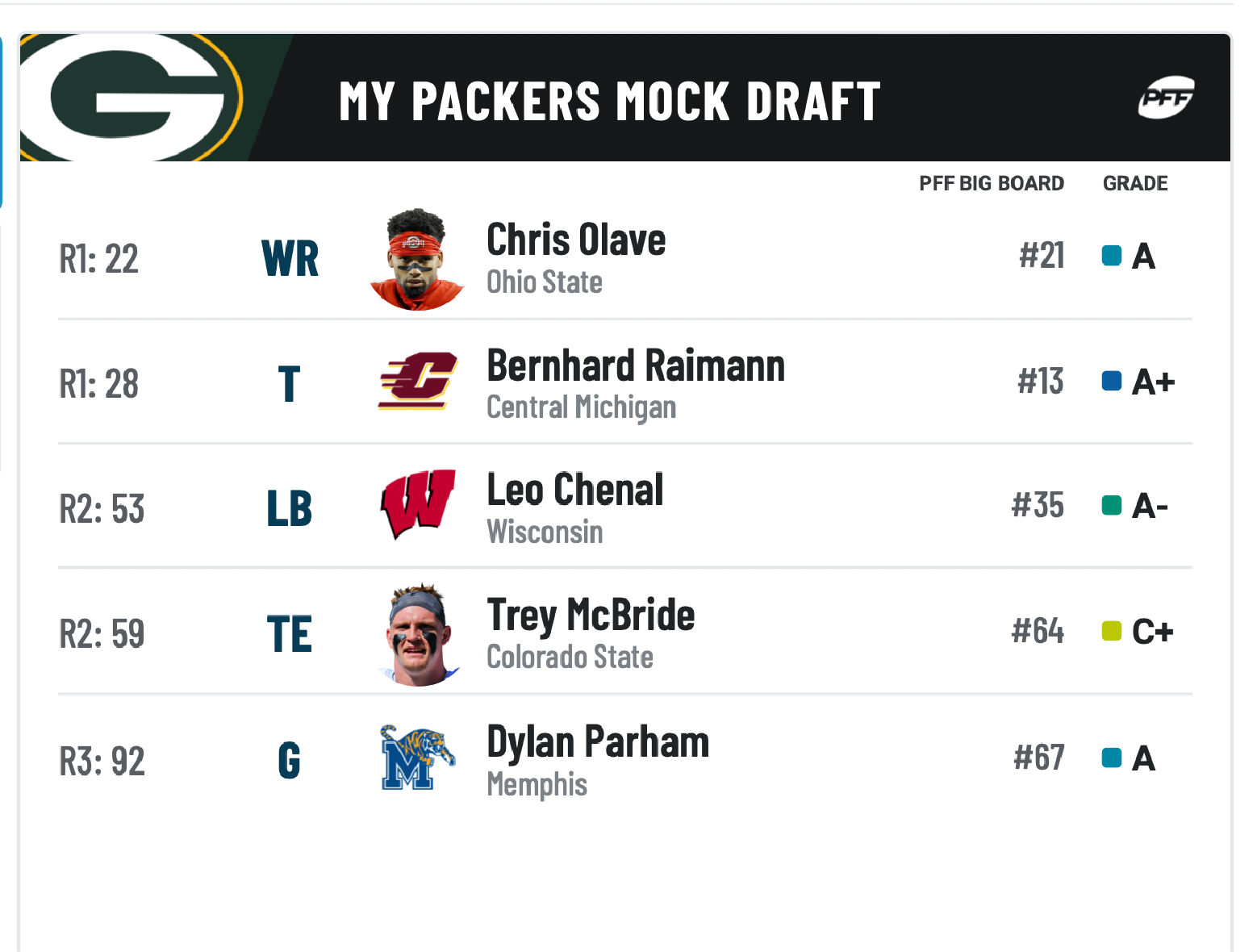
The mock draft thing at PFF.com is fun. Here's mine. I totally did a homer pick on Chenal - but I think he would fit for us (stress 'think'). I figure he can help a ton in the run game, plus he can still play as a pass rusher. Thus his coverage skills are minimized. I really wanted a DL type - but just couldn't pass up Raimann at #28. I went with McBride - passing on WR George Pickens. That might have been a mistake, but whatever. Just fun.
-
Dotson would be a really nice add for us. I've seen him slotted mostly in the 2nd tier of WRs - after London, Olave, Wilson, Williams and Burks (in no particular order). His lack of size and strength are his biggest knocks, but he really is well rounded and should be able to help right away. He'd be a fine pick at #28 - but almost no way he drops to us in round 2.
-
I doubt we do three - but two wouldn't surprise me. All depends on who's available at our picks.
-
Malik Willis of Liberty had a great pro day this past week - and I'm seeing him rise up on draft boards (into the Top 10). Guy still has some work to do, but scouts say his has the big upside teams love. He's perfect for a team that can let him sit for a year or two. QBs tend to rise up on draft day. Kenny Pickett looks like a Top 20 pick as well, and Desmond Ridder is starting to pop up there as well. This is all good for the Packers. The more QBs that get taken ahead of us, the more other talent gets pushed down. Still a long way away from the draft. Lots can happen.
-
One guy that I had seen projected to GB was Michigan Edge rusher David Ojabo. Well, Ojabo torn his Achilles last week at Michigan's Pro Day. He will likely take at least six months to recover. Might mean he'll drop a bit come draft day.
-
If Chenal is around in the 4th, that would be a steal. But I think someone will bite earlier - especially after his combine performance. Even getting him in the 3rd would be nice. I've seen the Packers linked to safeties in some mocks - mostly Daxton Hill from Michigan - at #28. Perhaps with Douglas' signing the need for a DB will diminish.