


Brewers Video
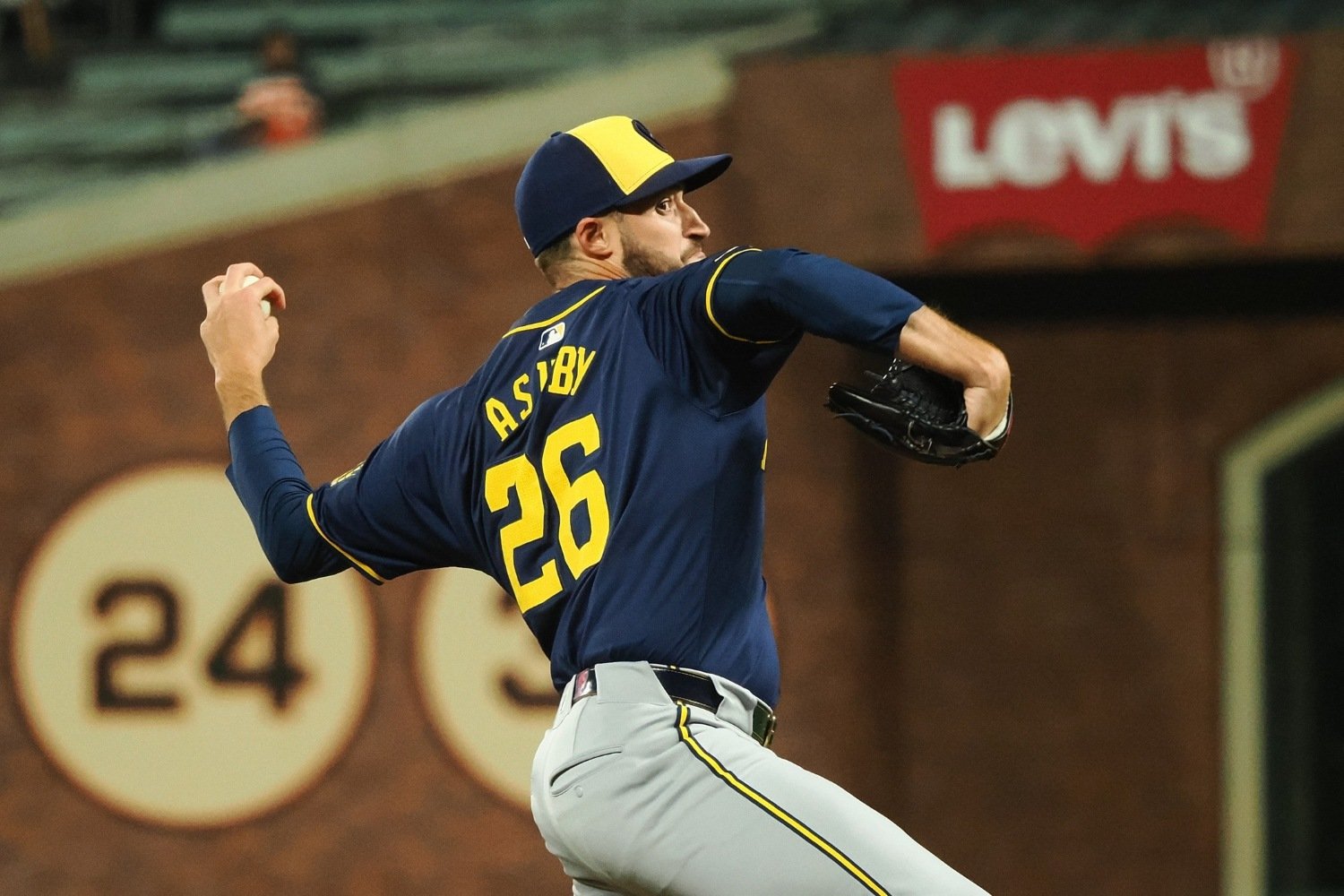
After toiling in the minor leagues for much of last season in his return from major shoulder surgery, Aaron Ashby shifted to relief for the Brewers in August. He immediately became a multi-inning bullpen weapon for the Brewers down the stretch, pitching to a 1.37 ERA and 0.78 FIP with a 36.8% strikeout rate in 19 ⅔ innings.
Ashby’s velocity and command were greatly diminished when he returned to game action in September 2023, and they showed few signs of improving across his 14 starts with Triple-A Nashville in 2024. After resurfacing in the big-league bullpen, though, his average sinker velocity climbed to 97.2 mph, and his walk rate fell to 3.9%.
The turnaround in a different role was the latest development in the years-long discourse over Ashby’s best long-term fit within Milwaukee’s pitching plans. The spontaneous improvement in how the ball left his hand presents a compelling case for keeping him in shorter stints. However, despite pitching as a reliever, Ashby’s arsenal became more nuanced than in past big-league stretches, a development that could carry over to one final crack at starting.
Ashby’s excellent breaking pitches have always been his calling card, and he’s always leaned heavily on them. He ramped up his sinker and four-seamer usage for much of the year in Nashville, perhaps in an attempt to ease his troubles with finding the strike zone, but reverted to the more breaker-centric mix upon his relocation to relief.

That changed when Ashby was called back to the big leagues. He reshuffled his pitch selection, starting with using his sinker more than he had in any extended big-league stint. Left-handed batters saw the sinker 55% of the time.

The pitch performed better than ever. Ashby’s sinker was worth -10 runs from his major-league debut through his last big-league start on Jun. 5; it was worth 4 runs down the stretch as a reliever. Opponents managed just a .213 wOBA and .244 xwOBA against it.
Increased velocity was undoubtedly a factor, but so was improved location. Ashby threw his sinker in the strike zone 63.7% of the time as a reliever, the highest rate of his career in a two-month span. Significantly more of those sinkers were of the comeback variety to the glove-side corner.

Keeping the ball closer to the right-handed batter’s box helped Ashby generate called strikes on 26.2% of sinkers, a bump from the 20.2% he had averaged to that point in his career. It also made it more challenging for hitters to shoot back up the middle, which had been a catalyst for Ashby’s previous struggles with the pitch.

Ashby also fine-tuned his breaking stuff. He closed the velocity gap between his slider and curveball by adding several ticks to the latter, and the former assumed more downward movement.


With these adjustments came new plans of attack. Previously a change-of-pace pitch, the firmer curveball became a weapon against right-handed hitters, overtaking the slider and changeup.

While the slider played just fine to righties, the curve’s greater break down and in proved even more challenging for opposite-handed batters to track. Ashby threw them the hook 30% of the time, and they managed just one hit against it while whiffing on 64.3% of swings.
His confidence in the pitch made plate appearances against Ashby daunting and unpredictable. He would spin the curveball practically in any count to a right-hander.

He still featured plenty of sliders against lefties, particularly as a put-away pitch, but Ashby also mixed in some curveballs when he needed to land a strike early or after falling behind.

How much of a game-changer was the new curveball? From his return on Aug. 25, its 164 Stuff+ was the sixth-best of all curveballs across baseball, and its 51.2% called strike plus whiff rate ranked first. DL Hall’s curveball was a distant second at 39.5%.
The urge to keep Ashby in the bullpen permanently is real and warranted. He’ll almost certainly shed some velocity upon stretching back out. However, assuming he loses only a couple of ticks, many adjustments that spurred his late surge are independent of how hard he throws.
As he enters his age-27 season, Ashby has emerged from significant professional adversity as a more mature pitcher. He’s transformed a good curveball into an elite one, developed greater confidence and awareness when throwing his sinker, and knows the best way to mix his pitches depending on the matchup. Ashby is not the same pitcher he was during previous rocky attempts at starting.
The bullpen will be Ashby’s ultimate home if he can’t throw with the necessary conviction while pacing himself to work five or six innings. For now, however, it remains possible his dominance in relief proves to be a springboard to future success in the rotation. Reynaldo López, Seth Lugo, Michael King, and Michael Lorenzen are among the recent hurlers who initially struggled as starters, broke out in the bullpen, and successfully transitioned back.
Matt Arnold was coy about Ashby’s future role at the end of the season, but Pat Murphy and Chris Hook have expressed a desire for him to compete for a rotation spot in spring training. After a long journey, the ingredients are finally ripe: a reliable fastball, two excellent breaking pitches to limit platoon splits, a capable changeup, and a rare mix of strikeouts and ground balls. Don’t be surprised if he gets one more crack at reaching his starter’s ceiling.
Are you optimistic about the Brewers right now?

Follow Brewer Fanatic For Milwaukee Brewers News & Analysis



-
 3
3
-
 1
1


Recommended Comments
Create an account or sign in to comment
You need to be a member in order to leave a comment
Create an account
Sign up for a new account in our community. It's easy!
Register a new accountSign in
Already have an account? Sign in here.
Sign In Now