


Brewers Video
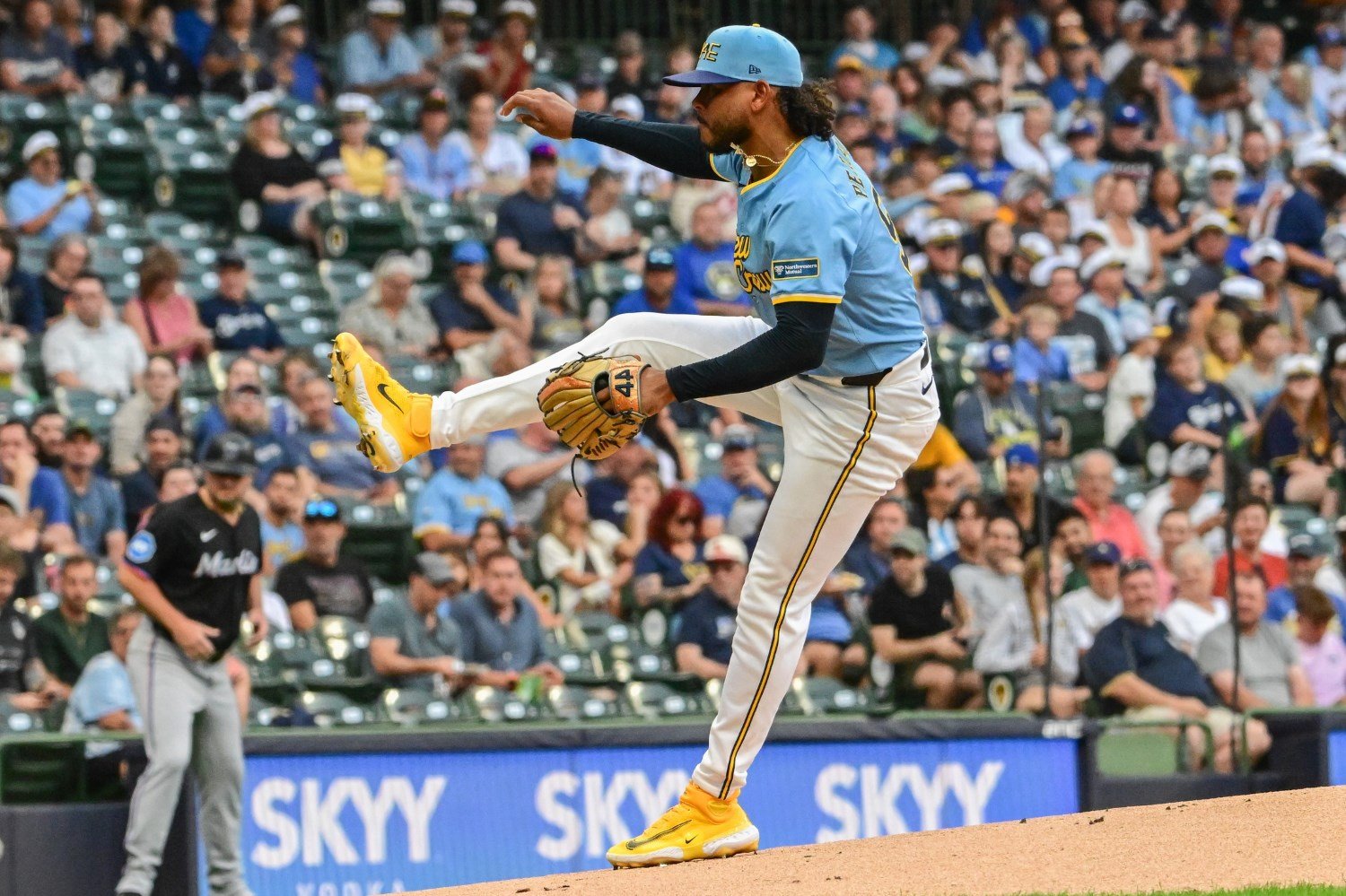
By now, you should be well aware that part of what makes Freddy Peralta special is his adaptability. The man once known as Fastball Freddy has become solidly four-pitch Freddy at times over the last two seasons. His slider is so manipulable and lethal that it effectively plays as four different pitches in itself, when he has the proper feel for it. He's an incredible athlete, and is always looking for the best way to put that physical brilliance to its highest use.
Alas, this year hasn't been quite the follow-up Peralta would have envisioned, after a tremendous second half last season that helped the team feel confident trading Corbin Burnes this winter. Peralta is 6-6 with a 3.89 ERA through his first 22 starts, albeit with an exceptional strikeout rate that speaks to his still-sizzling sheer stuff. He's spent the campaign trying to find the right balance between the things that make him unique and the elements of his game that are most sustainable from one pitch, one at-bat, and one outing to the next.
Specifically, Peralta has fought to find a delivery that he can repeat as well as he wants to, while holding onto the deception that made him unhittable down the stretch last year. He's gone through three distinct phases this year, in terms of setup and mechanics, and examining them gives us some insight into his season and what might come next within it.
First, let's establish what we're talking about. Here's Peralta in April, against the Rays, throwing a fastball by a hitter for a strike.
This is the iconic Peralta. From the blessedly square alignment of the center-field camera at home in Milwaukee, you can really see how crossfire he is. It's a long stride, and it takes him well toward the third-base line. Note, too, that he starts on that side of the mound, anyway. Peralta is practically throwing his combination of mid-90s heat and devastating breaking stuff around corners, in this formulation. It's viciously unfair to the hitter.
It's also an insanely hard set of moves and angles for Peralta himself. The way he opens his foot while striding so far closed, alone, puts considerable strain on multiple joints, and it's not easy to consistently throw strikes this way. This is like if Kobe Bryant started shooting all his threes off the dribble, fading sideways out of bounds.
Between his starts on May 11 and May 17, Peralta made a change. See if you can spot it.
Ok, actually, there are a couple of tweaks here, but there's one big one: Peralta's no longer set up on the third-base side of the rubber. He's a bit more neutral in his starting point, so while that crossfire action still means he's coming from way over toward third base, it's a bit less steep a horizontal angle from there to his targets. Then, too, there's a mechanical tweak. Peralta is more upright in the moments just before release here. He maintains a taller posture, rather than tilting the spine back in the direction he was coming from with that off-kilter stride, so his arm action is a little more around than over-the-top. If the verbal description doesn't help you spot or grasp it, another way to say it is that Peralta's vertical release and approach angles on his fastball were flatter during this phase than in the previous one.
Between his Jun. 14 and Jun. 19 starts, though, he made another change. This one will probably be more readily apparent.
The change in position on the rubber is no longer subtle, and hopefully, neither is the mechanical difference. Peralta is now working from the first-base side of the rubber. When he delivers, the crossfire stride direction is virtually gone. He's much, much more direct to home plate.
.png.de4e99574aa23c8abb5e5e5fd6e69a3a.png)
Why Peralta made each of these changes is not perfectly clear. It's certainly the kind of thing a pitcher might do to compensate for a nagging injury, especially to the back or knee, but it could just as easily be an effort to counteract some of the control trouble he ran into early this year. The most important questions are: Has it worked? And will he change again, for better or worse?
| SplitBy | G | P | BF | Chase% | Miss% | Barrel% | K% | BB% | SO%-BB% | HR% | RBBIP | BA | OBP | SLG | WHIP | ERA |
| Phase 1 | 8 | 724 | 182 | 27.0% | 34.0% | 18.4% | 31.9% | 8.8% | 23.1% | 2.2% | .278 | .196 | .289 | .310 | 1.05 | 3.63 |
| Phase 2 | 6 | 593 | 137 | 28.1% | 30.8% | 19.0% | 29.2% | 8.0% | 21.2% | 5.1% | .338 | .268 | .336 | .480 | 1.40 | 5.46 |
| Phase 3 | 8 | 804 | 185 | 26.5% | 30.3% | 12.2% | 27.6% | 9.7% | 17.8% | 3.8% | .271 | .206 | .288 | .358 | 1.17 | 3.05 |
You didn't think the answers would be simple, did you?
In brief, we can say that the middle phase (which appears to have been a conscious period of adjustment and stepwise progression anyway) was clearly the worst. Otherwise, though, it's muddier. Peralta has actually given up slightly more hard contact recently than early in the season, but less of it has been in launch angles where it tends to cause damage. His peripherals were better early, but his surface-level numbers are better now. What to make of that? In truth, we can only watch and wait to see what direction his evolution will turn next.
The bulk of this article was free to read. However, Brewer Fanatic Caretakers get a little bit more coverage of the subject, as a bonus. We invite you to sign up, and if you're already a Caretaker, read on!
Are you optimistic about the Brewers right now?

Follow Brewer Fanatic For Milwaukee Brewers News & Analysis



-
 3
3
-
 1
1



Recommended Comments
There are no comments to display.
Create an account or sign in to comment
You need to be a member in order to leave a comment
Create an account
Sign up for a new account in our community. It's easy!
Register a new accountSign in
Already have an account? Sign in here.
Sign In Now