


Brewers Video
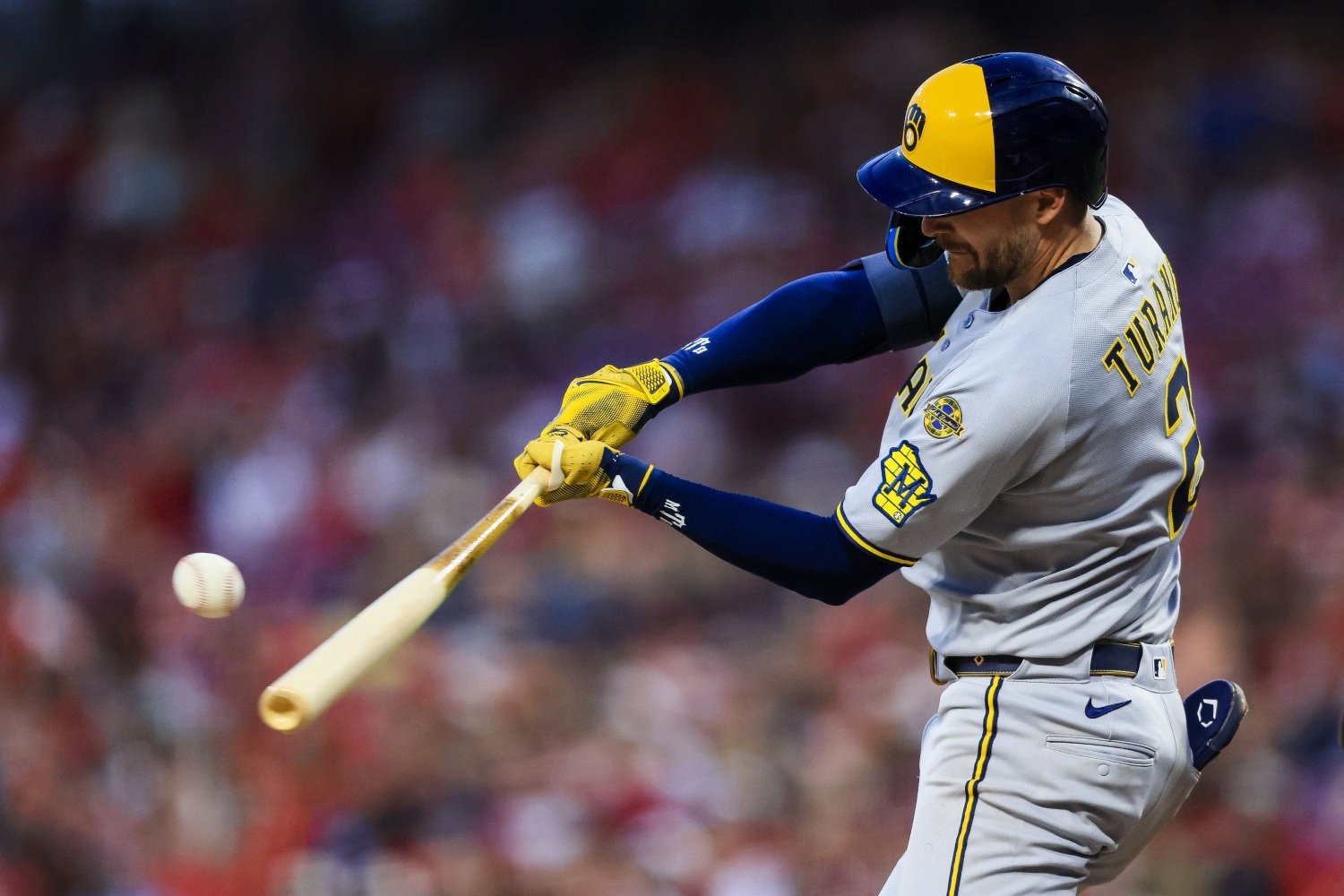
After more than 1,300 plate appearances, you should more or less know what you’re getting out of Brice Turang. He’s an outstanding middle infield defender with lackluster numbers at the plate. He almost changed our mind on his offensive capabilities last year, posting a .731 OPS in the first half, but by the end of the season, his numbers regressed to an 87 wRC+. This year, he’s off to another great start—but are his improved numbers a sign of a new leaf being turned, or just another first half tease?
The thing that has hamstrung his offensive production since he debuted has been his lack of pop. He has never slugged better than .350 over a full season, and his quality of contact numbers for his first two major-league seasons were comfortably in the bottom quartile of qualified hitters. This year, it seems to be more of the same. His current ISO of .086 is the 12th-lowest in MLB and is right in line with his career average. Without power in today’s game, it’s difficult to be productive at the plate. This, then, begs the question: why is Turang just one of two players to have an ISO .090 or lower and a wRC+ above 100?
To be fair, his wRC+ of 103 is just barely above the league-average threshold of 100, but it still deserves a closer look. His relatively high batting average (.270) and on-base percentage (.350) give him a boost, but is this the new norm or simply the result of luck on batted balls? His .337 batting average on balls in play seems to point us toward the latter, especially since people often use BABIP as a proxy for luck and offensive sustainability. But things are rarely that simple in the sport of baseball. If we instead look at his expected batting average (xBA), a metric that’s based on intrinsic characteristics like launch angle and exit velocity on batted balls, we see that it actually rates Turang as slightly unlucky, giving him a slightly higher mark of .279. To go even deeper, his expected slugging average (xSLG) of .421 makes it even more convincing: he's hitting into tough luck. But that wouldn’t (and shouldn’t) be enough to convince you that he has been swinging a better bat.
You see, expected stats aren’t perfect, either. They don’t take into account horizontal launch angle, and the scale by which individual batted balls are granted a batting average is hazy at best. So, let's take a closer look at some more metrics to see if they've moved in the right direction. If you’re a Turang truther like me, you’ll be happy to know that his average exit velocity this season of 91.4 mph is in the top quartile and is miles better (haha, get it? 'cause mph) than last year’s mark of 87.0. All of his quality of contact numbers have taken big steps forward, thanks in large part to a 3-mph increase in his bat speed. Perhaps the Flintstones vitamins I sent him in the mail this offseason finally arrived.
So if he’s hitting the ball harder than ever before, why are his ISO and SLG numbers still so disappointing? Well, first, it’s important to acknowledge that while they’re often used as a proxy for power, those metrics don’t translate perfectly. They’re based on a player’s ability to convert batted balls into extra-base hits, often doubles and homers, which require both power and lift to achieve. Unfortunately, Turang’s fly ball rate is below-average. Even more concerning is that he pulls just 3.9% of his batted balls in the air, dramatically limiting the distance he can achieve. In fact, he pulls the ball just 21.7% of the time, significantly lower than the league-average mark of 37.2%. It's pretty tough to be a power hitter when you hit the opposite way 36.7% of the time. Despite this quirk in his approach, though, he has still found a way to make it work thus far in 2025 and it’s clear that he’s closer to a true offensive breakout than he is to repeating the .585 OPS he had during his rookie year.
But the best part is that any production he gets out of his bat is just a cherry on top of his primary value, which is on the basepaths and with his glove. He isn’t swiping bags at the same torrid pace as he did last year, but he still has 15 stolen bases, seventh in the National League. He also has six Defensive Runs Saved, more than any second baseman in MLB other than Nico Hoerner (10). Compounded with the fact that offensive expectations for second basemen are generally lower to begin with, it should be no surprise that Turang has been worth 2.6 rWAR so far this year, comfortably more than any other player on the Brewers.
So yes, it’s true that after almost 70 games, he has just eight doubles and four homers. It’s also true that the peripherals are just waiting for him to pull a few balls in the air so his actual statistics can reflect what true Brewers fans have known since 2023: that Brice Turang is a talented and potentially helpful hitter.
Do you approve of the job Pat Murphy is doing as Brewers manager?

Follow Brewer Fanatic For Milwaukee Brewers News & Analysis



-
 2
2


Recommended Comments
Create an account or sign in to comment
You need to be a member in order to leave a comment
Create an account
Sign up for a new account in our community. It's easy!
Register a new accountSign in
Already have an account? Sign in here.
Sign In Now