


Brewers Video
Take a trip, with me, a little deeper into the wilds of bat-tracking data and its complexities. Two key Brewers hitters exemplify a particular wrinkle nicely.
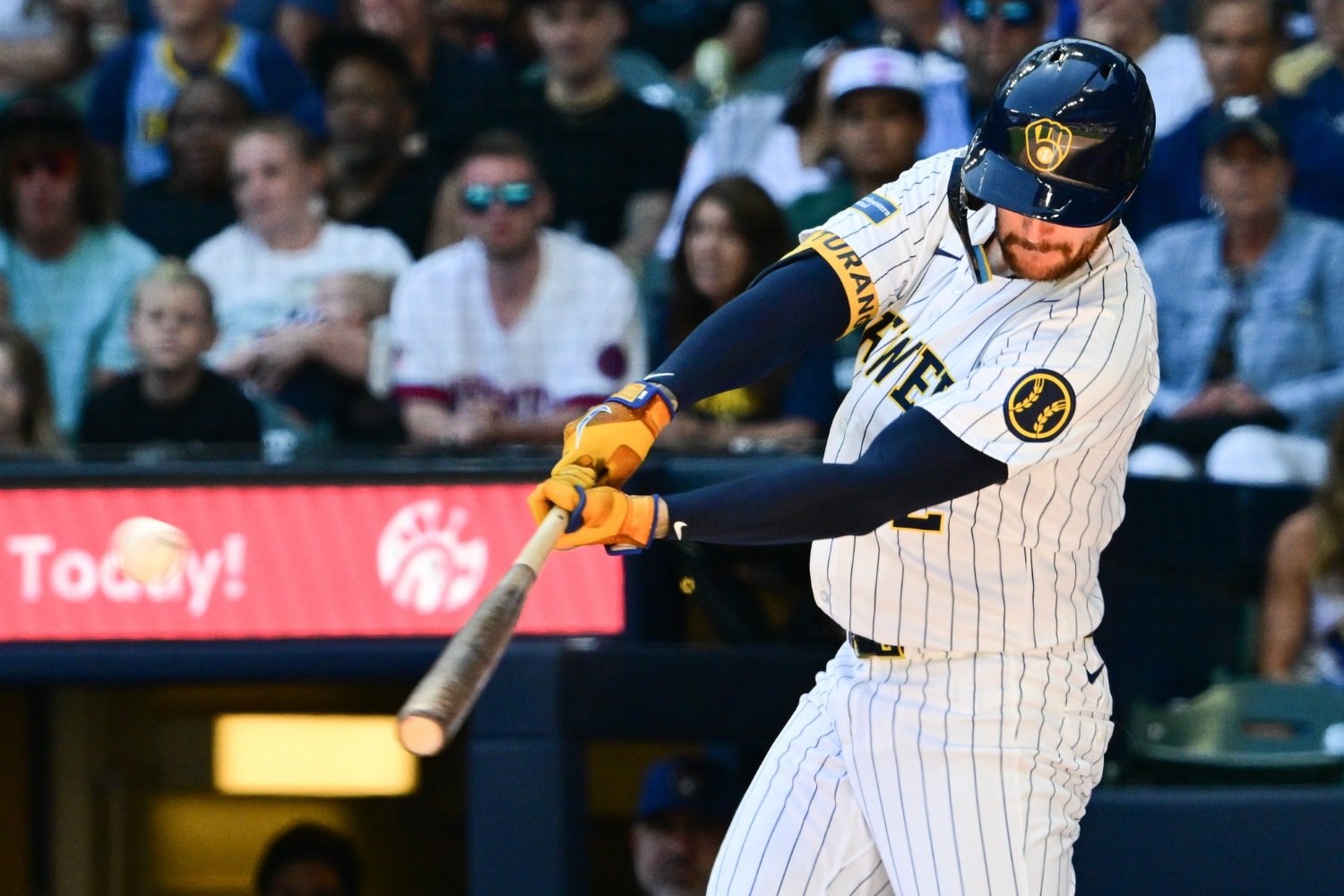
Last week, I wrote a bit about what I learned by watching some of Brice Turang's fastest swings of 2024. Turang has almost bottom-of-the-scale bat speed, according to the bat-tracking data from Statcast released on Baseball Savant early last season. Yet, he did show the ability to swing the bat as fast as 80 miles per hour, well above the needed line to generate power. Breaking down the times when he swung hardest helped me better understand what his ceiling is, in terms of power, but also why he hasn't gotten to much of that potential power thus far in the majors.
More recently, Jack Stern dug in deep Wednesday on Rhys Hoskins's struggles in 2024, searching for a key that might unlock his talent anew for 2025. One insight there: Hoskins's ability to rotate and transfer his weight was compromised by the leg injuries he was dealing with throughout the season, and the best hope for a resurgent season lies in him recovering that capacity.
As it happens, I wrote a piece for Baseball Prospectus this week that bears upon both Turang's and Hoskins's bat speed. Specifically, rather than being satisfied with the bat-tracking metrics served to us by Savant, I use the app developed by Kyle Bland, of Pitcher List—and that app offers numbers that give us more nuanced insight into the nature of swings and of hitters.
Bland derived swing acceleration (in feet per second per second, a different thing from swing speed, which is reported in miles per hour (or, if you convert it, in feet per second) based on the time it took a hitter to execute their swing and their measured (final) swing speed. Using that data and the strong relationship between swing speed and swing acceleration, I found an expected acceleration for each hitter and compared it to their actual acceleration. Of all hitters with at least 600 competitive swings, Turang had the greatest positive difference between his real and his expected acceleration. Hoskins, on the other hand, had the fourth-greatest negative difference.

Swing length is a key co-determinant of the gap between real and expected acceleration, and indeed, Hoskins's lack of acceleration has much to do with his long swing. However, even Turang's very, very short swing doesn't fully explain his boosted acceleration.
Why does acceleration gap matter? I found, perhaps unsurprisingly, that accelerators like Turang tend strongly to have great contact rates. I also found, a bit more surprisingly, that they tend to have great batting averages on balls in play. Why? Because a hitter with great acceleration in their swing can hit the ball hard to the opposite field more reliably. Most hitters who decelerate (relative to what we'd expect, based on their swing speed at contact) find all their value to the pull field. These tend to be players who have to get started earlier, because their swings are designed to get below and/or around the ball, hitting it well out in front of themselves.
Thus, a swing like Hoskins's is probably up to its desired speed only on the balls they catch out front and pull. An accelerator like Turang, by contrast, can catch the ball deeper in the hitting zone and with their bat perpendicular to the flight of the ball or even yet to get that far, and still have the barrel moving fast enough to hit it well. You can see the difference, in microcosm, by studying the average exit velocity on batted balls by direction for both Turang and Hoskins.
| Player | Pull | Straightaway | Opposite |
| Brice Turang | 89.2 | 87.9 | 84.4 |
| Rhys Hoskins | 90.9 | 88.4 | 82.9 |
Hopefully, we'll get even more and better detailed information about swings in 2025. There are more data to crave, like attack angles and contact points. For now, though, we have enough data to draw some interesting conclusions not only about the sheer value of swing speed and length, but about how different hitters time their swings and where in the arc of those swings they try to maximize their bat speed in anticipation of contact. Turang and Hoskins, about as different as two hitters can be, help us see how that plays out in the numbers.






Recommended Comments
There are no comments to display.
Create an account or sign in to comment
You need to be a member in order to leave a comment
Create an account
Sign up for a new account in our community. It's easy!
Register a new accountSign in
Already have an account? Sign in here.
Sign In Now