


Brewers Video
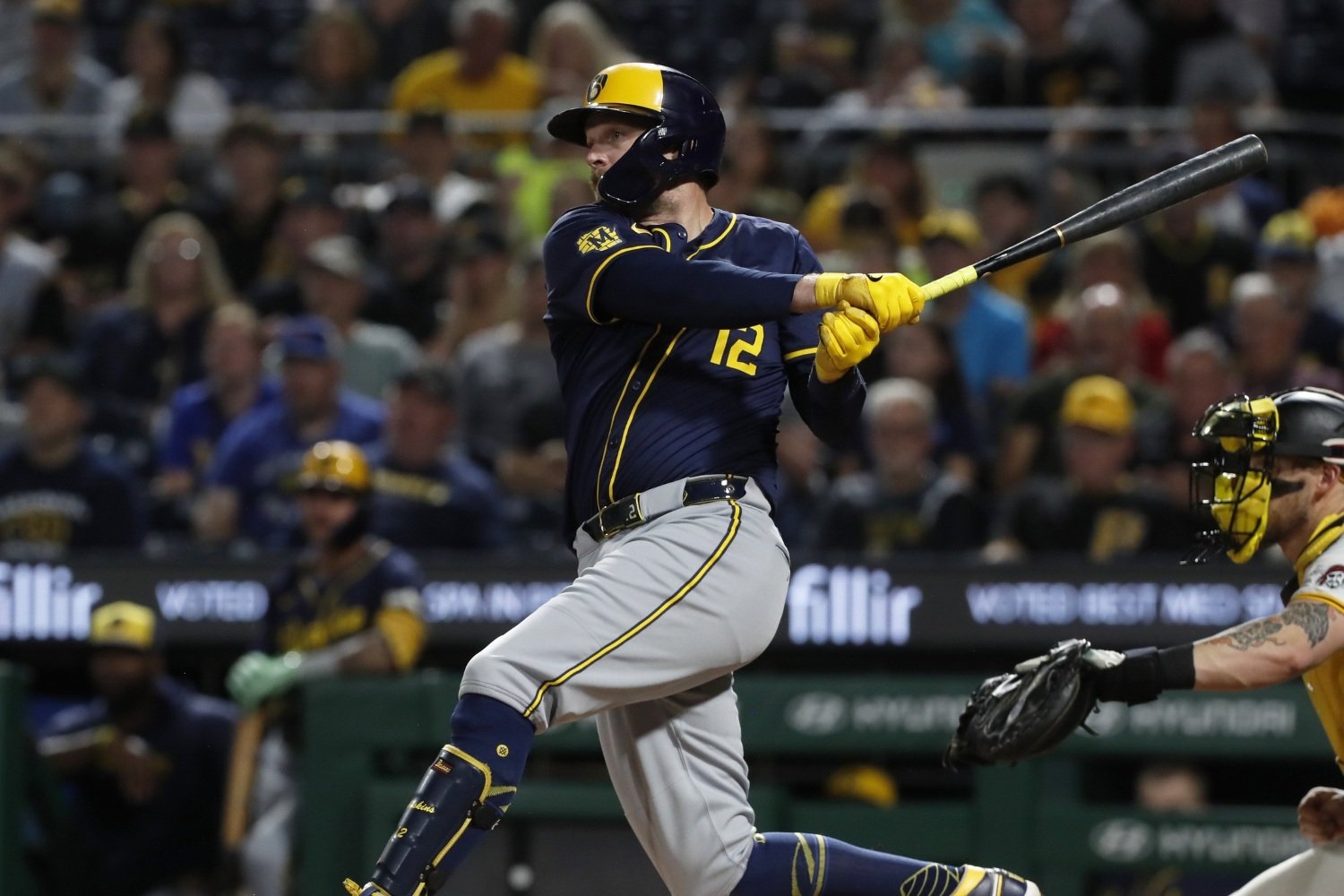
In Year One, the partnership between Rhys Hoskins and the Milwaukee Brewers was a mixed bag. While the veteran first baseman quickly settled into a role as one of Pat Murphy’s clubhouse pillars, the same was not true on the field.
Hoskins came to Milwaukee with a career line of .242/.353/.492 (126 wRC+), averaging 36 home runs per 162 games. He hit 26 home runs in 2024, but slashed just .214/.303/.419 for a 100 wRC+. As a league-average hitter and a poor defender at first base, the 31-year-old was a replacement-level player, finishing the year with 0.1 fWAR and -0.2 bWAR.
After the worst season of his career, Hoskins (unsurprisingly) picked up the $18-million player option for 2025 that always appeared to be a safety net in case he was not his former self upon returning from ACL surgery. While the Brewers presumably would prefer to offload that salary—and the $4 million they will owe him in a mutual option buyout next winter—via trade, such an opportunity always seemed unlikely. Hoskins is expected to return for a second season in the Cream City, with both parties hoping for improved performance.
The former Phillie joined the Brewers with a reputation as a feared fastball hitter. Hoskins was one of 385 hitters from 2017 through 2022 to log at least 500 at-bats that ended on a four-seamer or sinker; his .559 slugging percentage against those pitches ranked in the 88th percentile, and his 16.6% whiff rate ranked in the 62nd percentile.
The ability to handle velocity laid the groundwork for consistent power production throughout the first six seasons of his career. Hoskins held his own against hard stuff at the top of the zone, whiffing less than the average right-handed hitter.

Hoskins didn’t do much damage against up-and-in fastballs, nor did he hit the ball particularly hard when pitchers tried to bust him inside. Instead, he could fight off the heater high and tight and hit the remaining inside fastballs at ideal launch angles for line-drive hits.

In the clip below from 2022, Hoskins fouls back a 99-mph fastball from Spencer Strider in a full count.
Here he is taking a 94-mph Miles Mikolas fastball on the inner third back up the middle for a base hit. Hoskins didn’t crush this ball, hitting it just 84 mph, but he got started early enough and caught it far enough in front of him to line it at an ideal 14-degree launch angle for a clean single.
Finally, here’s a firmer liner hit when Sandy Alcántara attempted to eat him up inside with a 99-mph sinker.
The theme across these pitches is how quickly Hoskins turned on them. He had the strength and mobility to seamlessly shift his weight from his back leg to power an explosive but controlled swing. Channeling and transferring that lower-body strength brought his hands through the zone at the right time and angle to meet the ball in a good spot, producing solid contact.
Hoskins still slugged a respectable .442 against four-seamers and sinkers in 2024. However, that was a stark decline from his most productive seasons, and a deeper dive reveals more red flags. Instead of hitting fastballs all over the zone, his production was mostly limited to ones over the middle of the plate.

Hoskins could no longer catch up to many of the high fastballs he could previously fight off. His whiff rate on four-seamers and sinkers spiked along the top rail of the zone. What was once a key driver of his success was now a weakness, imparting a trickle-down effect that dampened his production.

When hitters can react successfully to elevated velocity, waiting back on soft pitches and even fastballs at the bottom of the zone becomes easier. Losing that ability puts them behind the 8-ball, often prompting a pivot to guess hitting. They may try to anticipate hard stuff, and start their swings earlier to reach it. An incorrect guess leaves them hopelessly out in front of any other pitch.
Hoskins often looked like a hitter trying to cheat for velocity he could not otherwise reach. It worked decently at times, as he still punished mistakes. However, it often left him ahead of pitches he once handled capably. From 2022 to 2024, his slugging percentage dropped from .374 to .316 against breaking balls and .563 to .479 against offspeed pitches. His pull rate jumped to a career-high 52.6%.
In 2024, an elevated 99-mph fastball near the hands often made Hoskins look helpless. The empty swing in the clip below was a frequent sight.
So, too, was this routine groundout against a low-and-in fastball.
Instead of fighting off the high fastball, catching the inside one with the sweet spot of the bat, and crushing the mistake, Hoskins was late on the high pitch and ahead of the low one. The former produced more whiffs and pop-ups, and the latter yielded weak rollovers because he pulled off out in front of the pitch. Hoskins spent most of the year caught in between, the most dreaded space for any hitter’s timing.

Compare the foul ball clip with the swing-and-miss one. Hoskins’s movements are less compact and lack explosiveness. The stable lower half is no longer present to bring his torso with it, so his upper body lags behind as it drags through. He got the front hip open earlier on the left, generating the torque to whip the barrel through and find the ball. For hitters with long swings, like Hoskins's, that's the key to hitting the inside pitch. He wasn't doing it in 2024.

Some of these trends were already present early in the year, even as Hoskins mirrored his established output with a .233/.340/.474 line and nine home runs through May 13. The issues worsened when he returned from a hamstring injury at the end of that month, forgoing a minor-league rehab assignment to play in a homecoming series in Philadelphia. Hoskins hit just .213/.289/.313 in June, displaying reduced bat speed.

For most of the season, Hoskins looked like a player without his legs under him. Now, an additional year after surgery, the question is how much of that lower body strength and mobility will return in his second year in Milwaukee. His outlook is muddied by the fact that he is likely exiting his physical prime. Hoskins will turn 32 in March, the age at which swing speed begins to decline steadily.
Most projection systems forecast only marginal improvement in 2025. Steamer expects a 106 wRC+, ZiPS a 105 OPS+, and Marcel a .229/.311/.425 slash. PECOTA is more pessimistic, assigning Hoskins a 50th-percentile line of .209/.292/.386.
That would constitute another underwhelming season for Hoskins and the Brewers, who will almost certainly bank on internal improvement to replace Willy Adames in the power department. Both player and team would benefit significantly from a bounce-back showing by the slugging first baseman. Restored health and mobility could help him rebound from a career-worst season, but that shouldn't be expected. Instead, Hoskins will have to prove he can turn back the clock.
Which team do you dislike the most in the NL Central?

Follow Brewer Fanatic For Milwaukee Brewers News & Analysis



-
 1
1



Recommended Comments
Create an account or sign in to comment
You need to be a member in order to leave a comment
Create an account
Sign up for a new account in our community. It's easy!
Register a new accountSign in
Already have an account? Sign in here.
Sign In Now