


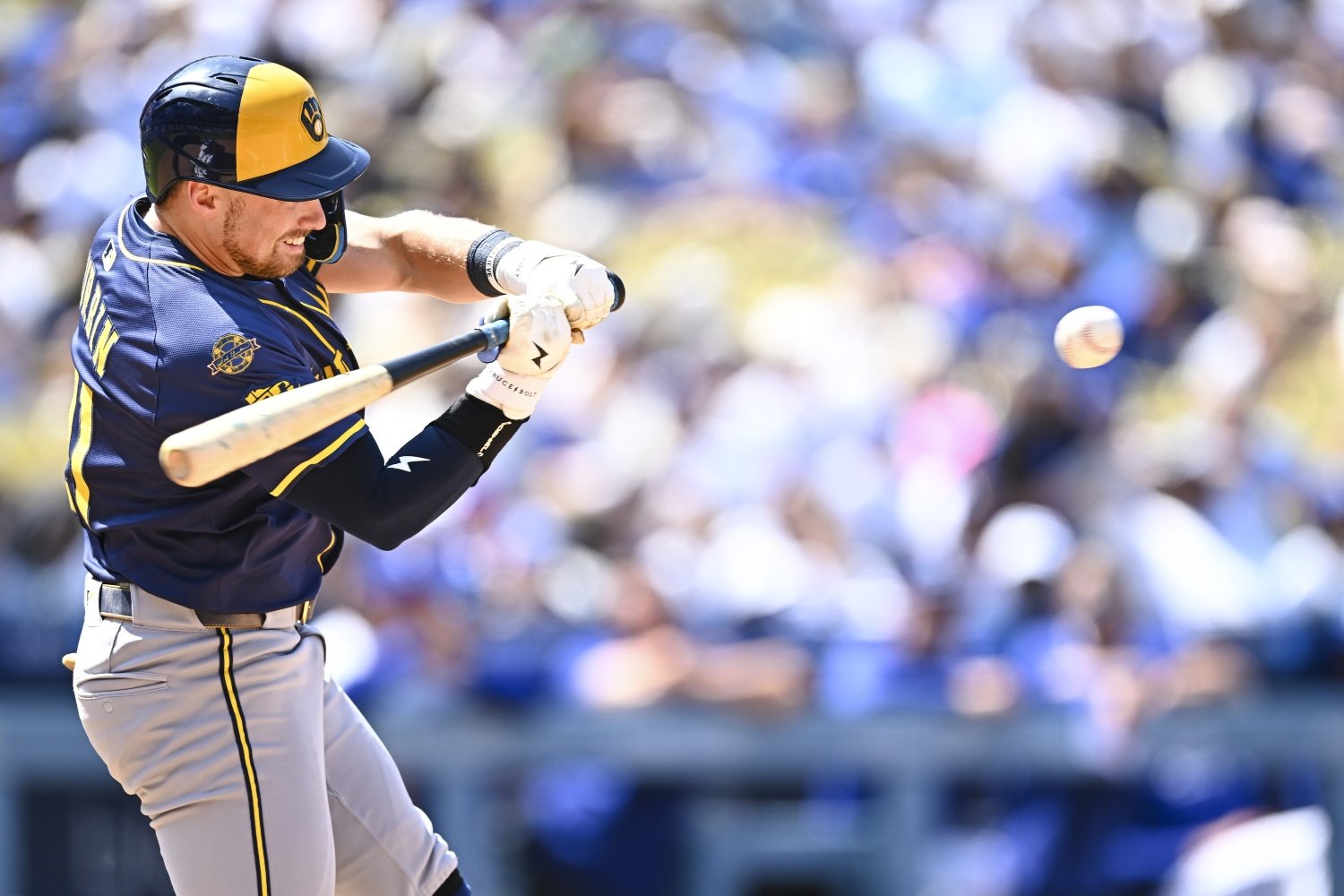
Brewers Video
If I told you before the season that the Brewers' third baseman had one of the lowest average exit velocities and hard-hit rates in the entire league and recorded a Statcast-qualifying Barrel less often than 90 percent of other batters, would you consider third base a positional weakness? Probably, right? What if I told you that same guy had a mediocre expected weighted on-base average (xwOBA, which estimates what a player should have expected to produce on a holistic basis, given the quality of their batted balls and their strikeout and walk rates) of .309, an expected slugging percentage among the lowest in the league, and a very modest walk rate? You'd probably be begging the Brewers to make a splash at the trade deadline.
Caleb Durbin, though, refuses to be boxed in by expectations, statistical or otherwise.
The above stats are all true. Yet, Durbin is hitting .265 with a .733 OPS, 107 OPS+, and a 112 wRC+. He’s already provided 2.1 WAR, less than 100 games into the season—even though he spent the first four weeks of the year at Triple-A Nashville. Durbin is also clutch: he’s walked off three different games and has a .313 batting average (.834 OPS) with runners in scoring position.
All of these stats lead me to one simple question: How can somebody who’s really bad at hitting the ball hard also be a statistically above-average hitter? Guys like Luis Arraez, Steven Kwan, and Jeff McNeil have been relatively successful with low exit velocities and hard-hit percentages, but all of those guys have significantly above-average expected batting averages (xBA). That metric estimates how often comparable balls (in terms of exit velocity, launch angle and, on certain types of batted balls, Sprint Speed) have become hits since Statcast was implemented.
Unlike those of his fellow light-hitting performers, Durbin’s xBA is also below-average, meaning that the balls he’s hit have been significantly less likely to become hits than Arraez, Kwan, and McNeil. All of those guys hit lots of line drives and cluster their batted balls in the most productive band of launch angles, which is normally a huge part of success for contact hitters. Durbin’s launch-angle sweet spot percentage? 26.6%, one of the worst in all of baseball. By all metrics, he’s about as bad as it gets at squaring the ball up and hitting it hard. Many contact hitters excel by using the whole field, something Durbin (an extreme pull hitter) also doesn't do.
However, Durbin is really good at a couple of important things. The first is bunting, as detailed in Matthew Trueblood’s article from last month. Durbin is pretty fast, so opposing third basemen have to respect him as a threat to bunt for a hit. How many times this year have you seen Durbin hit a ground ball down the third-base line for a double? (Three, is the answer, which is a solid number in such a limited sample of playing time.) That’s because the third baseman is playing in to prevent Durbin from bunting for a hit. Same thing goes for his hits up the middle. When the first baseman is playing in to protect against the bunt, the second baseman can’t cheat toward the middle, because he has to be prepared to cover first base. He pulls the defense out of shape, then exploits that fact.
Durbin’s second skill, and the reason he’s able to take advantage of the way that defenses are forced to play him, is his contact ability. Caleb Durbin straight-up does not strike out. His strikeout percentage is just 9.1%. Of the 262 players with at least 200 plate appearances this year, only five (Arraez, Kwan, Nico Hoerner, Jacob Wilson, and Chandler Simpson) have fanned less often. When the ball is always in play, you give yourself a huge number of opportunities to find hits.
Durbin’s BABIP (.275) is just .011 higher than his batting average. Most hitters have a significantly higher BABIP than their batting average, because they strike out at a normal rate. They have to hit for a higher average on balls in play, because they don’t put the ball in play every at-bat. Durbin, however, puts the ball in play nine out of every 10 at-bats. He doesn’t have to be all that successful at creating quality contact (hence the low xBA), because he’s making contact almost every time. It’s an old-school philosophy based around sheer volume. If you get the ball in play almost every plate appearance, some of those are bound to find holes, even if they are individually less likely to become a hit.
Durbin would have the third-highest batting average on the Brewers (after Sal Frelick and Brice Turang) if he had enough plate appearances to qualify. Look at this hit against the Mets. It's not good contact, but he's making contact.
Or this two-out RBI single. Durbin basically hits it off his hands, but he's getting the ball in play. If you strike out 9% of the time, as opposed to 25% of the time, you'll have more chances to find the gaps.
Durbin obviously doesn't square the ball up a lot, but putting the bat on the ball so often also increases the number of times he hits it hard. That leads us to another thing important to consider regarding Durbin's contact numbers: they dilute his batted-ball stats.
Hard-hit percentage, barrel percentage, and sweet spot percentage are all calculated by dividing the relevant stat by the number of batted balls. In short, his percentages are slightly diluted by the high contact rate. He's able to hit the ball more than your average hitter, which means he records more batted balls per plate appearance than your average hitter.
If Durbin were striking out two times for every 10 plate appearances, as an average batter does, his hard-hit, sweet spot, and barrel percentages would all (probably) be higher, because he'd record fewer batted balls and the ones that would disappear would (likely) be the weakest ones he's generating in this version of reality. The average exit velocity and hard-hit rates still wouldn't be high, but they would be higher. I'd prefer weak contact to a strikeout any day of the week, unless there's a runner on first and less than two outs, and you have a ground-ball hitter at bat. Durbin is not a ground-ball hitter—and he doesn't only make weak contact.
His contact abilities are also the reason he's so clutch. Durbin almost always puts the ball in play, so in late-game situations (for example, when the infield is playing in to try and prevent the runner on third base from scoring), he's more likely to make something happen. Take, for example, his walk-off single on June 12. There are runners on second and third with only one out in a tie game, so the first baseman is playing in. This ball is probably caught for an out if there was nobody on base, but instead, this happened:
Even this walk-off sacrifice fly is a great example of why Durbin has become a valuable contributor in the clutch. When you need someone to get the ball in play, call Caleb Durbin. A flyout isn't just a flyout when there's a runner on third in a tie game:
He's the opposite of most modern hitters, in a game leaning increasingly toward power and embracing the strikeout to get to it. Durbin does enough things well, though, to keep the line (and the ball, and then himself) moving. That's made him a very solid contributor for the surging Crew.
Do you approve of Brewers' ownership?

Follow Brewer Fanatic For Milwaukee Brewers News & Analysis



-
 2
2


Recommended Comments
Create an account or sign in to comment
You need to be a member in order to leave a comment
Create an account
Sign up for a new account in our community. It's easy!
Register a new accountSign in
Already have an account? Sign in here.
Sign In Now