


Brewers Video
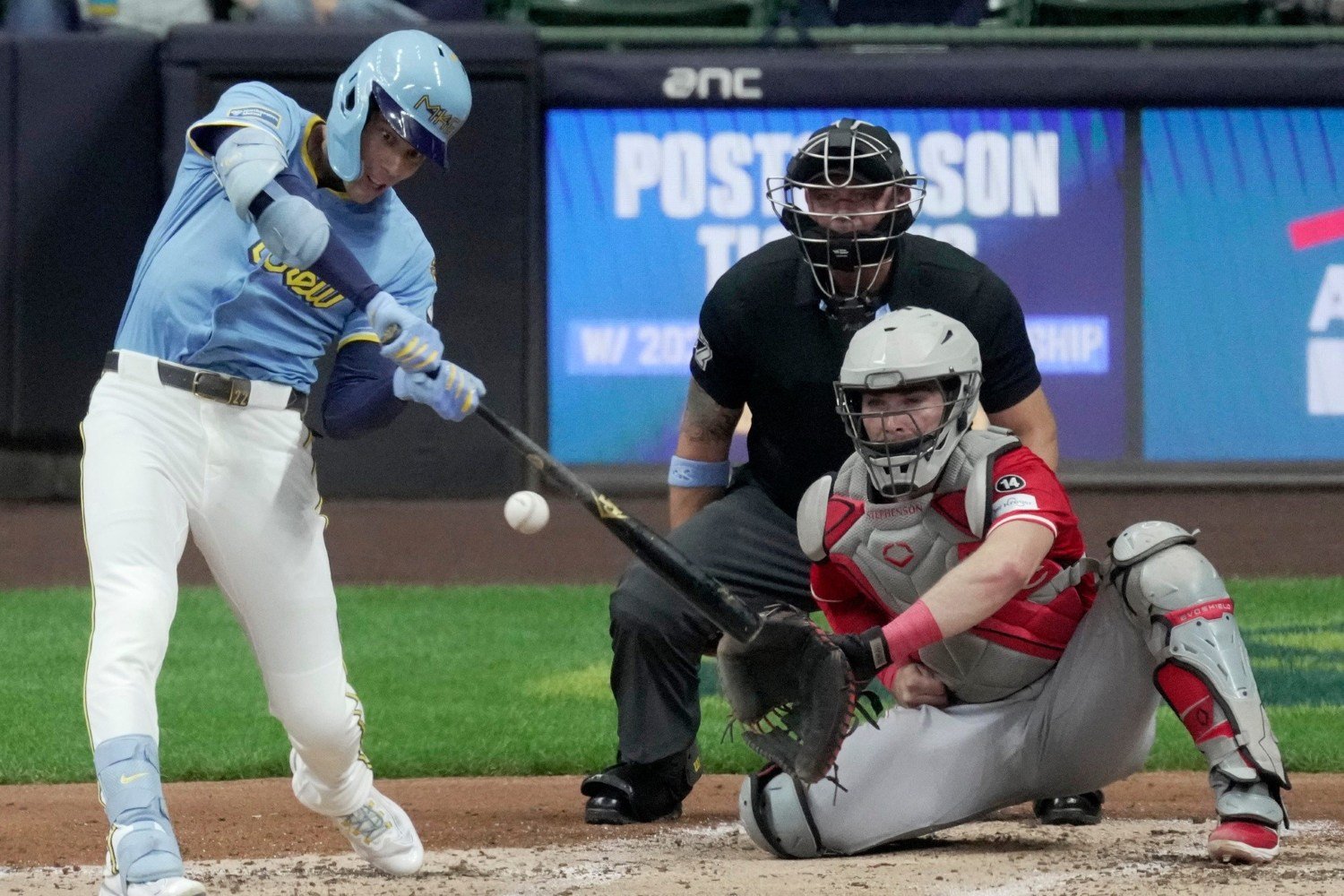
It took Pat Murphy a long time to decide to try out Christian Yelich as his leadoff hitter. Yelich batted second at the dawn of the season, then spent long stretches batting third and (especially as the season wore on) fourth. He even slid to fifth a few times, in August and September. Only in this final week has Murphy batted his highest-paid player first—but now that he's alighted on the idea, he's giving it a real look. Yelich was the leadoff man for each of the six games of the Brewers' final week of the regular season.
Taking Yelich's current skill set and the typical role of a leadoff hitter in a vacuum, the peg doesn't seem to be the same shape as the hole. The leadoff spot disproportionately rewards walks and doesn't reward power as much as other lineup spots, because the leadoff hitter is more likely to come up with nobody out and less likely to come up with runners on base than any other player in the lineup. Yelich is running his lowest walk rate in a decade, and his highest isolated power figure since 2020, so now is an odd time to give him any serious consideration atop the lineup card.
One argument for placing him first is that Yelich hits the ball on the ground a lot, which makes him (theoretically) prone to hitting into double plays if he comes up with runners on in front of him. In certain past seasons, that's even been true. However, the last two years, Yelich has actually been exceptionally good at avoiding double plays, as judged by the rate at which he hits into them when he comes up in double play situations. Fascinatingly, that seems to be because he's undertaken a real change to become more of a chameleon. He's shown a capacity to change his approach when he bats in spots where double plays are possible, to hit fewer grounders.

See how most of the trend lines are essentially flat, but the green one bends noticeably downward? Yelich is more assiduously avoiding the double play by changing either his swing or the pitches he attacks when the twin killing is a possibility, especially over the last two seasons. In one way, that further argues against batting him first, but in another, it's encouraging no matter where he hits. He's impressively adaptable; that might mean that he can do whatever is needed even if he's asked to change roles within the offense.
Speaking of adaptability, too, we had better figure out exactly how Yelich has been so productive in the power department this year. He's hitting the ball less hard (and hitting it hard less often), and his average launch angle is down. He's not hitting more fly balls, or pulling the ball more, and the ball is dead this year. Whence have come his 29 home runs?
Firstly, we can identify the batted balls that have turned into better power output. Here are his radial charts (showing launch angle and (by distance from the initial point) exit velocity) of batted balls for 2023-24 and for 2025, side by side.
.png.0a371feafb2046648915ebd3c97830a8.png)
As a glance, these look very similar, but note the small donut hole in the image on the right. Yelich has hit fewer medium-speed, low0trajectory liners and high-trajectory grounders this year. He's also hit fewer balls above about 40° of launch angle, and the high-trajectory, well-hit fly balls he has hit have carried much better.
But wait. As I already mentioned, the ball isn't flying well this year, league-wide. Why is Yelich having good luck hitting high fly balls that carry out of the park?
The answer to that is the same as the answer (or at least, it overlaps with the answer) to why Yelich has hit fewer of those low liners this season, and it gives us insight into how he's changed as a hitter on this side of last year's back surgery. He's also changed over the course of this year, itself.
For one thing, over the last two-plus years, Yelich has slowly let go of the idea that he needs to pull the ball to create power. Here's a rolling average of his attack direction when he makes solid contact, with the trend line (in gold) to highlight the direction of change.

Yelich has always been an opposite-field hitter first, but in his initial explosion into power hitting back in 2018-19, part of the key was that he would sometimes guess and attack the ball with the intent of driving it to the pull field. Lately, he's doing that less and less. He's still swinging fast and trying to drive the ball, but he's embraced the need to do so to the opposite field, which is truer to his natural stroke.
As you'd guess, that means that he's catching the ball deeper in the hitting zone. The ball is getting more on top of Yelich, when he hits it hard, but that means he's less likely to be rolling over it. Thus, he's backspinning the ball better.

The final ingredient in this suite of adjustments, though, is that you have to be smart about not chasing the ball down—and, in fact, about getting a pitch with enough air under it to lift the ball naturally. He's getting his 'A' swing off against slightly higher pitches, and that means slightly greater opportunity to let it travel while still getting under it enough to generate lift.

Even with these adjustments, sustaining his power surge has proved difficult. Yelich is still a 33-year-old a year removed from back surgery, and entering Sunday, he'd batted just .233/.291/.370 in September. He's not heading into October running especially hot, and moving him to the top of the order hasn't done anything to catalyze a relatively quiet Brewers offense. However, it's easy to see why Murphy trusts Yelich, and why he's giving him a look as the leadoff man after mixing and matching his five best hitters in several ways over the last month. First might not be the best place for Yelich, but third looks like a good spot for Brice Turang, and fifth works nicely for Sal Frelick. Yelich's ability to change what he's doing based on situation and the signals he's getting from his own body makes him a good candidate to slide up and accommodate that construction. It's a testament to the manager's team-over-egos mentality, but also to the player's superb feel for the game and willingness to do whatever the team needs.
Do you approve of the job Pat Murphy is doing as Brewers manager?

Follow Brewer Fanatic For Milwaukee Brewers News & Analysis



-
 1
1


Recommended Comments
Create an account or sign in to comment
You need to be a member in order to leave a comment
Create an account
Sign up for a new account in our community. It's easy!
Register a new accountSign in
Already have an account? Sign in here.
Sign In Now