


Brewers Video
It's so ubiquitous it feels inevitable, but the league is full of teams operating at a totally voluntary extreme.
Because of the COVID-19 pandemic and the massive attendant disruption to the sport, it was a long time between the league passing rules limiting teams to 13 pitchers on their 26-man active roster and those rules actually taking effect. Eventually, though, it did happen, and ever since, on somewhere north of 98% of all gameday rosters, teams have carried exactly 13 pitchers. It's what you do. It's why the rule exists, in the first place. Teams feel they need to keep stacking their roster with hurlers, to withstand the rigors of the modern game and cover for the much lower volume most clubs get from their top arms.
Every team you play, every day, all season, is going to have 13 pitchers and 13 position players. It's how they're built, and it's how they'll continue to be built. Maybe there would be an advantage, though--especially for the Milwaukee Brewers--in bucking that trend. Another set of recent rule changes has increased the plausibility of that plan, and the Brewers' particular roster construction might make it downright necessary.
That second set of changes, of course, is the 2023 implementation of the pitch timer, the enlargement of the bases, and the constraints on defensive positioning and throws over to the bases. As a result of those tweaks, the number of stolen bases attempted by teams throughout the league has exploded, and (of course) the time between pitches has shrunk. The job of pitching is certainly harder, but less visibly, so is the job of catching. Many more throws are required, and there's less time for the mental portion of their jobs, too. It's tiring. Perhaps driven by that very fact, we've seen sharp downturns in offensive production from catchers late in the season over the last two years.
Weighted On-Base Average By Month, MLB Catchers
| Month | 2016-17 | 2018-19 | 2021-22 | 2023-24 |
| Mar./Apr. | .296 | .300 | .290 | .303 |
| May | .302 | .307 | .286 | .294 |
| June | .310 | .300 | .308 | .285 |
| July | .314 | .302 | .303 | .317 |
| Aug. | .316 | .303 | .302 | .307 |
| Sept./Oct. | .307 | .291 | .295 | .292 |
| Playoffs | .270 | .239 | .267 | .249 |
Catchers wearing down a little bit in September is a tale as old as time, and the above data risks overstating it, anyway. After all, hitters at all positions typically hit a bit less well in September than in July and August, as the weather begins to cool a bit. Still, the fall-off has been more stark since the pitch timer went into effect than in previous years, and Brewers fans saw this happen in real time.
William Contreras was a superstar in August, stepping up heroically to fill the void left by the back problems that ended Christian Yelich's season. Over the final few weeks of the regular season, however, he clearly wore down under the heavy workload he bore throughout the campaign. He was physically compromised and unable to deliver in key situations in the team's three-game Wild Card Series defeat.
As the season went along, the team did prevail upon him to throttle back one of the heaviest catching loads in the league, and for most of the second half, they carried three catchers on their active roster. That was possible because Contreras could often be the designated hitter, keeping his bat in the lineup but sparing his knees, whatever body parts had recently taken a foul tip, and his mind, which had to be fully engaged and working fast whenever he caught.
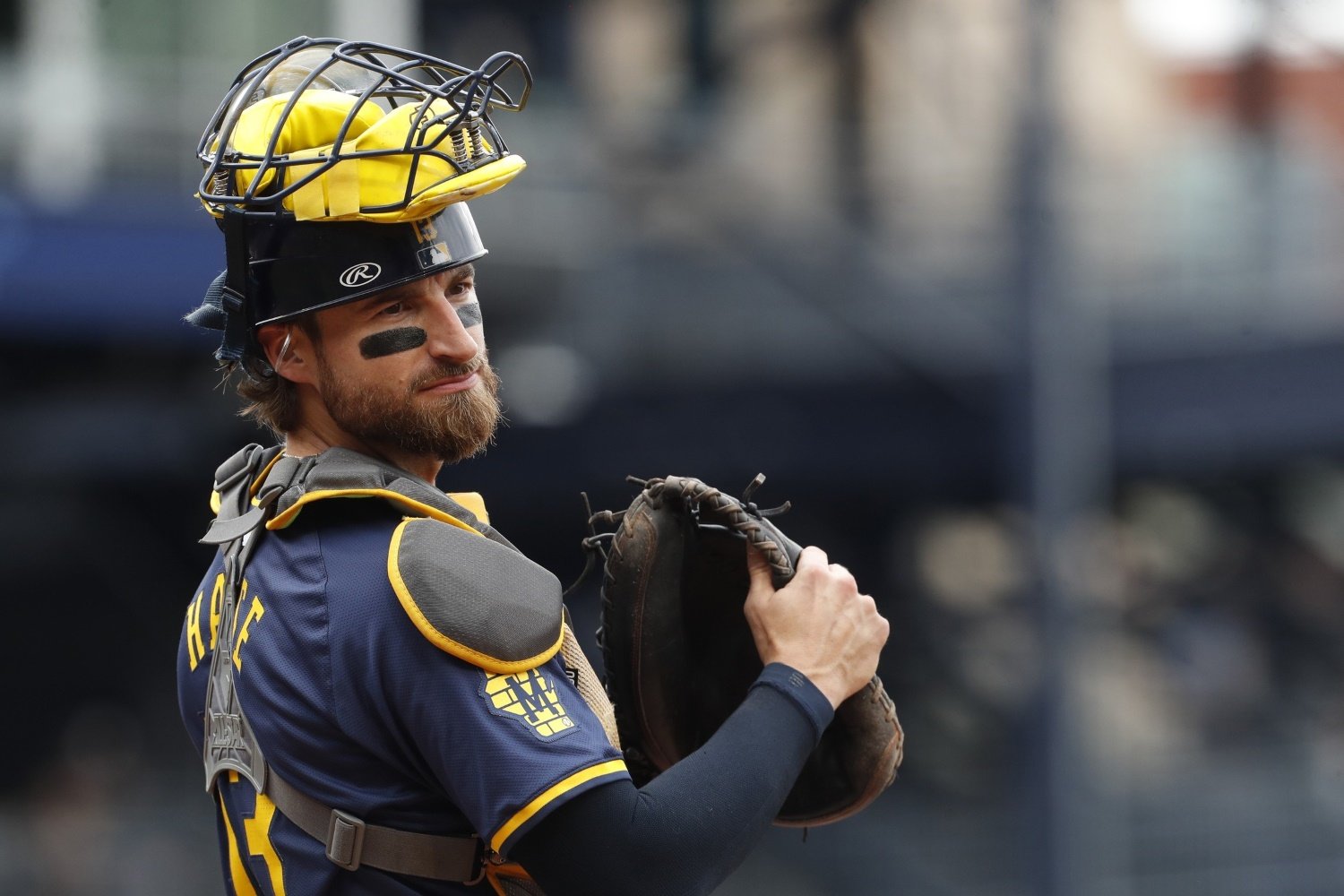
The strong bats of Sánchez and Haase made the arrangement more palatable, too, because penciling them in at catcher didn't mean taking a huge downgrade, relative to writing Contreras into that spot and using any other available hitter. In general, it was important both to have more than one usable offensive catcher, and three truly viable defenders, to make their juggling act work.
Throughout the final two months, there was frequent speculation--including from me--about whether they would need to end the three-catcher setup and remove one of Sánchez and Haase. They stuck with it, though, even though they nearly always dedicated half their active roster spots to pitchers, just like everyone else. It got a little bit easier as injuries piled up and when September brought expanded rosters, but it still felt like a strain on the roster. With three catchers, they had just two or (for the final month) three other bench spots available; that's a tangible penalty paid for the luxury of three backstops.
What if they just decided to make the plan permanent, though? Contreras's utility as a DH option doesn't figure to dwindle in 2025; he's a genuinely great hitter. Being able to spare him the abuse of catching on a more frequent basis would be a boon, but to do it without as often as they'd like, it would be nice to have three catchers around. You can play matchups offensively, and have a player to bring in for defense or in case of injury without disrupting Contreras's place in the DH slot.
Doing so with just 13 position players on the roster would wobble toward infeasibility, but maybe there's a different kind of roster math to do here. The duties of the third catcher would, presumably, be almost entirely about run prevention. They'd still need to take batting practice and be ready to contribute in certain situations, of course, but they'd most likely deliver the bulk of their value by helping build game plans, coming on to catch late in games, and helping secure leads. This could be Haase's job, if Jeferson Quero recovers well from his shoulder injury and comes to camp looking MLB-ready next spring, since Haase is a smart and respected veteran. It could just as easily be another very inexpensive specialist, though.
Austin Hedges will be a free agent this fall. He and Pat Murphy share a deep mutual appreciation, and Hedges might be the best all-around defensive catcher in the game; he just can't hit at all. As a late-game framing ace, he could help the Brewers continue dominating in run prevention, even if they don't find ways to miss more bats. Christian Bethancourt is also about to be available, and while he's merely solid as a framer, he might be the best throwing catcher in the game. As the running game becomes a more common and dangerous element for many teams, having someone who can shut it down off the bench would be tremendously valuable.
If you're carrying a Hedges or a Bethancourt, or even sliding Haase into a similar role, why can't they be treated as something of a 13th pitcher, on what would technically be a 12-pitcher staff? The rules stop a team from carrying more than 13 arms, but it certainly allows them to carry fewer if they want. With so many great fielders and a primary catcher so essential to their offense, the Brewers' positional group does a lot of heavy lifting even on the run prevention side of the ledger. Maybe it would be wisest to use the 26th spot on the roster for a fifth bench player, whose main job is pitcher support, even if it means shuttling pitchers back and forth to Triple-A Nashville a bit more frequently.






Recommended Comments
Create an account or sign in to comment
You need to be a member in order to leave a comment
Create an account
Sign up for a new account in our community. It's easy!
Register a new accountSign in
Already have an account? Sign in here.
Sign In Now