

Jump to content
Brewer Fanatic
  • Brewers News & Analysis

    Is Second-Class Free Agency an Existential Threat to Brewers' Model of Sustainable Success?


    Matthew Trueblood

    Most of the time, the Brewers don't want to spend big in free agency, anyway. But what happens when that's simply not an option anymore?

    Image courtesy of © Brett Davis-Imagn Images

    Brewers Video

    This winter has already carried off two of the Brewers' most important players of the last four seasons, in Willy Adames (a free-agent departure who pulled down $182 million in the process) and Devin Williams (traded to the hated, megarich Yankees, to save some money and give the Brewers a better long-term talent distribution). That's rapidly becoming par for the course; the Crew are winning despite needing to replace multiple key players with unproven, lower-paid alternatives virtually every season. It's why Matt Arnold just won two Executive of the Year awards. It's one of the most impressive records of consistent success in recent memory. It's also, arguably, unsustainable.

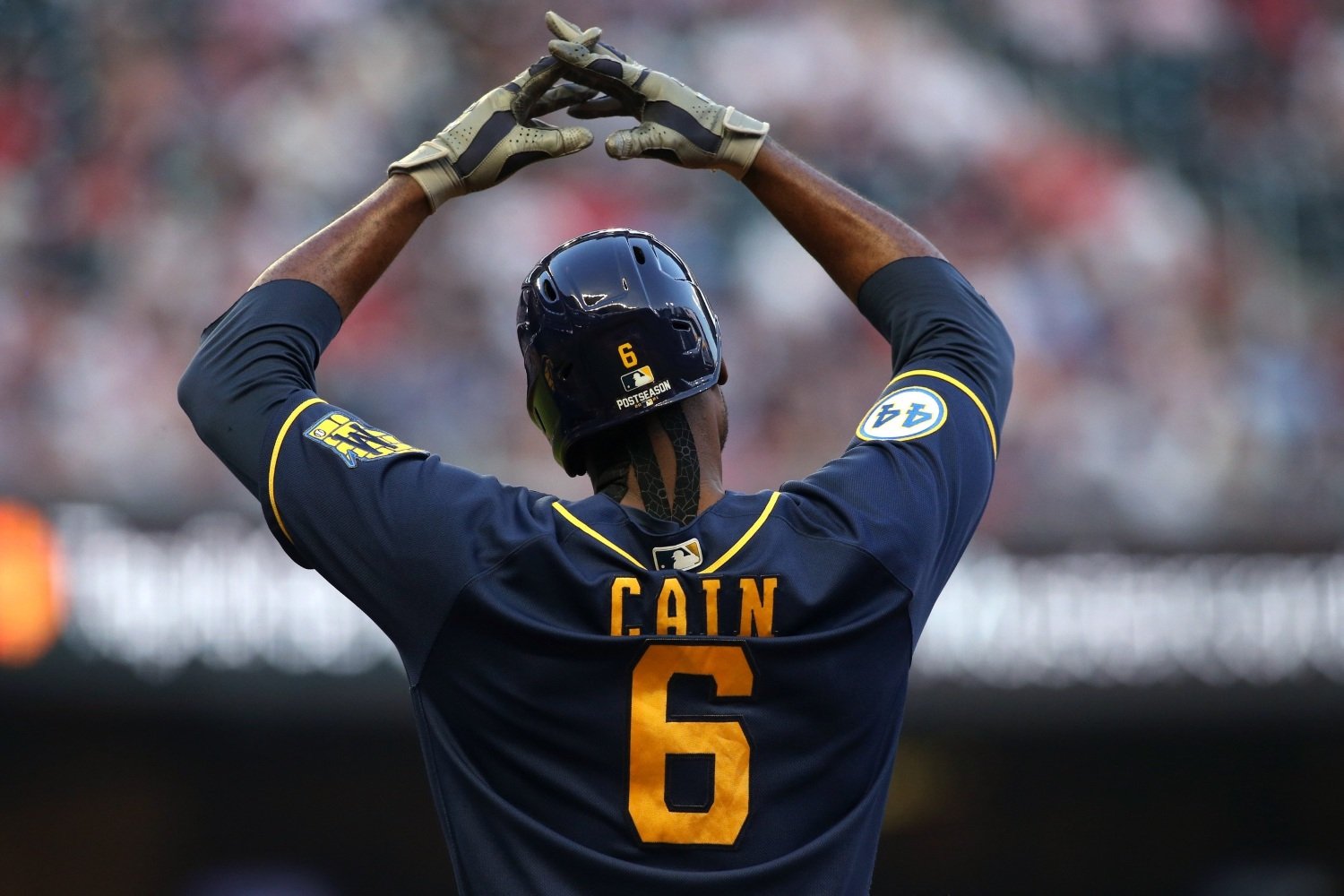
    Recall January 2018. That (and specifically, the final week thereof) is when the Brewers lashed out with the double-strike that kickstarted this era of NL Central dominance, trading for Christian Yelich and signing Lorenzo Cain almost simultaneously. Cain had wanted a nine-figure free-agent payday, but he ended up settling for $80 million over five years with the Crew. The market he dreamed of didn't quite materialize, but Milwaukee was able to step up and secure him on a handsome deal. It's probably the rough equivalent of the deal Nick Castellanos signed with the Phillies four years later, which was worth $100 million over the same five seasons, or of the one J.T. Realmuto signed to stay in Philadelphia a year before that—five years and $115 million. It remains the biggest payout the team has ever given to a free agent, and will probably remain so for a while.

    In today's market, though, the same kind of thing seems much more far-fetched. Even when players' markets do collapse, they just sign one-year deals or player-friendly ones with opt-outs that protect them from a bad season, and then they cycle back into free agency in a stronger position. Players of Cain's caliber either shack up with a team of convenience for a year, or they sign that huge, generational and multinational wealth-generating deal. The class of teams who can afford and actively pursue top free agents on an annual basis has grown, but in that very process, a fistful of teams at the other end of the spectrum are being priced out.

    We used to see the Yankees and Red Sox vie for the very best free agents, with occasional, unpredictable forays from the Dodgers, Mets, Angels, and Cubs. Now, though, it's a bigger field of top spenders, including all of those teams, plus the Phillies, Padres, Rangers, Giants, Braves, and Blue Jays. There are still occasional, stunning moves, like Kris Bryant signing with the Rockies or Carlos Correa pinballing his way to the Twins, but the class of top-spending teams has now grown large enough to furnish sufficient demand to meet the supply of stars almost every winter.

    That means that teams like the Brewers, Guardians, Tigers, Reds, and Mariners—clubs with the aspiration of winning every year but without owners as wealthy or revenue streams as fecund as those enjoyed by the big-market behemoths—are being slowly crowded into a corner of the market. We can fairly charge some of their billionaire owners with having the wherewithal to spend far more than they actually do, but that overlooks a key point. This is a sport, and the sportsmanlike approach to it is to ensure that when teams do make an expenditure aimed at improving their team, they all feel the pain of it about equally. That's the idea behind revenue sharing, and the idea (in other sports) behind salary caps.

    It's impossible to make them all feel each dollar the same way, because the Dodgers and Yankees make so much more money in so many more ways than do the Brewers, but it's worth evening out that distribution of effort and cost as much as possible. That way, we know that (to the greatest extent possible) the decisions each team makes are rooted in who they think are good players and who they think are bad, and that if one team is far outspending another, it really is a reflection of a greater commitment to winning, rather than about an accident of geography and media markets. 

    Right now, though, the soft cap of competitive balance tax thresholds and the existing revenue-sharing system is not nearly sufficient to put the Yankees and the Brewers on planes where they can see each other's eyes—let alone on a truly even playing field. That's always been true, but now there are 10 or 12 of the Yankees, and that applies an exponential amount of downward force on the Brewers' buying power. They can spend $17 million per year on a player if they want, but it will be someone like Rhys Hoskins, who was available largely because none of the very wealthy teams felt he was worth their money at a rate like that. Players truly in high demand—the kind who land nine-figure deals on the open market—hardly ever fall through enough cracks to get to teams like the Crew, and when they do, they refuse to sign such a deal with such a team. Instead, they seek opt-outs and make their plans to circle back to the market and make $150 million one year later.

    A team from Milwaukee, Cincinnati, or Tampa Bay can still win under these conditions, but it gets harder all the time. Developing a Jackson Chourio is shockingly difficult. Developing two straight otherwise generational relief aces is excruciatingly so. Catching a whiff of a chance to snag one of the five best catchers in the game as part of a three-team deal and getting the job done is like keeping one's ears open enough to hear a stock tip passed across a table halfway across the restaurant, and being ready to trade on the info thus gleaned at a moment's notice. It's a true threading of the needle that the league asks of small-market teams who want to win a lot for a decade, anymore, and it's not fair, and it's only fun if your team is as exquisitely good at it as the Brewers are.

    Should the Brewers pursue Alex Bregman in free agency? Absolutely. The fit is so good, it hurts. It's also a laughable idea. He's likely to sign a deal with a total value well north of the Brewers' annual payroll for all the seasons it covers, and signing such a player is impractical. His market is narrowing, with the incumbent Astros having moved on, but he has a strong backstop at (say) $160 million. He's not unlikely to make $200 million, and while the Brewers found that once to retain Christian Yelich for the rest of his career, they don't get to swing that big a second time. If they're surrounded by teams who can swing that big three times every five years, like the Yankees, Dodgers, Mets and Phillies do, how long can they realistically be successful—and how are they ever supposed to feel empowered to beat those teams in October?

    Again, beating the odds and toppling the titans isn't impossible. It just demands that Mark Attanasio spend a much greater percentage of his fortune than Steve Cohen, Hal Steinbrenner, or even Tom Ricketts spend of theirs. That's not fun. The game should be about desire to win and cleverness and the actual ball, not about who can and can't afford to buy Juan Soto an entire island nation, without really hurting in the pocketbook.

    Major League Baseball needs comprehensive revenue-sharing, on a scale perhaps double the current one. That sounds radical, and perhaps it is, but from a fan perspective, that's what the game needs. Attanasio and his fellow smaller-market owners should take the fight to their wealthier rivals over the coming months, so that when it's time to negotiate a new CBA with the players' association, the owners can express to the union that they are ready for an overdue balancing-out. Imagine how good the Brewers would be, or would have been in any of the last several years, if their exceptional scouting and player development and analytics operations could be applied to courting some of the best players in baseball, instead of being confined to measures that ensure a huge return on a modest investment.

    Follow Brewer Fanatic For Milwaukee Brewers News & Analysis

    Recent Brewers Articles

    Recent Brewers Videos

    Brewers Top Prospects

    Braylon Payne

    Wisconsin Timber Rattlers - A+, OF
    On Thursday, the 2024 top pick went 2-for-3 with two walks, with his fourth steal, and his second home run of the season. He's hitting .320 (1.029 OPS) in 8 games.

    User Feedback

    Recommended Comments

    Featured Comments

    Well put. It’s one thing for like the Pirates or the A’s (until this offseason) whose owners don’t care about winning, and get stuck in losing.  Another for clubs like the Cards now or the Brewers for a decade where they tried but weren’t very good.  Now the teams who are really good at scouting, development and coaching (Rays, Guardians, Brewers for example) get punished because not only can’t they compete with the insane multi-billionaire owners with revenues streams to match, but that can’t even keep their best players.  A true cap won’t ever fly - wealthy owners don’t care enough and the players unions won’t ever accept it. But the luxury tax - maybe keeping it and not going up with it - along with some incentive (like maybe pooled money to help keep stars on their teams like a “Jordan” rule in baseball) would be good.  Just believing that a Burnes or an Adames or Contreras truly could stay for a long term would help teams and their fan bases.  Otherwise it is back to the 50s 60s where the poor teams are the feeders for the big clubs - thats what MLB is looking like these days.

    2 hours ago, biedergb said:

    Well put. It’s one thing for like the Pirates or the A’s (until this offseason) whose owners don’t care about winning, and get stuck in losing.  Another for clubs like the Cards now or the Brewers for a decade where they tried but weren’t very good.  Now the teams who are really good at scouting, development and coaching (Rays, Guardians, Brewers for example) get punished because not only can’t they compete with the insane multi-billionaire owners with revenues streams to match, but that can’t even keep their best players.  A true cap won’t ever fly - wealthy owners don’t care enough and the players unions won’t ever accept it. But the luxury tax - maybe keeping it and not going up with it - along with some incentive (like maybe pooled money to help keep stars on their teams like a “Jordan” rule in baseball) would be good.  Just believing that a Burnes or an Adames or Contreras truly could stay for a long term would help teams and their fan bases.  Otherwise it is back to the 50s 60s where the poor teams are the feeders for the big clubs - thats what MLB is looking like these days.

    Baseball will never change to make the teams truely competitively  balanced as the author has so eloquently stated. It’s in their DNA as it has been this way for over 100  years (at least since the 1920s). Excellently written and describes the true problem with baseball. Baseball is destined to be a second class sport sometime during the 21st century. That’s what greed gets you, To bad as it’s a great sport with an equally great history.

    My guess is the Brewers have a good 10-15 years left before enough of their best in baseball SM FO have been poached to see a decline in their infrastructure performance.

    Hopefully by that time there will have been meaningful changes in media revenue sharing among teams (Dodgers monstrous TV contract expires mid 30’s I believe). 

    In the meantime, we are fortunate to be fans of the best run SM team in baseball that later this decade will have big-league talent the equal of any team in baseball thanks to their BIB international department & among the BIB, domestic draft department. How long these departments remain as elite as they are will determine how long this team will remain the best SM team in the game.

    With that incredible pipeline of talent flowing, the FO has decided to feed their domestic draft department with extra draft-capital with some of their trades and signings that allow their draft department to maximize their prowess in that area — the 2025 draft (5 top 68 picks/$17M+ pool money) has a chance to be as great as the 2023 franchise-altering draft-class that if it happens would give the team 3 of the best classes in the game since the ‘24 IFA class is considered the BIB, and all within a 2 year period of time that should lead to farm system not only the best in baseball, but by a large margin that will eventually transfer to the big-club.

    This is not fantasy thinking. This is the current trajectory of the team’s prospect-procurement. It really gets exciting when thinking about adding comp picks from Woodruff-Cortes (good health & good performance needed) for the ‘26 draft.

    If the team can extend some of this incredible young talent ahead, there’s your 10-15 year period of excellence.

    • Like 2

    What sometimes gets lost is a more balanced field would force the large markets to find and develop players better. If all the teams were forced to do what the Brewers do to field a good team how much better could the overall talent base be? As it is why waste time scouting and developing a Jackson Chourio when you can just buy a Juan Soto in his prime? How many Jackson Chourios does baseball never find or develop because only a few teams feel it's worth the effort when they can just buy the best of a smaller group.

    • Like 2
    7 hours ago, SF70 said:

    My guess is the Brewers have a good 10-15 years left before enough of their best in baseball SM FO have been poached to see a decline in their infrastructure performance.

    Hopefully by that time there will have been meaningful changes in media revenue sharing among teams (Dodgers monstrous TV contract expires mid 30’s I believe). 

    In the meantime, we are fortunate to be fans of the best run SM team in baseball that later this decade will have big-league talent the equal of any team in baseball thanks to their BIB international department & among the BIB, domestic draft department. How long these departments remain as elite as they are will determine how long this team will remain the best SM team in the game.

    With that incredible pipeline of talent flowing, the FO has decided to feed their domestic draft department with extra draft-capital with some of their trades and signings that allow their draft department to maximize their prowess in that area — the 2025 draft (5 top 68 picks/$17M+ pool money) has a chance to be as great as the 2023 franchise-altering draft-class that if it happens would give the team 3 of the best classes in the game since the ‘24 IFA class is considered the BIB, and all within a 2 year period of time that should lead to farm system not only the best in baseball, but by a large margin that will eventually transfer to the big-club.

    This is not fantasy thinking. This is the current trajectory of the team’s prospect-procurement. It really gets exciting when thinking about adding comp picks from Woodruff-Cortes (good health & good performance needed) for the ‘26 draft.

    If the team can extend some of this incredible young talent ahead, there’s your 10-15 year period of excellence.

    The key, then is two-fold:

    1. Constantly have a pipeline of FO talent. Evaluate FO personnel on how well they train those below them. "Next man up" isn't just for on the field, have it be the same for the front office as well. Just have a constant pipeline for when people get poached/retire/move on.

    2. Make the Brewers more than just a club, fill that same front office with people for whom winning baseball IN MILWAUKEE is their passion. Work with local high schools and colleges to talent-scout potential front office talent for the Brewers.


    Create an account or sign in to comment

    You need to be a member in order to leave a comment

    Create an account

    Sign up for a new account in our community. It's easy!

    Register a new account

    Sign in

    Already have an account? Sign in here.

    Sign In Now

×
×
  • Create New...
