


Brewers Video
The right-hander was a better pitcher after his move to Milwaukee in every way—except one. He must keep the ball in the park to carve out a high-leverage niche.
The Brewers could trade former closer Devin Williams in December because they possess an embarrassment of riches in the bullpen. Even with each reliever ascending one notch on the totem pole, the group should remain one of baseball’s best in the coming season.
Trevor Megill handled the ninth inning with aplomb last season while a back injury sidelined Williams through the first half, and he appears the favorite to return to the role. Jared Koenig, Joel Payamps, and Bryan Hudson were impressive in setup roles. Abner Uribe needs more work controlling his triple-digit sinker and fiery temperament on the mound, but his tantalizing stuff keeps him in the late-inning conversation. Aaron Ashby could return to the bullpen this year, and prospects Jacob Misiorowski, Craig Yoho, and Logan Henderson may emerge there in a few months.
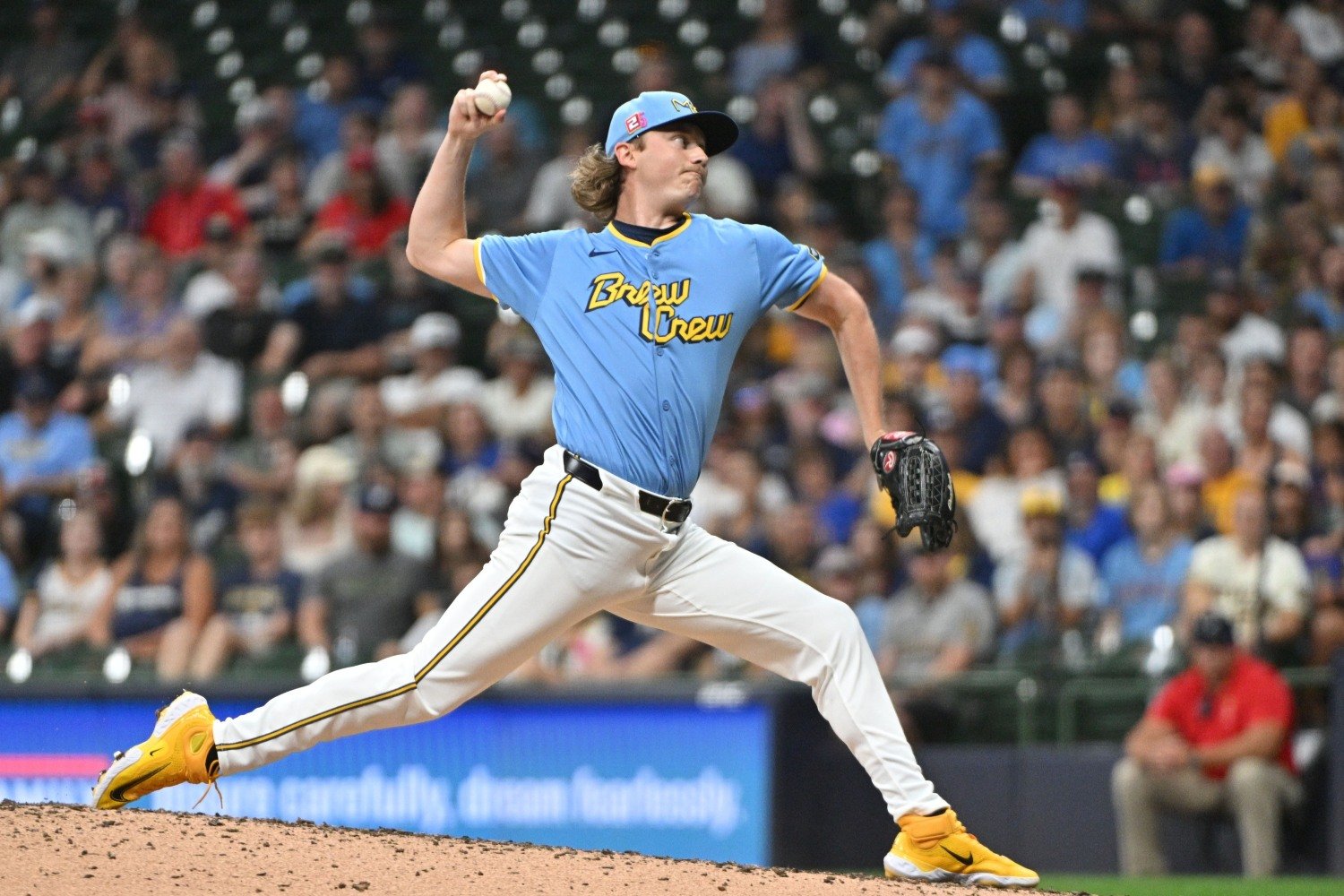
It’s easy for flamethrowing Nick Mears to get lost in the shuffle. However, he may be as likely as anyone to assume an elevated role near the end of close games, at least to start the season.
It didn’t happen down the stretch in 2024, after the Brewers sent pitching prospect Bradley Blalock to the Colorado Rockies to bring Mears to the Midwest. Opponents lit him up for a 7.30 ERA in 12 ⅓ innings, interrupted by a month-long stay on the injured list.
The move was as much for the future as the short term, anyway. Mears was a development project with two additional years of control, and the Brewers hoped to maximize the elite stuff of a reliever with a career 4.93 ERA at the time of the trade.
Optimizing his pitch usage presented an avenue for doing so. Notice in the visual below how the release and trajectory of Mears’s curveball have greater and earlier separation from his fastball and slider. Between the two breaking balls, his short slider created a tighter tunnel with his heater, yet he used both breaking offerings at nearly equal rates as a member of the Rockies.

Mears started ramping up his slider usage in July and continued doing so as a Brewer, relegating the curveball to a show-me pitch against left-handed batters.

The change made Mears more deceptive in most aspects of his brief post-trade work. He was in the strike zone more often, induced more in-zone whiffs, and coaxed more chases, fueling significant improvements to his strikeout and walk rates.
| Team | Z-Contact% | O-Contact% | O-Swing% | SwStr% | K% | BB% |
| COL | 83.9% | 54.7% | 30.2% | 11.8% | 28.1% | 10.3% |
| MIL | 73.2% | 53.8% | 34.7% | 17.2% | 34.0% | 5.7% |
That growth was drowned by a spontaneous home-run explosion. After allowing two all year with Colorado, Mears coughed up five with his new club.
Mears, whose arsenal resembles Megill’s, will always battle the long ball. However, whereas the latter will likely see his home run rate rise in 2025, Mears appears due for positive regression in that realm, at least relative to his existing Brewers sample. His 1% home run rate and 4.2% HR/FB ratio at the time of the trade were unsustainably low; the second-half shift to the other extreme left him with a more realistic overall 2.7% home run rate. Mears will almost certainly trend closer to that figure than his post-trade 9.4% homer rate.
Still, rotten luck was only partially responsible for the power surge, so banking purely on stabilization may not be enough. Four of those five homers came against Mears’s fastball, which opponents began torching when they made contact, particularly at the top of the zone.

While running into a few fastballs in a small sample happens often, hitters deliberately took bigger hacks at high heaters. Their average swing speed on fastballs at the top of the zone increased by several ticks across the top rail from Mears's time in Colorado to that with the Crew.

Take, for example, this two-pitch sequence against Matt Carpenter. Both offerings were elevated fastballs. Carpenter took a massive cut at the first and came up empty. He did the same on the second and was right on time, launching it into the right-field seats.
Mears adjusted how he came set midseason, after an opponent told him he was tipping pitches. Whether the issue took a new form in Milwaukee or he indeed masked his tell, hitters down the stretch appeared increasingly expectant of velocity at the top and acted accordingly. Fixing Mears starts with reducing confident swings against high fastballs.
He and the Brewers could explore a couple of solutions. They could eschew high targets for more low-and-away heaters or throw fewer overall. In two dominant postseason outings, Mears threw 13 sliders and 12 fastballs. Perhaps he does need to mix in curveballs as slower pitches that also start at the top of the zone, even if it’s not the best conventional tunnel. If he was still tipping, further adjustments to his pre-pitch routine and mechanics are in order.
With pitchers and catchers reporting this week, Mears enters camp among the arms with something to prove in Cactus League play. New looks from the right-hander may soon emerge as a story.





Recommended Comments
Create an account or sign in to comment
You need to be a member in order to leave a comment
Create an account
Sign up for a new account in our community. It's easy!
Register a new accountSign in
Already have an account? Sign in here.
Sign In Now