


Brewers Video
We already know that the Brewers excel at finding pitchers on the baseball world's scrap heap and turning them into average or better hurlers. Now, we have a new way to identify a trait they use to identify targets for that kind of move.
Thanks to the never-ending increase in our knowledge about the inner workings of baseball, there's now a way to concretely (if indirectly and imperfectly) measure a pitcher's arm angle, using Statcast data. Teams, of course, have access to more and better data, but through some impressive work by researchers in the public sphere, we can mimic some of those teams' insights.
What does it tell us? Arguably, and immediately, not much of this is new, if you knew to be thinking about and looking for it, anyway. For any given team's handful of most prominent pitchers, most fans can readily give an approximation of arm angle, from watching the pitcher pitch. What this does begin to tell us, though, is whose arm works in an unusual way. In the next iteration (on which developer Trevor Thrash already seems to be plugging away), we might learn how a pitcher's movement varies from what we'd expect, based on their arsenal--and that might yield new insights into the nature of deception and why certain pitches without extraordinary raw movement characteristics have so much success, or vice-versa.
Let's take a look at the data, in a visual format. Here's the horizontal and vertical release point for every pitcher in MLB so far this year, with position players-as-pitchers removed. The points are colored according to the arm angle class to which they were assigned, based on Thrash's work. The size of each bubble (though hard to differentiate, because of the scale) describes each pitcher's height.
.png.d9ab0ed8c9e34e3620d61a5f4a28a3fd.png)
As you can probably tell from these data, there is overlap between each classification. Not all pitchers with identical release points are created equal. As you might also be able to tell, the high three-quarters delivery is the most common in baseball. If you're an observant and interested fan, you probably aren't surprised by that. Truly overhand hurlers are rare, and so are sidearmers. There's only one true submarine twirler in the big leagues.
Most pitchers are somewhere on that three-quarters spectrum, and because coming from too low a slot usually gives opposite-handed batters an early look at the ball, the higher end of that spectrum is more heavily populated than the lower end. Specifically, guys who come from the high three-quarter slot are about twice as numerous as those who come from the low three-quarter slot. Of 625 pitchers overall, more than half (360) are high three-quarters guys. Low three-quarters arms make up around 70 percent of the remaining arms, at 195.
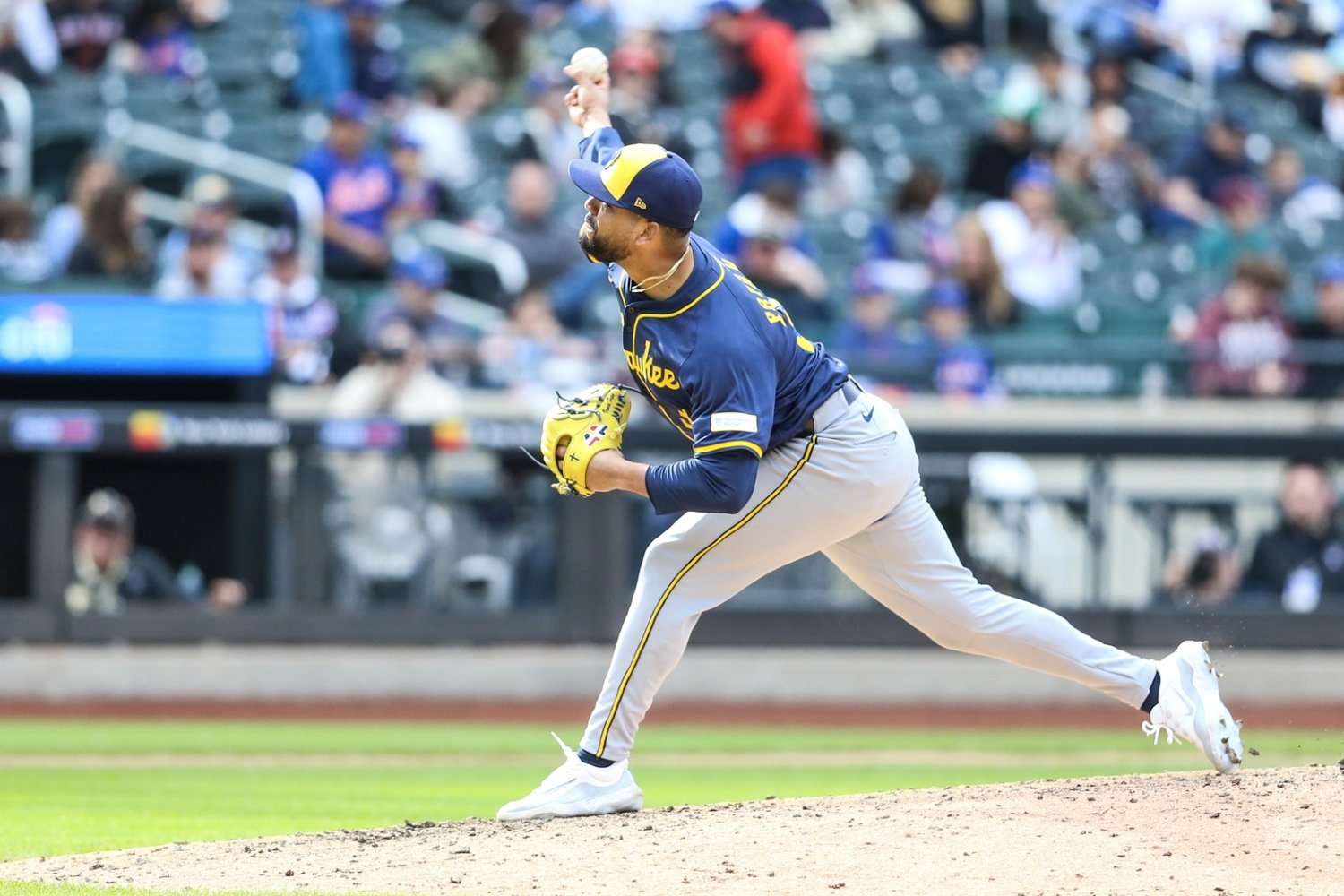
Ok, but why is this interesting for Brewers fans, in particular? You might've already guessed: they stand out in this regard. Of the pitchers they've employed so far this year, 13 use low three-quarter slots. Then there are overhand guys Trevor Megill and Aaron Ashby, and sidearmer Hoby Milner, and nine guys who come from a high three-quarter angle. More telling than the sheer counts are the innings thrown by each group. Of just under 600 innings for the season, 376 were thrown by guys who come from the lower side of the three-quarters section, and if you add Milner, it soars past 400. By the league's standards, the Brewers heavily lean toward low three-quarters guys!
Now, these are inferred arm angles, rather than directly measured ones. There are some players Thrash's system codes as low-three-quarters deliverers whom I might classify as a true three-quarters, if such a classification were created. I don't think of Bryse Wilson as having a low slot at all, and the way he's changed his setup to release the ball from as far toward third base as possible is part of why the system reads him as such.
If I'm more inclined to trust my human eye than the data on Wilson, though, I'm also happy to acknowledge that it's picking up something I would have missed with Joel Payamps, whose spine tilt pushes his release point higher but whose angle of shoulder adduction really is pretty low.
Why does this matter? There are at least three important reasons:
- Deception is influenced by arm angle, both in an absolute sense and in a relative one. As I wrote earlier this year, the Brewers like to give teams extremes of release point with which to contend. The arm angle that gets the ball to those release points is an important part of making that strategy work.
- Arm angle influences movement. When Thrash finishes creating a data set that will allow us to compare raw movement to that expected based on arm angle, we'll be better able to see this, but to take one broad-strokes example: it's hard to throw an effective sinker from a high three-quarters or an overhand slot. The low three-quarters gang (Wilson, Payamps, Jared Koenig, Colin Rea, Elvis Peguero, and so on) generate a lot of value with their good sinkers. It's also a good slot for creating sweep on breaking stuff, at which the team excels lately.
- It's hard to alter a pitcher's arm angle, without huge and unpredictable ripple effects on their whole game. It's much easier to tweak pitch mixes, grips, which side of the rubber a guy sets up on, or how their front side works. Those are all things that the team has tweaked to help players named above find tons of success in the last two seasons or so. If you can identify pitchers who aren't fully tapping into their stuff and who throw from angles not favored by other teams throughout the league, it gives you a head start on the kind of developmental wins that have helped the Crew dominate as a full pitching staff throughout their half-decade and change as the best team in the NL Central.
This is just a first foray into a rich field of research and future learning. Thrash and others are delving into the available data and trying to find more ways to unspool it for our shared benefit. In the meantime, though, we've already learned some interesting things about the Brewers and the way they perennially overachieve on the mound.
Are you optimistic about the Brewers right now?

Follow Brewer Fanatic For Milwaukee Brewers News & Analysis



-
 1
1



Recommended Comments
Create an account or sign in to comment
You need to be a member in order to leave a comment
Create an account
Sign up for a new account in our community. It's easy!
Register a new accountSign in
Already have an account? Sign in here.
Sign In Now