


Brewers Video
The Brewers have well-oiled systems in place to maximize pitcher performance, even if their velocity or pitch shapes do not turn heads. Milwaukee hurlers enjoy the built-in benefit of an elite defense that turns would-be hits into outs, but they also level up their performance by creating as much deception as possible.
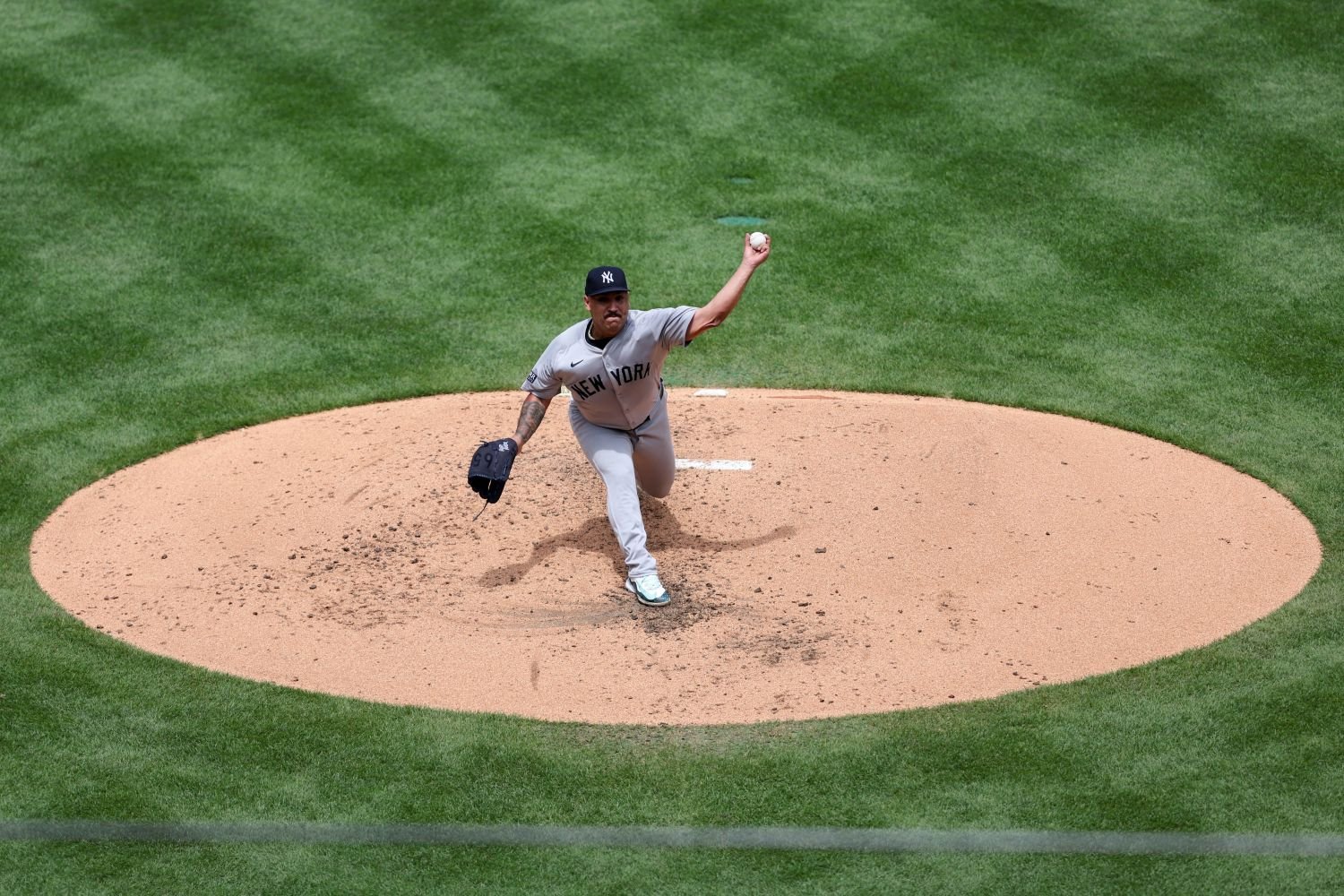
Newly acquired Nestor Cortes will receive a boost from excellent outfield defense, but Chris Hook and friends cannot pull out many of the same stops with him that they have for most pitchers in recent years. While they almost certainly have a small tweak or two in mind, Cortes is already plenty deceptive in different ways than any other Brewers pitcher—and most across the league, for that matter.
While the Brewers craft a personalized development plan for each individual, their broader methodology for making pitches harder to recognize and track is pretty consistent. They create the most extreme angle from which a pitcher can execute and equip his arsenal with multiple pitches that have different shapes but look similar out of the hand.
To create tough angles, some pitchers move to one edge of the rubber, modify their arm slot, or both. That’s what made Bryan Hudson’s fastball, which averages 90 to 92 mph with neither remarkable carry nor unusual run, so challenging to square up. His height, extension, arm slot, and positioning on the rubber create an off-putting visual for the hitter.
Hook is also a firm advocate of throwing multiple fastball variations. Because these pitches spin in similar directions, it’s challenging for the naked eye to differentiate them immediately. The pitches’ trajectories separate as they approach the plate: a sinker runs to the arm side, a cutter breaks late to the glove side, and a four-seamer remains straighter, with more carry. Someone with all three can work both sides of the plate and the top of the strike zone with pitches that all appear to have the same spin after release.
Twelve of 25 Brewers who threw at least 10 innings in 2024 used two or more kinds of fastballs at least 15% of the time, and six threw three variations regularly. Colin Rea, Frankie Montas, and Bryse Wilson applied this strategy especially well, with the latter also moving to the third-base edge of the rubber to better bust his sinker inside to right-handed hitters.
For most Brewers pitchers, promoting deception begins with keeping as many things as possible looking the same for as long as possible. Changes to one’s arm slot, extension, or positioning on the rubber remain constant across every pitch. It’s tough for opponents to know what’s coming until the ball is close to the plate, because everything looks nearly identical leading up to that point.
Cortes does the opposite. He creates deception through chaos and inconsistency. The crafty southpaw is well-known for mixing windups and arm slots in attempts to throw hitters off-balance.
Freddy Peralta varied the pacing of his windup with three distinct leg kicks down the stretch, but that’s tame in comparison to the exploits of his new rotation mate. It’s the same case for arm angle – Peralta’s rose slightly in the second half, but Cortes’s release points were wide-ranging and unpredictable. In that sense, he’s the inverse of Rea, who excelled at delivering every pitch from the same slot.

In the charts above, Cortes’s release cluster is an amalgamation of different arm slots. Some are subtle variations of his default slot, but others are him dropping down to throw sidearm.
The chaos has worked. Since the start of the 2021 season, Cortes has pitched to a 3.33 ERA, 3.68 FIP, and 3.84 FIP with a 4.06 strikeout-to-walk ratio. He posted similar numbers in 2024, while tossing a career-high 174 ⅓ innings.
Cortes is a uniquely successful pitcher, not a reclamation project like Rea, Montas, Aaron Civale, and Tobias Myers. As such, don’t expect the Brewers to alter much. If anything, Hook may apply his eye for mechanical adjustments to make Cortes’s windup and arm slot alterations more seamless than ever.
The more noticeable change the Brewers may pursue is developing a true two-seamer. Cortes’s release point chart indicates he throws a sinker, but only from the sidearm slot. This is Statcast misclassifying sidearm four-seamers: By dropping his arm, Cortes changes the shape pretty dramatically to resemble a two-seamer.
| Pitch | MPH | IVB | HB |
| 4-Seam/Sinker, Arm Angle ≥ 35° | 92.1 | 19.2 | 4.9 |
| 4-Seam/Sinker, Arm Angle ≤ 30° | 90.1 | 13.8 | 12.1 |
In its current form, the sidearm fastball is a show-me pitch. Cortes throws most of his pitches closer to a three-quarters slot, so “two-seamers” accounted for just 1.2% of his offerings in 2024. If he threw a legitimate one from his primary arm slot, it could become a mainstay in his arsenal. The pitch would play well with his riding four-seamer and cutter. If the Brewers see potential for a balanced three-fastball mix, they’ll almost certainly pursue it.
Hook will not deprive Cortes of what makes him unique. He always says that the Brewers focus most on what each pitcher does best. However, the front office has recently handed him several pitchers suited for similar methods of masking their pitches. Cortes is a different breed, so Milwaukee’s pitching development brass should embrace the chaos and only apply sporadic elements of their usual deception blueprint.
Do you approve of the job Pat Murphy is doing as Brewers manager?

Follow Brewer Fanatic For Milwaukee Brewers News & Analysis



-
 2
2



Recommended Comments
Create an account or sign in to comment
You need to be a member in order to leave a comment
Create an account
Sign up for a new account in our community. It's easy!
Register a new accountSign in
Already have an account? Sign in here.
Sign In Now