


Brewers Video
Statcast unveiled its latest round of bat-tracking metrics last week, opening public access to more information about players' swings than ever before. For a more thorough explanation, Brewer Fanatic's @Jason Wang walked through how to interpret the new data on Tuesday.
Because MLB did not upgrade to the Hawk-Eye high-speed camera system that makes bat tracking possible until 2020, the information that's new to fans is also a fresh and ongoing study in front offices. In spring training, Pat Murphy revealed that the Brewers' research and development department was analyzing bat path data to determine which types of swings work best at the big-league level.
"We're studying bat angle and bat path in the zone, how it gets to the zone, all different things of it," Murphy said. "How it starts in the zone, how long it's in the zone, what angle it is in the zone, and then what's most effective of that. Contact point. We study all of that. It's fairly new. We don't have all the research on it."
Hitting is a complex equation of meeting the ball with enough force, at the right time and on the right plane, and the path to getting there differs for each hitter. Most will tell you that their in-game swings rarely feel fully calibrated, so making their window for productive contact as wide as possible is crucial.
Without the fancy numbers and graphics now available to the public, several of baseball's greatest hitting minds have concluded that a more vertical, steeper bat path with a slight arc best meets the plane of the incoming pitch, giving a hitter the most wiggle room for making productive contact, even if their timing is slightly off. Ted Williams was saying it back in the 1970s. Murphy agrees.
"I think the more vertical bat produces better results when beat," he said in March, more than two months before bat path metrics went public.
When a hitter swings late at a pitch but still makes contact, he's catching it closer to the back of home plate. The bat is sometimes coming down as it meets the ball, instead of as it levels out or comes up. That means that when a steeper swing is late, it's more likely to clip the bottom half of the ball. Murphy says that allows a hitter to stay alive for another pitch or hit a near-automatic single.
"A more vertical bat, meaning (steeper), produces a potential foul ball, which lets you live again, if you hit the inside of it the right way," he said. "And, obviously, a chance for a 70-30 – 70 miles an hour, 30 degrees is a hit."
League-wide in 2025, balls hit with an exit velocity between 65 and 75 mph and a launch angle between 25 and 35 degrees have a batting average of .783. They're the bloop singles that fall into no-man's land between an infielder and an outfielder. Nobody tries to hit a ball like that, but a single is a solid outcome after getting beaten by a pitch.
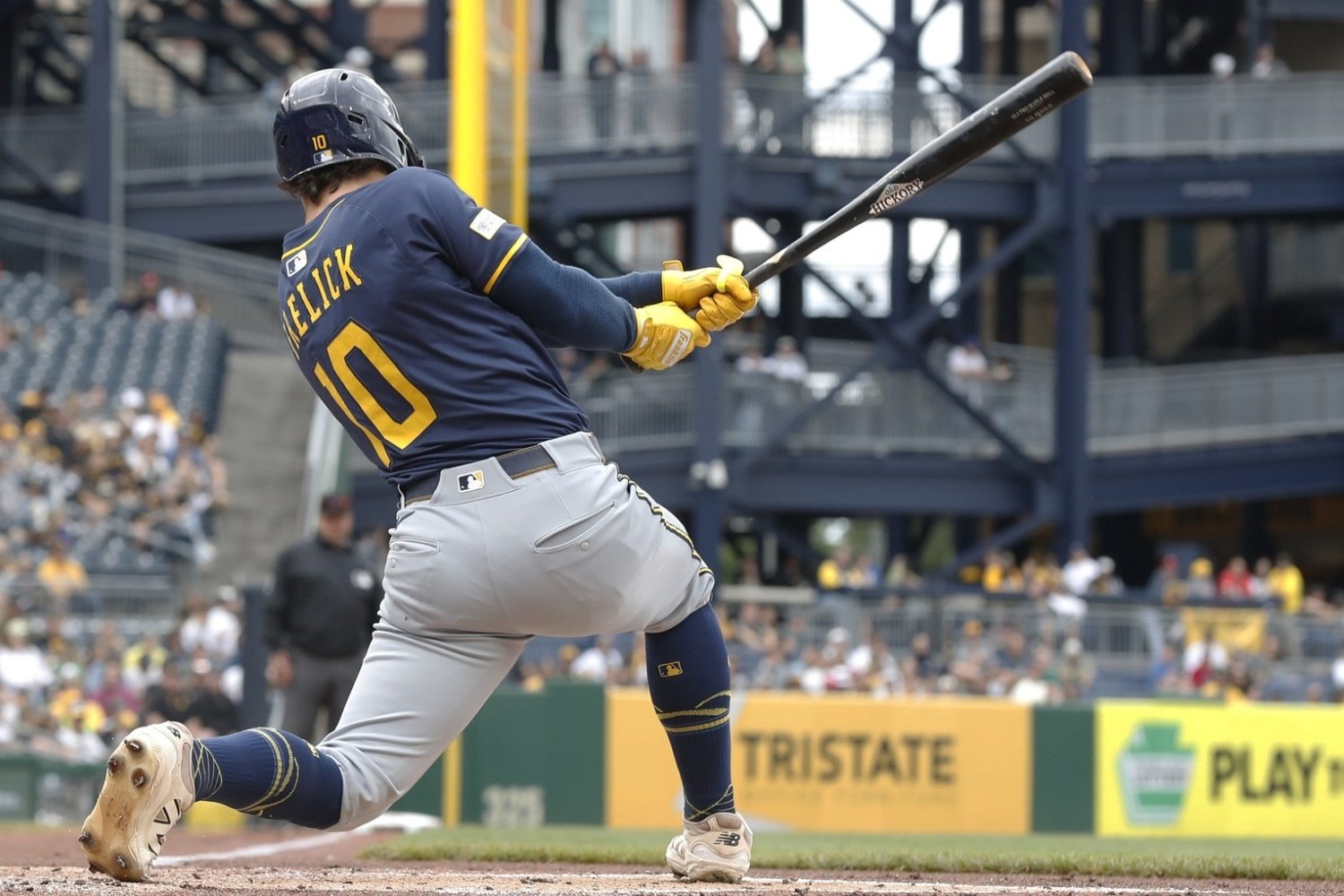
A flatter, more horizontal swing also has its strengths. When late, it's more likely than a steep swing to meet the ball flush, producing an opposite-field line drive. That's why hitters with such swings—Brice Turang and Sal Frelick, for example—are often more comfortable with letting the ball get deep and slashing it the other way.
This Turang single from earlier this month against the Minnesota Twins was a successful horizontal swing against a high fastball.
Turang's swing tilt—the angle of his bat path, measured 0.4 seconds before contact—on this hit was 23 degrees, much flatter than the MLB average of 30 degrees. It was level enough to help him turn around a high pitch deep in the hitting zone for a line drive, but not too flat.
"There's a lot of horizontal bat that can beat a ball back here (toward the back of home plate) and hit you a laser to (the opposite field), and you're like, 'Wow, vertical bat, that would have been a foul ball,'" Murphy said. "But there's some horizontal bat guys, that's all they hit."
More often, a horizontal swing hits the top of the ball at contact and produces a ground ball, like this Turang groundout against a fastball in a similar location to the one on which he singled.
Turang got too flat on this swing, down to 16 degrees. The result was an easy rollover.
"If I'm above (the ball), I'm out, right?" Murphy said. "If I hit a ground ball in today's game, you're probably out."
Back in March, Murphy invoked Freddie Freeman as an exemplar of a successful vertical bat hitter. The new data backs it up. Freeman's average swing tilt is 42 degrees, making his bat path the second-steepest among qualified hitters.
Many Brewers hitters are on the opposite end of the spectrum. As a team, their average swing tilt is 30 degrees, which ties them for the lowest in baseball. Many of their most prominent hitters have more horizontal bat paths.
| Player | PA | Swing Path Tilt |
| Jackson Chourio | 247 | 26° |
| Brice Turang | 227 | 30° |
| Christian Yelich | 226 | 36° |
| William Contreras | 220 | 30° |
| Sal Frelick | 204 | 29° |
| Rhys Hoskins | 203 | 34° |
| Joey Ortiz | 187 | 28° |
Compare the shape of Freeman's swing to those of several Milwaukee hitters.
A flat bat path does not automatically preclude a hitter from driving the ball. Chourio, for example, has one of baseball's most horizontal swings, but has still flashed power by meeting the ball in a good spot with his 78th-percentile bat speed. However, the new metrics partially explain why the Brewers again have the game's third-highest ground ball rate, despite players and coaches claiming their goal is to elevate balls in play. Because of their bat paths, when many of their hitters mistime a pitch, they hit it on the ground. It's a predicament the organization created for itself by acquiring and developing so many players with flatter swings.
Murphy would like that to change. He doesn't want his horizontal bat hitters to forgo their existing strengths and try to become Freeman, but he thinks adding more vertical variations of their existing swings will help them get to certain pitches better.
"It's going to lead to more of a vertical bat," he said earlier this week, predicting the adjustment the metrics will spur. "Because really, the ability to kind of do a little bit of both and not just have one horizontal swing is going to be the difference."
It's not a simple fix, though. Murphy noted in spring training that hitters are somewhat bound to their natural movement patterns and can't make their swings steeper with a snap of their fingers, something he reiterated after the numbers came out.
"It's not something you can do in a day," he said, later adding that the offseason is the best time for broader swing adjustments. "It's recognition, understanding, awareness. Now, what am I going to do about it? And it's probably going to take some time to understand it, because it's not as easy as that. Freddie Freeman does that real simple. (Christian) Yelich does that real simple, you know? So it's like, it's different."
For now, the Brewers are directing hitters to swing as little as possible at pitches their bat paths struggle to hit. For those with horizontal swings, that includes high pitches and low-and-inside ones.
"You've got to step back and really analyze it," Murphy said. "Right now, it's, 'I don't swing at that.'"
In the long run, he hopes the new data will help hitters formulate plans better suited to their strengths and make their swings more versatile.
"That's the mode we're in, now that we're tracking this. It's going to allow players to see, like Brice Turang, like, 'No, you don't do damage. No, you don't hit that ball down-and-in as a horizontal bat guy. So how are you going to adjust?'"
Do you approve of Brewers' ownership?

Follow Brewer Fanatic For Milwaukee Brewers News & Analysis



-
 1
1



Recommended Comments
There are no comments to display.
Create an account or sign in to comment
You need to be a member in order to leave a comment
Create an account
Sign up for a new account in our community. It's easy!
Register a new accountSign in
Already have an account? Sign in here.
Sign In Now