


Brewers Video
Modern baseball has arrived at a deleteriously narrow definition of power. For whatever reason, in an age of endlessly detailed information and in a sport that likes to congratulate itself on creative problem-solving, most fans and media members seem to check just one column to test whether a player or team has pop: home runs.
The allure of hitting the ball over the fence—the way progress toward scoring can't be erased or wasted when the score comes all at once, and the way finding the seats circumvents modern defenses and their scarily excellent positioning, both infield and outfield—is easy to understand. Until the double-expansion era that began in 1998, though, there was always an understanding among savvy watchers of the game that power comes in other forms, too: doubles and triples, of course, but also, in some sense, singles. Hitting the ball hard applies pressure to a defense and creates many chances for extra advancements. The name of the game is scoring runs, and power is rightly defined as any means of doing that which achieves success by forcing the defense backward and sending the ball far from where it needs to be for a play to be made, allowing runners to move more than one base at a time. Homers are the most obvious form thereof, but far from the only one.
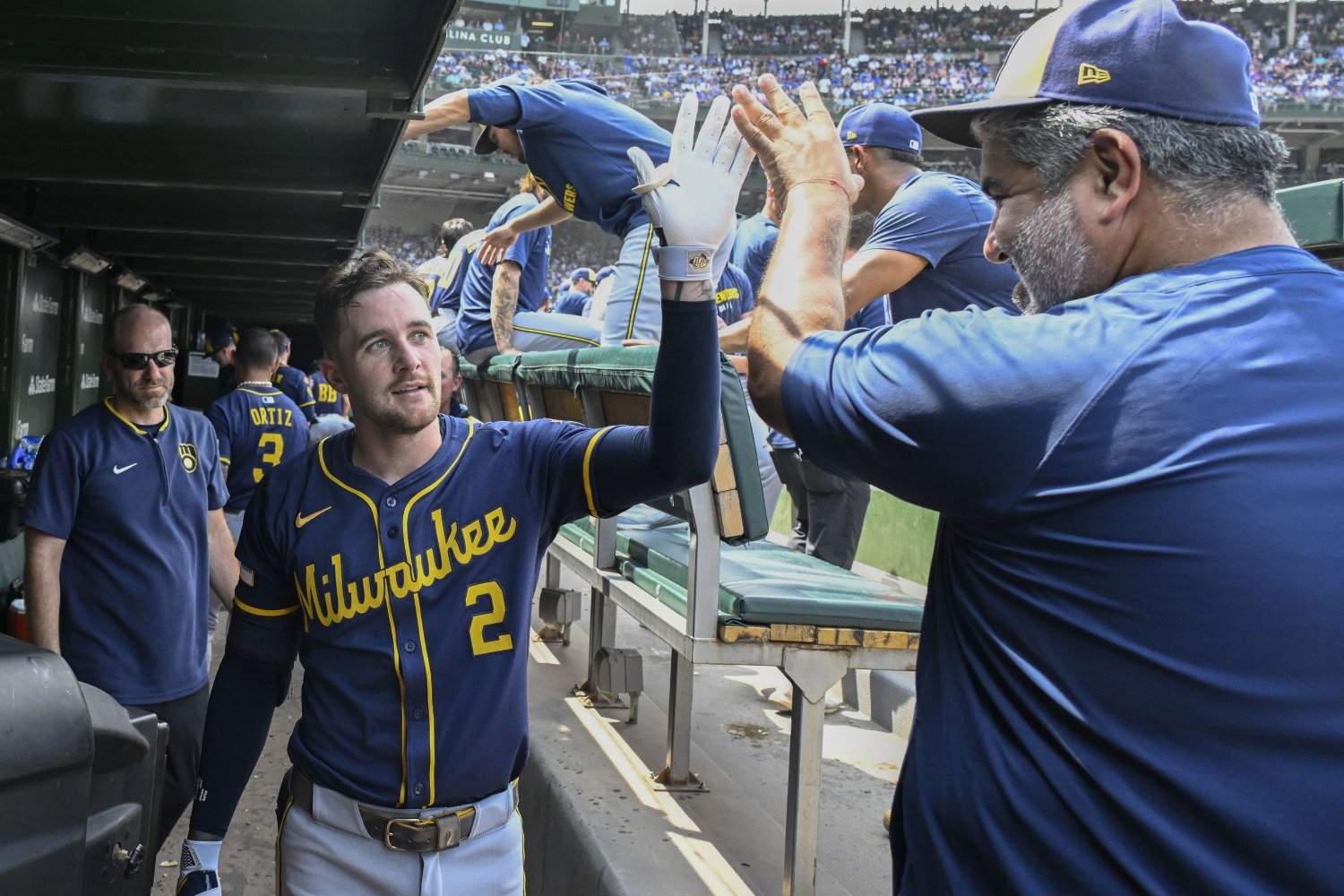
This year, the Milwaukee Brewers are scoring more runs per game than any other team in baseball. Even as they've established their greatness, though, some public commenters have denigrated them, either as "lucky" or as a team destined for an early October exit. Always, always, always, these sources of pessimism cite the team's lack of power as the pillar of their argument. That pillar is made of sand, though, because here's the thing: the Brewers have plenty of power.
Firstly, while those who mentally locked in what the lineup looked like in May might be fooled, those of us who have monitored the team throughout the year know that they have considerably more over-the-fence power than they did a few months ago. Brice Turang has 13 home runs this year, and seven of those have come this month. He came into this year swinging faster, and that bat speed has begotten more exit velocity. As he's learned to pick his spots to get around on the ball, he's tapped into all the power he began to generate when he cranked his swing up to this intensity, and he's a legitimate homer threat now.
Ditto Sal Frelick, albeit on a smaller scale. He, too, is swinging faster this year, and he's also pulling the ball much more than he did in the past. By changing his intent, he's gone from a guy who hit two home runs all year in 2024 to one who already has nine this season. Both Turang and Frelick are examples of the team developing young hitters at the major-league level, accepting their extremely limited power output over their first two seasons in order to patiently bring them along. Because each was permitted—and expected, and then commanded—to evolve into their current approach, each has found the ability to drive the ball without sacrificing the other things they already did well.
It's not just the marginal increases from those two, though. William Contreras rediscovered his bat speed (after three months of diminution due, presumably, to the pain in the fractured finger on his left hand through which he's played since last season) in early July, and after making some adjustments to account for his renewed capacity, he's been torrid in the homer department, too. Seven of his 13 homers have come since July 30. Then there's Andrew Vaughn, who took over for the injured Rhys Hoskins in early July and has nine homers in six weeks since.
All four of those guys are complementary sluggers for this team. So is Isaac Collins. But they all play in the shadow beneath the power umbrella that is Christian Yelich. While everyone relentlessly laments the lack of a cornerstone slugger for Milwaukee, Yelich is being exactly that guy. He has 25 home runs, with 38 games to play. He's unlikely to get to 36, which is the number he hit when he won the NL MVP Award in 2018, but he's got a great shot at 30. He's been the power source, taking pressure off several of the other cogs in the lineup to do that particular thing.
If you imagine this group with Jackson Chourio (17 homers before hitting the injured list with a hamstring strain at the end of last month), it's an awfully dangerous lineup, even by the narrow 21st-century understanding of power. Yelich, Chourio, Turang, Contreras and Vaughn makes a total of five guys who are hitting like 20-homer guys (or better) of late, and the under-the-hood data tells us it's not a fluke.
Let's move past the homers, though. Consider that the only team with a higher total batting average than Milwaukee's is the Toronto Blue Jays. (The Jays are also the only ones with a higher OBP than the Crew's.) No one is recommending that you start evaluating individual batters based on batting average, as if it were the 1980s, but there is a difference between a .250 hitter with a .350 OBP and a .275 hitter with that same OBP. The .250 hitter might be doing more sustainable things, because they're not as reliant on getting hits to get on base, and perhaps they're making good tradeoffs to get more power at the expense of their batting average. However, in an absolute sense (for as long as it lasts), the .275 hitter is more valuable. More of their on-base events are hits, which means they're creating more chances for teammates to advance an extra base or two. Even if every hit making up that 25-point difference in batting average is a single, that batter is worth an extra handful of bases, relative to the .250 guy, because he's sending the ball all over the field and his teammates will sometimes come home from second or go from first to third as a result.
More importantly, the Brewers don't just have guys hitting .275. Since June 1, there are 247 hitters who have come to bat at least 156 times. Seven Brewers rank in the top 60 in batting average among that group. Here are their batting lines, for this 11-week stretch:
- Collins: .324/.419/.527
- Chourio: .304/.348/.515
- Yelich: .295/.370/.500
- Frelick: .295/.360/.425
- Turang: .289/.341/.477
- Joey Ortiz: .280/.318/.408
- Caleb Durbin: .277/.355/.419
(Vaughn only has 134 plate appearances over this span, but he's hitting .325/.391/.598, himself. Contreras is batting .263/.351/.421 in this period, though as we noted already, he's been much hotter than that lately.)
The staying power of Ortiz's production is questionable, for now; he's still in the crucible from which Turang and Frelick have just emerged. Even so, he's been a valuable bat for over two months, now. While few of these guys hit a lot of homers, note the way their high batting averages prop up their slugging averages. Even Ortiz, who still isn't really in touch with his power, is slugging .408 over this long stretch.
Hitting lots of singles can be a recipe for heartbreak, and for each individual player, it's not the best way to create runs. As a team, though, if you can assemble somewhere between six and 10 guys who all hit .270 or better, those singles become multipliers for each other. They drive offense; they add up to power by clustering and clumping into run-producing sequences.
No National League team has stolen as many bases as the Brewers. No National League team takes the extra base on hits at a higher rate than the Brewers. Their speed, their depth and their burgeoning secondary homer sources make them a lethal offense. Is it in the same shape as the typical 2020s offense? No. Are they anything like short on power? No. This team gets more of its slugging average from its batting average than most, but because they can create so many chances within a game—because every half-inning is likely to see someone get on base, due to that balance—only the Red Sox have had more plate appearances with runners in scoring position this year. The value everyone sees in hitting home runs is that those are chances that can't go to waste. For many modern teams, creating chances consistently is an impossibly tall order, so converting them is the name of the game. The Brewers, though, have more than enough thump to rack up runs, because they don't struggle with chance creation.
Which team do you dislike the most in the NL Central?

Follow Brewer Fanatic For Milwaukee Brewers News & Analysis



-
 1
1


Recommended Comments
Create an account or sign in to comment
You need to be a member in order to leave a comment
Create an account
Sign up for a new account in our community. It's easy!
Register a new accountSign in
Already have an account? Sign in here.
Sign In Now