


Brewers Video
Though he's batted second against a couple of left-handed opposing starters lately, the highly-paid veteran slugger bats seventh most days. His rediscovered pull-side thump may mean it's time to change that.
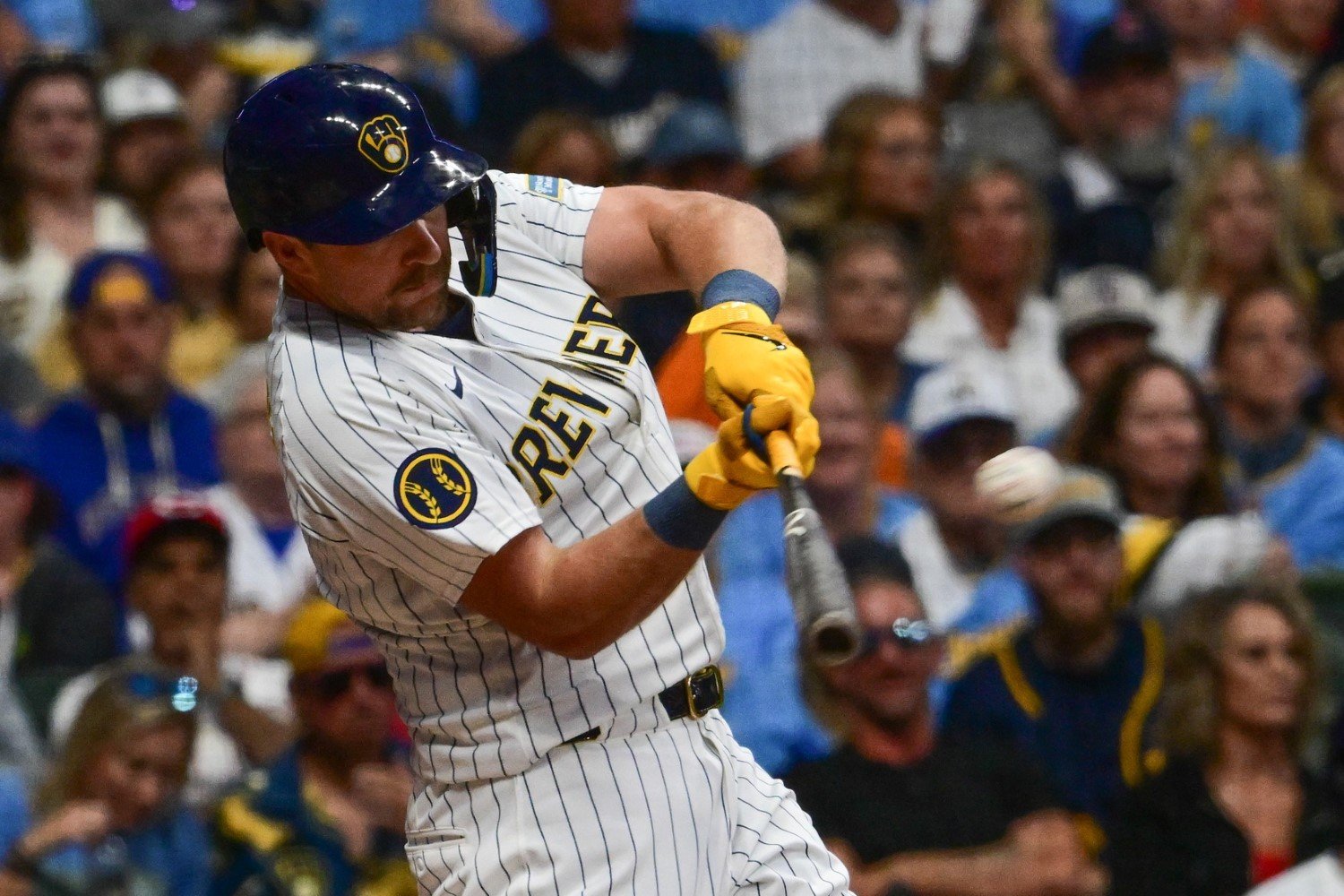
Somewhat predictably, Rhys Hoskins's first season back from a torn ACL that cost him 2023 has really been three different campaigns. There was the first month and a half, before he strained his hamstring; then there was the period between his rapid return from that injury and the All-Star break; and now there's the time since the break. He's been three very different hitters during those spans, in ways that make plenty of sense.
Early on, Hoskins was more or less the guy the Brewers paid for--the one whom the Phillies enjoyed from 2017 through 2022, before a knee injury wiped out his walk year ahead of free agency. He batted .233/.340/.474, with 9 home runs in 156 plate appearances, with a terrific walk rate and a very reasonable strikeout rate, for a prodigious slugger. It wasn't a roaring start, but that's basically what you'd expect from Hoskins in any of his previous seasons: a take-and-rake star tracking toward 35 home runs over a full season of playing time.
The hamstring injury Hoskins suffered while rounding first base on a single May 13 threw all of that into chaos. Surely frustrated by the disruption, impatient to get back into the mix after losing a year, and thinking ahead to his possible free agency again this fall, Hoskins came back from the injury after just 17 days and 15 games. That was quick. Over the previous six full seasons, when a hitter suffered an early-season hamstring strain, their median number of days missed was 19, and the average was 25. When you account for the fact that Hoskins is 31 years old and was coming off a major leg injury, too, you'd have guessed he would miss more like four weeks than two.
.png.8bbd1d42a3f2e1770f7dde40a40f9e65.png)
It quickly became clear, too, that Hoskins wasn't quite himself. He returned to the lineup, but his power didn't. From May 31, when he came back, to the All-Star break, he batted .195/.273/.350. In 140 plate appearances, he had just 5 home runs, drew 12 walks, and struck out a whopping 47 times. Whether he still had lingering damage in the hamstring or whether he was just out of rhythm and not yet confident in his moves from head to toe in the box, he lost touch with his talent.
Thankfully, the team's unusual five-day All-Star break acted like a second IL stint for Hoskins. He got a full week off, since Pat Murphy sat him in the first-half finale. Since the beginning of the second half on Jul. 20, Hoskins is back. He's only come to the plate 83 times in that span, but he's batting .280/.325/.547 in that time, with 6 home runs. His strikeout rate is back under control, too.
When you break out Hoskins's spray chart into those three season-fragments, it's fairly easy to see a change.

Always a hitter focused on driving the ball in the air to the pull field, Hoskins has done that more effectively over the last four weeks than at any other time this season. He's not getting quite as far out in front of the ball, which means more balls to the gap and fewer down the line, but it also means fewer ground balls, and that he's on time more often, so more of his flies and liners go to the middle chunk of the diamond. His strength and the leverage in his swing are conducive to that subtle change in approach, and we've seen the results follow that improved process.
Interestingly, though, that change in hit distribution reflects a less expected shift in his approach at the plate. Hoskins has always been the kind of hitter who patiently waits for the ball in his happy zone, from the upper thigh up and on the inner half. In the first half, you could see that approach in his swing rate heat map; it just didn't work equally well in the two subsets on either side of his injury.

Since the break, though, part of the transformation in Hoskins has been a much more aggressive tack, especially on pitches away from him. He's expanding the zone more often than he ever does, and in a place where he's historically been notable for his patience.

This isn't just a problem with pitch recognition, though. It's a conscious choice. Hoskins is creating damage on those outside pitches, in a way he didn't do in the first half this year and has rarely done in his career. Here's a homer from late last month, on a changeup in a location where Hoskins hardly ever has such good luck.
Here's a chart showing the average exit velocity of batted balls by Hoskins in the first half, based on the location of the pitch he hit. The numbers and color indicate how hard he hits balls in that spot. The size of each square shows, relative to other locations, how often he hits balls in that spot.

Now, here's the same chart for the second half.

Whether in reaction to the way pitchers have been attacking him, or as part of a change to cheat a bit on the ball and get his arms extended more, Hoskins has shifted his sights at the plate. He now wants that outer-third pitch, even though he's still a dead pull hitter. He's just pulling it to the gap, instead of down the line, unless the ball runs back over the plate and into his swing path.
Not all of this is good. It's only been a small number of plate appearances, and his solid overall numbers are inflated by a considerably higher BABIP than he ran in the previous segments of his season. They're also achieved despite his increased aggressiveness and sagging walk rate. Most notably, though, he's not hitting the ball as hard as he did before the injury, or even hitting it hard as often. Maybe he's going to start drawing more walks as he settles into this altered approach, and maybe he doesn't need to hit it much harder than he already does, if he can keep hitting the ball with loft to the pull field. Maybe, on the other hand, opposing pitchers will figure out this new pattern from him, and he'll have to migrate to another one.
So far, Murphy hasn't responded to this hot streak by moving Hoskins up in the batting order, except when the Brewers face left-handed starters. That might be the most reasonable course, given the uncertainty that remains about the staying power of this improvement. At the same time, the team needs more power to keep up with the rest of the powerhouses in the National League, and Hoskins can provide it, even without eye-popping exit velocities. As the balance of this month unfolds, if he stays hot, Hoskins should get more plate appearances, by creeping higher in the lineup.
Which team do you dislike the most in the NL Central?

Follow Brewer Fanatic For Milwaukee Brewers News & Analysis



-
 1
1


Recommended Comments
Create an account or sign in to comment
You need to be a member in order to leave a comment
Create an account
Sign up for a new account in our community. It's easy!
Register a new accountSign in
Already have an account? Sign in here.
Sign In Now