


Brewers Video
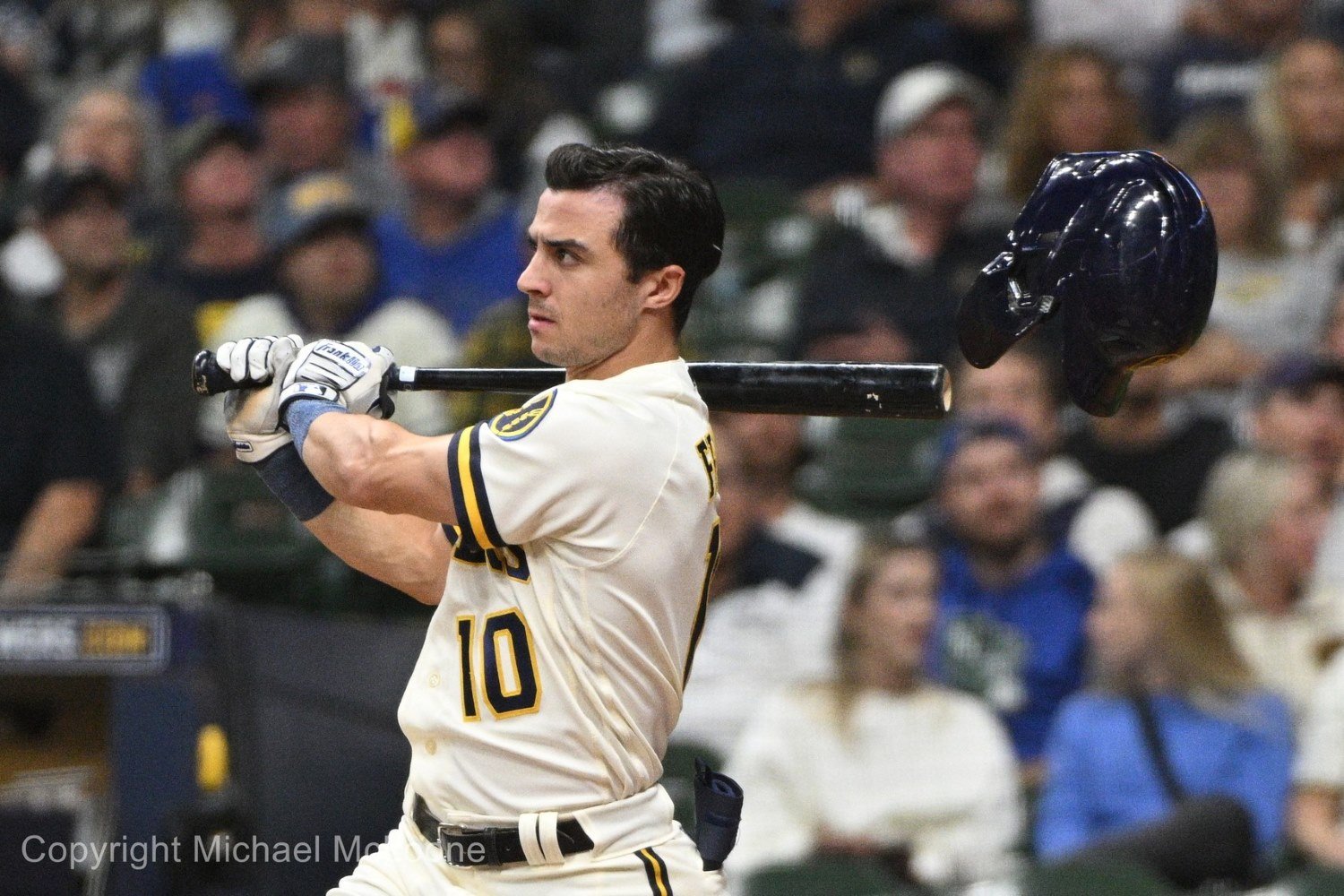
The first thing that jumps out when you talk to Sal Frelick is that he's not talking about his conversion to the infield as a passing flight of fancy. To him, this move (while not total or definitive) is very real, and it's happening. In the Brewers clubhouse in Maryvale Friday, he talked about the differences in the way he needs to prepare and approach defense between his established positions and the one he adopted over the offseason.
"There are just little things you have to think about differently with different hitters. For the most part, in the outfield, I’m just shaded a few steps to my left or right," Frelick said. "But here, it’s sometimes like, I’ve gotta take away bunt, gotta basically play shortstop when a lefty’s up, gotta hug the line, so it’s a little different with the positioning, but the pre-step and setup is the same for the most part."
Did you catch it? He not only called the infield "here," but isn't thinking of the infield as an amorphous project. He's not an infielder. He's a third baseman. All the unusual positioning he's talking about there relates to third base.
"I’ve been doing both all spring," Frelick said of the work fans don't see, on backfields and with teammates. "I make sure I get my work in with the infielders here [in Maryvale, even when the team is playing elsewhere in the Cactus League], and I’m not working with the outfielders, but during BP I’ll make sure I go out to the outfield and shag, just to make sure I’m getting those live reads.
Last game was the first game I did both in the same game—started in the outfield, came to the infield, which I think we’ll try to do a little bit more of here, just because you never know the situation."
Indeed, you never do. Admittedly, too, Frelick needs many more reps in the infield than he does in the outfield, as he proved with a dazzling, diving catch in right field Tuesday in Tempe. A much more experienced outfielder, Frelick can play great defense there with relatively little practice. It's on the dirt that he needs to progress beyond the rudiments.
Still, it's telling that Frelick isn't working with the outfielders in any of their dedicated drills. He's fully committed to this. Whether it will turn into a consistent thing or not remains to be seen, but he's certainly trying to make it a viable option.
Manager Pat Murphy hasn't made any definitive statements about the position switch, except to confirm that it's no gimmick. The most important word in Murphy's vocabulary is "trust". He thinks about players and possibilities in terms of what and whom he trusts, and there's no player he's proclaimed his trust in more often this week than Frelick.
"I don’t know if the analytics are good or bad on this guy, to be honest with you," Murphy said Wednesday. "I know one thing: he’s a ballplayer. Is it pretty all the time? No. But I trust him."
In that light, it's easy to see how the skipper might entrust Frelick with a big role in the offense, and a flexible but equally important one in the team's run prevention. We can safely assume, based on last season, that the sophomore will at least meet the latter expectation, If nothing else, he can be a sterling defensive outfielder. Whether he emerges as more than a useful role player, then, depends mostly on his bat.
Frelick has a plan to improve on that side of the ledger. His numbers were fine in his rookie campaign, but there was a troublesome dearth of power. Most of that problem lied in his inability to hit non-fastballs--only, unlike most players who struggle against soft stuff, Frelick didn't whiff much at those offerings. On the contrary, only four of the 362 hitters with at least 200 plate appearances last year missed less often on swings against non-heaters than Frelick. Why did spin and changes of pace rob him of power, but not cost him strikeouts?
"The one thing I’ve had trouble with a lot in my career is that I have really good hand-eye [coordination], so when I do swing at bad pitches, I usually still put them in play," Frelick said. "I think that’s what happened with a lot of the offspeed pitches. Where a lot of guys might swing and miss at them, when I get fooled, I still put them in play. So I really have to be better at just swinging at strikes and balls in the zone. I think most of the balls I swung at outside of the zone last year were offspeed pitches, which just resulted in these light, dinky rollovers."
That checks out. Frelick wasn't any more successful in Triple-A than in MLB last year, but he did hit the ball harder, and much of that was because he better honed his strike zone. In the minors, he focused on swinging at hittable pitches.

After his promotion, he expanded and got out of sorts. He was chasing more, and although he wasn't suddenly striking out at a high rate, he wasn't locked in on stuff against which he could be productive.
.png.5315f8d8965620e86d4b7e93166ba6cf.png)
Frelick's not totally right about the nature of his problem, and he's probably being a bit overly optimistic about solving it. Note the swings above the zone (probably at fastballs, not junk), and consider, too, that although his average exit velocity was nearly two miles per hour higher in the minors than in MLB, his 90th-percentile figures were nearly identical. That suggests an obdurate power shortfall.
Still, listen to him talk about hitting, and it's easy to see why Murphy trusts him so much. Frelick is a multilevel thinker in the box. I asked, for instance, whether he would adjust by hunting heat earlier in counts, to counteract this issue.
"It’s not exactly what type of pitch," he said. "I mean, I’m obviously gonna be geared up for the fastball early in counts, but if they hang those offspeed pitches up for strikes, I’m definitely gonna be ready to hit them. Those first few pitches, pitchers don’t want to get behind. Those are the best times to compete and try to do some damage."
Frelick, who has batted first and second during his limited Cactus League action so far, has been very aggressive in those games, though. He's hit the first pitch of the game into play twice already, for instance. Is that about breaking ball avoidance?
"It’s a combination of things. A lot of these starters we’ve been seeing—like [Thursday], Nate Eovaldi, just a guy you don’t want to get down to," Frelick said. "I know he’s gonna challenge you early with his heater. Sometimes, too, when I get aggressive early—especially in my first at-bat—-later in the game, good chance I’ll get ball 1, ball 2, just because they know I’m staying aggressive early. And then vice-versa: Sometimes my first at-bat, I’ll go up there auto-taking, really try to work a good count, so that later in the game, I know I’m going to get those first-pitch strikes."
If a player with Frelick's speed and contact skills is able to consistently outguess opposing pitchers, let alone set them up in one at-bat for a change in tack and a crucial edge in a later moment, then the Brewers have a budding star on their hands. That goes double if he's a competent third baseman, and given his attention to detail in both regards, that feels increasingly plausible.
Do you approve of the job Pat Murphy is doing as Brewers manager?

Follow Brewer Fanatic For Milwaukee Brewers News & Analysis



-
 2
2


Recommended Comments
Create an account or sign in to comment
You need to be a member in order to leave a comment
Create an account
Sign up for a new account in our community. It's easy!
Register a new accountSign in
Already have an account? Sign in here.
Sign In Now