


Brewers Video
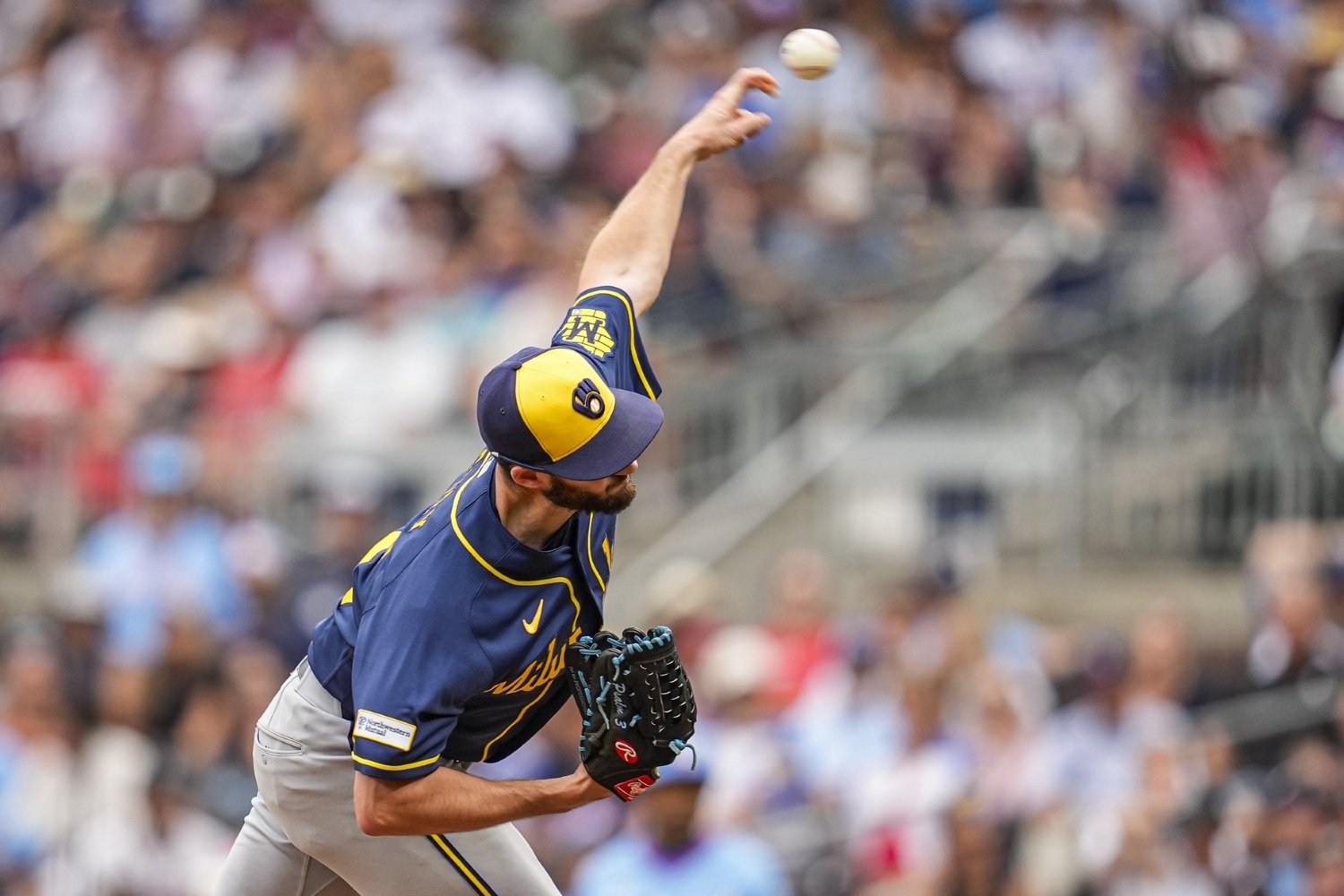
Aaron Ashby is the most potent weapon the Brewers have in their bullpen. He can be deployed in a multitude of different roles and has one of the nastiest, most diverse arsenals of any reliever in baseball. Using a shorter stride than most, Ashby gets vicious break on everything he throws, and it's caused despair for a number of the best hitters in baseball. That being said, you cannot succeed in a high-leverage role consistently without a strong fastball, and Ashby hasn't been as dominant with his sinker this year. This month, that's starting to catch up to him.
Hitters are hitting .321 and slugging .462 against Ashby's sinker, with an expected weighted on-base average (xwOBA) of .355. All of these are career-high marks for one of the most unusual, outstanding pitches in baseball. Excuse a paragraph or two of nerdiness incoming, but it's important to break down why his sinker is so effective at its best, before diagnosing where it might be struggling this year.
Ashby's high release point usually coincides with more vertical break and is not always conducive to a sinking fastball. Ashby's short extension gives his pitches more time to break, though, and his ability to generate seam-shifted wake (how the air moves around the seams of a baseball to enhance its movement) makes the sinker drop a lot more than a hitter would expect from his release point.
On average. Ashby's sinker drops four inches more than expected from the seam-shifted wake he generates, and runs almost seven inches more than expected from his release point. To show that in a diagram, Ashby's expected movement on the sinker is the shaded orange area. The actual movement is the orange circle. It's a massive difference, and that movement is a key reason for Ashby's ground balls and how he has utterly overmatched hitters in the past. If that pitch is located well, good luck.

If anyone has any questions surrounding the graph above or how to translate the data, please let me know in the comments below, by the way, I'm always happy to explain, but if you'd like a further breakdown of seam-shifted wake, I wrote a piece on the phenomenon over the winter here.
The problem Ashby is finding so far in 2026 is that his sinker is being elevated at ideal launch angles far more frequently than it has in the past. That's key because, with this Brewers infield, even hard-hit balls are likely to turn into outs if they stay on the ground, and Ashby has historically induced a lot of worm burners. If you can get it over the infield, however, those hard-hit balls turn into extra-base hits and even home runs.
Opponents' average launch angle on Ashby's sinker in any season previously reached a high of 2° way back in 2022, and was -1° in 2025. This season, it's all the way up to 8°, and that's the primary reason why we're seeing more hard-hit balls. His ground ball rate has dropped from 64% in 2025 to 51% this season. The first thing to check is whether the movement profile has changed, and it has—but ever so slightly. Ashby is getting about an inch less induced "drop" on the sinker. During his more dominant stretches, Ashby averages about seven inches of induced vertical break, but has been above eight inches each month so far in 2026.
.png.7557f3400b62dd17cc19662a9bdc87b3.png)
We can see from this graphic (both of the above graphics are from Jeremy Maschino at Pitch Profiler, an excellent resource for pitching information and analysis) that Ashby's Stuff+ grades on his sinker are largely identical this year. He's throwing from a slightly higher arm slot, which explains the increase in induced vertical break, but he's still getting impressive drop for that release slot. What is interesting, however, is the reduction in his ProPitch+ score, which combines location and his Stuff+ grades. His ProPitch+ has dropped this year, while Stuff+ remains the same—suggesting we could have a location issue so far.
The other point to note is whether he's adjusted his pitch mix, and while I don't think this has made a massive difference, Ashby is using his slider more this year at the expense of his curveball. The changeup usage has slightly dropped, and a good changeup can keep hitters off your primary fastball, but not enough to cause this level of change in contact quality. So let's dig into Ashby's locations with his sinker.
At his best, Ashby manages to get hitters off the end of the bat (a "flail") with regularity; that can be helped by hitting the outer third of the plate. We mentioned earlier that Ashby gets a lot of seam-shifted wake effects that help the pitch "sink", but have an even bigger effect on how much horizontal movement he gets. To right-handers, in particular, this movement can force the pitch onto the end of the bats and help with inducing weak contact. If we look at 2025 pitch locations to right-handers:
.gif.8e3d551696d572e6ffe49f723b8a9398.gif)
While Ashby wasn't averse to hitting the heart of the plate, and that's something he could get away with given the vicious movement and depth in his arsenal, his most often hit zone was on the outer third of the plate to righties. He was happy enough to front-door his sinker to them, as well, locating quite evenly across the strike zone, but he didn't specifically live in the heart of the plate. When he did, he also kept it down more than up in the strike zone, and we can see the importance of Ashby keeping the ball off the heart of the plate when it comes to his ground ball rate on the sinker:
.gif.46817e3366bed2273f282f5e0f365102.gif)
Ashby's ground ball rates were far higher when he could find the inner and outer thirds of the plate, staying away from the center of the barrel, and saying good luck to any who dared chase below the strike zone. There are two clear areas in which Ashby didn't get ground balls with regularity: middle-middle fastballs, and middle-up fastballs. So let's take a look at his locations in 2026:

Well, there's a fairly clear answer here. Overall, Asbhy is staying in those two danger areas more often than any other location inside the strike zone. Compounding this is that he seems to have lost the feel for locating in the bottom third of the zone, with his zone rate (how often a pitch lands inside the rulebook strike zone) dipping from 59% in 2025 to 53% in 2026. Ashby is electric when he gets ahead of hitters, but every pitcher in baseball finds it more difficult when they fall behind to a hitter. When they force him into the strike zone in a fastball count, 37% of those pitches are in the danger zone where his sinker gets elevated and hit hard.
In short, Ashby needs to find his command of the sinker. Command has never been his overarching strength, but this is a step back for him in that regard. If he can command the two sides of the zone, or even locate better at the bottom of the strike zone, the Brewers will have their high swing-and-miss, high ground ball pitcher that's one of the toughest relievers in baseball. If he can't establish the fastball a bit more tidily, prepare for a slightly bumpier ride.
Do you approve of the job the Brewers' front office is doing?

Follow Brewer Fanatic For Milwaukee Brewers News & Analysis



-
 1
1


Recommended Comments
Create an account or sign in to comment
You need to be a member in order to leave a comment
Create an account
Sign up for a new account in our community. It's easy!
Register a new accountSign in
Already have an account? Sign in here.
Sign In Now