

Jump to content
Brewer Fanatic
  • Brewers News & Analysis

    The Brewers Pitching Staff Has a Major Strikeout Rate Problem


    Matthew Trueblood

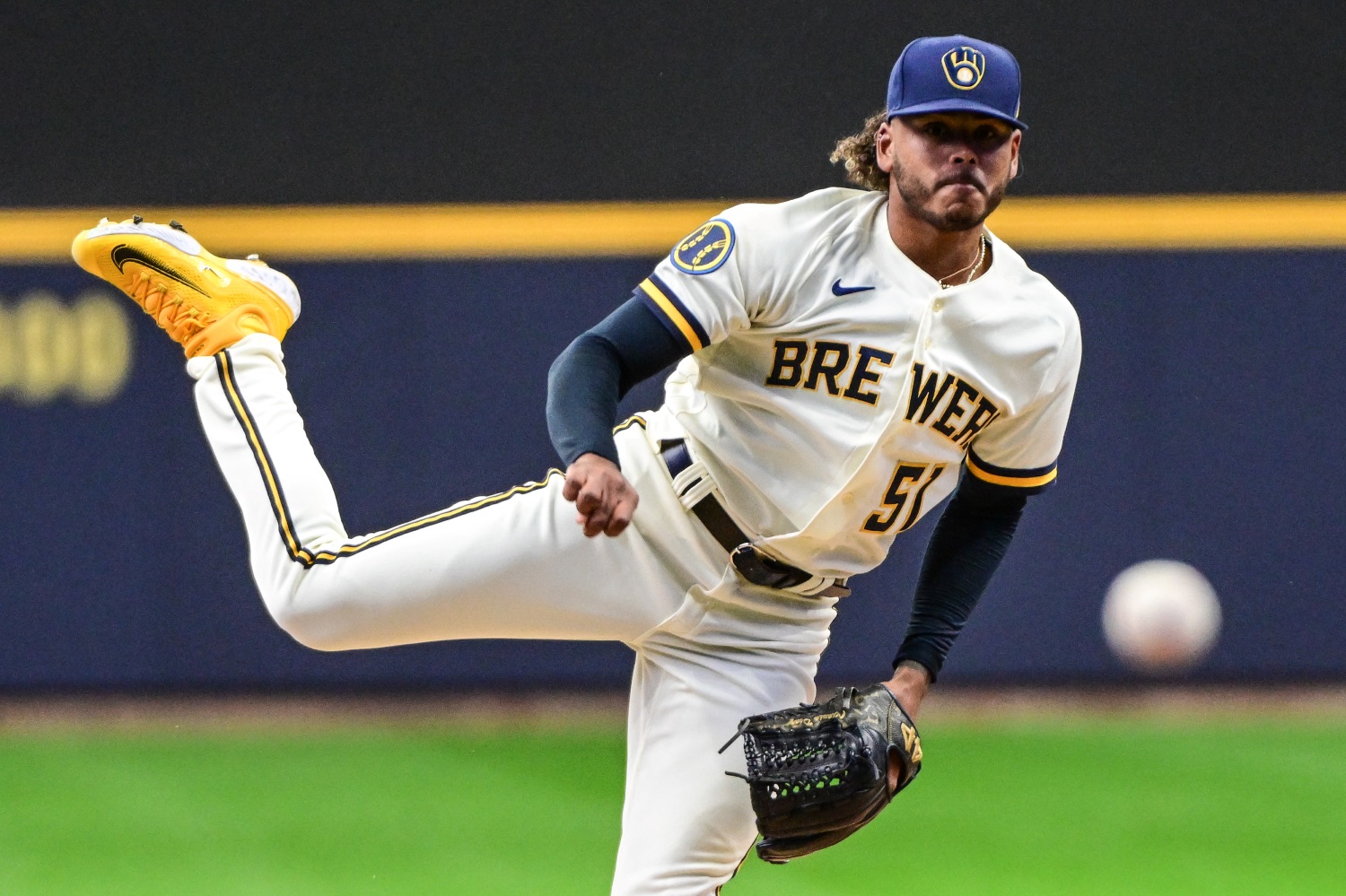
    Twelve games into a long season, it’s too early to draw any sweeping conclusions about the strengths and weaknesses of a team. So far, though, the Brewers have the fourth-lowest strikeout rate in MLB. Can they be a playoff team without missing bats?

    Image courtesy of © Benny Sieu-USA TODAY Sports

    Brewers Video

    Brewers ace Corbin Burnes broke out of his funk with eight dominant innings against the Diamondbacks this week. He struck out eight along the way, partially thanks to using his changeup more often than he ever had in an outing before. As much as anything, though, that outing was about generating weak contact and letting the Brewers play good defense behind him. Burnes got 16 swings and misses along the way, easily outstripping his total from the previous two starts combined, so he did dominate, but eight strikeouts in as many innings is not a huge total for the modern game.

    That’s a fair microcosm for the Brewers’ whole pitching staff, thus far. Only the Angels have allowed a lower Hard-Hit percentage than the Crew to start this season. Only the Mariners have allowed a lower Barrel percentage. Milwaukee has excelled on the mound, but they’ve done it by getting weak contact instead of by missing bats altogether. With the young, athletic defense the team can field behind its hurlers, there’s some reason to think they can keep doing so.

    On the other hand, big-league hitters are dangerous, and it’s very unlikely that the Brewers have so thoroughly hacked the system as to alter that fact. Only 5.2 percent of opponents’ batted balls have been Barrels (batted balls whose exit velocity and launch angle give them an expected batting average of at least .500 and an expected slugging average of at least 1.500) according to Statcast. Last year, the lowest rate in the league was 6.2 percent. Over the sample of a long season, a difference of one percentage point in that stat is something like 40 hits, most of which will be extra-base hits about which the defense can do virtually nothing.

    Tellingly, the three teams with lower strikeout rates than the Brewers’ so far are the Tigers, Athletics, and Nationals. Strikeout rate isn’t destiny, even in the modern game, but it’s not a good idea to put yourself in that company in 2023, regardless of the statistic in question. The Brewers are going to need to miss more bats in order to reach the postseason.

    Again, it’s very early. The Crew has only played four series, and their four opponents (Cubs, 22nd; Cardinals, 25th; Mets, 26th; Diamondbacks, 28th) are all among the bottom nine in team strikeout rate by hitters. Then again, for each of those clubs, the Brewers are roughly a quarter of the sample, so it’s hard to tease out cause and effect.

    Yesterday against Arizona, Janson Junk couldn’t sneak the ball past anyone, and neither could the relievers who took over for him. The Diamondbacks took 63 swings, and only whiffed twice: one on a Hoby Milner curveball, and one on a Gus Varland heater. The last time any team swung and missed fewer than three times in a game was 2015. That clearly says something about the Arizona batters, but it says something about the Brewers, too.

    While Junk pitched in Arizona, Robert Gasser racked up seven strikeouts for Triple-A Nashville. He might need to get a shot at Brandon Woodruff’s vacated rotation spot the next time around, if the team is still struggling this badly with generating whiffs. Jake Cousins has struck out six of his first 10 batters faced for Nashville; maybe it’s time to end the Joel Payamps experiment and recall Cousins.

    Obviously, strikeout rate can’t be the only criterion by which a team judges and selects its pitching staff. Cousins, who walks too many batters and sometimes finds opponents’ barrels with his nasty slider, is a perfect example of that. Still, an inability to get strikeouts in key spots will catch up to the team in the long run, so they need to be proactive about fixing the issue, even if that just means adjusting specific hurlers’ pitch mixing or sequencing. If they don’t, they won’t be able to sustain their early success preventing runs. 

    Follow Brewer Fanatic For Milwaukee Brewers News & Analysis

    Recent Brewers Articles

    Recent Brewers Videos


    User Feedback

    Recommended Comments

    Featured Comments

    The perfect storm of conditions. Mostly good hitting teams faced. Burnes K power down. Bush velo waaaay down. Big leads in at least 4 games has lead to the team being able to use their B relievers in those games. Strez velo down as well.

    Would love Gasser to spot start but, his lack of command right now is an issue. Same with Cousins, who’s SL in AAA gets the flail from minors hitters that he wouldn’t get from big-leaguers.

    • Like 2
    2 minutes ago, SF70 said:

    The perfect storm of conditions. Mostly good hitting teams faced. Burnes K power down. Bush velo waaaay down. Big leads in at least 4 games has lead to the team being able to use their B relievers in those games. Strez velo down as well.

    Would love Gasser to spot start but, his lack of command right now is an issue. Same with Cousins, who’s SL in AAA gets the flail from minors hitters that he wouldn’t get from big-leaguers.

    I think I agree with most of that. I certainly haven’t been a Cousins backer before now and am not morphing into one purely because he might give them more whiffs. 
     

    my biggest worries are about Lauer and the middle relievers, but it’s not that hard to imagine a scenario where this problem plagues them for a good chunk of the season. Anyway, it’s interesting to follow, given the overall good vibes from the pitching staff.

    Brewers team ERA of 2.83 ranks 4th, their 4.28 FIP is right in the middle at 15th and their 4.57 xFIP ranks 17th.

    Regression is surely incoming, it’ll just come down to how much, though it should also be noted the Brewers team ERA has beaten their FIP in every full season since 2016 leading to the 4th best cumulative margin in MLB during that time.

    Tough to read too much into the numbers when the samples are still so small and noisy this early on, even at the team level. Here are the ranges from best to worst for last year vs so far this year…

    Team ERA
    2022: 2.80 to 5.08
    2023: 2.17 to 7.54

    Team K/9
    2022: 9.79 to 7.38
    2023: 10.61 to 6.35

    Team HR/9
    2022: 0.83 to 1.56
    2023: 0.42 to 1.97

    Looking at the projections, FanGraphs has them 12th for rest of season runs allowed and BPro has them around 8th/9th.

    That range feels more accurate to me of where they’ll likely end up than either of their current ERA or FIP/xFIP rankings to this point.

    • Like 1
    1 hour ago, sveumrules said:

    Brewers team ERA of 2.83 ranks 4th, their 4.28 FIP is right in the middle at 15th and their 4.57 xFIP ranks 17th.

    Regression is surely incoming, it’ll just come down to how much, though it should also be noted the Brewers team ERA has beaten their FIP in every full season since 2016 leading to the 4th best cumulative margin in MLB during that time.


    My argument is slightly more difficult with Woodruff injured, but Burnes/Woodruff/Peralta have a pretty solid track record of striking guys out. Even Lauer does. Miley is really the only guy that is a well below average strikeout guy. Looking at their numbers, all our starters except Miley are striking out about a batter per inning. Burnes has the worst k rate of the other 4, I'll go out on a limb and say that's unlikely to be how we end the season. Right now our SP is 21st in MLB in k rate, that'll improve when Woodruff is back and Junk and his 3.86 SO/9 stops making starts. Now in relief, Milwaukee is dead last in k rate at 6.18. Slightly ahead of us is the 12-0 Rays with 6.34 and then significantly ahead of them is the 28th ranked Nationals at 6.89. On one hand, we knew our relief was going to be a question mark at best with Williams really the only established guy. Also, being in the company of the Rays right now certainly isn't a bad thing and maybe us and them know something other teams don't. 

    One other major point, our defense to this point is inarguably one of the best in the league. We are in first by a wide margin in DRS, and fangraphs has us in the top 5 in both RAA and OAA. The eye test backs that up, especially when we have our best options out there(I'm imaging a world with Taylor/Frelick in LF and Yelich DH or bench...we'd be plus or better at every spot). Bottom line is weak-moderate contact with a superb defense might be better than k's and a high pitch count.

    • Like 1
    2 hours ago, KeithStone53151 said:

    Bottom line is weak-moderate contact with a superb defense might be better than k's and a high pitch count.

    I think there's an interesting topic here. I think I've been conditioned during the 3TO era to believe that K-rate is the most important pitching stat, and that bigger is always better, like hitting more HRs is almost always better. We celebrate, and rightly so, the dominance of the "immaculate inning," but conversely constantly worry about pitch counts. Perhaps, if our defense continues to be as good as we think it is, having a lower K-rate will allow our best pitchers to rack up what I believe is the most overlooked counting stat for pitchers... Innings Pitched. Or as Counsell likes to say, "getting outs".

    1 minute ago, Playing Catch said:

    I think there's an interesting topic here. I think I've been conditioned during the 3TO era to believe that K-rate is the most important pitching stat, and that bigger is always better, like hitting more HRs is almost always better. We celebrate, and rightly so, the dominance of the "immaculate inning," but conversely constantly worry about pitch counts. Perhaps, if our defense continues to be as good as we think it is, having a lower K-rate will allow our best pitchers to rack up what I believe is the most overlooked counting stat for pitchers... Innings Pitched. Or as Counsell likes to say, "getting outs".

    I probably should have tweaked my comments a bit. A strikeout is better than weak contact. Weak contact sometimes goes for hits while a strikeout is virtually never anything but an out. Problem is, the k rate is so sought-after right now...the option of relievers that don't get strikeouts but generate weak contact at a very high rate might be the better value option than high k rate pitchers...allowing us to utilize resources elsewhere in the roster. Also as you noted, weak contact generally requires less pitches than a strikeout, so you can get more outs and be more fresh than the guy using 20 pitches to strike out 3 guys in an inning.

    I'm not worried, yet. It's a small sample size. Corbin, Woody (provided it's a short IL stay), and Freddy have established themselves as among the best strikeout artists in the game. Same with Devin from the bullpen. He's only pitched 3 times thus far, which obviously impacts the overall K numbers. These guys are the reason why we've been among the top pitching staffs in terms of Ks over the past few years. 

    We'll see with guys like Lauer, Bush, Strzelecki, etc. Velocity concerns in the beginning of the season generally tend fade away the further you go and the warmer the weather gets, unless there's an underlying injury. I just find it hard to believe that all of those guys simultaneously have underlying injuries.

    Trading a Hader definitely hurts. And the guys we've replaced him with (Payamps, Guerra, etc.) don't exactly have high K histories..

    But, at the same time, you have Uribe, Cousins, Gasser knocking on the door in the minors...


    • Like 1
    1 hour ago, Brewcrew82 said:

    I'm not worried, yet. It's a small sample size. Corbin, Woody (provided it's a short IL stay), and Freddy have established themselves as among the best strikeout artists in the game. Same with Devin from the bullpen. He's only pitched 3 times thus far, which obviously impacts the overall K numbers. These guys are the reason why we've been among the top pitching staffs in terms of Ks over the past few years. 

    We'll see with guys like Lauer, Bush, Strzelecki, etc. Velocity concerns in the beginning of the season generally tend fade away the further you go and the warmer the weather gets, unless there's an underlying injury. I just find it hard to believe that all of those guys simultaneously have underlying injuries.

    Trading a Hader definitely hurts. And the guys we've replaced him with (Payamps, Guerra, etc.) don't exactly have high K histories..

    But, at the same time, you have Uribe, Cousins, Gasser knocking on the door in the minors...


    I don’t think any of the 3 pitchers you mentioned are injured. Lauer’s velo has dropped before when his mechanics got out of whack, which is what I think is happening now.

    Bush, was babied in ST and still probably has to build-up arm strength. Strez’s velo isn’t down all that much and hopefully he gets it back with more innings.

    • Like 1


    Create an account or sign in to comment

    You need to be a member in order to leave a comment

    Create an account

    Sign up for a new account in our community. It's easy!

    Register a new account

    Sign in

    Already have an account? Sign in here.

    Sign In Now

×
×
  • Create New...
