


Brewers Video
Since the Corbin Burnes trade brought back a middle infielder who looks like a fixture for the future, speculation about Willy Adames's future with the Milwaukee Brewers has been rampant. The question is, what would make trading Adames worth it?
The most natural destination for Willy Adames in a trade would be the Los Angeles Dodgers, who are trying to put the finishing touches on the best roster in baseball. Whenever Adames and the Dodgers are linked in trade discussions, the name that pops up is Gavin Lux. It feels almost lazy, since Lux is a Wisconsin native, but there's also a real fit there. Lux has three years of team control remaining, and despite losing all of last season to injury, he's a promising left-handed hitter with some big-league bona fides.
After bringing in Joey Ortiz for Corbin Burnes, though, the Brewers don't necessarily need that profile of player--at least not to the extent that they did a month ago. In addition to Ortiz, they have Tyler Black (whom they hope will be able to stick at third base, and who, like Lux, bats left-handed) on the doorstep, and if you pencil those two in for long-term roles, it leaves just one of the three throwing infield positions to be filled by some combination of Brice Turang, Andruw Monasterio, Oliver Dunn, and Vinny Capra.
That quartet doesn't contain any player certain enough to be a first-division regular that the Brewers should totally foreclose the possibility of adding another infielder, but with Ortiz on board, they're a good enough mélange to take the urgency out of the search for an infielder. Besides, the Crew would need to pay Lux fairly handsomely in arbitration in 2025 and 2026 if he had a good season in 2024, and he'd be a free agent thereafter. He doesn't really open their window wider, the way you'd like an Adames trade to do.
What if, to get a deal done that satisfies that standard, Matt Arnold and Andrew Friedman got a third team involved? The Miami Marlins are in the market for shortstop help, but they're not taking on the salary owed to Adames, and they don't want a one-year solution to the position. They do, on the other hand, have controllable starting pitchers they're willing to move in the right deal--a deal that would bring them a hitter who could fit into the same timeline on which they're trying to build around the likes of Jazz Chisholm Jr., Luis Arráez, Jake Burger, and more.
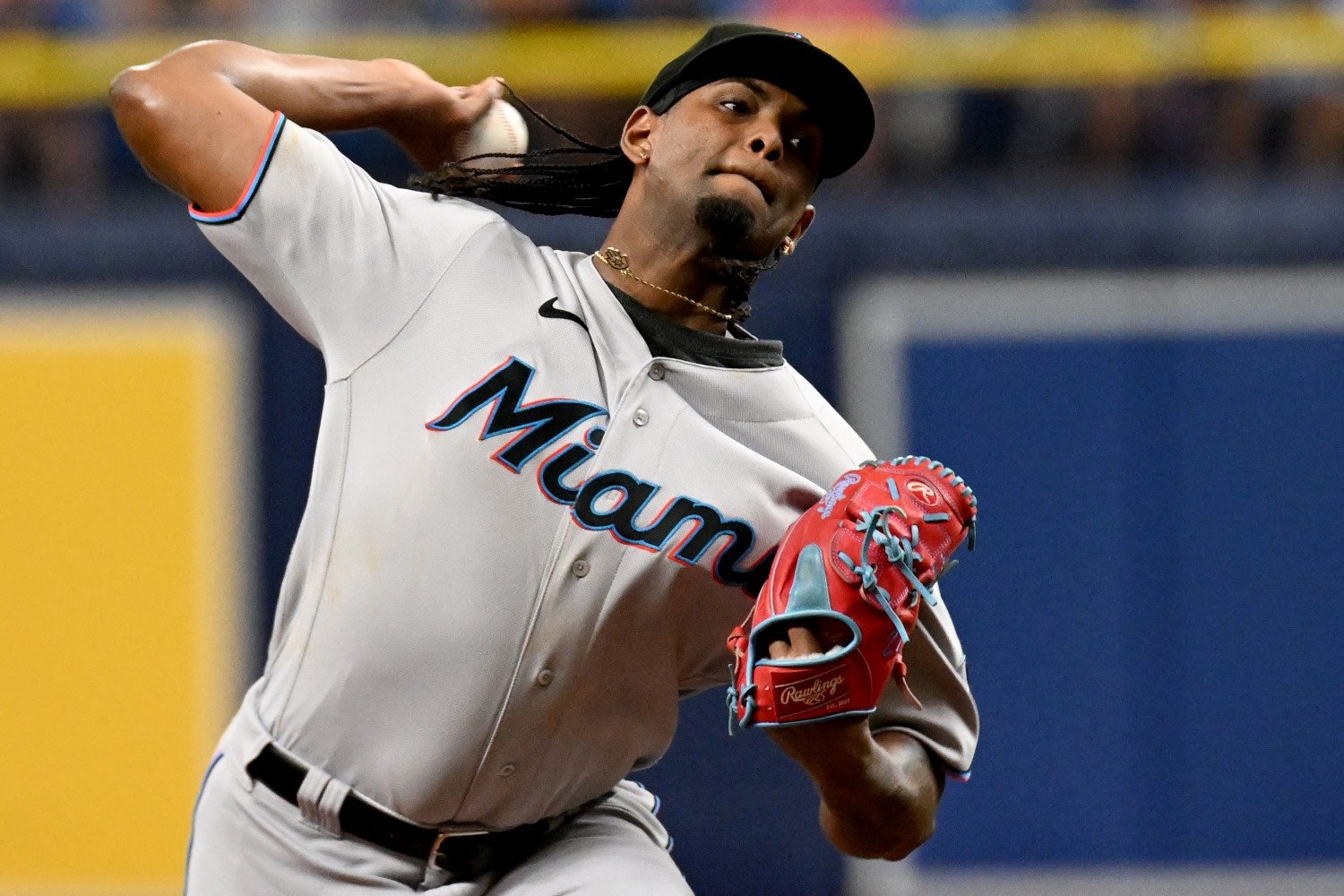
In fact, there are active rumors that the Fish could send Edward Cabrera to the Pirates, in a trade that would net them a position player with a blend of team control and established production capacity. Cabrera, who will turn 26 in April, has five years of team control remaining, but will be arbitration-eligible as a Super Two player next winter. Miami has not been able to get the electric stuff Cabrera has under control well enough to make him more than a back-end starter, and the match between his earning power and his performance so far in the majors will be distasteful to a team in transition.
If the Brewers send Adames to the Dodgers, maybe the Dodgers could package Lux and a low-level prospect and send them to Miami, instead of to Milwaukee. In turn, the Marlins could send Cabrera to the Crew, rounding out what would be one of the deepest, highest-upside starting rotations in MLB.
Re-signing Wade Miley, adding Jakob Junis and Joe Ross, and trading for DL Hall already has the Brewers seemingly set, but their current rotation is a little shy on upside. Cabrera would change that in a hurry. His fastball sits around 96 miles per hour, and his changeup is devastating. He only managed a 4.24 ERA last year, because he walked 15.2 percent of opposing batters, but there is some low-hanging fruit in front of him--the kinds of adjustments that could easily turn him into a co-ace alongside Freddy Peralta under the tutelage of Chris Hook.
Firstly, Cabrera needs to better utilize his arsenal. He has a four-seamer and a sinker; that almost-famous changeup; and two breaking balls, a curve and a slider. Last year, he threw all five a fair amount, but the way he mixed them against right-handed batters didn't make much sense. He threw that changeup against them too often, given that he doesn't have very good glove-side command of his four-seamer to set it up, and that his sinker has very little movement differential (and not even much velocity differential; he throws the change at more than 90 MPH) from that pitch. Here's all his offerings against righties last year, plotted according to their movement.

What Cabrera should be doing is ditching the change against righties, and using the four-seamer to set up the curve, the sinker to set up the slider. One reason he couldn't, for much of the season, was that he just couldn't throw enough strikes, but that might be one problem he's already begun to solve.
Check out this video of Cabrera from early in 2023.
Mechanically, there are plenty of things the Brewers would do differently with Cabrera. The direction of his stride and the way he lands on his front leg contribute to his difficulty with control and command. For now, though, just look at where he was set up on the rubber for that offering. He's basically right in the middle.
Now, take a look at this pitch, from late September against the Brewers.
Shew. So, first of all, that changeup explodes away from lefties, right? It's a filthy pitch. But pause and notice from where he starts that offering. He's as far toward the first-base side as he can legally get. Cabrera made his move in three phases. Early in the year, he was right in the center of the rubber. In the middle of the season, he moved over slightly. Then, in August and September, he went to the extreme first-base side.

That was a momentous change, because while we tend to think of pitching science as all physics and biomechanics, there's a good bit of geometry to it, too. Sometimes, your angles are just plain wrong, and you have to find a way to make them friendlier. Cabrera filled up the zone (especially inside on lefties and away from righties) much better after making his moves.

In the three subdivisions of the season I've created here, Cabrera threw 40.1, 42.8, and 45.6 percent of his pitches in the zone, respectively. Opponents swung more (both inside and outside the zone) and took more called strikes as Cabrera slid over. Batters had a weighted on-base average (wOBA, scaled to OBP such that a number around .325 is average, and higher is more hitter-friendly) of .337 through mid-May; then .313 from mid-May through the end of July; then .286 after Aug. 1.
The move further helped Cabrera against lefties, but hurt him against righties. That's largely because of the pitch mix problems we already talked about, though. With the Brewers, he would make better use of his new angles against same-handed batters by making greater use of the stuff he throws to the side of the plate toward which he moved. He's one pitcher who probably doesn't need his sinker at all, and Hook would almost certainly scrap it for him.
It's possible the Brewers would have to throw in some small consideration, be it cash or a far-off, low-probability prospect, in order to get Cabrera for Adames. If they can do it, though, they ought to. The payoff could be huge, and with Adames just a year from free agency, anyway, the opportunity cost isn't.
Would you trade Adames for Cabrera, straight-up? Should the Brewers try to swing such a deal, even if it means tossing in a second piece of some kind? Does keeping Cabrera out of the Pirates' hands enter the equation for you? Discuss!
Research assistance provided by TruMedia.
Do you approve of Brewers' ownership?

Follow Brewer Fanatic For Milwaukee Brewers News & Analysis



-
 2
2


Recommended Comments
Create an account or sign in to comment
You need to be a member in order to leave a comment
Create an account
Sign up for a new account in our community. It's easy!
Register a new accountSign in
Already have an account? Sign in here.
Sign In Now