

Brewers Video
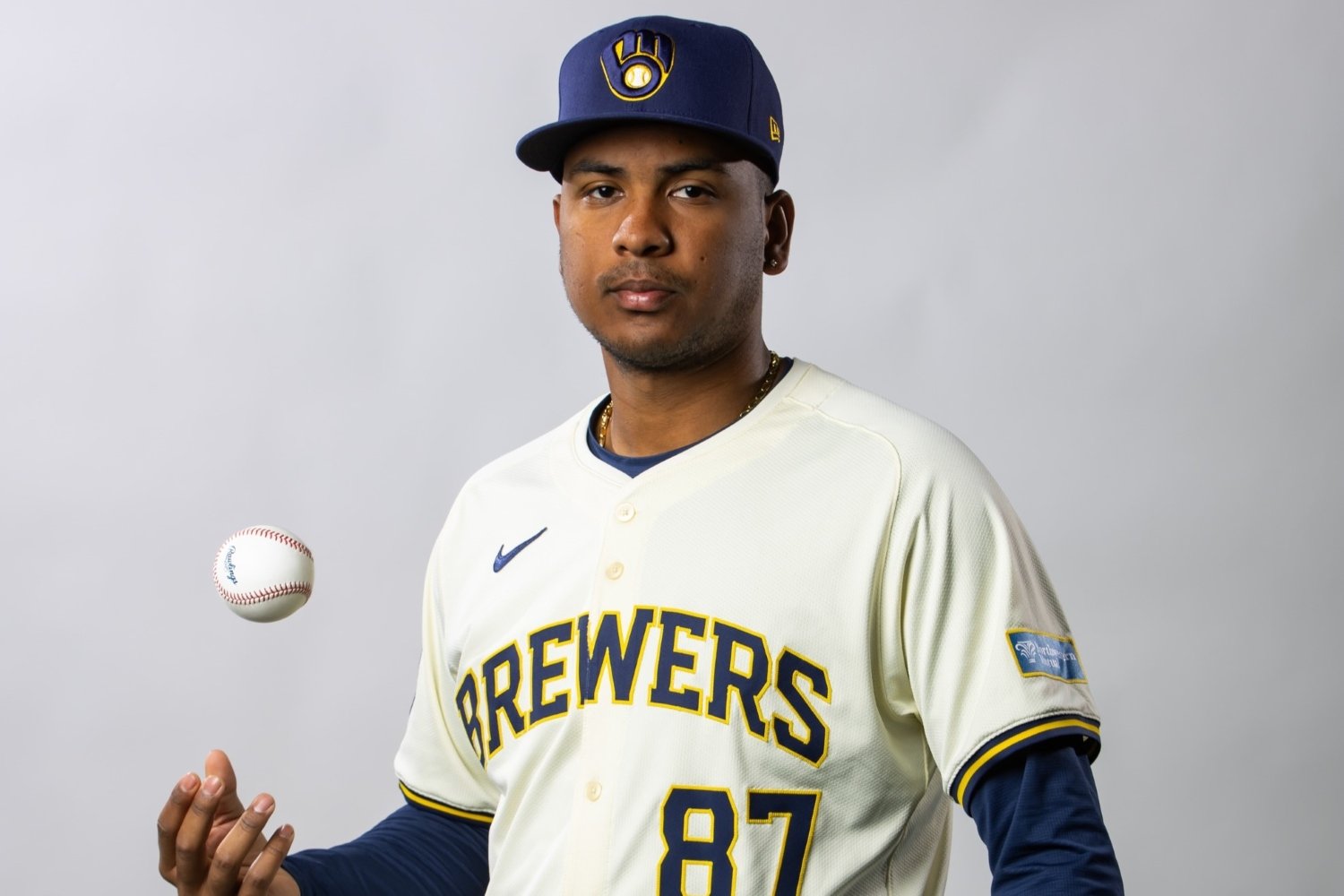
Carlos Rodriguez was selected by the Brewers in the sixth round of the 2021 MLB Draft, out of Florida Southwestern State Junior College. That means you can include him on the growing list of juco pitchers who have succeeded (or are showing signs of future success) in the Brewers system. Rodríguez is a six-pitch pitcher who throws the kitchen sink at hitters and keeps them off-balance. This profile isn’t always the most exciting for fans, but Rodríguez is more than “just a junkballer”. A number of his pitches come in as pretty solid offerings.
The Repertoire

To begin, Rodríguez throws three different “fastballs”: a four-seamer, a sinker and a cutter. The four-seamer is a riding fastball that plays above what the movement metrics would indicate, due to a low release point that gives it a Vertical Approach Angle (VAA) of -4.4. It sits in the 90-93 MPH range and can get up to 95 or so on occasion.
His sinker averages 15 inches of run; he gets the majority of his ground balls with it. The sinker sits in a similar velocity band to the four-seam, while his cutter is a bit slower, coming in around 87-88 most days. He often uses it to keep the ball off the barrel, but in Triple-A, the cutter has started to miss more bats than it did in the past as well. As is true for Bryse Wilson and some other recent Brewers hurlers, it bends toward the breaking ball end of the spectrum on which cutters exist, but has fastball-like power.
To go along with the three heaters, Rodríguez also throws three different offspeed pitches: a changeup, a slider, and a curveball. The change is often graded as his best pitch out of the six. Usually thrown in the 83-86 MPH range, it’s his go-to swing-and-miss pitch against lefties, and he can generate ground balls with it, as well. His command of it can come and go, and when it isn't there, he does sometimes allow some loud contact. When it is on, though, it can carry him through a start.
You could also make a case for the slider as his best pitch. With its velocity usually hovering around 80 MPH, it shows flashes of being another big-time swing-and-miss pitch, but (again) with some inconsistencies in command that can be costly, the results he has had show a lot of variance. That has changed in 2024, and we will get into just how successful the slider has been for him recently, a bit later.
His curveball has mostly been used to “steal a strike,” by landing a slow one in the zone. Coming in with both sweep and drop, when he’s throwing it as a swing-and-miss pitch, the velocity is usually around 73-75 MPH. When he wants to land it for a strike, he has dropped as low as the 60s at times. It isn’t a great pitch on its own, but he can use it to help all his other offerings play up, and it does give a hitter more velocity bands to worry about.
2024 Performance at Triple-A

Having made one start at Triple-A in 2023, Rodríguez returned to the level to begin 2024 and got off to a very rough start, causing a lot of his season-long numbers to look pretty rough. Through April, he had posted an ERA of 8.13 in 27 2/3 innings pitched. He had a strikeout rate of 19.7% and a walk rate that was only slightly lower, at 15.2%. His WHIP was hovering up close to two hitters reaching base per inning, at 1.81.
While he certainly didn’t get off to the start that fans were hoping for, given his prospect status, it’s hard to imagine there was much panic coming from the Brewers' side at that time. They likely knew that there was a chance Rodríguez would need to go through an adjustment period at this level. After all, he did come into the season as the fifth-youngest pitcher in all of Triple-A.
Whether the organization was worried at that time or not, since the calendar flipped to May, Rodríguez has done everything he can to put any concerns there may have been to rest. In that span, Rodríguez has posted a 2.83 ERA in 35 innings pitched. His WHIP is nearly an entire point lower than before May 1, down to 0.89. His strikeout rate is up to 29.2%, and his walk rate is down to 6.6%.
Per TruMedia, over that same period, among pitchers with at least 20 innings pitched in Triple-A, his ERA places him in the 87th percentile and his WHIP is in the 98th percentile. The strikeout rate he has posted is in the 95th percentile, and his 28.2% whiff rate is in the 82nd percentile, while his walk rate is also in the 82nd percentile. It’s also important to note that, of the 127 Triple-A pitchers who qualified for this list, Rodríguez was the second-youngest.
After being rewarded with International League Pitcher of the Month in May, Rodríguez’s first start in June picked up right where he left off, as he carried a no-hitter into the sixth inning. He eventually lost it on an infield hit and was immediately pulled from what would be his final Triple-A outing prior to making his MLB debut. His final line in that one was 5 1/3 IP, 1 H, 1 ER, 7 K and 2 BB.
Potential Pitfalls Early On and How the Brewers Could Look to Proactively Solve Them
Rodríguez has still shown a propensity for allowing homers, even during the post-April renaissance. He allowed five homers in those 35 frames, which comes out to 1.29 per nine innings. As someone who has largely been a fly-ball pitcher in the minors, this will likely always be part of his profile. However, the Brewers may be able to help.
One way the team may try to help him reduce his vulnerability to home runs is to have him increase his sinker usage (while lowering the four-seam usage) in hopes of trying to keep the ball on the ground a bit more. Over these past six starts, the ground-ball rate on his sinker has been 53.3%, while the four-seamer's has been 23.8%. The Brewers have also already employed that strategy once this year, when they increased Robert Gasser’s sinker usage upon his promotion to the big leagues. While it has been a pretty small sample, Gasser's ground-ball rate of 43% in MLB is 6% higher than it was in Triple-A this season, and 11% higher than the number he had in a full season with Nashville in 2023.
As the chart below lays out, the four-seam fastball is the one of the three fastballs Rodríguez throws that has had the most damage done against it, by a pretty wide margin.

While those are the season-long stats, the only pitch Rodríguez had any issues with in the past six starts is his curveball. On balls in play, hitters had an xwOBA (Expected Weighted On-Base Average) of .503 against that pitch. However, it also generated a whiff rate of 43% in that time. It seems that if he can keep it down in the zone, the pitch works fine. But it loses its shape the more he leaves it up, and the generally slow nature of the curve gives hitters some extra time to adjust to a mistake.
His slider, on the other hand, generated a 42% whiff rate, while also limiting hard contact extremely well. The xwOBA against the slider is only .103, meaning there's next to no damage being done against the pitch. This is another pitch he could probably use more often than he has for most of 2024, and it would not be a surprise to see the Brewers go in that direction.
The changeup got fewer whiffs than you would expect a changeup to, but it continued the trend of avoiding much hard contact and was the only pitch with a higher ground-ball rate than the sinker during that span, coming in at 55.7%. All of the fastballs were above-average in terms of xwOBA, and the cutter’s whiff rate of 31.6% was well above average for that pitch type. Going with a heavier usage rate on the sinker and cutter combination (while lowering that four-seam usage) could prove to be beneficial for Rodríguez, even beyond the increase in ground balls. Sneaking four-seamers past hitters at the top of the zone (or above it) becomes a lot easier if the hitters haven't been seeing the four-seam over 30% of the time.
Wrap-Up
To put a bow on what fans can expect to see from Rodríguez, first, remember that his season-long stats do not tell the full story and that he has shown a lot more of the qualities that make him a top prospect in the Brewers system of late. Beyond that, you can expect to see a very deep repertoire, with six solid offerings. You can probably expect to see him get burned by the home run ball at times, but also to see some swing-and-miss and a lot of fly ball outs if he keeps the same pitch mix he has had in Triple-A. It's worked well for Wilson, for instance. You could see an increase in grounders if the Brewers take a similar approach to the one they took with Robert Gasser.
We should be clear, though, in saying that Rodríguez is unlikely to ever be a top-of-the-rotation arm, at least without a sudden increase in his velocity. What he could be, instead, is a Colin Rea-type of pitcher who can go out and consistently give the Brewers a chance to win the game the day he starts. While that may not be the most exciting profile, it’s a very valuable one for almost any rotation--especially when that profile is attached to a 22-year-old who is under team control for the next six to seven years (minimally), and who also has more room left to develop than a pitcher like Rea does.
What are you hoping to see from Rodríguez in his debut? Do you expect him to stick around, or do you think he will spend more time in Nashville after this start, even if it goes well? Let us know in the comments!
Do you approve of the job the Brewers' front office is doing?

Follow Brewer Fanatic For Milwaukee Brewers News & Analysis



-
 3
3



Recommended Comments
Create an account or sign in to comment
You need to be a member in order to leave a comment
Create an account
Sign up for a new account in our community. It's easy!
Register a new accountSign in
Already have an account? Sign in here.
Sign In Now