


Brewers Video
Brice Turang is a mess. He's totally lost out there. His game has gone backward in a profound and troubling way.
Ok, that's not true on the whole. At the plate, Turang has never been better. In the field, he remains one of the best second basemen in the game. He's still a very valuable piece of the Brewers' lineup, and an increasingly conventional weapon. He's running a 98 DRC+, according to Baseball Prospectus, meaning that he's functionally average at the plate. He's striking out slightly more than he did last season, but his walk rate is way up, to 10.4%. His 90th-percentile exit velocity is also up almost 3 miles per hour, to 103.7 mph. He's running a .361 OBP, which is well-earned, and for a guy who stole 50 bases last year, it should be especially dangerous to opponents.
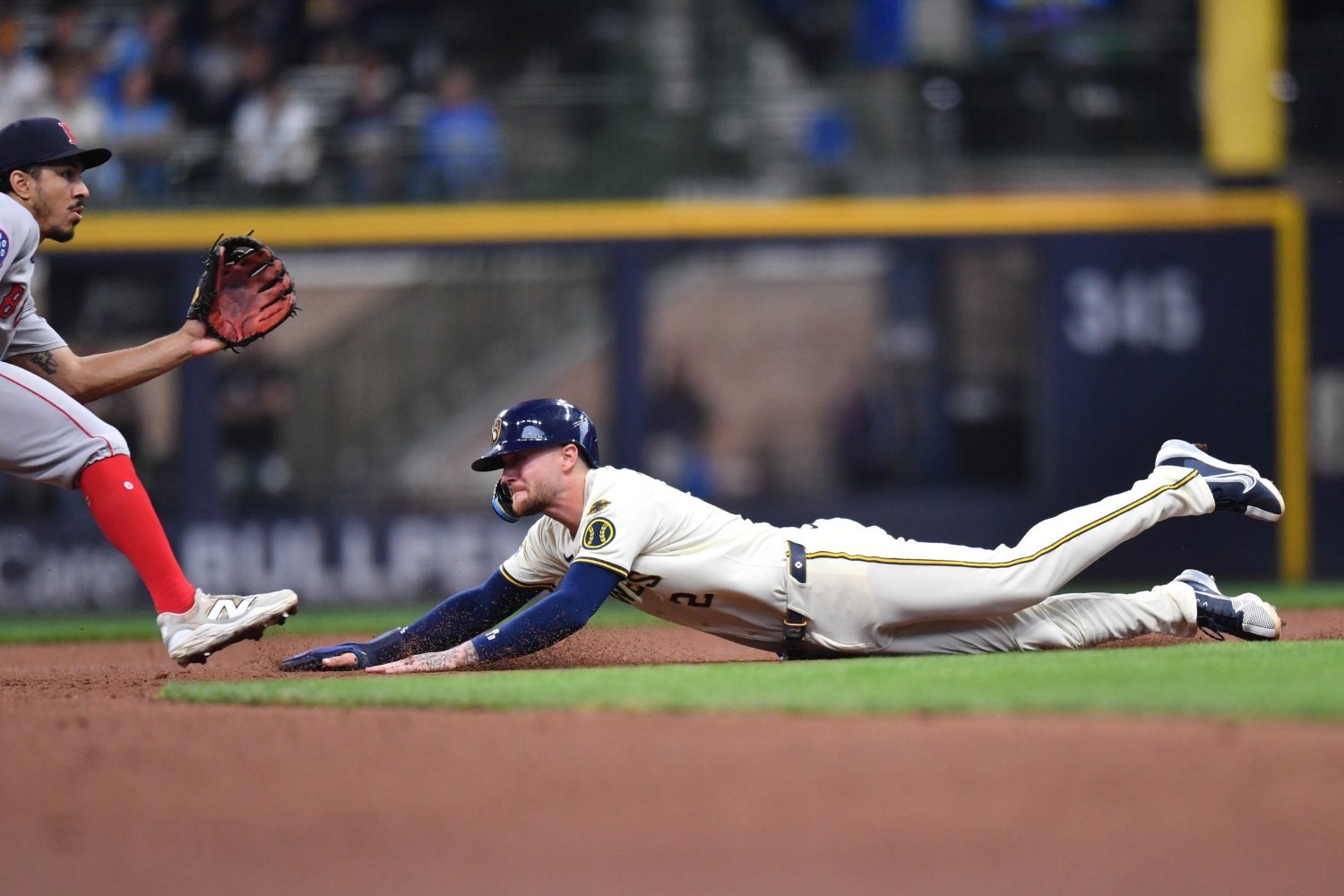
That, alas, is where we find the rub. Turang has been on base so much that one might fairly expect him to be more than halfway to that 50-steal season from last year. Instead, he's running less often (a 4.1% attempt rate, down from 6.2% last year), and that's not the worst news. The worst news comes when he does run.
Turang has been caught in seven of his 24 steal attempts. His sprint speed is down a tiny bit this year (29.0 feet per second, down from 29.3 in 2024), but that doesn't come anywhere near explaining this sudden plunge in efficiency on steals. Much slower players run just as often and are safe at a far higher rate, and Turang himself has shown a certain flair for the steal in the past. What happened?
Leads. Turang has gone from quite good at establishing healthy leads and getting a good jump when taking off for second base, to often attempting steals despite short leads and dreadful jumps. His speed simply can't make up for that. In fact, he's consistently gotten such poor starts that he's quite lucky to have been safe as often as he has been. Let's go to the tape.
Here's Turang getting caught stealing against the Pirates last week at Uecker Field.
This view is especially telling. It helps us see not only how short his lead is, but how late he starts once Andrew Heaney makes his first move. Turang was only 10.9 feet away from first base when Heaney began his delivery, according to Statcast. That's actually a hair better than his average on steal attempts this year, but over the two previous campaigns, he averaged 11.8 feet off first at first movement. That can be overcome if a runner gets a great jump when the pitcher does move—that is, if they've read the hurler well and move confidently as soon as their leg begins to rise—but that wasn't the case here. This still frame tells the tale of woe.

Heaney's well into his kick-and-fire, and Turang is merely leaning. He doesn't get a quick start, and as a result, he's toast at second.
More often than not, though, he's been safe. When he is, can he claim credit—or do we need to acknowledge that he's been the beneficiary of some bad execution by opponents? Check out this successful swipe against the Orioles.
Turang was safe here, and relatively easily. Kudos to him, and to the Brewers' scouting, because they knew Yennier Canó is very slow to home plate. His delivery took forever. He did uncork a good pitch on which to throw, though, so Maverick Handley had a shot. Alas, his throw was a bit short, and if it's going to be that far in front of second base, the catcher wants it to be more toward the first-base side of the base, where his infielder can catch it and apply a quick tag. We have a pitcher who's slow to the plate, a catcher who didn't make a good throw, and then this:

Despite the slow delivery and the poor throw, if Jackson Holliday merely avoids turning himself into a pretzel, he has a world of time to catch the ball and tag Turang. Turang's lead was just 10.8 feet on this play, and he'd only gained another 8.7 feet when Canó released the ball. That's usually math that results in a runner being caught, and despite Turang's speed and a fine slide, there were three variables here that were really ugly on Baltimore's part. If they do just a bit better on one of them, he's out.
Here's another steal, from a few days earlier, against the Twins.
Statcast tells us a runner's lead distance at first move and the amount they gain by the time the pitcher releases the ball. Both of those numbers indicate a runner's skill, but they also reflect the pitcher's work to limit them. For instance, on the previous steal against Canó, Turang gained 8.7 feet between when he began his delivery and when he released the ball, but was that even a reflection of him getting a decent jump—or was it just capturing that Canó took forever to get rid of the pitch? It's some of each. In this case, Turang did get a pretty good jump, in that he gained 8.8 feet between the start of Pablo López's delivery and his release, despite López being much quicker than Canó. However, he'd only managed to create a 10.6-foot lead before López began his delivery, so he was still less than 20 feet off the base when the ball left the hand. The Twins had a chance to get him, again.
Christian Vázquez's throw was a bit stronger than Handley's, from the last clip, and Brooks Lee camped at the base to catch it and then move to Turang, rather than getting himself turned around. That led to the ball being in Lee's possession in plenty of time to tag even the speedy, sliding Turang.

This time, we should give Turang a bit more credit. He did a great job of sliding to the back edge of the base, forcing Lee to sweep the ball across his frame to land the tag. However, if Lee gets just a bit more around the throw and can let the ball travel a hair more, he's got him. It's not great tag execution, on a slightly undercooked throw. Partial credit goes to Turang, but his short lead left open a window for the Twins to get him, had they each played their parts better.
How about another steal from that same weekend?
Turang's lead was incrementally but importantly larger against Joe Ryan, and Ryan is a hair slower to the plate than López, so Turang also got a full 9.0 feet farther toward second by the time the ball left the righty's hand. However, this is still one of the seven (of 17 attempts to steal second Statcast has fully captured this year) times Turang has been under 20 feet toward second by the time the pitcher released the ball. It's also a case of him being safe thanks to another good slide (hard and right to the back edge of the base, albeit a bit out of control, which has been a problem for him on other occasions), but also to a bad whiff by a defender.

Lee isn't exactly a freak athlete around the bag, and sometimes, he pays for it. On this play, though, he still should have had Turang. He just took for granted that he'd be in the lane Lee envisioned, and the fielder didn't leave himself any extra freedom of movement to extend his tag when that wasn't true.
Last year, Statcast fully documented 36 attempted steals of second by Turang. He only had a head start under 20 feet seven times in that sample, roughly double the size of the one over which he's had seven such bad attempts this year.
That, of course, is why this keeps happening.
If there's one opposing hurler Turang should be well-equipped to read, it's Bryse Wilson. Instead, he not only had a tiny lead for a basestealer (10.4 feet) but got a horrendous jump against a quick delivery by Wilson (7.5 feet gained). He was out, and not by a little bit—by a mile. Lenyn Sosa, unlike Turang, is no Gold Glove winner, but even Holliday or Lee could have converted this out.

We might be seeing a tangible loss of value based on the departure of Quintin Berry, who defected to the Cubs last winter. We might be seeing a player who's a bit less comfortable in the flow of the game once he's on base, batting in the middle of the order instead of at the top and seeing more of his steal opportunities in front of lesser hitters. One way or another, though, we are decidedly seeing Turang struggle on the bases.
Great sliding and staying fast through the bag are valuable skills for a base thief. Turang still has them, and that's helped him be safe on some of the plays above. However, you can make a bigger difference in that equation at the other end of the play, by gaining as much as a foot or two via good leads and quick jumps. That part of his game has gone AWOL. He's still an excellent athlete, but in his rookie and sophomore seasons, he was an excellent basestealer. Right now, he's a long way from that.
Which team do you dislike the most in the NL Central?

Follow Brewer Fanatic For Milwaukee Brewers News & Analysis



-
 4
4


Recommended Comments
Create an account or sign in to comment
You need to be a member in order to leave a comment
Create an account
Sign up for a new account in our community. It's easy!
Register a new accountSign in
Already have an account? Sign in here.
Sign In Now