

Jump to content
Brewer Fanatic
  • Brewers News & Analysis

    Why Mutual Options Are Such Powerful Financial Tools for Teams Like the Brewers


    Matthew Trueblood

    As Milwaukee's front office tries to close out their winter by scooping up one or two more contributors, it's worth taking note of the ways they can nimbly spread the money they'll owe to them out beyond the end of the 2025 season.

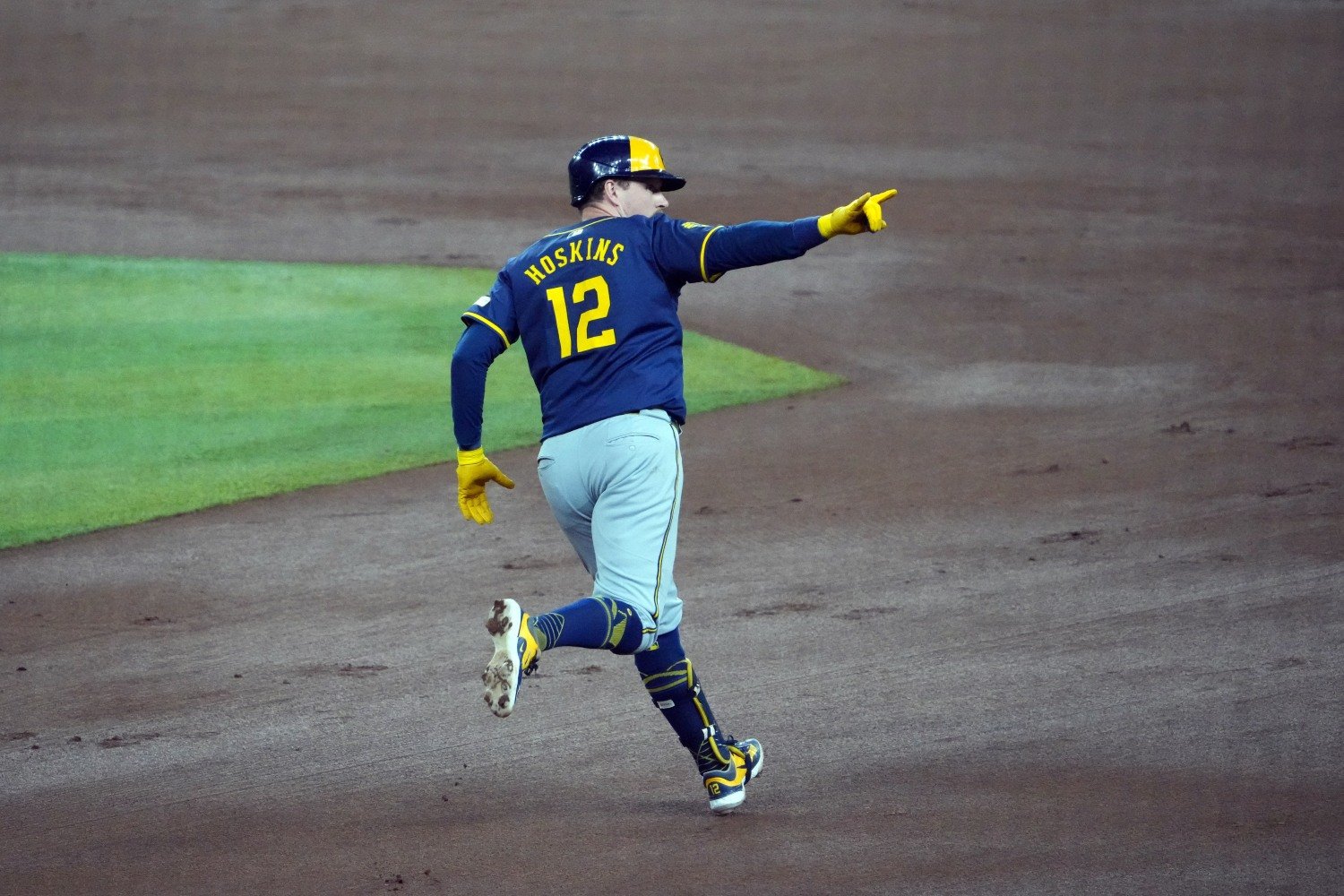
    Image courtesy of © Joe Camporeale-Imagn Images

    Brewers Video

    Free agents worth signing have quickly become thin on the ground. While the Brewers' admirable depth across the roster made players like Harrison Bader, Tommy Pham, Randal Grichuk, and Ramón Laureano tricky fits, there was a clear path to possible playing time for Yoán Moncada. Instead, Moncada signed a one-year, $5-million deal with the Angels Thursday, becoming the fifth free-agent hitter to go elsewhere this week alone. If Matt Arnold does want to bring in another player or two to brace the two-time defending division champions, he's running out of ways to do it.

    Milwaukee could still take interest in a player like Connor Joe, Justin Turner, Brandon Drury, or Anthony Rizzo, to bolster the corner infield spots in various ways. They could join the scramble for the few remaining viable, versatile infielders, José Iglesias, Paul DeJong, and Brendan Rodgers. None of these should command multi-year deals. Nor should the handful of interesting pitchers still on the market, as I wrote Thursday afternoon

    Unfortunately, though, Arnold probably has little money left to spend. According to Cot's Contracts, the Crew's projected 40-man payroll for 2025 now stands at $108 million. Nominally, that's well below last year's mark of $125.6 million. However, on the condition of anonymity, team sources have indicated that their payroll was likely to shrink in 2025. The team anticipated a loss of local TV revenue this coming season, based on their planned move to league-produced, league-distributed broadcasts. On Dec. 31, the team retreated from that course and renewed their agreement with FanDuel Sports Network, which might have stretched the wallet a bit wider again, but it's unlikely they'll spend even as much as they did last year, let alone more.

    To figure out what the team has to spend, though, we need to look a bit harder at what they actually spent last year—and how they can bend their expenditures in 2025 to maximize their own spending power by spreading out their payments a bit.

    That final figure of $125.6 million for 2024 is a bottom line, but for revenue-sharing payees like the Brewers, when dollars are due can matter nearly as much as how much is being doled out. Of that nominal total, the Crew paid $8.75 million in buyouts on club and mutual options for 2025, all in the first week of November. Over the regular season itself, then, their operating payroll was more like $116.9 million.

    Why does that matter? Under the league's revenue-sharing plan, an administrator (jointly selected by the players union and the owners) uses prior-year earnings and projections to estimate the net payments that need to be made (by payors) and then distributed (to payees), which break up into five segments. The schedule of those payments goes like this:

    Screenshot 2025-02-06 223722.png

    The Brewers, then, are getting big chunks of money every May 25, July 25, September 25, and November 25. That eases their cash flow a ton, especially in the fall—because they hardly owe anyone salary for games played after that September payout. Thus, any money the team can defer to that final quarter of the year will hit their books less hard than money paid as straight-up salary, throughout the campaign. 

    Delaying payments is always beneficial, of course, if it can be done without penalty. That's why teams are required to discount the actual value of contracts if there's an officially deferred portion of any contract, as is the case for Christian Yelich and for so many players who have signed big leagues recently throughout the league. Structuring contracts to slide payments back beyond the year or years for which a player actually suits up via buyouts on mutual or club options, though, can be effective ways to unofficially bake in deferrals.

    The $108 million number I quoted above for 2025 does not include any buyouts. That's because, at the moment, the only buyouts they look likely to pay after this season are on the contracts they signed with Rhys Hoskins (two years, $34 million, but the final $4 million of that due as a buyout on an $18-million mutual option, to be paid Feb. 1, 2026) and Brandon Woodruff (a $10-million buyout on a $20-million mutual option for 2026, to be paid in two installments of $5 million, Jan. 15 and Jul. 15, 2026) last winter. It's a hefty $14-million bill, but it all comes due in 2026, on the other side of several more revenue-sharing disbursements. So, the number we should compare their current projection of $108 million to is the $116.9 million they spent in the flow of last season.

    By that reckoning, they sure don't have much flexibility—unless, of course, they're willing to push more money to the fall, or into 2026. Last year, they paid Gary Sánchez $4 million of his $7 million in total earnings via a buyout in November. Could they do the same thing with a player like Turner or Kenley Jansen for 2025? The payroll actually seems to be set up perfectly for that. If, for instance, they signed Jansen to a deal worth $9 million, but made half that money payable in November by attaching a mutual option for 2026 with a $4.5-million buyout, they'd sit at $117 million for this season, with $112.5 million due during the season.

    Those numbers would still be a bit down from 2025, but it would let them make a substantial addition to their roster. It also wouldn't exacerbate the problem they might otherwise run into in 2026, when they look likely to have $14 million in dead money from Woodruff and Hoskins on their ledgers and will have to go spend a bunch of money to replace likely departures Aaron Civale, Nestor Cortes, Woodruff, Hoskins and (via trade) Freddy Peralta. They'll be contending with the sharply rising arbitration cost of William Contreras and others.

    This front office is very good at shaping and shuffling the money they pay to players. It's the only way for a small-market team to maximize its own spending power, and it leverages the installments in which they're paid their share of pooled revenues from throughout the league. Tedious though it might seem, this is the way the Brewers keep finding just enough money to outspend their market size and hold onto their leadership of the NL Central. Though the market is shrinking, they might just have another such move in them this winter.

    Follow Brewer Fanatic For Milwaukee Brewers News & Analysis

    • Like 3

    Recent Brewers Articles

    Recent Brewers Videos


    User Feedback

    Recommended Comments

    Featured Comments

    Interesting article. And given the recent few years with high interest rates, the team will want to minimize any loans it needs to keep cash flow in the positive territory. A few years ago they could probably average out some short term crunches with various measures, but may be more reluctant to now, so keeping the bottom line lower - as well as whatever they are doing to pay off the infrastructure of the buildings they have invested into such as Arizona and DSL.

    However, it still stinks that these things are factors for the club and they can't just dole out some extra cash for good players to augment the roster.

    The change in local revenue doesn't impact the teams finances to the extent that they let on, especially with other teams/the league's revenue on the rise.

    “Under the new collective bargaining agreement (CBA) negotiated in 2022, each MLB team pools 48 per cent of local revenues with the total amount split equally between all 30 teams. This results in each team taking in 3.3 per cent of the total—an estimated $110 million USD, if not more. Teams also receive a share of national revenues, totalling around $90 million USD per team.”

    Source: https://www.thetribune.ca/sports/mlb/#:~:text=Under%20the%20new%20collective%20bargaining,million%20USD%2C%20if%20not%20more.

    22 hours ago, MilwaukeeBravesFan said:

    The change in local revenue doesn't impact the teams finances to the extent that they let on, especially with other teams/the league's revenue on the rise.

    “Under the new collective bargaining agreement (CBA) negotiated in 2022, each MLB team pools 48 per cent of local revenues with the total amount split equally between all 30 teams. This results in each team taking in 3.3 per cent of the total—an estimated $110 million USD, if not more. Teams also receive a share of national revenues, totalling around $90 million USD per team.”

    Source: https://www.thetribune.ca/sports/mlb/#:~:text=Under%20the%20new%20collective%20bargaining,million%20USD%2C%20if%20not%20more.

    The facts you cited are facts... but I'm not sure they amount to the conclusion with which you began. For one thing, while we can all agree it would be a better, more just world if the billionaires who own teams simply spent a higher percentage of their revenues on those teams, that's beyond our control, and probably (unfortunately) unrealistic. The Brewers were, by the best estimates we can cobble together, exactly average in the percentage of their 2023 revenues spent on payroll in 2024. So, spending is going to be responsive to revenue (and, by extension, cash flow), whether it actually needs to be or not.

    Second, without letting teams off the hook, we do have to acknowledge that there are massive costs of operation for an MLB team, beyond player payroll. If the Brewers have gross revenues of $300 million a year, and they spend $140 million on players, the other $160 million isn't just sitting in a war chest. There are usually a few hundred full-time employees to pay beyond the playing field, plus a LOT of part-time employees and contractors. Facility rentals, equipment, travel, marketing and advertising.... it genuinely is a LOT. Again, that doesn't mean any of these are struggling businesses. What it does mean is that if you've set a certain level of expected spending and you're right up against it, things that ease cash flow matter quite a bit. All those people and contractors and other companies you pay for things bill on regular cycles, more or less, so staggering your single biggest expenses (player salaries) to fit the timing of big payments received can still be hugely helpful.

    Or could it be the Brewers think they have enough on the roster right now and want to see the people they have been developing now that many of them are ready for big league ball.      2025 they added Caleb Durbin and I think he will be a fan favorite instantly.   I believe Ortiz, Turang and Chourio will all outclas their 2024 numbers and I think Garrett Mitchell is going to step into Stardom of his own in 2025.   If Yelich is truly repaired and his back does not become an issue through the season he could win another MVP this season.     The players out there to get are not better than the people currently on this roster.   Names like Oliver Dunn and Tyler Black are forgotten after odd 2024 campaigns yet both players could have exceptional 2025 seasons helping mend the gap left without Willy and his big time bat.     

    The Brewers seem good to me .  While everyone else is screaming for the Brewers to buy one of these left over free agent pieces I simply think they should stick with the people they have who have way more upside and investment by Management than anyone of the group can offer this team .  If the season gets underway and it seems the plan is lacking and there becomes a need for more of one thing or another then and only then would I wish for Arnold to go shopping for a piece.   Otherwise I am very much interested in seeing the Brewers as they are and feel this team is more talented than most believe.   

    Blake Perkins, Garrett Mitchell, Jackson Chourio, Sal Frielck, Caleb Durbin and Joey Ortiz are all extremely good baseball players who are just stepping into who they can be .    Chourio alone could hit 40 home runs and Mitchell is not beyond that kind of production with a clean bill of health.   


    The Pitching seems shaky with Woodruff not being an actual option for the season and Gasser is a no help for most of 2025.   But Myers looks ready for years of success as a rotational gem, I expect him to become an even better pro in 2025.   Nasty Nestor is uber talented and better than anyone who pitched here in 2024.   Freddy is playing for a mega contract in the coming seasons so I also expect a much better 2025 than his 24'   Freddy could contend for a Cy Young with a bit of a rebound season this year.    The other starter will be one of the young stars coming up in 2025 and given there are more than one pitcher ready for big league work the last rotational spot should be one of the funnest on the roster this season .   Civale is there.     He will take up innings every 5 days.     And the bullpen has so many great pieces that it will be hard to keep all the talent they have on the roster as other bullpen needy teams start to make offers to get help for their franchises. 


    Fear nothing . this team is good and I do not think it needs to shop around to be the Central division champion in 2025.     


    Create an account or sign in to comment

    You need to be a member in order to leave a comment

    Create an account

    Sign up for a new account in our community. It's easy!

    Register a new account

    Sign in

    Already have an account? Sign in here.

    Sign In Now

×
×
  • Create New...

