


Brewers Video
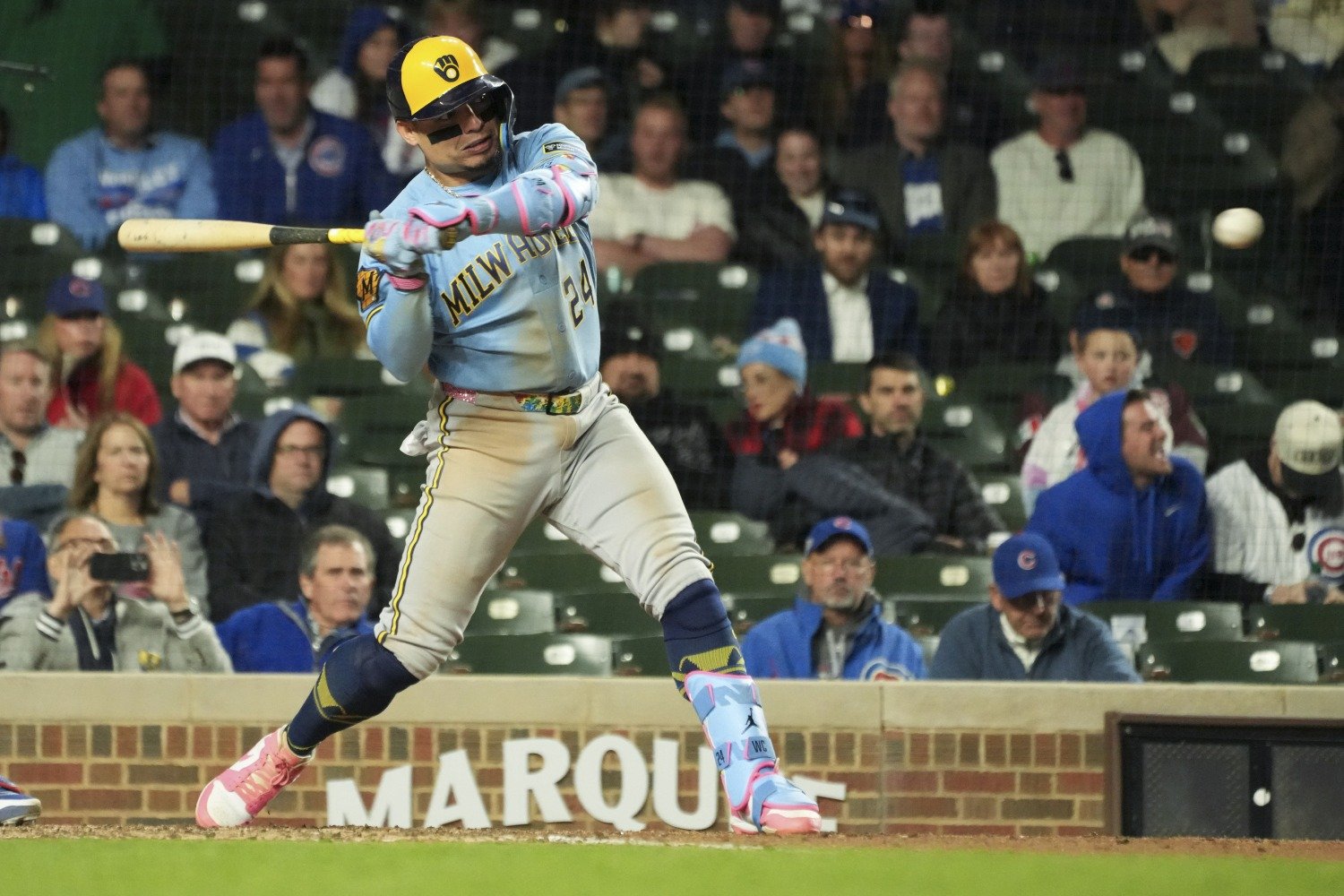
William Contreras played a portion of 2024 and all of 2025 with a fracture in his left middle finger, causing discomfort that affected his game. We know that. He underwent surgery in November to address it, because he and the Brewers felt that the injury had lingered and prevented him from being his best self for the majority of 2025. Because he had that operation, though, the hope was that this year would mark a return to the peak of Contreras's powers—literally.
In his first two seasons with the Brewers, Contreras batted .285/.366/.462. In 1,290 plate appearances, he clubbed 75 doubles, 3 triples and 40 home runs. That was an elite offensive profile for a catcher, of course, but more importantly, it made Contreras a productive part of the middle of the Brewers lineup. They could win with pitching, defense and speed, because they had a very good hitter who could generate enough power to cash in the chances other players created, while playing a premium defensive spot.
Last year, Contreras was gutting it out. His bat speed was down early in the season, but he rediscovered it by midsummer. Still, his swing wasn't quite the same. He used a well-structured approach to maintain his on-base skills, but the power went missing. For the year, he batted .260/.355/.399, with 28 doubles and 17 home runs in 659 trips to the plate. That's still solid work for a catcher; it's still solid work for anyone. The league averaged an OBP of .319 and a slugging average of .404, and OBP is more important than slugging, so a .355 OBP with roughly average power is hugely valuable, particularly for a player with major defensive responsibilities.
Still, the hope was that the power (and perhaps the batting average, by dint of more exit velocity even on non-fly balls) would rebound in 2026, to somewhere near .450. Giving him a reset on that finger injury and then a full offseason to recover and prepare should have positioned him to do that. Instead, this year, the batting average is back—but the power isn't. Contreras is hitting .294/.366/.389 in 202 plate appearances. He has only 11 extra-base hits, and eight of those are doubles. What gives?
It's not a problem of batted-ball profile, in the usual sense. He's pulling the ball more than in the past. He's lifting the ball more than he has in the past—and especially, he's hitting fewer ground balls. He's hitting it a little bit less hard, but that should be made up for by more lift and more pull. In fact, in fairness, his expected slugging this year is .430, up from .393 in 2025. But that's almost entirely because his expected batting average is up from .248 to .281; his isolated power hasn't surged along with the rise in average.
Instead, Contreras's expected average is up almost entirely because he's making way, way more contact. He's swinging almost exactly as often as he did last year, but he's whiffing on just 18.3% of those swings, down from 24.2% last year and more like 28% in 2023 and 2024. Thus, his strikeout rate is down to an extraordinary 11.2%, so he's going to get more hits. That's happened, but the power hasn't come along for the ride, even though the expected stats say it should have at least halfway done so.
Here's why.
.png.f7898a59a649d02d5438533d0b611188.png)
Since 2024, Contreras has gotten increasingly closed in his setup at the plate. His stance has angled itself more and more toward first base, closing his front shoulder to the pitcher. As we've discussed in the past, that doesn't necessarily set his direction to the baseball. He opens up toward the pitcher more with his stride than most batters. In the past, that allowed him to turn on the ball unexpectedly and generate a ton of power to left field. Here's an example, from 2024.
Crazy though it might sound, the slight closure of his stance has made that tougher, even though his stride still opens him up relatively well. That's because he's also made another change, perhaps a bit less consciously. His stride is longer than it was last year, by about two inches. That sounds tiny, but for one thing, all the margins that differentiate bad from good and good from great in hitting are tiny; and for another, the magnitude of this change's impact on Contreras's game is boosted by the change in his stance and the directionality of his swing. Here's what it looks like this season.
With that initial set of his body to a slightly more closed angle and a slightly longer stride, Contreras ends up a bit less able to get his front hip open and maximize the torque of his torso. He also ends up having to go out a bit farther, around his frame and in front of himself. To wit, Contreras's contact point has moved a bit farther out in front of him this year—another thing we would typically expect to result in more power, not less—but he's also flatter to the ball. His swing has less tilt and is working less uphill when he catches the ball, because of the way his body moves in this new combination of stance orientation and stride length.
Here are two telling moments in his swing, from each of the last three years. On the left, from top to bottom, we see what it looks like when Contreras's front foot comes down and he begins his swing, for 2024, 2025 and 2026. On the right, we see the moment when his barrel stops working down into the hitting zone and starts to work upward, through the ball.
.png.6b6a4867f81e831d63de41f902c64853.png)
First, let's talk about his first moves. Last year, cheating a little bit to make up for diminished bat speed, he got his hands a bit farther from his body and a bit lower, with his bat a bit flatter. This season, he's basically back to the set point he used in 2024—but note the angles of his lower half. He's locked a bit more into that position than in the past.
Now, look at the images on the right. The differences are a bit more pronounced. For one thing, his weight hasn't shifted forward as much as it had in the past. That gives him more adjustability, which might explain his better contact rate, but it means slightly less energy crashing forward into the ball. The longer stride doesn't let him rotate as well, because it puts him deeper in his legs. Meanwhile, his front shoulder is more closed, and his hands are working differently. He's not hitting underneath his front side. His bat is coming around more than in the last two seasons; his top hand is already getting around and in front of his frame.
All of these are small changes, but they add up to a swing with a lower launch-angle sweet spot than his old one and a greater likelihood of his best contact being toward center field. It's possible Contreras is doing it all on purpose, in the name of getting on base as often as possible by putting it in play at the best possible rate. Ideally, though, he'd reorient himself just enough to get back the version of his swing that maximizes his power potential. A small tweak to his setup and stride should have him slugging at somewhere close to his old rate. It's just a matter of time before he finds the right way to make that adjustment.
Do you approve of the job Pat Murphy is doing as Brewers manager?

Follow Brewer Fanatic For Milwaukee Brewers News & Analysis



-
 1
1


Recommended Comments
Create an account or sign in to comment
You need to be a member in order to leave a comment
Create an account
Sign up for a new account in our community. It's easy!
Register a new accountSign in
Already have an account? Sign in here.
Sign In Now